
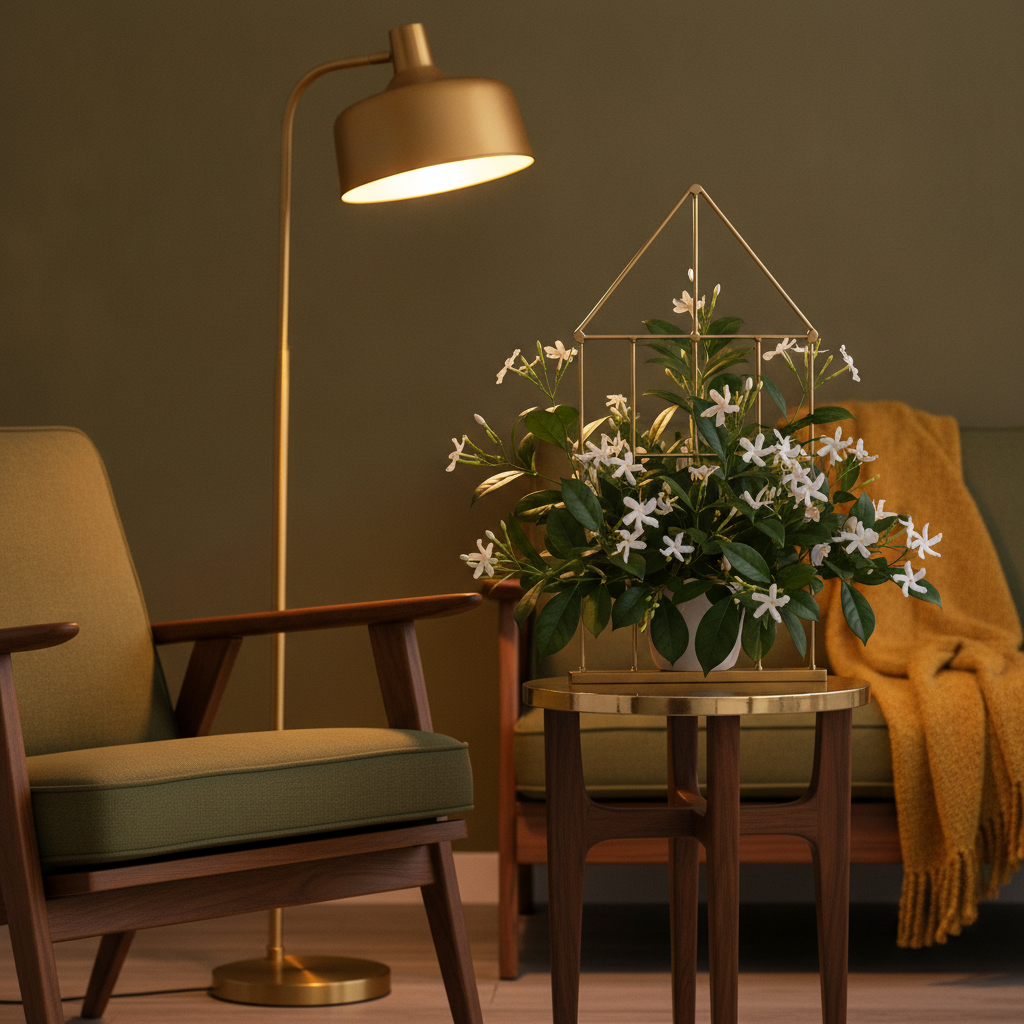
Few houseplants announce themselves to the nose before the eye, but star jasmine is one of them. Known botanically as Trachelospermum jasminoides, this evergreen twining climber from the woodlands of eastern and southeastern Asia, where it ranges across China, Japan, Korea and Vietnam, carries dense clusters of small white pinwheel flowers whose perfume can fill an entire room. Despite the common name, it is not a true jasmine at all but a member of the dogbane family, Apocynaceae, a relative of oleander and frangipani. Gardeners also know it as confederate jasmine or trader’s compass, and its glossy dark foliage and willingness to climb a trellis have made it a favourite for sunrooms, conservatories and bright windowsills.
Star jasmine has a reputation as an outdoor wall-climber in mild climates, yet it adapts surprisingly well to life in a pot indoors, provided it receives the bright light it craves. The gap between merely keeping it alive and coaxing it into bloom is wider than with many foliage plants, and it comes down to light, a cool winter rest and patient feeding. This guide walks through everything that separates a leggy green survivor from a fragrant, free-flowering specimen, covering light, watering, soil, feeding, propagation, pests and the cultivars worth seeking out.
Contents
- Quick Reference
- Why Star Jasmine Makes a Rewarding Houseplant
- Light Requirements
- Watering & Humidity
- Soil, Potting & Repotting
- Fertilising
- Propagation
- Pests & Diseases
- Popular Varieties
- Frequently Asked Questions
Quick Reference: Star Jasmine at a Glance
| Light | Bright indirect light with two to four hours of direct sun; essential for flowering |
| Watering | Keep evenly moist in growth, allowing the top 3 to 4 cm (about 1.5 in) to dry; reduce in winter |
| Temperature | 18 to 24°C (64 to 75°F) in growth; a cool rest at 7 to 13°C (45 to 55°F) in winter encourages buds |
| Humidity | Moderate, around 40 to 50 per cent; tolerant of average room air |
| Fertiliser | Balanced feed in spring, switching to higher potassium to support flowering, every two to four weeks in growth |
| Toxicity | Low toxicity; the milky sap can irritate skin and cause mild stomach upset if eaten |
Why Star Jasmine Makes a Rewarding Houseplant
The appeal of star jasmine indoors rests on a rare combination of qualities: evergreen good looks, a long flowering season and one of the most intoxicating fragrances in the plant world. The leaves are leathery, oval and deep glossy green, holding their colour through the year and clothing the twining stems densely enough to make an attractive specimen even out of bloom. When the flowers arrive, usually from late spring into summer, they open as five-petalled white pinwheels barely two centimetres across, but they come in such profusion and carry such a sweet, far-reaching scent that a single plant can perfume a hallway or a small sunroom.
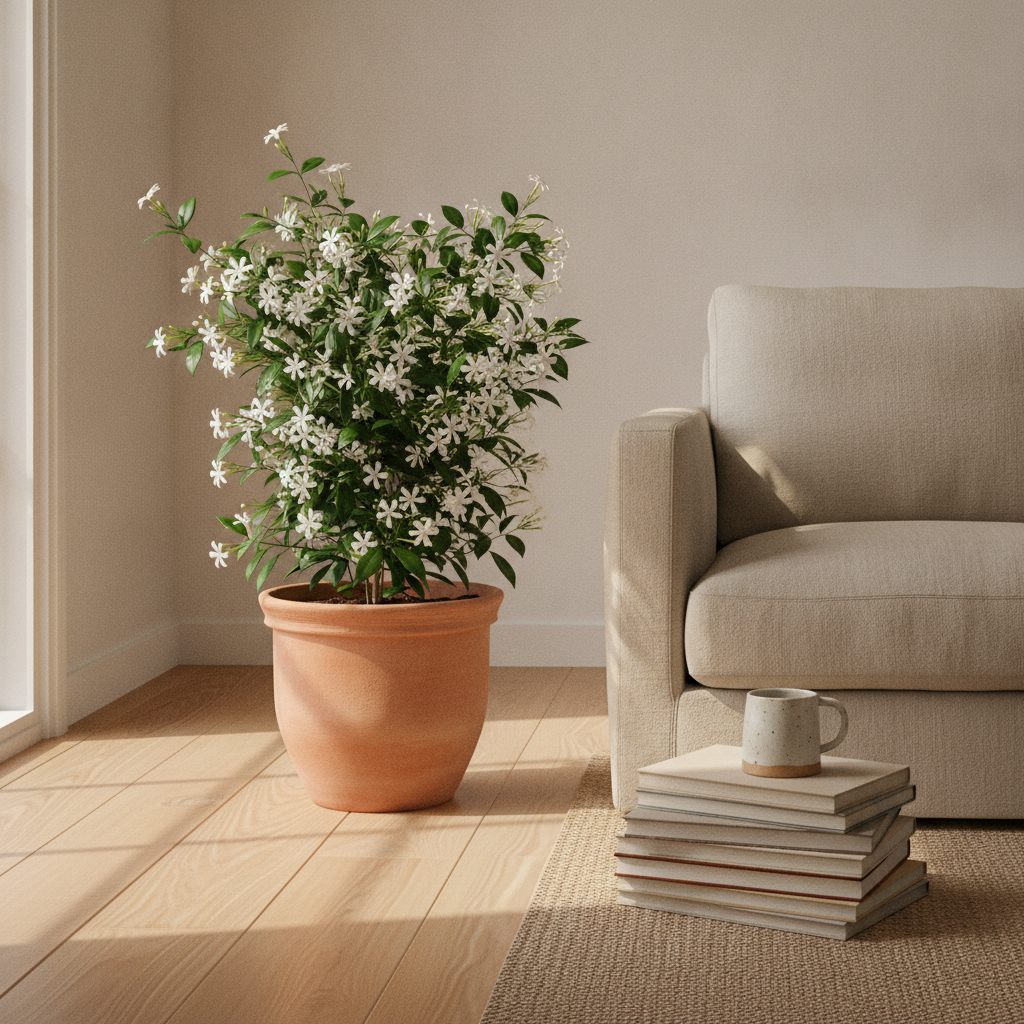
As a climber, star jasmine offers a flexibility that few houseplants match. Given a trellis, a moss pole or a hoop of wire, it will twine upward into a green column; left in a hanging pot, the same stems will cascade and trail. This pliability lets you shape the plant to the space rather than the other way round. The trade-off is that star jasmine is more demanding than a pothos or a snake plant when it comes to light and seasonal rhythm. It will hold its leaves in a dim corner, but it will not flower there, and the difference between a foliage plant and a fragrant one is almost entirely down to how well you read its needs.
Important — Toxicity: Like other members of the dogbane family, star jasmine exudes a milky white latex when cut. This sap is a mild skin irritant and can cause minor mouth and stomach upset if leaves or stems are chewed, so site the plant away from inquisitive pets and small children and wash your hands after taking cuttings. It is far less dangerous than its relative oleander, but it is not a plant to nibble.
Light Requirements
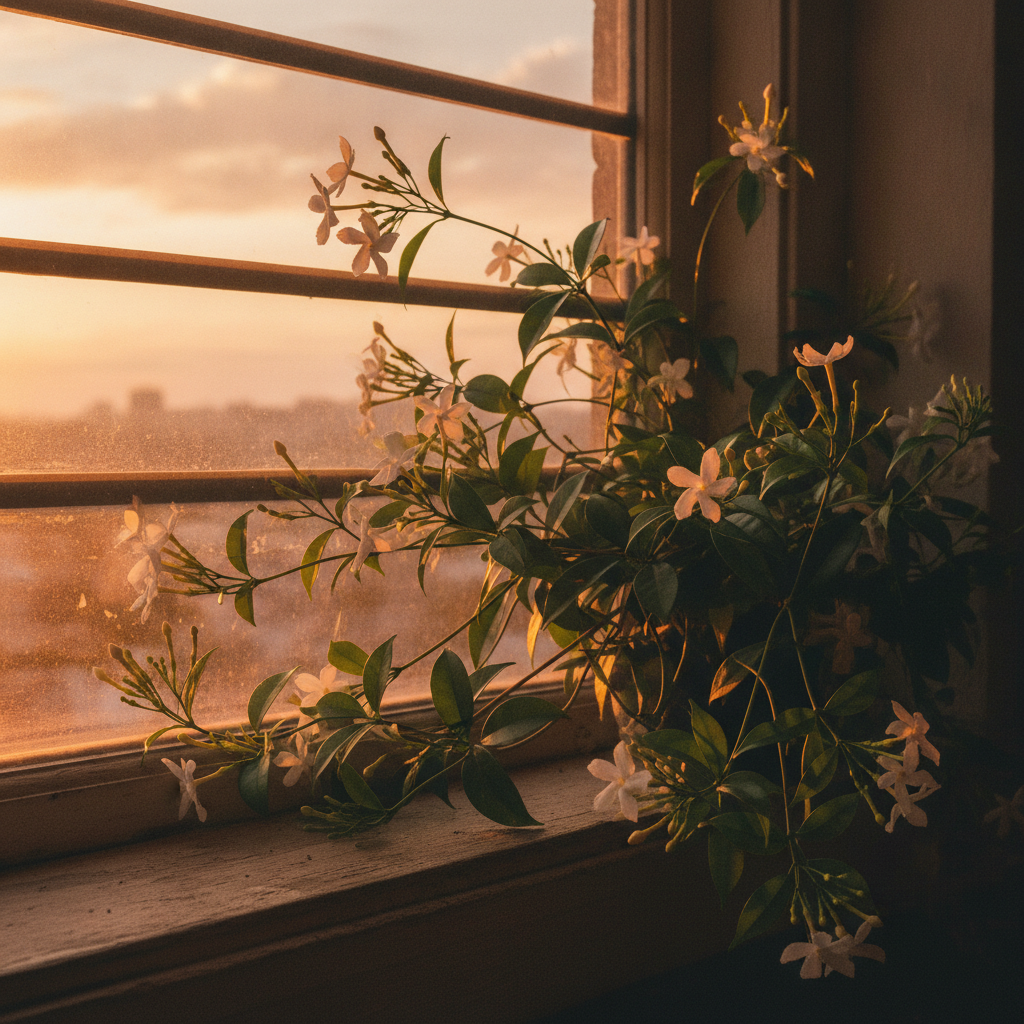
If there is a single factor that decides whether your star jasmine merely lives or genuinely thrives, it is light. In the wild this is a plant of woodland edges and scrambling sunlit walls, accustomed to strong, open brightness rather than deep shade. Indoors it wants the brightest position you can give it, with several hours of gentle direct sun each day to fuel the energy reserves it needs to set flower buds.
The ideal indoor spot is directly in or beside a window that receives morning or filtered midday sun. Bright indirect light keeps the foliage healthy and green, but flowering is unreliable without some direct exposure. A plant that produces lush leaves yet stubbornly refuses to bloom is almost always telling you it needs more light, not more fertiliser.
Light Levels Explained
Understanding how star jasmine responds to different intensities of light helps you place it for the result you want. The table below sets out the practical outcome you can expect at each level.
| Light Category | Approx. Level | Typical Location | Outcome |
|---|---|---|---|
| Direct sun | 20,000 lux and above | Unobstructed south or west sill | Strong growth and best flowering; guard against scorch in high summer |
| Bright with some direct | 10,000 to 20,000 lux | East window or filtered south | The sweet spot; healthy foliage and reliable bloom |
| Bright indirect | 5,000 to 10,000 lux | Near but not in a bright window | Good leaves, sparse or no flowers |
| Medium | 2,000 to 5,000 lux | A metre or two back from a window | Slow, leggy growth; flowering very unlikely |
| Low | Below 2,000 lux | Dim corner or north room interior | Survival only; gradual decline over time |
Window Orientation and Placement
South-facing window: In most homes this is the prime location for star jasmine, offering the long hours of bright light it loves. In the strongest weeks of summer a sheer curtain or a little setback from the glass prevents the midday sun from scorching the leaves, but for much of the year a south aspect is hard to better.
East-facing window: An excellent choice. Gentle morning sun delivers the direct exposure the plant needs to bloom while the cooler afternoon light avoids any risk of burn. Many growers find east windows give the most trouble-free flowering.
West-facing window: Also very good, with strong afternoon light that supports flowering. Because west sun arrives at the warmest part of the day, watch for heat stress behind glass in summer and water a touch more attentively.
North-facing window: The weakest option. A north aspect keeps the foliage alive but rarely provides enough energy for buds. If a north window is your only choice, plan to supplement with a grow light if you hope to see flowers.
Pro Tip — Turn for Even Growth: Star jasmine grows toward the light and can become lopsided on a windowsill. Give the pot a quarter turn every week or two so the stems clothe the support evenly and the whole plant flowers rather than just the sunward side.
How Light Affects Flowering
Flower production in star jasmine is driven by accumulated light energy, so the brighter and longer the daily exposure during spring and early summer, the more buds the plant sets. Variegated cultivars need even more light than the plain green species because their cream-marked leaves contain less chlorophyll and photosynthesise less efficiently. In too little light, variegated forms lose contrast and revert toward green as the plant tries to claw back lost capacity, while the species simply stretches, producing long internodes and few if any blooms.
Warning — Direct Sunlight: While star jasmine welcomes direct sun, a plant grown in low light and then moved abruptly into a blazing summer window can scorch, developing bleached or brown patches on the most exposed leaves. Acclimatise it over a week or two, increasing exposure gradually, rather than relocating it in a single move.
Artificial Lighting
Where natural light falls short, a full-spectrum LED grow light can make the difference between foliage and flowers. Position the light around 20 to 30 cm (8 to 12 in) above the canopy and run it for 12 to 14 hours a day during the growing season. Supplementary light is especially useful through the short days of winter for growers in northern latitudes, though if you are giving the plant a cool winter rest to encourage spring bloom, you can ease back on both light and warmth together.
Seasonal Adjustments
Light levels indoors fall sharply between summer and midwinter, and star jasmine responds to the rhythm. Through spring and summer, keep it in the brightest, sunniest position available to build the reserves it needs for flowering. As autumn light weakens, move the plant closer to the glass to capture what remains, and clean the leaves and the window so nothing is wasted. A cool, bright winter rest, rather than warm dim conditions, is what sets the stage for the following year’s display.
Watering & Humidity
Star jasmine likes consistency at the roots. It is neither a thirsty bog plant nor a drought-hardy succulent, and the aim through the growing season is to keep the compost evenly moist without ever letting it sit waterlogged. Getting the balance right rewards you with steady growth and a plant primed to flower; getting it wrong, almost always by overwatering, is the most common way star jasmine is lost indoors.
When to Water
Water when the top 3 to 4 cm (about 1.5 in) of compost has dried out. Push a finger into the surface to check, or lift the pot to feel its weight, which is the most reliable guide once you learn what a freshly watered pot feels like against a thirsty one. In the bright, warm months of active growth this may mean watering once or twice a week, while in the cool of winter the interval stretches considerably.
Reduce watering markedly during the winter rest. With less light and lower temperatures the plant uses far less moisture, and compost that stays soggy in cold conditions is a recipe for root rot. Let the top half of the pot dry before watering again, giving just enough to stop the rootball drying out completely. Resume more generous watering as growth restarts in spring.
Pro Tip — Water at the Roots: Star jasmine flowers and foliage dislike sitting wet, which encourages fungal spotting and can spoil the blooms. Water the compost directly rather than showering the whole plant from above, and water in the morning so any splashes dry quickly through the day.
How to Water Correctly
- Check that the top few centimetres of compost have dried before reaching for the watering can.
- Water slowly and thoroughly around the base until liquid runs freely from the drainage holes, ensuring the whole rootball is wetted.
- Let the pot drain completely for several minutes so no water is held at the bottom.
- Empty the saucer or cache-pot; never leave the plant standing in collected water.
- Return the plant to its position and wait until the surface dries again before the next watering rather than following a fixed calendar.
Signs of Overwatering vs. Underwatering
| Symptom | Overwatering | Underwatering |
|---|---|---|
| Leaf colour | Yellowing, often from the lower leaves upward | Dull green fading to brown, starting at the tips and margins |
| Leaf texture | Soft, limp and sometimes translucent | Dry, crisp and brittle |
| Soil | Stays wet for days, may smell sour | Pulls away from the pot edge, bone dry |
| Roots | Brown, mushy and foul-smelling | Dry and papery but usually still firm |
| Stem base | Soft or blackened near the soil line | Shrivelled but firm |
Warning — Root Rot: Persistent wet compost is the chief killer of indoor star jasmine. If you notice yellowing leaves, a sour smell and stems softening at the base, slide the plant from its pot at once, trim away any brown mushy roots with clean scissors, and repot into fresh, free-draining compost. Caught early, the plant often recovers; left unchecked, root rot is usually fatal.
Humidity Requirements
Star jasmine is relaxed about humidity compared with many tropical houseplants, and average indoor air of around 40 to 50 per cent suits it well. It tolerates the drier conditions of a centrally heated room better than ferns or calatheas, which is part of what makes it a manageable indoor subject.
That said, very dry air, such as that close to a radiator in winter, can cause leaf tips to brown and may discourage flowering. If your home runs especially dry, the plant will look fresher and bloom more freely with a modest lift in humidity, though it never demands the rainforest levels some aroids expect.
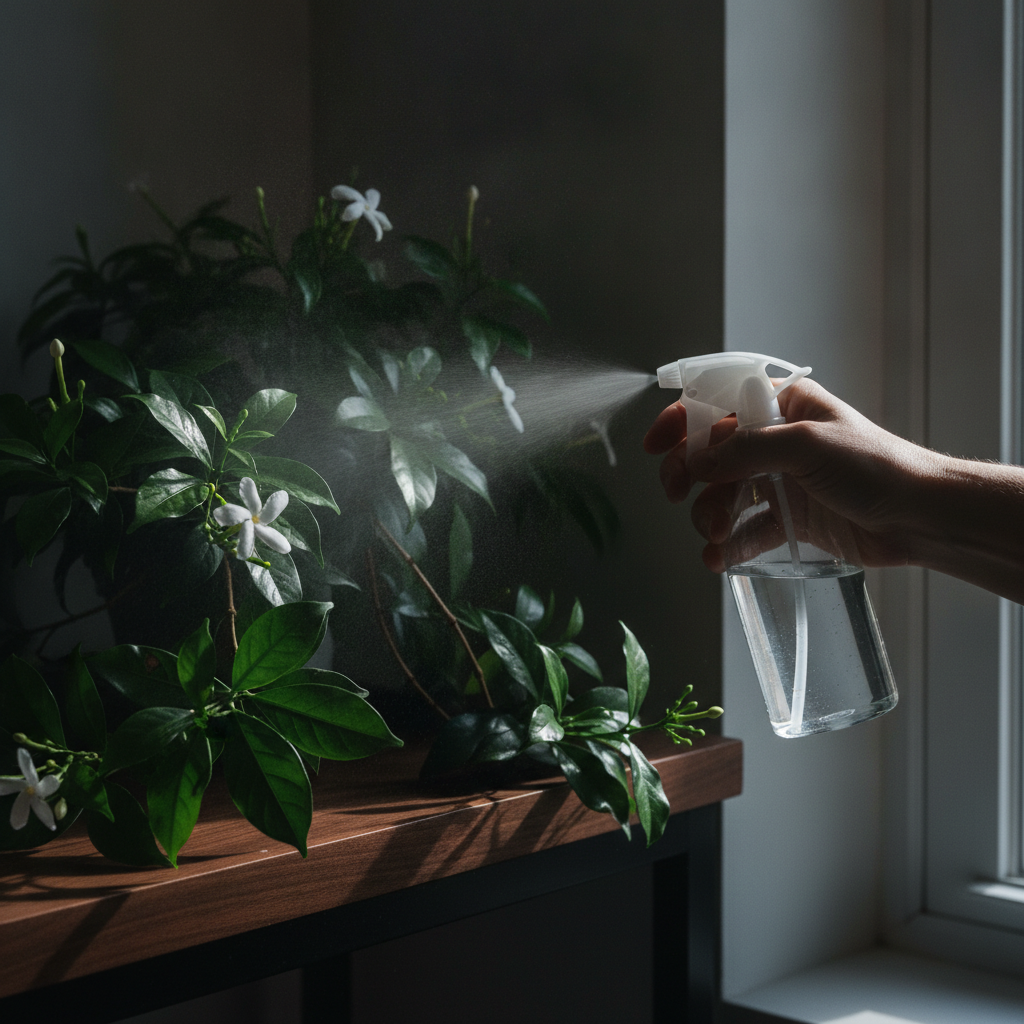
To raise humidity gently, stand the pot on a tray of damp pebbles, group it with other plants so they share transpired moisture, or run a small humidifier nearby during the driest months. Avoid heavy, frequent misting once buds and flowers appear, since water lingering on the blooms invites grey mould and can shorten the display.
Water Quality
Star jasmine is not especially fussy about water, but it prefers conditions on the slightly acidic side and can show leaf-tip browning where tap water is very hard or heavily chlorinated. If your water is hard, letting it stand overnight before use allows some chlorine to dissipate, and using filtered or rainwater where convenient keeps the compost from drifting too alkaline over time. Room-temperature water is always kinder to the roots than cold straight from the tap.
Soil, Potting & Repotting
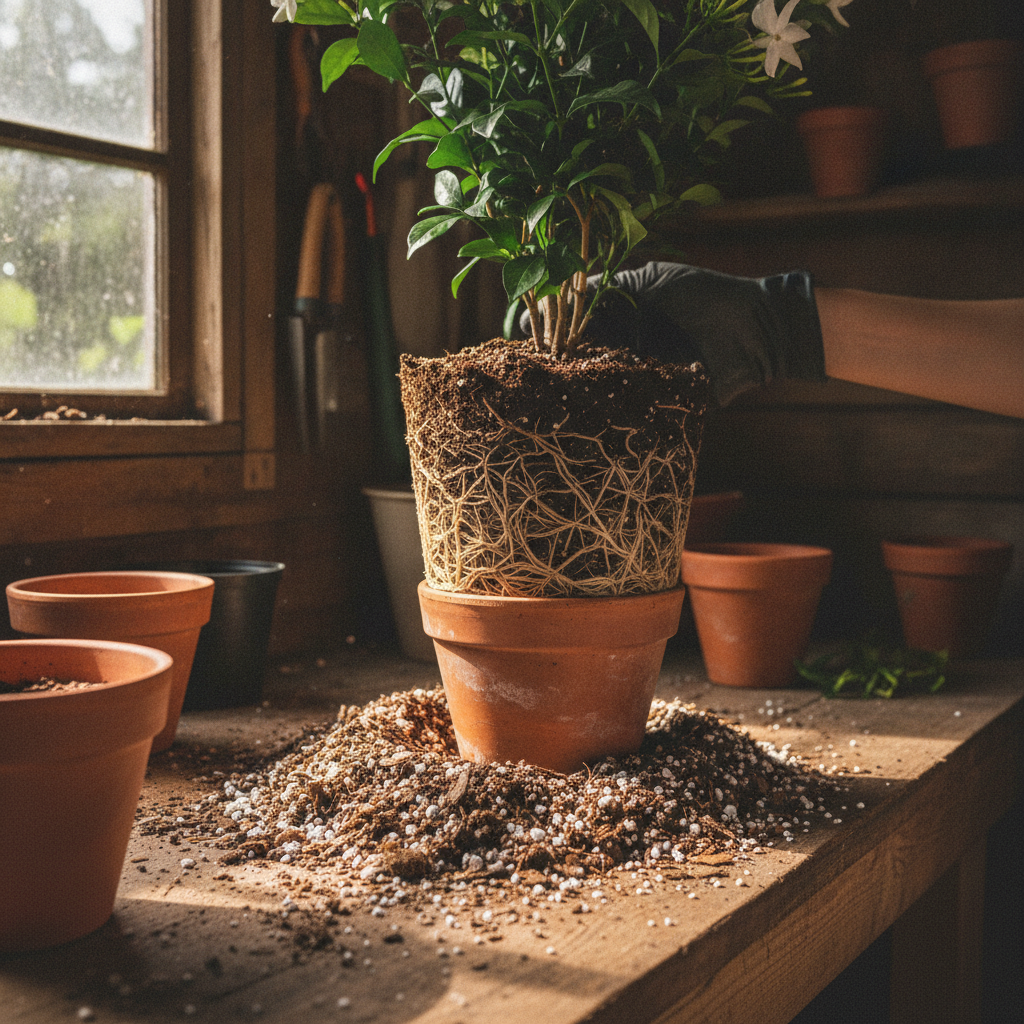
The right growing medium underpins everything else in star jasmine care. As a plant that resents both drought and waterlogging, it needs compost that holds enough moisture to stay evenly damp yet drains freely so the roots never suffocate. A loam-based mix opened up with grit and bark hits that balance far better than a bag of plain peat-based houseplant compost on its own.
Ideal Soil Composition
A dependable recipe combines a quality loam-based compost as the backbone with added drainage and a little organic richness. The loam gives body and holds nutrients, while grit or perlite creates the air pockets that keep roots healthy and bark adds structure that resists compaction over time.
| Component | Proportion | Function |
|---|---|---|
| Loam-based compost | Two parts | Holds moisture and nutrients, gives the mix body and weight |
| Perlite or horticultural grit | One part | Opens the mix for drainage and aeration around the roots |
| Composted bark or coir | One part | Adds structure, resists compaction and retains gentle moisture |
| Worm castings or leaf mould | A small handful | Supplies slow, mild nutrition and beneficial soil life |
Star jasmine prefers a soil pH that is slightly acidic to neutral, in the range of roughly 6.0 to 7.0. Most loam-based composts sit comfortably within this band, and the occasional use of rainwater rather than hard tap water helps keep the medium from creeping toward alkalinity, which can lock up iron and yellow the foliage.
Pro Tip — Quick Mix Recipe: For a fast, reliable blend, mix two handfuls of John Innes No. 2 or a similar loam-based compost with one handful of perlite and one of composted bark. The result drains well, holds steady moisture and gives star jasmine the firm anchorage a climbing plant appreciates.
Choosing the Right Pot
The pot you choose affects how often you water and how securely the plant can climb. Because star jasmine carries the weight of a developing framework of stems and any support attached to it, a slightly heavier pot adds welcome stability and stops a trained plant from toppling.
Drainage holes are non-negotiable. Whatever container you select, it must have open holes at the base so excess water can escape freely. A decorative pot with no drainage will trap water around the roots and bring on the rot this plant is prone to; if you love a particular cache-pot, keep the jasmine in a plain plastic pot inside it and lift it out to water.
Pot material: Terracotta is an excellent choice because its porous walls let the compost breathe and dry more evenly, reducing the risk of overwatering, though it does demand slightly more frequent watering. Glazed ceramic and plastic hold moisture longer and suit growers who tend to underwater or keep the plant in a very bright, drying position.
Pot size: Move up only one size at a time, choosing a pot 2 to 4 cm (1 to 2 in) wider than the current one. An oversized pot holds a reservoir of damp compost the roots cannot use quickly, which keeps the medium wet and invites trouble. Star jasmine also flowers more freely when slightly snug at the roots, so resist the urge to over-pot.
When to Repot
Repot every two to three years, or when you see roots emerging from the drainage holes, water running straight through without wetting the rootball, or growth slowing despite good care. The best time is spring, just as the plant rouses into active growth, so it can re-establish quickly. Because a slightly pot-bound star jasmine tends to bloom better, there is no need to rush it into a larger home before it has genuinely filled its pot.
How to Repot: Step-by-Step
- Water the plant a day beforehand so the rootball is moist and holds together, easing it from the pot with less stress.
- Support any trellis or trained stems, then gently slide the plant out, tipping the pot and easing the rootball free rather than pulling on the stems.
- Tease out a few of the encircling outer roots and trim away any that are brown, soft or dead.
- Add a layer of fresh, free-draining compost to the base of the new pot so the plant will sit at the same depth as before.
- Centre the plant, fill around the rootball with fresh mix and firm gently to remove large air pockets without compacting the soil.
- Reposition the support if needed, water thoroughly to settle the compost, and let the pot drain fully.
- Return the plant to bright but not harshly direct light for a week or two while it settles.
Warning — Transplant Shock: Star jasmine can sulk briefly after repotting, dropping a few leaves or pausing its growth. Resist the temptation to fertilise straight away; wait three to four weeks for new roots to establish, keep the compost evenly moist and hold off on any heavy pruning until the plant is clearly growing again.
Fertilising
Star jasmine is a moderately hungry plant when it is growing and flowering, and the right feeding regime makes a visible difference to both the density of the foliage and the abundance of bloom. The key is to match the feed to the plant’s purpose: a balanced diet to build the plant in spring, then a shift toward flowering nutrients as bud season approaches.
Equally important is knowing when to stop. Feeding through the dormant winter months does the plant no good and can lead to a damaging build-up of salts in the compost. A plant that is resting cannot use the nutrients you give it, so fertiliser then simply accumulates around roots that are barely active.
Understanding Plant Nutrients
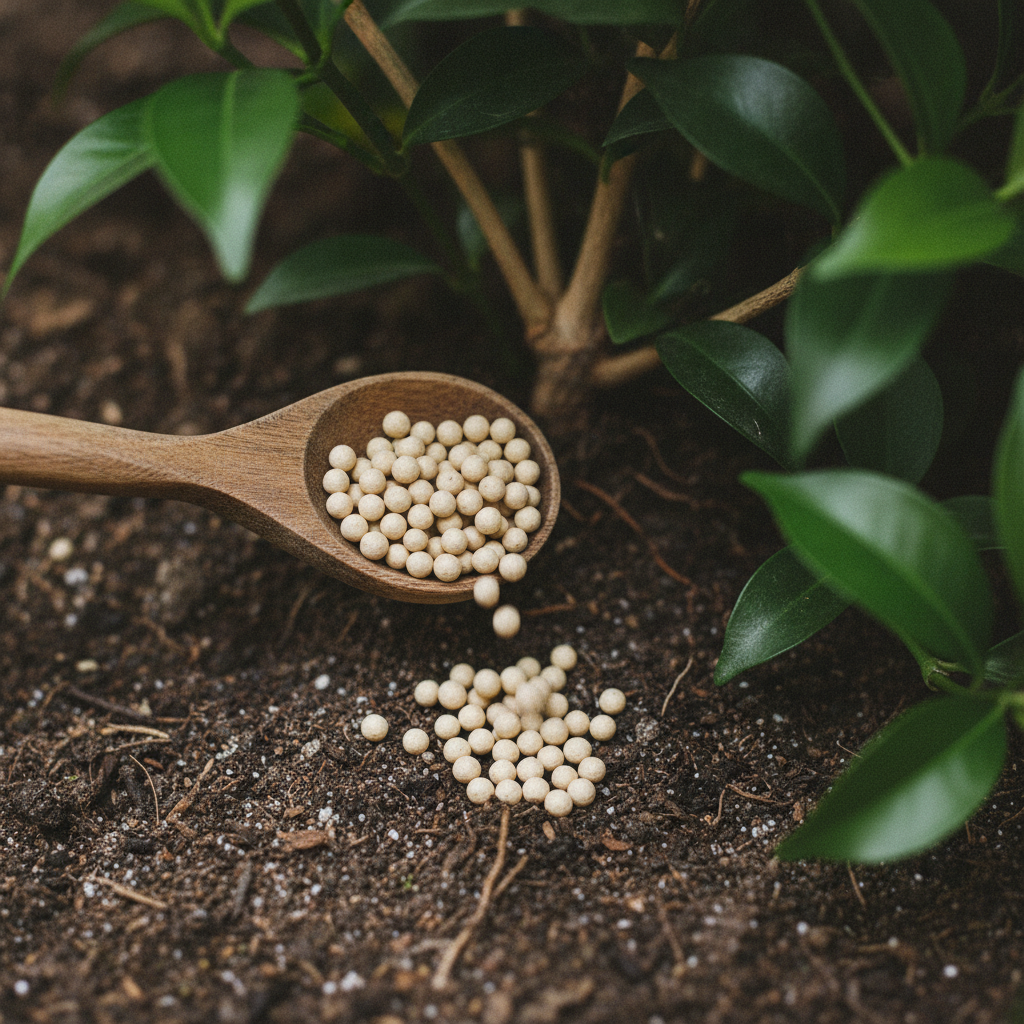
Fertiliser labels carry three prominent numbers, the NPK ratio, giving the percentages of nitrogen, phosphorus and potassium. Nitrogen drives leafy growth, phosphorus supports roots and flowering, and potassium underpins overall vigour and bloom quality. For a flowering climber like star jasmine, a feed too heavy in nitrogen produces lush leaves at the expense of flowers, which is why switching to a higher-potassium formula before bud set pays off.
| Nutrient | Symbol | Primary Function | Deficiency Symptoms |
|---|---|---|---|
| Nitrogen | N | Drives leafy growth and green colour | Pale, yellowing older leaves and stunted growth |
| Phosphorus | P | Supports root development and flowering | Dull leaves, weak roots and poor bud set |
| Potassium | K | Regulates water use and improves flowering | Browning leaf edges and sparse blooms |
| Calcium | Ca | Builds strong cell walls and new growth | Distorted young leaves and weak shoot tips |
| Magnesium | Mg | Central to chlorophyll and photosynthesis | Yellowing between the veins of older leaves |
| Iron | Fe | Essential for chlorophyll production | Yellowing between veins on the youngest leaves |
Types of Fertiliser
Liquid fertilisers: The most responsive option, mixed into the watering can and applied during growth. They act quickly and let you fine-tune the diet, moving from a balanced feed in spring to a high-potassium tomato-type feed as flowering approaches. Dilute to half the recommended strength to avoid overfeeding a container plant.
Slow-release granular: Coated prills that release nutrients gradually over several months with each watering. Scattered on the compost surface in spring, they offer a low-effort way to feed steadily through the season, though they give less control over the nitrogen-to-potassium balance than liquids.
Organic fertilisers: Worm castings, seaweed extracts and other organic feeds release nutrients slowly and nourish the soil life that supports healthy roots. They are gentle and forgiving, making them a sound choice for growers who prefer a hands-off, lower-risk approach to feeding.
Feeding Schedule
Feed every two to four weeks from spring through to late summer while the plant is actively growing. Begin the season with a balanced feed to build foliage and framework, then switch to a higher-potassium formula from late spring to encourage and sustain flowering. Taper off in early autumn as growth slows and stop altogether through the winter rest, resuming only when new growth appears in spring.
Pro Tip — Feed at Half Strength: Container plants are easily overfed, and star jasmine responds better to a little and often than to occasional heavy doses. Mixing liquid feed at half the label strength but applying it regularly gives steadier growth and reduces the risk of fertiliser burn and salt build-up.
How to Fertilise
- Water the plant lightly first if the compost is very dry, since feeding into bone-dry soil can scorch the roots.
- Dilute the liquid fertiliser to half the recommended strength in your watering can.
- Apply evenly to the compost around the base until it is moist, avoiding splashing the leaves and flowers.
- Let any excess drain away and empty the saucer so the roots do not sit in nutrient-rich water.
- Flush the pot with plain water every couple of months to wash out accumulated salts.
Warning — Salt Build-Up: A white crust on the compost surface or around the pot rim, along with browning leaf tips, signals a build-up of fertiliser salts. Flush the pot thoroughly with plain water, letting it run freely from the drainage holes several times, and scale back the strength or frequency of feeding.
Propagation
Propagating star jasmine is a satisfying way to multiply a plant you love or to share its fragrance with friends. The most reliable method indoors is taking semi-ripe stem cuttings in summer, when this year’s growth has begun to firm but is not yet fully woody. Layering, where a stem is encouraged to root while still attached to the parent, offers an even more dependable, if slower, route.
Patience is the watchword with star jasmine cuttings. They root more slowly than fast and easy plants like pothos or tradescantia, often taking six to ten weeks to form a usable root system, and a gentle bottom heat and steady humidity noticeably improve the success rate. Take several cuttings at once to allow for the few that inevitably fail.
Understanding Nodes and Semi-Ripe Wood
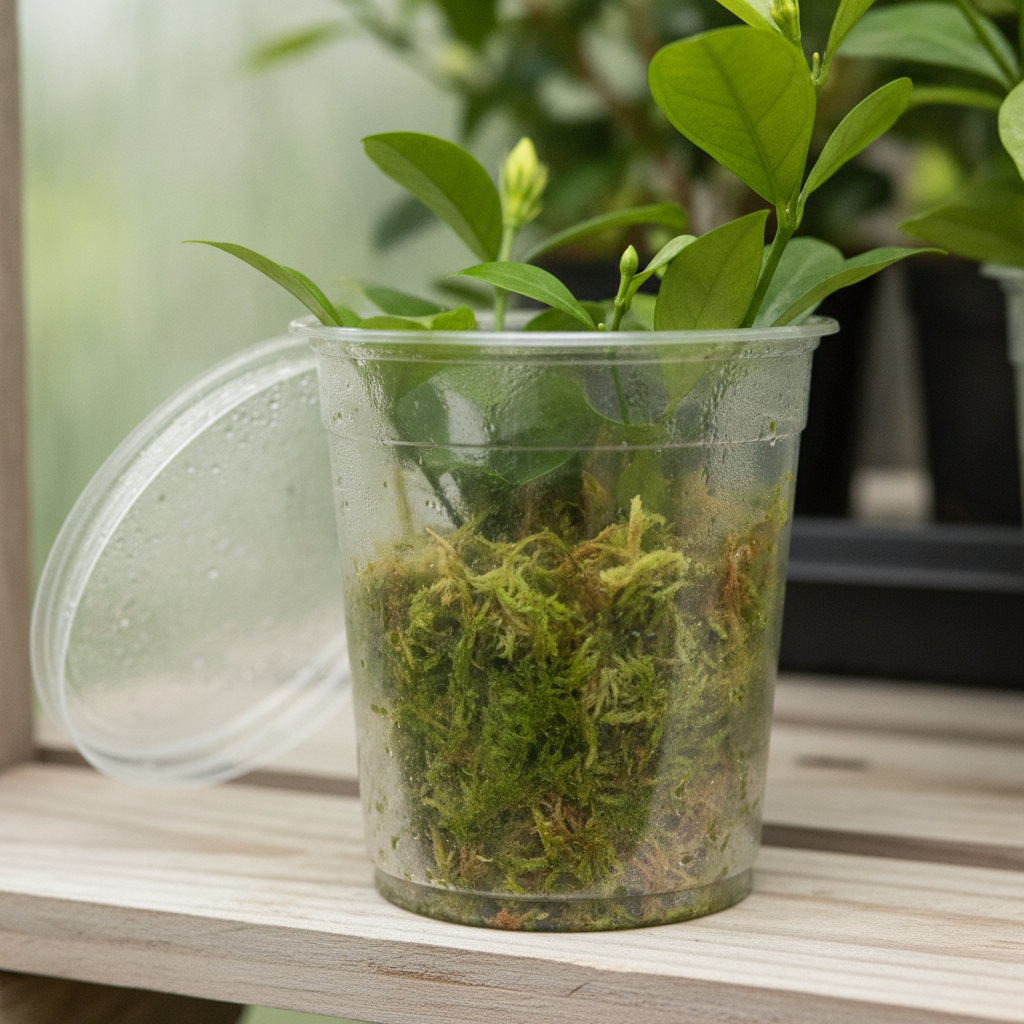
The node, the slightly swollen point where a leaf joins the stem, is where roots emerge, so every cutting must include at least one or two nodes. Semi-ripe wood, taken in mid to late summer, is the ideal material: flexible enough to be alive and vigorous, yet firm enough to resist rotting before it roots. Soft, sappy spring growth tends to collapse, while old hard wood is reluctant to root at all, which is why timing the cutting to the right stage matters so much.
Stem Cuttings: Step-by-Step
Stem cuttings are the standard way to propagate star jasmine and, with a little warmth and humidity, give good results from summer material.
- Choose a healthy, non-flowering shoot of this year’s semi-ripe growth and cut a length of 10 to 15 cm (4 to 6 in) just below a node with clean, sharp secateurs.
- Remove the leaves from the lower half of the cutting, leaving two or three leaves at the top.
- Dip the cut base in rooting hormone to encourage faster, more even rooting, tapping off any excess.
- Insert the cutting into damp sphagnum moss or a gritty cutting compost so the lower node is buried.
- Cover with a clear lid, bag or propagator to hold humidity, and keep in bright indirect light at around 20 to 24°C (68 to 75°F).
- Keep the medium lightly moist and air the cover briefly every few days; roots usually form in six to ten weeks, after which you can pot the cutting on.
Pro Tip — Gentle Bottom Heat: Star jasmine cuttings root markedly faster and more reliably on a heated propagation mat set to around 21°C (70°F). The steady warmth at the base spurs root formation while the cooler air above keeps the foliage from wilting, tipping the odds firmly in your favour.
Layering: Step-by-Step
Layering is the most fail-safe method because the new plant stays nourished by the parent until its own roots have formed. It suits the long, flexible stems of star jasmine perfectly.
- Select a low, flexible stem long enough to bend down to a second pot of damp compost placed beside the parent.
- At the point of contact, nick the underside of the stem lightly near a node to stimulate rooting.
- Pin the wounded section onto the compost surface with a bent wire or a small stone, keeping the growing tip free and upright.
- Keep the compost consistently moist and wait, often eight to twelve weeks, for roots to form at the pinned node.
- Once the layer is well rooted, sever it from the parent and grow it on as an independent plant.
Troubleshooting Propagation
| Problem | Likely Cause | Solution |
|---|---|---|
| Cuttings rot and blacken | Medium too wet or wood too soft | Use a grittier mix, water less, and take firmer semi-ripe material |
| Cuttings wilt and dry out | Humidity too low or no roots yet | Cover to hold humidity and keep out of direct sun until rooted |
| No roots after many weeks | Too cool, or wood too old and hard | Add bottom heat and take cuttings from the current season’s growth |
| Mould on the medium | Stagnant air and excess moisture | Ventilate the cover briefly each day and remove any affected material |
Pests & Diseases
Star jasmine is reasonably robust, but indoors it can attract the usual sap-sucking pests, particularly when air is dry or a plant is stressed by poor light or erratic watering. The good news is that regular inspection catches most problems early, while they are still easy to deal with by hand or with a mild treatment.
The milky sap of star jasmine offers no real protection against pests, so vigilance matters. Check the undersides of leaves and the leaf axils every week or two, since these sheltered spots are where infestations begin before they spread across the plant. A plant that is well fed, well lit and watered with care shrugs off pests far more easily than a struggling one.
Common Pests
Mealybugs (Pseudococcus species)
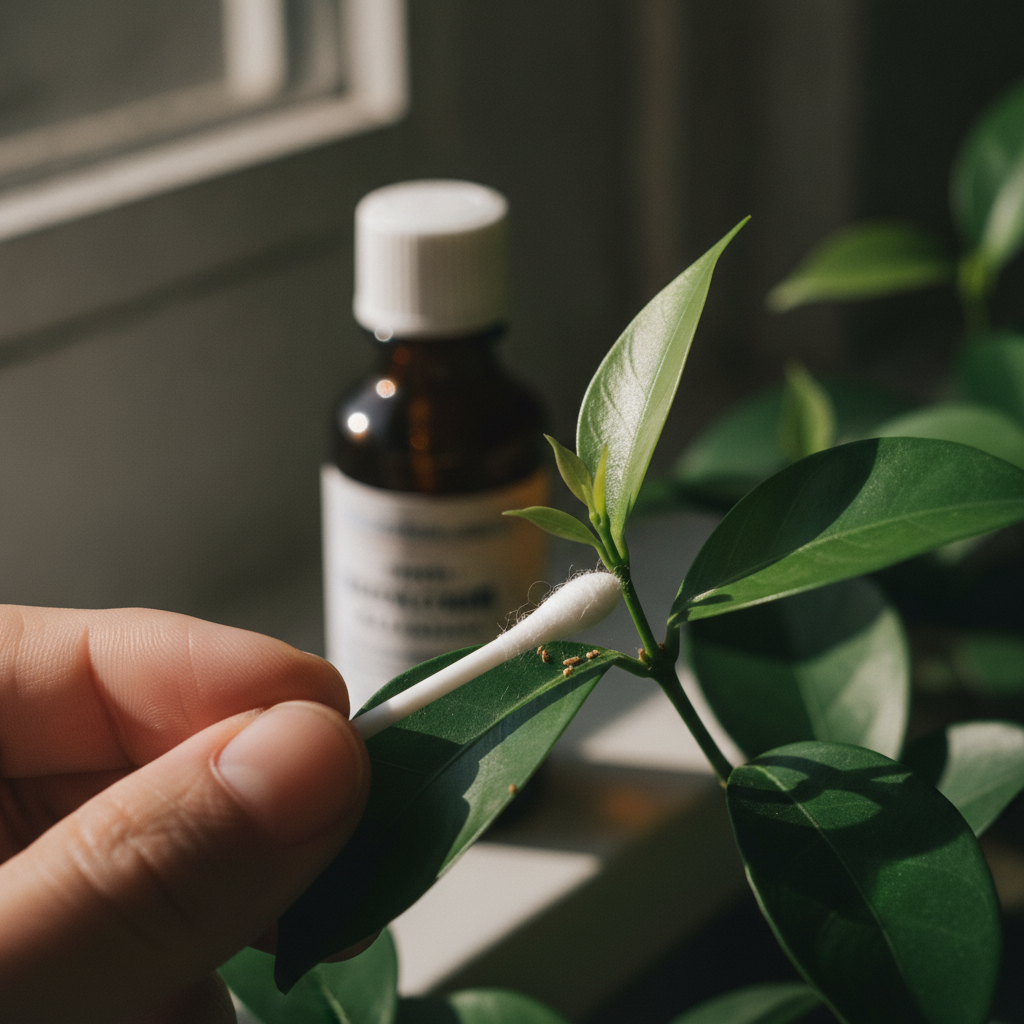
Mealybugs appear as small, soft, white cottony tufts clustered in leaf axils and along stems, where they suck sap and weaken the plant, excreting sticky honeydew as they feed. On a twining plant like star jasmine they love the sheltered junctions where stems wrap around their support.
Treatment: Dab each insect directly with a cotton bud dipped in diluted isopropyl alcohol, then follow up with a thorough spray of insecticidal soap or neem oil. Repeat every few days for two to three weeks to catch newly hatched young, and isolate the plant until it is clear.
Scale Insects (Coccidae family)
Scale shows up as small brown or tan domed bumps fixed along the stems and the midribs of leaves. Protected by their waxy shells, they are easy to overlook until the sticky honeydew they produce, and the sooty mould that follows, draw attention to them.
Treatment: Scrape off the visible scale with a fingernail or an old toothbrush, then treat the plant with neem oil or horticultural oil to smother any remaining young. Persistent infestations may need repeated applications over several weeks.
Aphids (Aphidoidea superfamily)
Aphids are tiny green, black or pink insects that gather on soft new shoots and flower buds, sucking sap and distorting fresh growth. They breed rapidly and, like other sap-suckers, leave a coating of honeydew behind.
Treatment: Dislodge light infestations with a firm jet of water, then spray with insecticidal soap or neem oil, paying attention to the growing tips and buds where they congregate. Repeat until no new colonies appear.
Spider Mites (Tetranychus urticae)
Spider mites thrive in warm, dry air and are most likely in a centrally heated room in winter. The first sign is usually a fine pale stippling on the leaves, followed by delicate webbing in the leaf axils as numbers build.
Treatment: Raise humidity and rinse the foliage, including the undersides, with water to knock numbers down, then treat with neem oil or a miticide. Because mites breed quickly in dry warmth, repeat treatments and improved air moisture are key to clearing them.
Common Diseases
Root Rot (Pythium and Phytophthora species)
Root rot is the most serious disease of indoor star jasmine and almost always follows overwatering or poor drainage. Affected plants yellow, wilt despite wet soil, and develop brown, mushy roots with a sour smell as the fungal pathogens spread through saturated compost.
Treatment: Remove the plant from its pot, cut away all soft, discoloured roots with clean scissors, and repot into fresh, free-draining compost in a clean container. Water sparingly while it recovers and correct the drainage problem that caused it.
Leaf Spot (various fungi)
Fungal leaf spot produces brown or black blotches, sometimes ringed with yellow, usually where foliage stays wet and air movement is poor. It rarely kills an established plant but disfigures the leaves and can spread if left unchecked.
Treatment: Remove and bin affected leaves, improve airflow around the plant, and water at the base rather than over the foliage. A fungicide may help in stubborn cases, but cultural changes usually bring it under control.
Sooty Mould (Capnodium species)
Sooty mould is a black, soot-like film that grows on the honeydew left by sap-sucking pests. It does not attack the plant directly but blocks light from the leaves and signals that an infestation is underway somewhere on the plant.
Treatment: Wipe the mould away with a damp cloth and, crucially, eliminate the pests producing the honeydew, since the mould will keep returning until the underlying infestation is cleared.
Pest and Disease Summary
| Pest / Disease | Identification | Treatment |
|---|---|---|
| Mealybugs | White cottony tufts in axils and on stems | Alcohol on a cotton bud, then insecticidal soap or neem |
| Scale | Brown domed bumps on stems and midribs | Scrape off and treat with horticultural oil |
| Aphids | Clusters on new shoots and buds | Rinse off and spray with insecticidal soap |
| Spider mites | Fine stippling and webbing in dry air | Raise humidity, rinse, and apply neem or miticide |
| Root rot | Yellowing, wilting and mushy roots | Trim rotten roots and repot into dry, fresh compost |
| Leaf spot | Brown or black blotches on leaves | Remove affected leaves and improve airflow |
| Sooty mould | Black film over honeydew deposits | Wipe clean and eliminate the underlying pest |
Prevention Strategies
Prevention is far easier than cure with star jasmine. Inspect the plant regularly, paying attention to leaf undersides and the axils where stems meet, and quarantine any new arrival for a couple of weeks before placing it near your other plants. Keep the foliage clean and dust-free so the leaves photosynthesise efficiently and pests have nowhere to hide unnoticed.
Beyond inspection, good general culture is the best defence. A plant grown in bright light, watered with care and fed in season is far more resistant to attack than a stressed one. Good airflow around the foliage discourages both pests and fungal disease, so avoid cramming the plant into a stagnant corner.
Pro Tip — Neem as Routine Defence: A light monthly spray of diluted neem oil through the growing season acts as a gentle preventative, deterring sap-suckers before they establish. Apply it in the evening or out of direct sun to avoid leaf marking, and always test a single leaf first.
Popular Varieties
While the plain green species is the most widely grown and the most reliably fragrant, breeders and nurseries have introduced a handful of distinctive selections of star jasmine. These vary in leaf colour, flower hue and hardiness, letting you choose a plant suited to a particular position or simply to your taste.
It is worth remembering that variegated and unusual-flowered forms often grow a little more slowly and, in the case of variegated types, need brighter light to keep their markings and to flower. The species itself remains the benchmark for vigour and scent, so the cultivars are best chosen for their looks rather than for any improvement in fragrance.
| Variety | Leaf Appearance | Light Needs | Growth Rate | Availability |
|---|---|---|---|---|
| Species (plain green) | Glossy deep green ovals | Bright with some direct | Moderate to vigorous | Common |
| ‘Variegatum’ | Green marbled with creamy white, pink in cold | Bright, more than the species | Moderate | Fairly common |
| ‘Star of Toscana’ | Green, with soft yellow flowers | Bright with some direct | Moderate | Increasingly available |
| ‘Tricolor’ | Green, cream and rose-pink new growth | Bright, more than the species | Moderate | Specialist |
| ‘Madison’ | Deep green, broader leaves, hardier | Bright with some direct | Vigorous | Specialist |
| ‘Pink Showers’ | Green with blush-pink flowers | Bright with some direct | Moderate | Specialist |
Featured Varieties
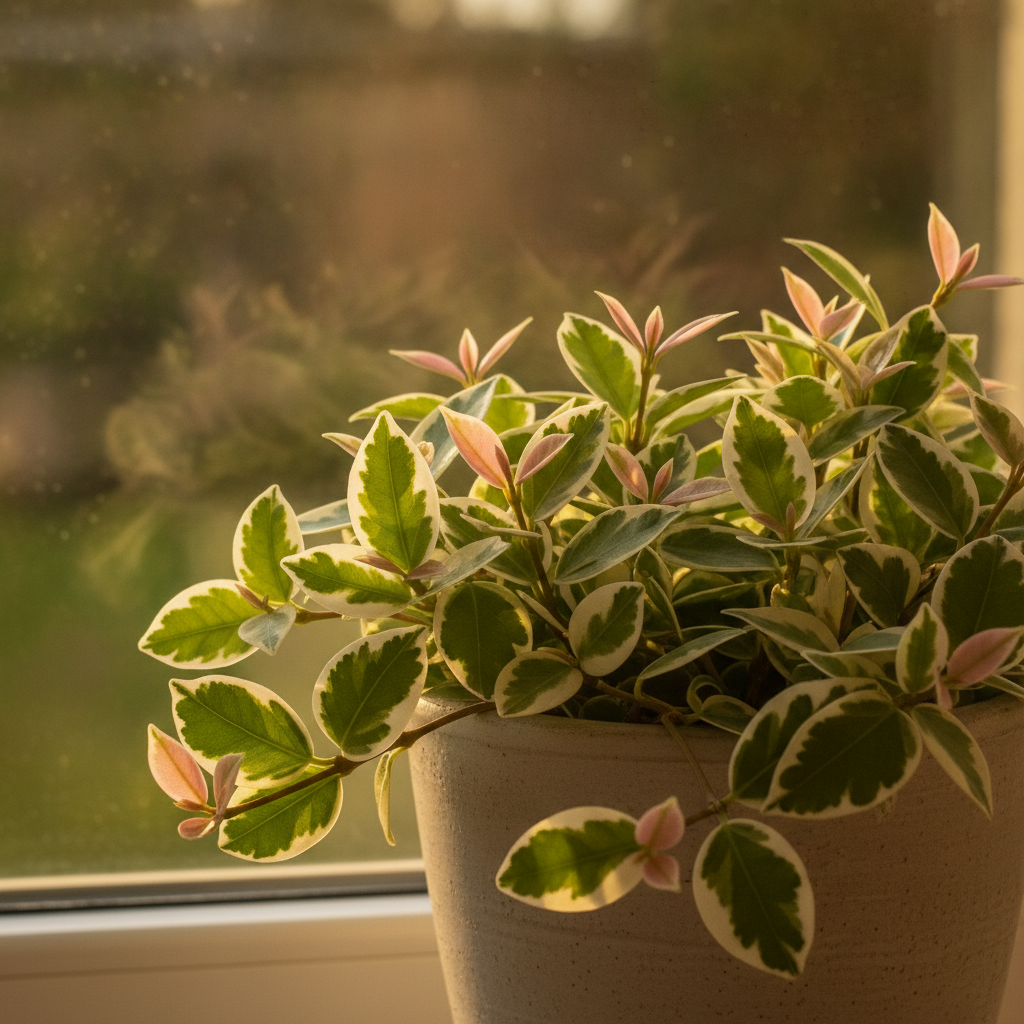
‘Variegatum’
The most popular ornamental form, with leaves marbled and edged in creamy white that flush rose-pink in cool weather. It is grown as much for its year-round foliage as for its white flowers, and it wants the brightest position to hold its variegation and bloom well.
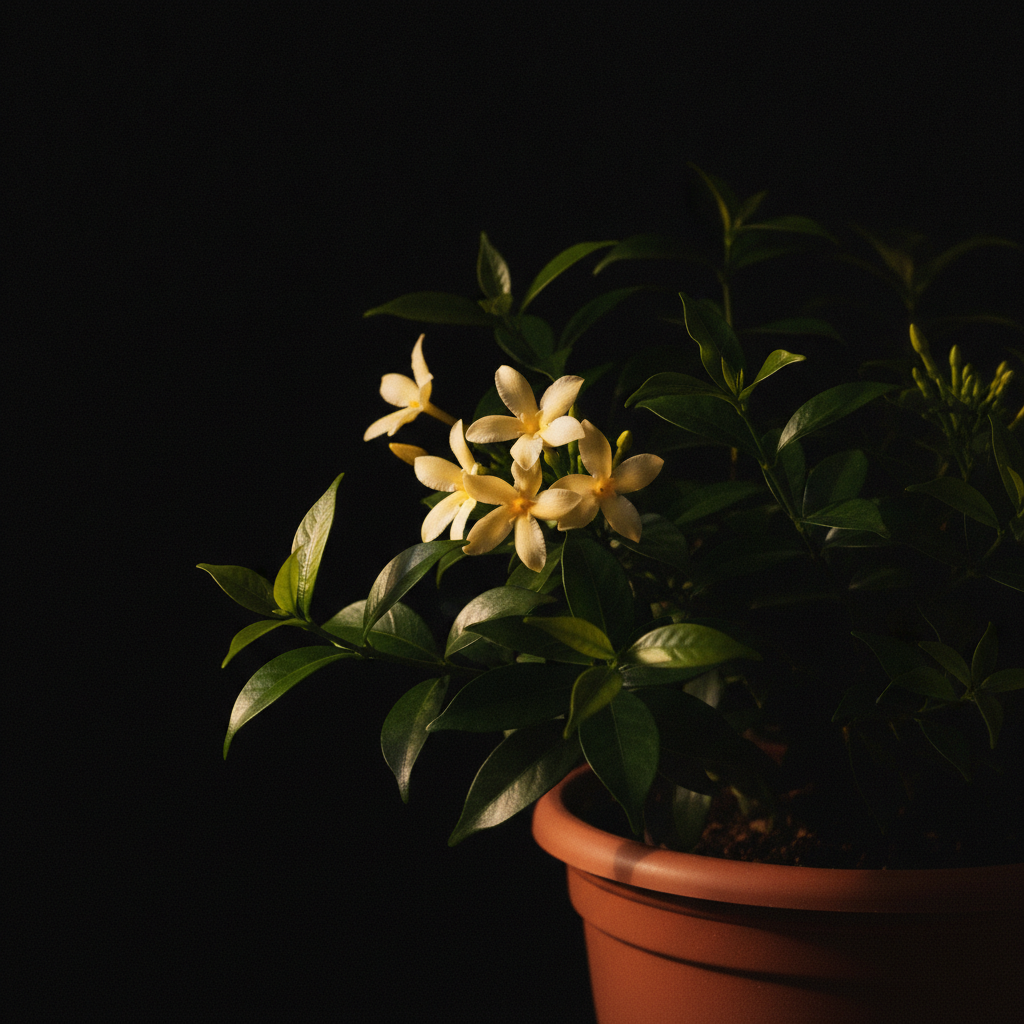
‘Star of Toscana’
A striking selection that swaps the usual white pinwheels for soft buttery-yellow flowers over the same glossy dark foliage. The warm bloom colour and familiar sweet scent make it a sought-after alternative for growers wanting something a little out of the ordinary.
Variety Profiles in Detail
‘Variegatum’ (Trachelospermum jasminoides ‘Variegatum’)
This variegated form turns star jasmine into a foliage feature in its own right. The cream-and-green leaves bring light to a planting even before the white flowers open, and the pink tints that develop in cold spells add a seasonal twist. Because the variegated tissue carries less chlorophyll, give it your brightest spot, keep an eye out for any all-green reverting shoots and remove them promptly so the plant does not lose its markings.
‘Star of Toscana’ (Trachelospermum jasminoides ‘Star of Toscana’)
Prized for its unusual yellow flowers, this cultivar offers the same easy climbing habit and rich fragrance as the species in a fresh colourway. The blooms open a deeper buttery shade and fade paler with age, giving a pleasing two-tone effect across a flush of flower. It needs the same bright light and cool winter rest as the species to perform at its best.
‘Madison’ (Trachelospermum jasminoides ‘Madison’)
Selected for improved cold tolerance, ‘Madison’ carries broader, deep green leaves and a vigorous habit. While its hardiness is most relevant to outdoor growers, indoors it makes a robust, full-bodied plant that clothes a support quickly, with the classic white flowers and strong scent intact.
Choosing the Right Variety for Your Space
For most growers, the plain green species is the soundest choice, offering the best balance of vigour, reliable flowering and the strongest fragrance, all on a forgiving constitution. If you have a very bright window and want year-round interest from the leaves, ‘Variegatum’ earns its place, while ‘Star of Toscana’ rewards those after a different flower colour. Whichever you choose, match it honestly to the light you can provide, since no cultivar will flower well without the bright conditions star jasmine fundamentally demands.
Frequently Asked Questions
Why won’t my star jasmine flower indoors?
The usual culprit is insufficient light. Star jasmine needs bright conditions with some direct sun to set buds, and a plant in merely moderate light will produce healthy leaves but few or no flowers. A cool winter rest at 7 to 13°C (45 to 55°F) also helps trigger spring bloom, and feeding with a higher-potassium fertiliser as the season warms encourages flowering rather than just leafy growth.
Is star jasmine the same as true jasmine?
No. Despite the shared common name and a similar fragrance, star jasmine (Trachelospermum jasminoides) belongs to the dogbane family, Apocynaceae, while true jasmines belong to the genus Jasminum in the olive family. They are unrelated plants that happen to share a sweet scent and a climbing habit.
Is star jasmine toxic to cats and dogs?
Star jasmine is considered low in toxicity, but its milky sap can irritate skin and may cause mild mouth or stomach upset if pets chew the leaves or stems. It is far less hazardous than its relative oleander, yet it is sensible to site the plant out of reach of pets and children and to wash your hands after pruning or taking cuttings.
How fast does star jasmine grow?
Outdoors in a warm climate it is a vigorous climber that can put on a metre or more of growth in a season. Indoors in a pot it grows more moderately, but a healthy plant in good light will still extend its stems steadily through spring and summer and will need a support to twine around and the occasional pinch to keep it bushy.
Can I grow star jasmine in a hanging basket?
Yes. Although it is naturally a twining climber, star jasmine adapts happily to a hanging pot, where its long stems trail and cascade rather than climb. The care is identical, with the same need for bright light and even moisture, and a trailing plant in a sunny window can flower just as well as a trained one.
When and how should I prune star jasmine?
Prune just after the main flush of flowering, which is the safest time as it lets the plant set buds for the following year on new growth. Trim back overlong or wayward stems, thin out congested growth to improve airflow, and pinch the tips through the growing season to encourage a fuller, more branching plant. Always use clean, sharp secateurs and wash your hands afterwards, as the cut stems weep irritant sap.
Why are my star jasmine’s leaves turning yellow?
Yellowing has several possible causes. The most common is overwatering, where lower leaves yellow and the soil stays wet; let the compost dry further and check the roots are sound. Yellowing between the veins can indicate an iron or magnesium shortage, often linked to hard, alkaline water, while a general fade may simply reflect too little light or a need for feeding in the growing season.
Does star jasmine need a cold period to bloom?
A cool winter rest genuinely helps. Keeping the plant at around 7 to 13°C (45 to 55°F) in winter, with reduced watering and no feeding, mimics its natural seasonal cycle and primes it to flower in spring. A star jasmine kept warm and growing all year round often flowers more sparsely than one given a distinct cool, quiet season.






