
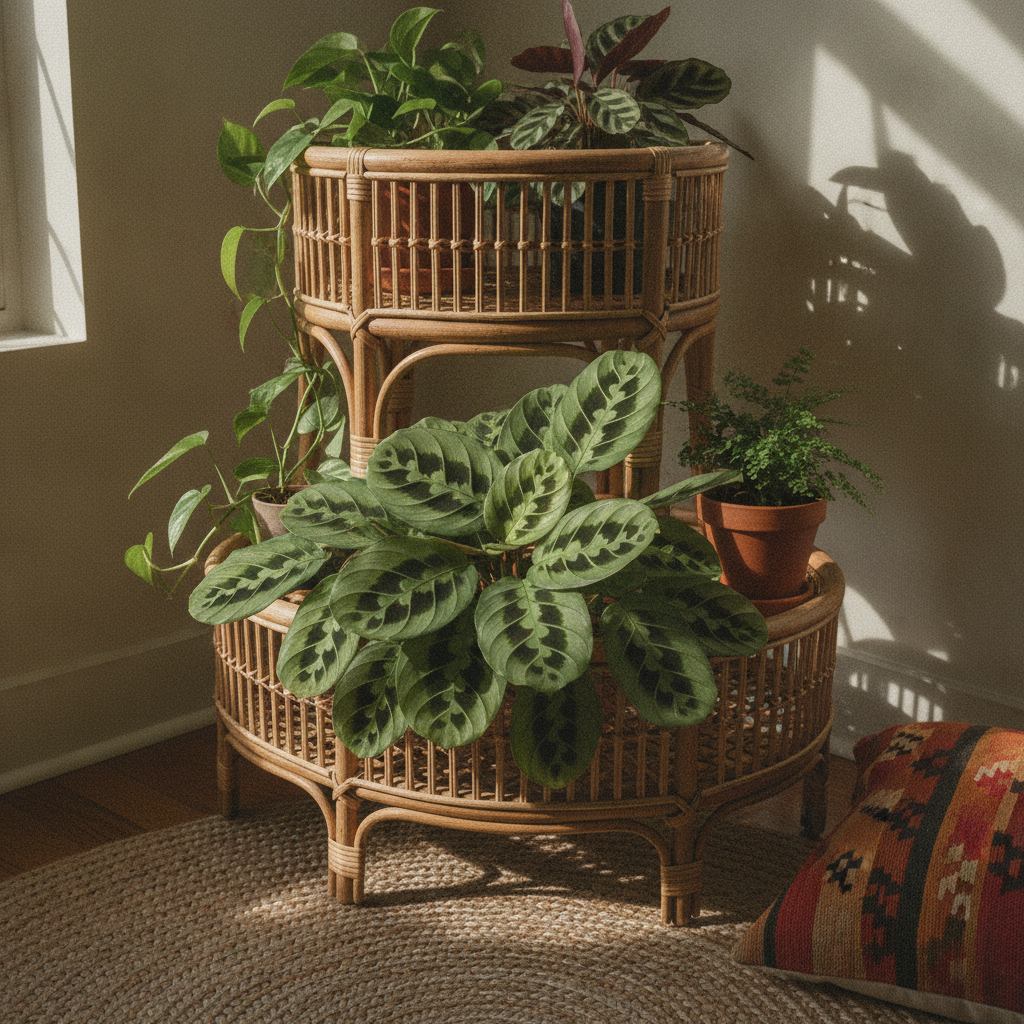
Few houseplants wear their personality as plainly as the rabbit foot prayer plant, a low, spreading member of the genus Maranta leuconeura whose soft oval leaves are stamped with two neat rows of dark blotches that look uncannily like the paw prints a rabbit leaves in fresh snow. Known in the trade as Maranta leuconeura var. kerchoveana, and sometimes sold simply as the green prayer plant or rabbit tracks plant, it belongs to the Marantaceae family and hails from the warm, shaded floor of the Brazilian rainforest, where it sprawls across the leaf litter rather than climbing toward the canopy.
What earns the wider group its “prayer plant” name is a nightly performance: as light fades, the leaves fold upward and press together like a pair of hands closing in prayer, then relax flat again by morning. This guide covers everything needed to move a rabbit foot prayer plant from merely surviving on a shadowed shelf to genuinely thriving, with the deep colour, dense growth and reliable nightly movement that signal a contented plant. The species has a reputation for being thirsty, humidity-hungry and fussy about water quality, so most of the work lies in getting moisture and air right rather than chasing light.
Contents
- Quick Reference
- Why the Rabbit Foot Prayer Plant Makes a Rewarding Houseplant
- Light Requirements
- Watering & Humidity
- Soil, Potting & Repotting
- Fertilising
- Propagation
- Pests & Diseases
- Popular Varieties
- Frequently Asked Questions
Quick Reference: Rabbit Foot Prayer Plant at a Glance
| Light | Medium to bright indirect light; no direct midday sun |
| Watering | Keep soil lightly and evenly moist; water when the top 1 to 2 cm (0.5 to 0.75 in) feels dry |
| Temperature | 18 to 27 degrees C (65 to 80 degrees F); avoid below 15 degrees C (59 degrees F) |
| Humidity | High, ideally 60 percent or more; struggles below 50 percent |
| Fertiliser | Balanced feed at half strength every 3 to 4 weeks in spring and summer |
| Toxicity | Non-toxic and considered safe for cats, dogs and humans |
Why the Rabbit Foot Prayer Plant Makes a Rewarding Houseplant
The rabbit foot prayer plant occupies a useful middle ground in the houseplant world. It is not as forgiving as a pothos, yet it is far less temperamental than its cousins the calatheas, which share the Marantaceae family and many of the same demands. Because it naturally grows low and outward rather than tall, a healthy specimen forms a soft, overlapping mound of foliage that drapes gently over the rim of its pot, making it equally at home on a shelf, in a hanging basket or trailing from a plant stand. The leaves themselves are the main attraction: a fresh, light green canvas marked with paired chocolate-brown patches that gradually mute toward green as each leaf matures, with undersides flushed a quiet silvery grey-green.
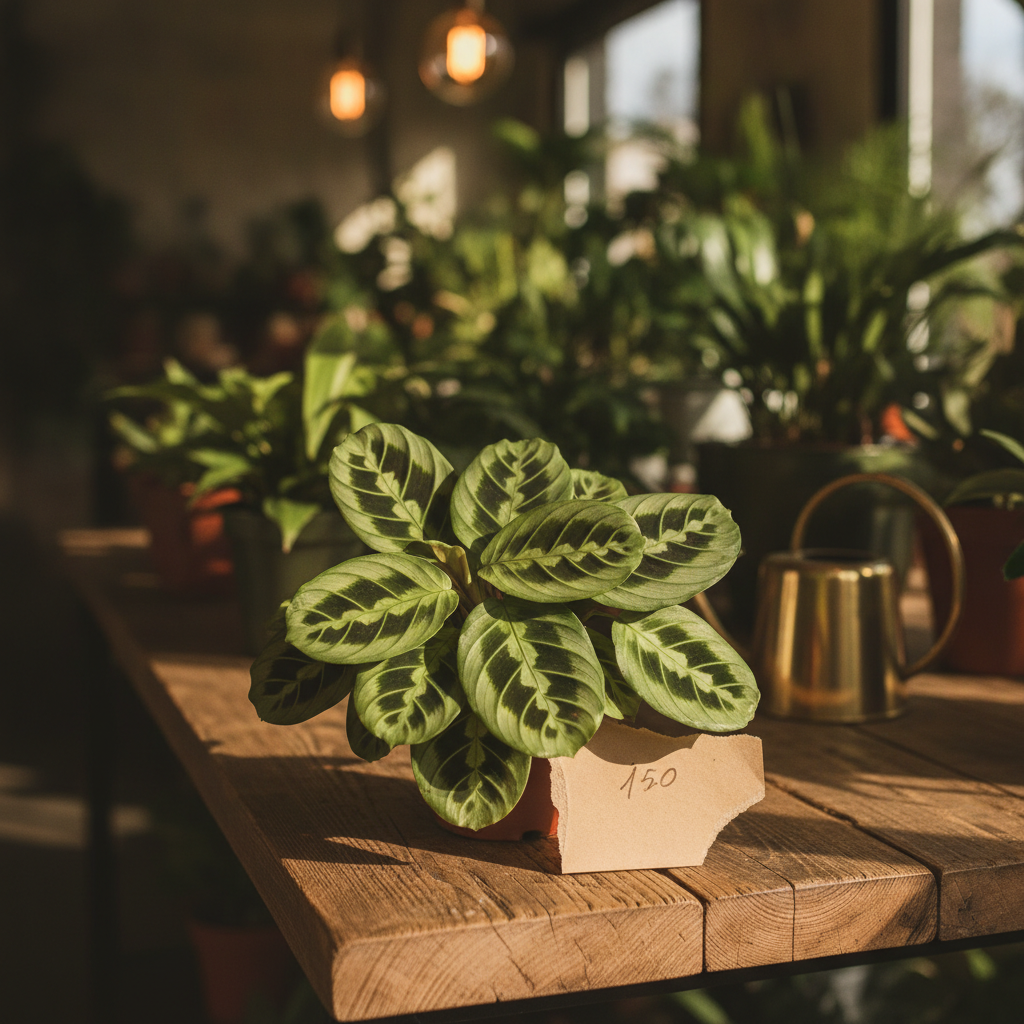
Beyond looks, the plant offers something most houseplants cannot: visible daily motion. The nightly folding and morning unfurling is driven by a swollen joint at the base of each leaf called a pulvinus, which pumps water in and out of its cells to swing the leaf up and down in response to light. Watching a shelf of rabbit foot prayer plants rise and settle through the day turns an ordinary windowsill into something quietly alive, and it doubles as a useful health signal, since a plant that stops moving is usually telling its owner that something about water, light or temperature has drifted out of range. Add to this its genuine pet safety and its modest footprint, and it is easy to see why the species remains a staple of indoor collections.
Important — Toxicity: The rabbit foot prayer plant is non-toxic and is widely regarded as safe for cats, dogs and humans, making it one of the better choices for homes with curious pets. Even so, no plant is meant to be eaten, and a nibbling animal may still suffer mild stomach upset from the fibre, so it is sensible to keep grazing to a minimum.
Light Requirements
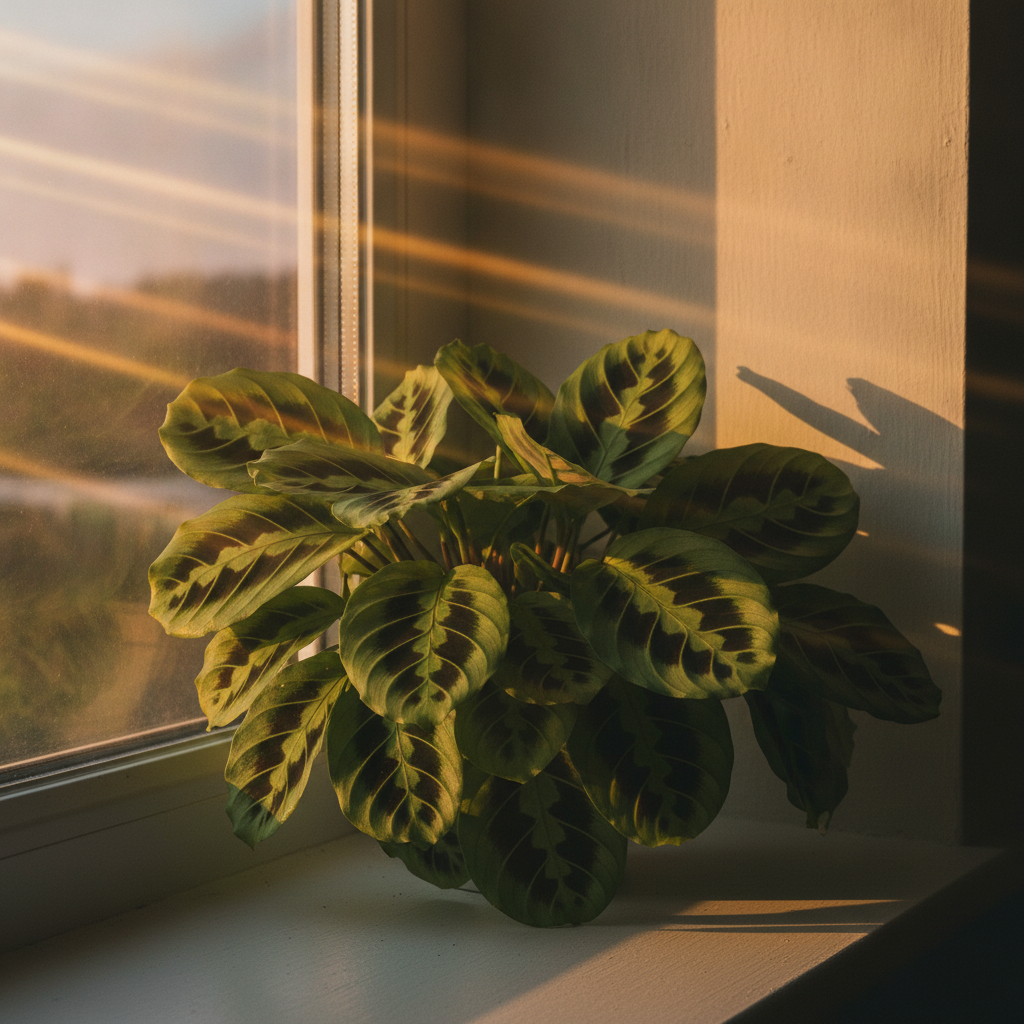
In its native habitat the rabbit foot prayer plant grows beneath a dense canopy, receiving only the dappled, broken light that filters through layers of taller foliage. That ancestry shapes everything about how it should be lit indoors. The plant wants bright but thoroughly indirect light, the kind found a short distance back from a window or beside one screened by a sheer curtain. It tolerates medium light better than most patterned-leaf houseplants, which is part of its appeal, but tolerance and preference are not the same thing.
The sweet spot is steady, gentle illumination for most of the day. In good light the leaves stay compact, the markings stay crisp and contrasted, and the nightly movement is pronounced. In light that is too dim, growth slows, new leaves emerge smaller and paler, the spaces between leaves stretch as the plant reaches, and the daily folding becomes sluggish or stops altogether. Too much direct sun, on the other hand, scorches the delicate foliage within hours.
Light Levels Explained
Indoor light is far dimmer than most people assume, and a spot that looks bright to the eye may sit well below what a plant registers. The table below translates the usual categories into approximate light intensity, typical placements and the result to expect from a rabbit foot prayer plant in each.
| Light Category | Approx. Level | Typical Location | Outcome |
|---|---|---|---|
| Direct sun | Over 50,000 lux | On an unscreened south or west sill | Leaves scorch, bleach and curl; avoid |
| Bright indirect | 10,000 to 20,000 lux | Near an east window or back from a bright one | Ideal; rich colour and steady growth |
| Medium | 5,000 to 10,000 lux | A metre or two inside a bright room | Good; slightly slower but healthy |
| Low | 1,000 to 5,000 lux | A dim corner or north room | Survives but pales, stretches and slows |
| Very low | Under 1,000 lux | Interior hallway, far from any window | Decline over time; not sustainable |
Window Orientation and Placement
South-facing window: The brightest exposure in the northern hemisphere and generally too intense at the glass. Place the plant at least 1.5 to 2 metres (5 to 6.5 ft) back, or fit a sheer curtain to soften the midday hours.
East-facing window: Often the best choice. The gentle morning sun is mild enough to fall directly on the leaves for an hour or two without harm, and the rest of the day delivers bright indirect light.
West-facing window: Workable, but the late afternoon sun carries real heat. Set the plant back from the glass or filter the light, much as for a south window.
North-facing window: Provides soft, even light all day with little risk of scorch. The plant can sit right at a north sill, though growth will be a touch slower than in a brighter room.
Pro Tip — Rotate for Even Growth: Because the leaves angle themselves toward the strongest light, a plant left in one position will lean and grow lopsided. Give the pot a quarter turn each time you water to keep the mound full and symmetrical on every side.
How Light Affects Leaf Markings
The contrast between the pale green leaf and its dark paired blotches is at its sharpest in bright indirect light. In low light the whole leaf tends toward a flat, uniform green, the markings blur, and the plant loses much of the character that makes it worth growing. Good light also keeps the foliage tightly packed, so the rows of “rabbit tracks” line up neatly along the spreading stems rather than scattering across long, leggy growth.
Warning — Direct Sunlight: The thin, soft leaves of this species have little defence against direct sun. A few hours on an unscreened summer sill can bleach the green to a washed-out beige, crisp the edges brown and permanently mark the foliage. When colour fades suddenly and the leaves feel dry and papery, suspect too much sun before anything else.
Artificial Lighting
The rabbit foot prayer plant responds well to supplemental lighting, which makes it a practical choice for rooms with few windows or for the dark months of winter. A standard full-spectrum LED grow light positioned 30 to 45 cm (12 to 18 in) above the foliage and run for 10 to 12 hours a day will comfortably maintain a plant that would otherwise languish. Because the species is naturally a low-light understory grower, it does not demand the intense output that high-light plants need, so even a modest desk-style grow lamp can keep it healthy.
Seasonal Adjustments
Light shifts markedly through the year, and the plant should move with it. In the weak, short days of winter, slide it closer to the window to make up for the loss, and clean both the glass and the leaves so nothing blocks what little light there is. As spring returns and the sun climbs higher and stronger, ease the plant back from the brightest windows to head off scorch. A specimen that thrived on a winter sill can burn in the same spot by late spring.
Watering & Humidity
Water is where most rabbit foot prayer plants are won or lost. The species comes from consistently moist rainforest soil and resents both extremes, drying out and waterlogging alike. The goal is steady, even moisture: a growing medium that stays lightly damp like a wrung-out sponge, never bone dry and never sodden. Get this balance right and the plant grows steadily and folds its leaves on schedule; get it wrong and the leaves curl, crisp or yellow with discouraging speed.
When to Water
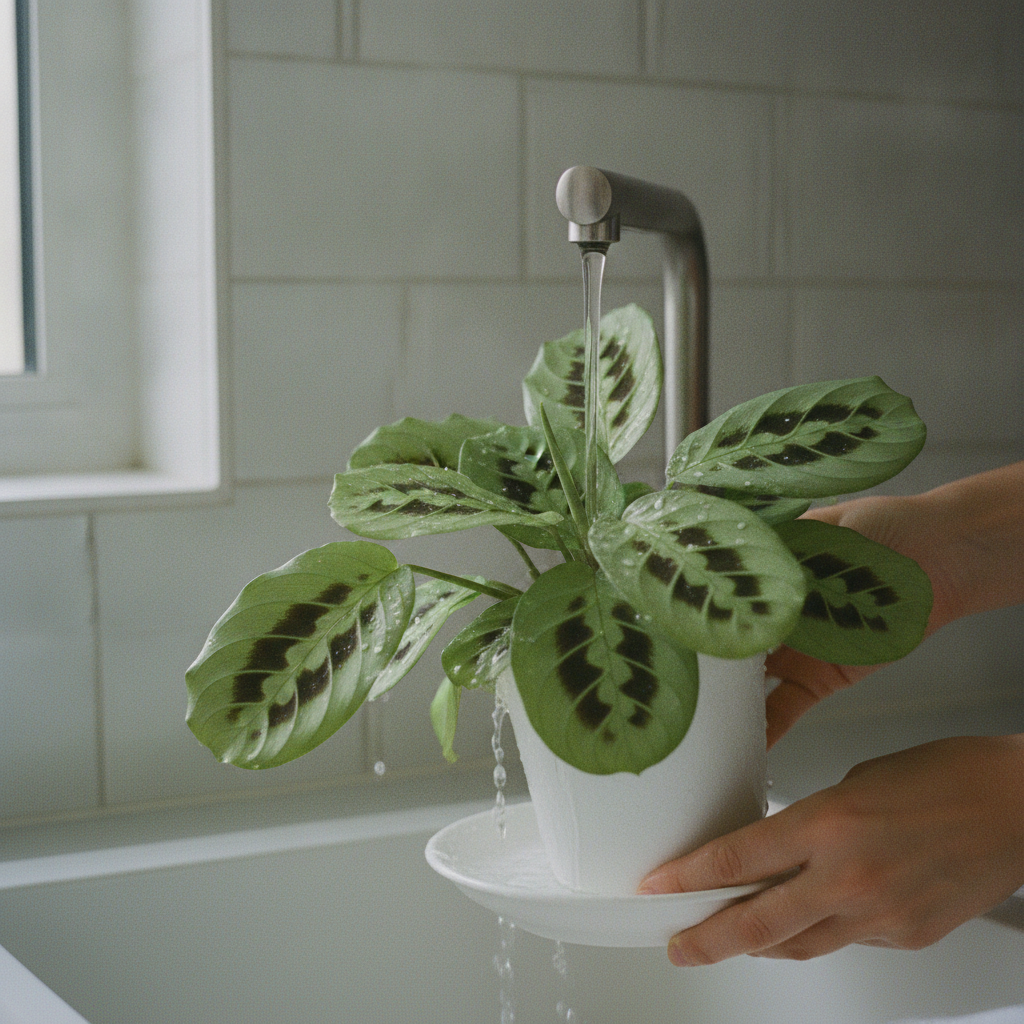
Rather than watering on a fixed calendar, check the soil with a finger. When the top 1 to 2 cm (0.5 to 0.75 in) has dried but the layer beneath is still slightly moist, it is time to water again. During the active growth of spring and summer this often works out to roughly twice a week, while in the cooler, darker months it may stretch to once a week or less. The plant uses far less water when growth slows, and the same routine that suited July will drown it in January.
The plant gives clear feedback once you learn to read it. Leaves that curl inward and feel dry usually signal thirst, and they typically perk up within a day of a good soak. Leaves that yellow and turn soft, especially the lower ones, point the other way, toward soil that has stayed wet for too long. The leaf movement itself helps too: a well-watered plant folds crisply at night and opens fully by day, while erratic or weak movement often traces back to moisture stress.
Pro Tip — Lukewarm Only: Cold tap water shocks the roots of this tropical plant and can trigger leaf curl and spotting. Let water come to room temperature first, or mix in a little warm water, so it sits at roughly the same temperature as the room the plant lives in.
How to Water Correctly
- Check the soil first, watering only once the top 1 to 2 cm (0.5 to 0.75 in) has dried.
- Use room-temperature water that is low in minerals, such as rainwater, distilled or filtered water.
- Pour slowly and evenly across the whole surface until water runs freely from the drainage holes.
- Let the pot drain completely for several minutes so no water remains around the roots.
- Empty the saucer or cover pot; never leave the plant standing in collected water.
- Wait until the surface dries slightly again before repeating, adjusting frequency to the season.
Signs of Overwatering vs. Underwatering
| Symptom | Overwatering | Underwatering |
|---|---|---|
| Leaf colour | Yellowing, often starting low on the plant | Browning, crisp tips and edges |
| Leaf texture | Soft, limp and translucent | Dry, papery and tightly curled |
| Soil | Stays wet for days, may smell sour | Pulls away from the pot edge, dusty dry |
| Roots | Brown, mushy and foul smelling | Dry but firm and pale |
| Growth | Stalled, with leaf drop | Slowed, with little new foliage |
Warning — Root Rot: Persistently soggy soil starves the roots of oxygen and invites root rot, the most common killer of this plant. If the soil smells sour and the lower leaves yellow and collapse, unpot at once, trim away any brown mushy roots with sterile scissors, and repot into fresh, barely moist mix. Caught early, the plant often recovers; left unchecked, rot spreads quickly to the crown.
Humidity Requirements
If watering is the first pillar of success, humidity is the second, and the two are closely linked. The rabbit foot prayer plant evolved in air that rarely drops below 60 percent humidity, and it shows its displeasure quickly in the dry air of a centrally heated or air-conditioned home. Aim for 60 percent or higher; the plant will manage at 50 percent but begins to struggle below that, and winter indoor air can fall to 30 percent or less.
The clearest symptom of low humidity is browning along the leaf tips and edges, often with a thin yellow halo between the dead and living tissue. Crisping margins, slowed growth and leaves that never fully unfurl all point the same way. Because dry air also favours spider mites, a humidity problem and a pest problem frequently arrive together.
Raising humidity reliably usually means more than the occasional misting, which lifts moisture only briefly. A room humidifier is the most effective tool and the one most worth buying for a Marantaceae collection. Grouping plants together raises the local humidity as they transpire, a pebble tray of water beneath the pot helps in a small way, and a naturally humid room such as a bright bathroom or kitchen can suit the plant well. Avoid placing it near heating vents, radiators or draughty doors, all of which dry and stress the foliage.
Water Quality
This species is notably sensitive to the minerals and additives in tap water. Fluoride, chlorine and dissolved salts accumulate in the leaf margins and show up as brown, scorched tips that no amount of humidity will cure. Where tap water is hard or heavily treated, switch to rainwater, distilled or filtered water, or at the very least leave tap water to stand uncovered overnight so some of the chlorine can dissipate. Many growers trace stubborn tip-burn directly to water quality once light, humidity and watering have all been ruled out.
Soil, Potting & Repotting
The right growing medium lets the rabbit foot prayer plant hold the steady moisture it craves while still draining fast enough to keep the roots breathing. A heavy, water-retentive soil stays wet too long and breeds rot, while a coarse, sandy mix dries out faster than the plant can cope with. The aim is an airy, organic blend that stays evenly damp without ever turning to mud.
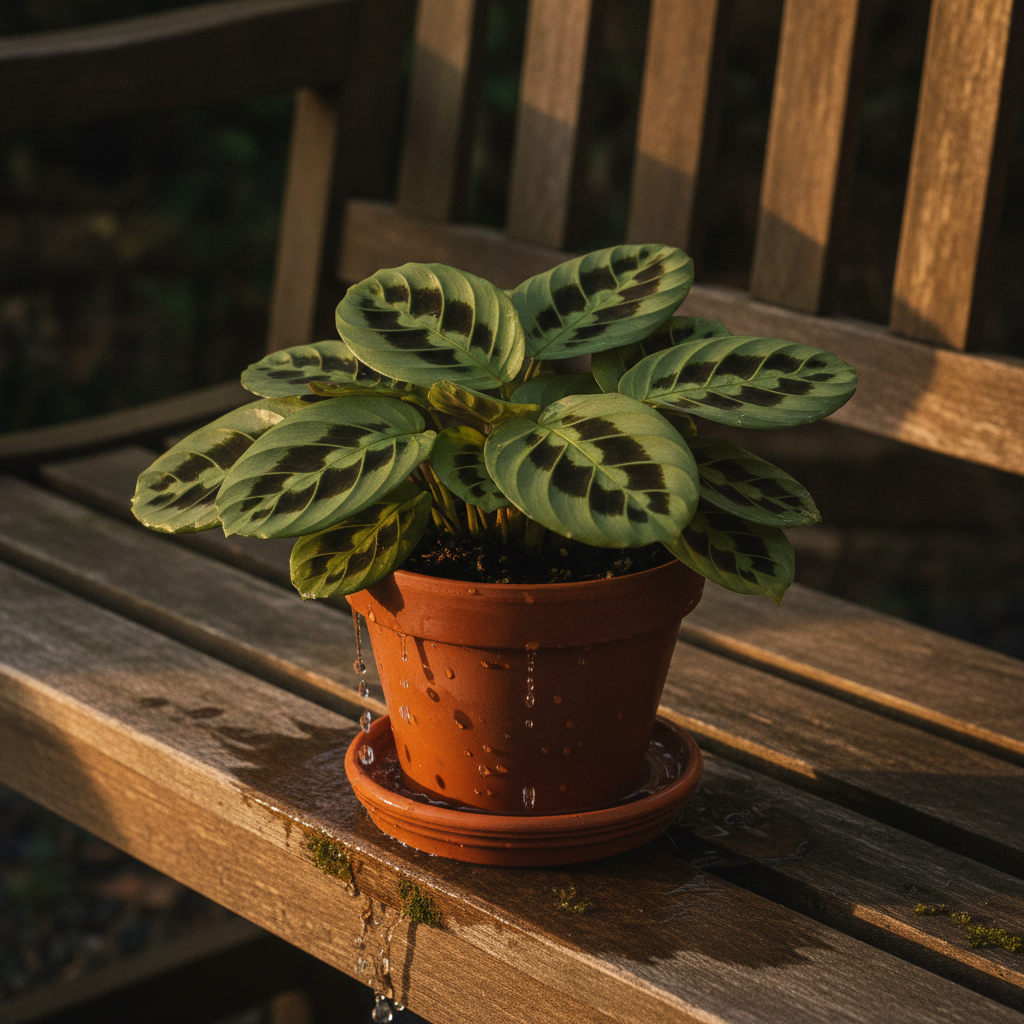
Ideal Soil Composition
A good base is a quality peat-free houseplant compost loosened with materials that add air and improve drainage. Coco coir holds moisture evenly, perlite or fine bark opens up the structure, and a handful of worm castings adds gentle, slow nutrition. The result should feel light and springy in the hand and never compact into a dense block.
| Component | Proportion | Function |
|---|---|---|
| Coco coir or peat-free compost | 50 percent | Holds even moisture and provides body |
| Perlite or pumice | 25 percent | Adds aeration and prevents compaction |
| Fine orchid bark | 15 percent | Improves drainage and structure |
| Worm castings | 10 percent | Supplies gentle, slow-release nutrients |
The plant prefers a slightly acidic to neutral medium, roughly pH 5.5 to 6.5, which is the natural range of most peat-free houseplant composts and coco-based blends, so no special adjustment is usually needed.
Pro Tip — Quick Mix Recipe: For a fast, reliable blend, combine two parts peat-free houseplant compost, one part perlite and one part fine bark, then stir through a generous handful of worm castings. This holds moisture without staying soggy and suits the whole prayer plant family.
Choosing the Right Pot
Because the rabbit foot prayer plant grows from shallow, spreading roots rather than a deep taproot, it is happiest in a wide, fairly shallow pot rather than a tall, narrow one. A container that is too deep holds a reservoir of wet soil below the roots that never dries and invites rot.
Drainage holes are non-negotiable. Whatever the material or shape, the pot must have holes so excess water can escape. A decorative cover pot is fine, but the plant should sit in an inner pot that drains freely and never be left standing in pooled water.
Pot material: Plastic and glazed ceramic hold moisture longer and suit this thirsty plant well, reducing how often you need to water. Unglazed terracotta breathes and dries faster, which can be useful for heavy-handed waterers but means more frequent watering overall.
Pot size: Move up only one size at a time, choosing a pot 2 to 4 cm (1 to 1.5 in) wider than the old one. Over-potting surrounds the roots with excess wet soil and does more harm than good.
When to Repot
This is a slow to moderate grower that dislikes disturbance, so it needs repotting only every one to two years, ideally in spring as growth resumes. Tell-tale signs that it is ready include roots creeping out of the drainage holes, water running straight through without wetting the soil, and growth that has stalled despite good care. If the plant is healthy and not yet crowded, refreshing the top few centimetres of soil each spring is often enough.
How to Repot: Step-by-Step
- Water the plant a day ahead so the roots are hydrated and the rootball slides out cleanly.
- Ease the plant from its pot, supporting the crown and teasing loose any tightly circling roots.
- Gently shake off some of the old, spent soil, inspecting the roots and trimming any that are brown or mushy.
- Add a layer of fresh mix to a clean pot only one size larger, then centre the plant at its previous depth.
- Fill around the roots with fresh mix, firming lightly to remove air pockets without compacting.
- Water thoroughly, let it drain completely, and return the plant to its usual bright, indirect spot.
- Hold off on feeding for four to six weeks while the roots settle into the new soil.
Warning — Transplant Shock: Expect some sulking after repotting, with a little curling or drooping for a week or two. Keep conditions stable, warm and humid, resist the urge to overwater the disturbed roots, and the plant will recover. Repotting in the cold, dark months greatly increases the risk of a setback, so wait for spring whenever you can.
Fertilising
The rabbit foot prayer plant is a light feeder by nature, drawing modest nutrition from the rich but rapidly recycled litter of the forest floor. It benefits from regular, dilute feeding through the growing season but is easily harmed by too much, so restraint matters more than generosity here.
A balanced liquid houseplant fertiliser, diluted to half the recommended strength, suits it perfectly. Heavy or concentrated feeding pushes salts into a soil this plant is already sensitive to, scorching the very leaf tips you are trying to keep pristine.
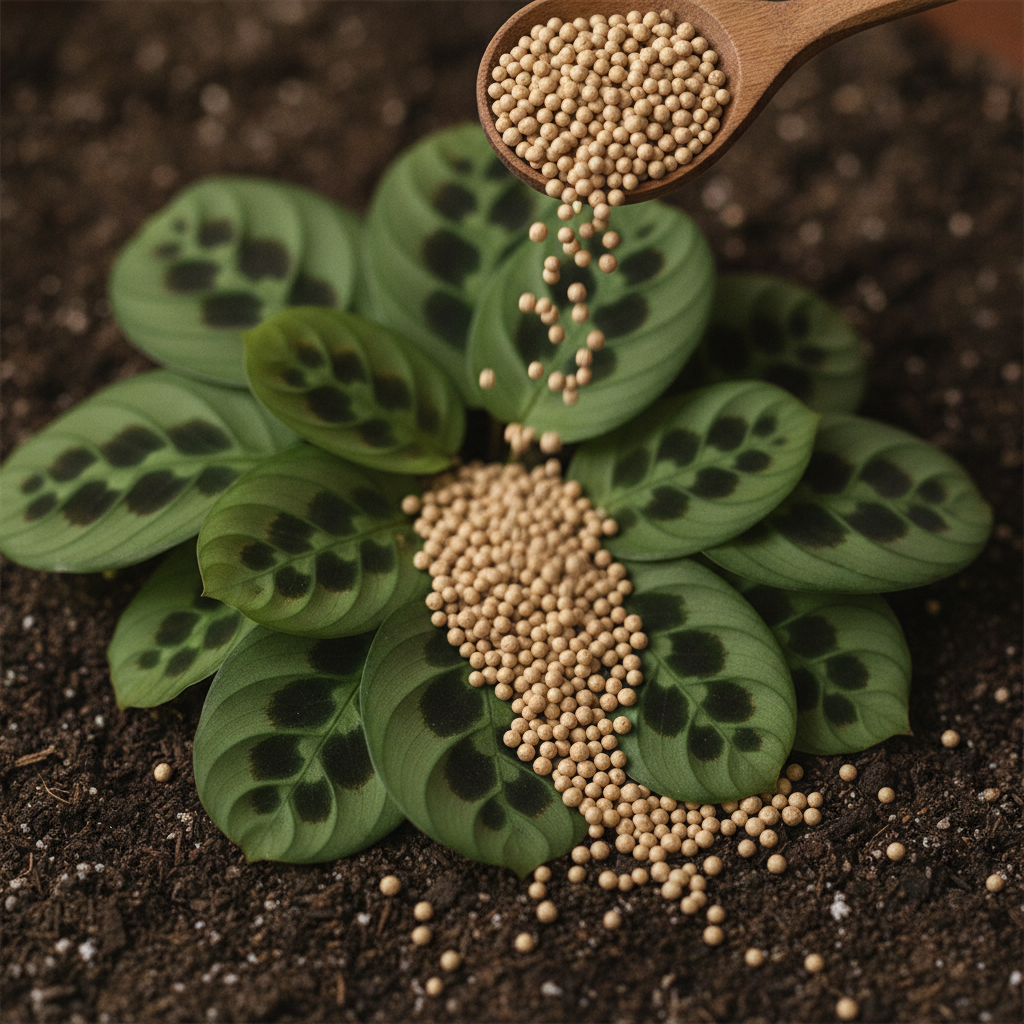
Understanding Plant Nutrients
Most fertilisers are described by their N-P-K ratio, the percentages of nitrogen, phosphorus and potassium they contain. For a foliage plant like this one, a balanced ratio such as 10-10-10 or a slightly nitrogen-forward blend keeps the leaves growing lush and green. The table below outlines the main nutrients and the deficiencies that follow when they run short.
| Nutrient | Symbol | Primary Function | Deficiency Symptoms |
|---|---|---|---|
| Nitrogen | N | Leaf and stem growth, green colour | Pale, yellowing older leaves; slow growth |
| Phosphorus | P | Root development and energy transfer | Stunted growth, dull or purplish leaves |
| Potassium | K | Overall vigour and water regulation | Brown leaf edges, weak stems |
| Calcium | Ca | Cell wall strength, new growth | Distorted, hooked new leaves |
| Magnesium | Mg | Core of the chlorophyll molecule | Yellowing between the leaf veins |
| Iron | Fe | Chlorophyll production | Yellow new leaves with green veins |
Types of Fertiliser
Liquid fertilisers: The easiest to control and the best match for this plant. Diluted into the watering can, they deliver nutrients evenly and can be skipped or flushed the moment trouble appears.
Slow-release granular: Convenient and long-lasting, but harder to dial back if the plant shows signs of overfeeding. If used, apply at a reduced rate and watch the leaf tips closely.
Organic fertilisers: Worm castings, diluted seaweed and similar gentle options release nutrients slowly and are very forgiving, making them well suited to a salt-sensitive plant like this one.
Feeding Schedule
Feed every three to four weeks through spring and summer, when the plant is actively producing new leaves. As light wanes in autumn, taper off, and stop entirely through winter when growth naturally pauses; feeding a dormant plant simply piles unused salts into the soil. Resume gentle feeding only when fresh growth signals the return of the growing season.
Pro Tip — Always Feed onto Damp Soil: Applying fertiliser to dry soil can burn the roots. Water lightly first, or feed straight after a normal watering, so the diluted nutrients spread evenly and gently around the rootball.
How to Fertilise
- Dilute a balanced liquid fertiliser to half the strength stated on the label.
- Water the plant lightly first if the soil has dried, so the roots are not fed dry.
- Apply the diluted feed evenly across the soil surface until it is lightly moistened throughout.
- Let any excess drain away and empty the saucer so no salty residue collects.
- Every couple of months, flush the pot with plain water to wash out accumulated salts.
Warning — Salt Build-Up: A white crust on the soil surface or pot rim, paired with worsening brown tips, signals that fertiliser salts have accumulated. Flush the pot thoroughly with several pot-volumes of plain water, let it drain, and cut back on feeding until the plant recovers.
Propagation
Propagating the rabbit foot prayer plant is one of the more satisfying parts of growing it, partly because the plant spreads so willingly and partly because a single mature specimen can yield several new plants at once. The two reliable methods are division, which is the simplest and most successful, and stem cuttings taken at the nodes, which root readily in water or moist mix.
The best time to propagate is spring or early summer, when the plant is in active growth and recovers quickly. Both methods build on the same key feature, the node, so it pays to understand that structure before reaching for the scissors.
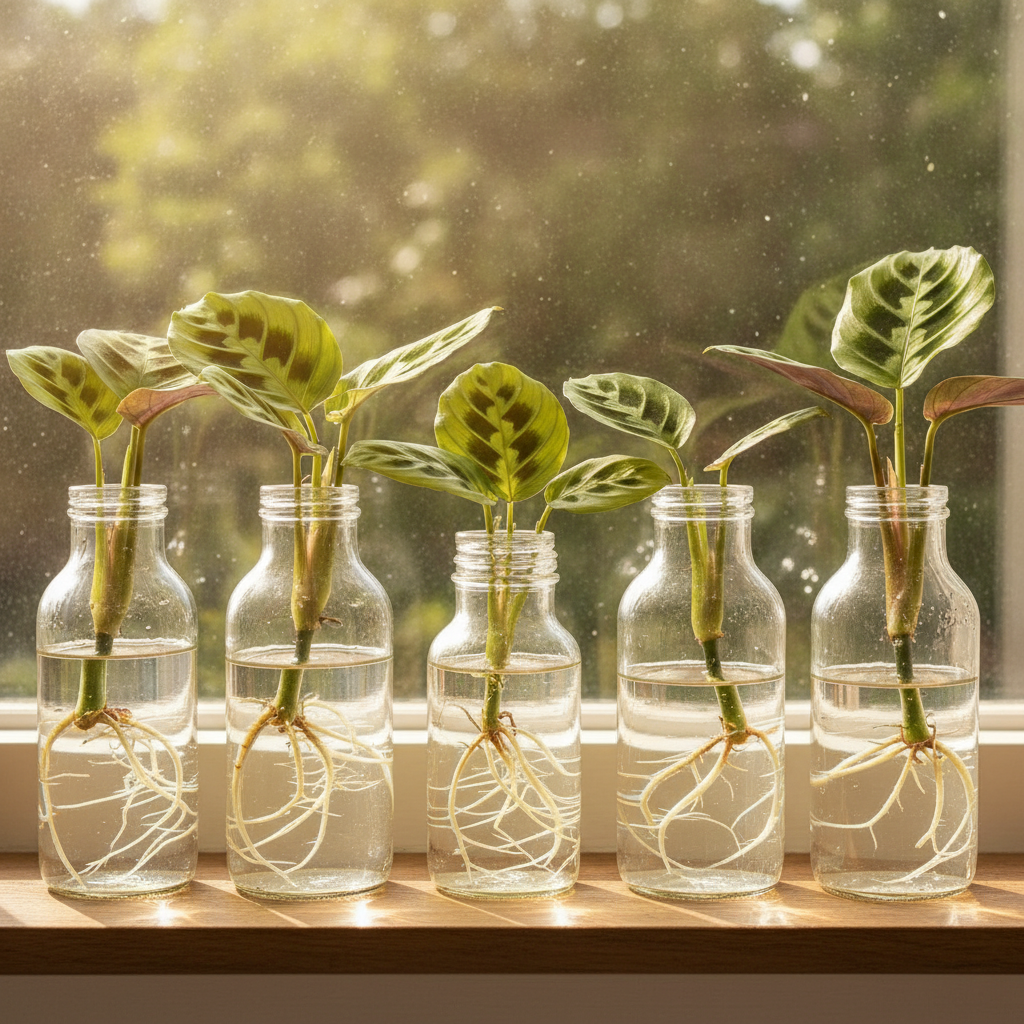
Understanding Nodes and Rhizomes
A node is the slightly swollen point on a stem where a leaf joins and from which new roots will emerge. Every viable cutting must include at least one node, since this is where rooting happens. Below the soil, the rabbit foot prayer plant also grows from a shallow, spreading rhizome, a horizontal underground stem that sends up clusters of leaves along its length. This rhizome is what makes division so straightforward: the plant has, in effect, already separated itself into clumps that simply need teasing apart.
Division: Step-by-Step
Division is the fastest route to a new full-sized plant and carries the highest success rate. It is best done at repotting time, when the rootball is already out of the pot.
- Water the plant the day before, then gently lift the whole rootball out of its pot.
- Brush away loose soil so you can see the natural clumps and the rhizomes connecting them.
- Tease the rootball apart by hand into two or three sections, each with healthy roots and several leaves.
- Use clean scissors only where roots will not pull apart, cutting through the rhizome between clumps.
- Pot each division into its own small pot of fresh, lightly moist mix at its original depth.
- Water in, then keep the new plants warm, humid and out of direct sun while they establish.
Pro Tip — Keep Divisions Generous: Resist the temptation to split a plant into too many pieces. Each division needs a decent cluster of roots and at least three or four leaves to support itself; larger sections re-establish far faster and sulk far less than tiny scraps.
Stem Cuttings: Step-by-Step
Stem cuttings are ideal when you want several new plants without disturbing the parent, or when a stem has grown long and leggy and could use a trim. Cuttings root well in either water or a moist propagation mix.
- Choose a healthy stem and cut just below a node with clean, sharp scissors.
- Take a cutting with one or two leaves and at least one node, removing any leaf that would sit underwater.
- Place the cutting in a jar of room-temperature water, or insert it into damp propagation mix.
- Set it in warm, bright indirect light and refresh the water every few days to keep it clean.
- Wait for roots 2 to 3 cm (about 1 in) long to develop, usually within three to five weeks.
- Pot rooted cuttings into the standard mix and keep them humid as they transition to soil.
Troubleshooting Propagation
| Problem | Likely Cause | Solution |
|---|---|---|
| Cutting rots in water | Stale water or a submerged leaf | Refresh water often; strip lower leaves |
| No roots after weeks | No node included, or cold conditions | Re-cut below a node; keep warm and bright |
| Division wilts badly | Too few roots or low humidity | Raise humidity; keep larger divisions next time |
| Roots form but plant stalls | Shock when moving water roots to soil | Pot into very moist mix and tent for humidity |
Pests & Diseases
A well-cared-for rabbit foot prayer plant is reasonably resilient, but the warm, humid conditions it loves can also tempt pests, and its sensitivity to moisture extremes leaves it open to a few diseases. The single best defence is vigilance: a quick look over the leaves, especially their undersides, every time you water will catch most problems while they are still easy to solve.
Most trouble traces back to the growing environment. Dry air invites spider mites, soggy soil breeds rot and fungus gnats, and a stressed plant of any kind is more inviting to pests than a thriving one. Fixing the underlying conditions usually does as much as any spray.
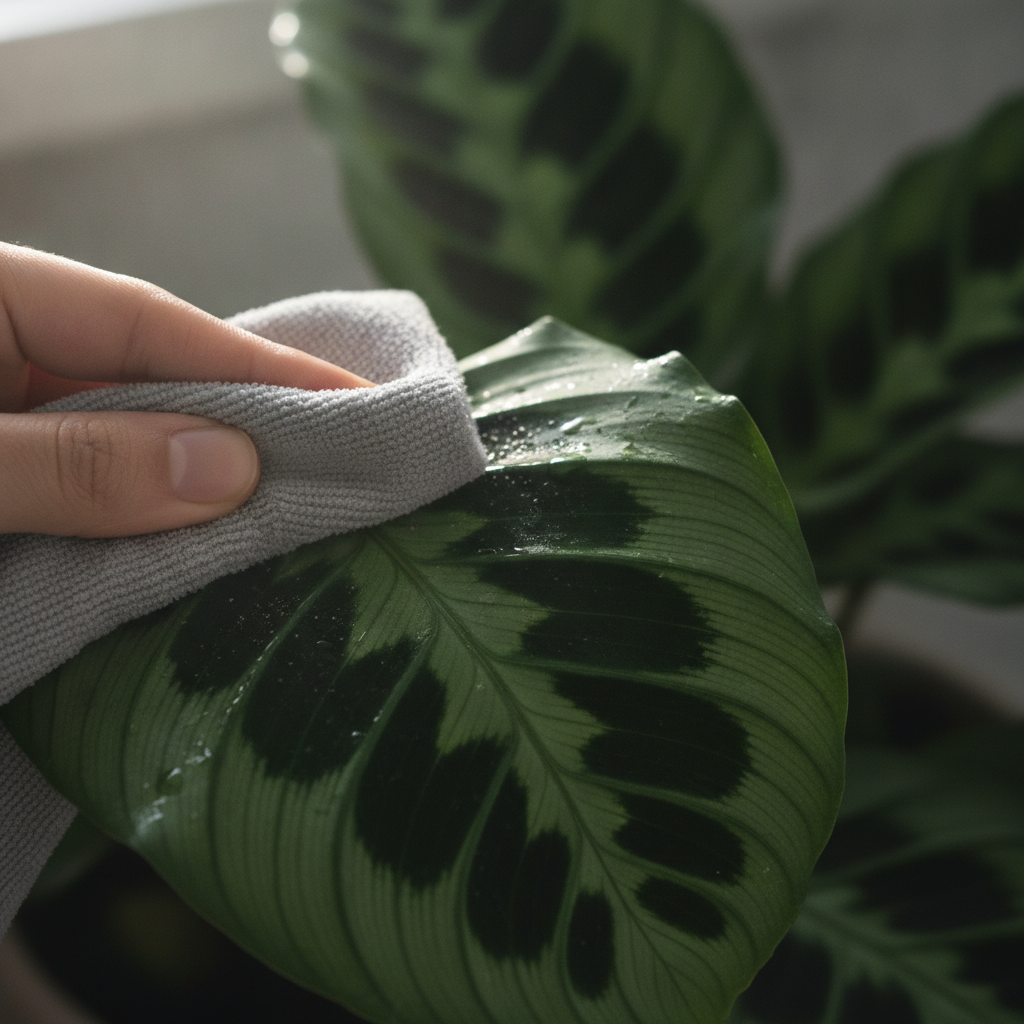
Common Pests
Spider Mites (Tetranychus urticae)
By far the most common pest of this plant, spider mites thrive in dry air and attack stressed, dehydrated foliage. They are tiny, almost invisible to the naked eye, and announce themselves through fine speckling or stippling on the leaves and faint silken webbing in the leaf joints. Left unchecked they can quickly bronze and shrivel whole leaves.
Treatment: Rinse the plant thoroughly, paying attention to the leaf undersides, then treat with insecticidal soap or neem oil every five to seven days until clear. Raising humidity is both cure and prevention, since mites detest moist air.
Mealybugs (Pseudococcus spp.)
Mealybugs appear as small, white, cottony tufts tucked into leaf axils and along the stems. They feed on sap, weakening the plant and leaving behind a sticky residue that can encourage sooty mould.
Treatment: Dab each insect directly with a cotton bud dipped in isopropyl alcohol, then follow up with neem oil or insecticidal soap. Isolate the plant until no new bugs appear, as they spread easily to neighbours.
Fungus Gnats (Bradysia spp.)
These small black flies hover around the soil and are a near-constant temptation given how moist this plant likes to be kept. The adults are merely a nuisance, but their larvae feed on roots and organic matter in persistently wet soil.
Treatment: Let the very top of the soil dry between waterings, use yellow sticky traps to catch the adults, and drench with a beneficial nematode or a hydrogen peroxide solution to deal with the larvae.
Common Diseases
Root Rot (Pythium and Phytophthora spp.)
The most serious threat to the plant, root rot sets in when soil stays waterlogged and the roots suffocate. Above ground it shows as yellowing, wilting lower leaves and a general collapse despite wet soil; below ground the roots turn brown, soft and foul smelling.
Treatment: Unpot the plant, cut away all rotten roots with sterile scissors, and repot into fresh, free-draining mix. Water more conservatively thereafter and ensure the pot drains freely.
Leaf Spot (Helminthosporium and Drechslera spp.)
Fungal leaf spot produces small water-soaked patches that enlarge into brown lesions, sometimes ringed with yellow. It is encouraged by water sitting on the foliage in still, humid conditions.
Treatment: Remove affected leaves, avoid wetting the foliage when watering, and improve air circulation. A copper-based or general fungicide can help if the spread is severe.
Pest and Disease Summary
| Pest / Disease | Identification | Treatment |
|---|---|---|
| Spider mites | Fine speckling and faint webbing | Rinse, neem oil, raise humidity |
| Mealybugs | White cottony tufts in leaf axils | Alcohol swab, neem oil, isolate |
| Fungus gnats | Small flies around damp soil | Dry topsoil, sticky traps, nematodes |
| Root rot | Yellow wilting leaves, mushy roots | Trim rot, repot, water less |
| Leaf spot | Brown lesions with yellow halos | Remove leaves, keep foliage dry |
Prevention Strategies
Prevention rests on consistency. A plant kept in stable warmth, bright indirect light and humid air, watered to its needs rather than a rigid schedule, simply has fewer weak points for pests and disease to exploit. Quarantine any new plant for a couple of weeks before it joins the collection, and keep the leaves clean and dust-free so problems show up early.
Good air movement matters too, particularly for a humidity-loving plant. Gentle circulation from an open door or a low fan discourages the stagnant, damp pockets where fungal spots and rot take hold, without drying the plant out. The balance to strike is moist air that is also moving.
Pro Tip — Inspect at Watering Time: Make a habit of turning a couple of leaves over to check their undersides each time you water. The undersides are where spider mites and mealybugs gather first, and catching them at this stage turns a major infestation into a five-minute fix.
Popular Varieties
The rabbit foot prayer plant is one of several named forms of Maranta leuconeura, a species that has given rise to a small but striking range of cultivars. They all share the same low, spreading habit, the same nightly leaf movement and broadly the same care, differing mainly in the colour and pattern of their foliage.
For anyone drawn to the rabbit foot form, the other Maranta varieties make natural companions, since a shelf of them can be cared for as a single group. The table and profiles below set out the most widely available forms and how they compare.
| Variety | Leaf Appearance | Light Needs | Growth Rate | Availability |
|---|---|---|---|---|
| Rabbit Foot (var. kerchoveana) | Light green with paired dark blotches | Medium to bright indirect | Moderate | Common |
| Red Prayer Plant (var. erythroneura) | Dark green with pink-red herringbone veins | Bright indirect | Moderate | Common |
| Lemon Lime | Deep green with lemon-lime fishbone veins | Bright indirect | Moderate | Frequent |
| Black (var. massangeana) | Dark olive with silver-white veining | Medium to bright indirect | Slow | Occasional |
| Marisela | Green with a pale feathered midrib | Bright indirect | Moderate | Occasional |
Featured Varieties
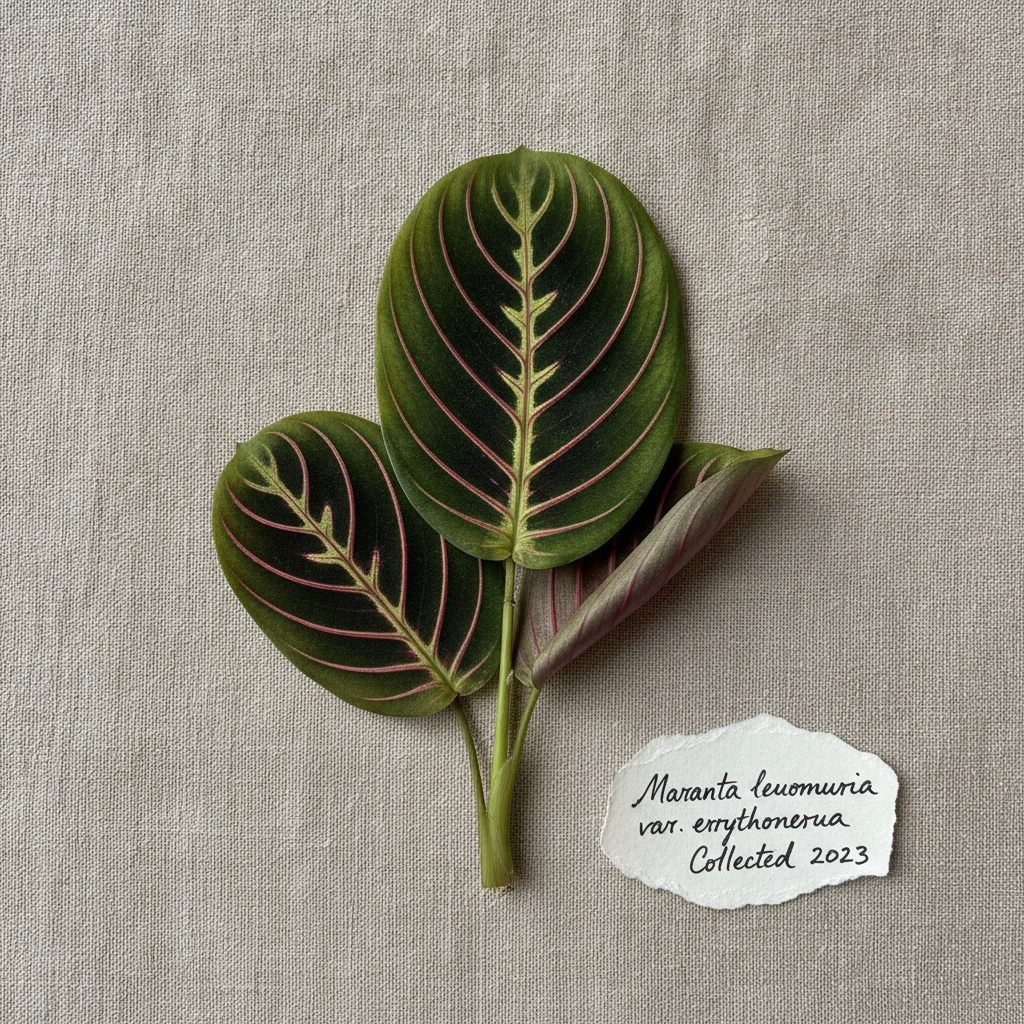
Red Prayer Plant
The showiest member of the family, with deep velvety green leaves split by vivid pink-red veins that radiate in a herringbone pattern from a pale central midrib. It wants slightly brighter indirect light to hold that colour.
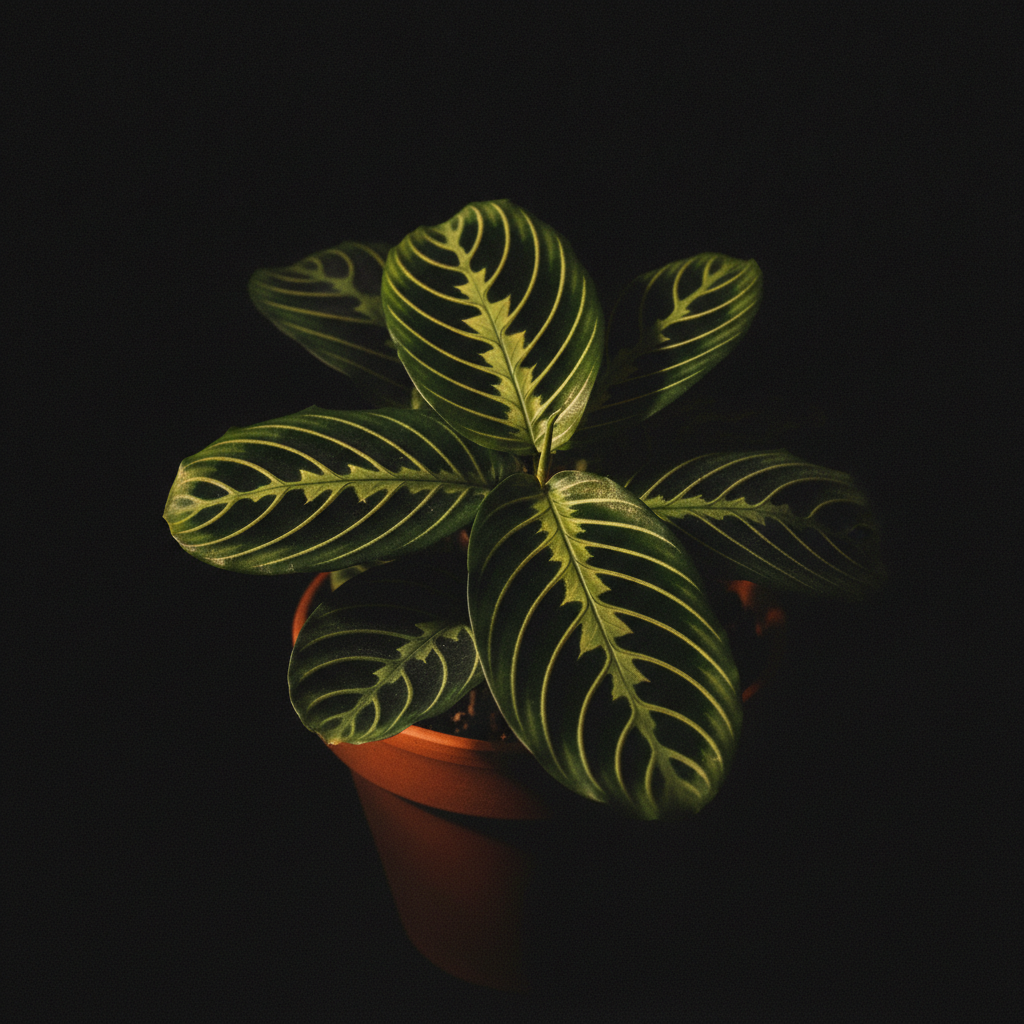
Lemon Lime Maranta
A vivid, contemporary form whose bright lemon-lime veins splash in a fishbone pattern across deep forest-green leaves. It brings an electric brightness to a shelf and shares the same easygoing prayer plant care.
Variety Profiles in Detail
Rabbit Foot Prayer Plant (Maranta leuconeura var. kerchoveana)
The subject of this guide and the green workhorse of the group. Its soft, light green leaves carry two rows of dark olive-brown blotches that fade toward green as the leaf ages, giving the “rabbit tracks” effect. It is the most forgiving of the Marantas and the best starting point for anyone new to the family.
Red Prayer Plant (Maranta leuconeura var. erythroneura)
Also sold as the herringbone plant, this is the variety most people picture when they hear “prayer plant”. The dramatic pink-red veining over dark green makes it a centrepiece, though it is a little more demanding of humidity and bright indirect light to keep its colour vivid.
Black Prayer Plant (Maranta leuconeura var. massangeana)
A moodier form with very dark olive leaves overlaid by fine silver-white veining and a paler central zone. It grows more slowly than the others and is less commonly stocked, but rewards patient growers with some of the most refined foliage in the genus.
Choosing the Right Variety for Your Space
If this is a first prayer plant, the rabbit foot form is the kindest choice, tolerating a wider range of conditions while still delivering the family’s signature markings and movement. Where a room offers reliably bright indirect light and good humidity, the red and lemon lime forms reward it with far bolder colour. All of them stay low and compact, so the deciding factor is usually colour preference and how much humidity the space can realistically provide rather than any difference in size or habit.
Frequently Asked Questions
Why is my rabbit foot prayer plant getting brown leaf tips?
Brown tips almost always point to dry air or poor water quality, the two issues this plant is most sensitive to. Raise humidity toward 60 percent and switch to rainwater, distilled or filtered water rather than hard or chlorinated tap water. Salt build-up from overfeeding can cause the same symptom, so flush the soil if you feed regularly.
Why won’t my prayer plant’s leaves fold up at night?
The nightly folding is driven by the daily cycle of light and dark, so a plant kept in too little light, or one stressed by inconsistent watering, often stops moving. Move it to brighter indirect light, keep the soil evenly moist, and ensure it experiences genuine darkness at night rather than constant artificial light. Movement usually returns as conditions stabilise.
Is the rabbit foot prayer plant safe for cats and dogs?
Yes. The species is non-toxic and is widely regarded as safe for both cats and dogs, which makes it one of the better options for pet households. As with any plant, a pet eating large amounts may still get a mild stomach upset, so it is best to discourage grazing.
How often should I water it?
Water whenever the top 1 to 2 cm (0.5 to 0.75 in) of soil has dried, which often means around twice a week in spring and summer and less in winter. Rather than fixing a schedule, check the soil and aim to keep it lightly and evenly moist at all times, never soggy and never bone dry.
Why are the leaves curling?
Leaf curl is usually a sign of thirst or low humidity. Check whether the soil has dried out too far and give a thorough soak if so; curled leaves often relax within a day. If the soil is moist, low humidity or cold draughts are the more likely cause, so move the plant away from heat sources and raise the humidity around it.
Can I grow it in a hanging basket?
Absolutely. Its naturally low, spreading habit means the foliage cascades attractively over the edge of a basket, and hanging it can also lift it into brighter, more humid air. Just remember that hanging baskets dry out faster, so check the soil moisture more often than you would for a plant on a shelf.
Why are the lower leaves turning yellow?
The occasional yellowing of an old lower leaf is normal as the plant ages it out. Widespread yellowing of soft, limp leaves, however, usually signals overwatering, so check that the soil is not staying wet for days and that the pot drains freely. Inspect the roots for any brown, mushy sections that indicate rot.
How big does a rabbit foot prayer plant get?
It stays modest, typically reaching around 20 to 30 cm (8 to 12 in) tall and spreading a little wider as a mounding clump. Because it grows outward rather than upward, mature plants make a dense, low cushion of foliage rather than a tall specimen, which is part of what makes them so well suited to shelves and baskets.






