
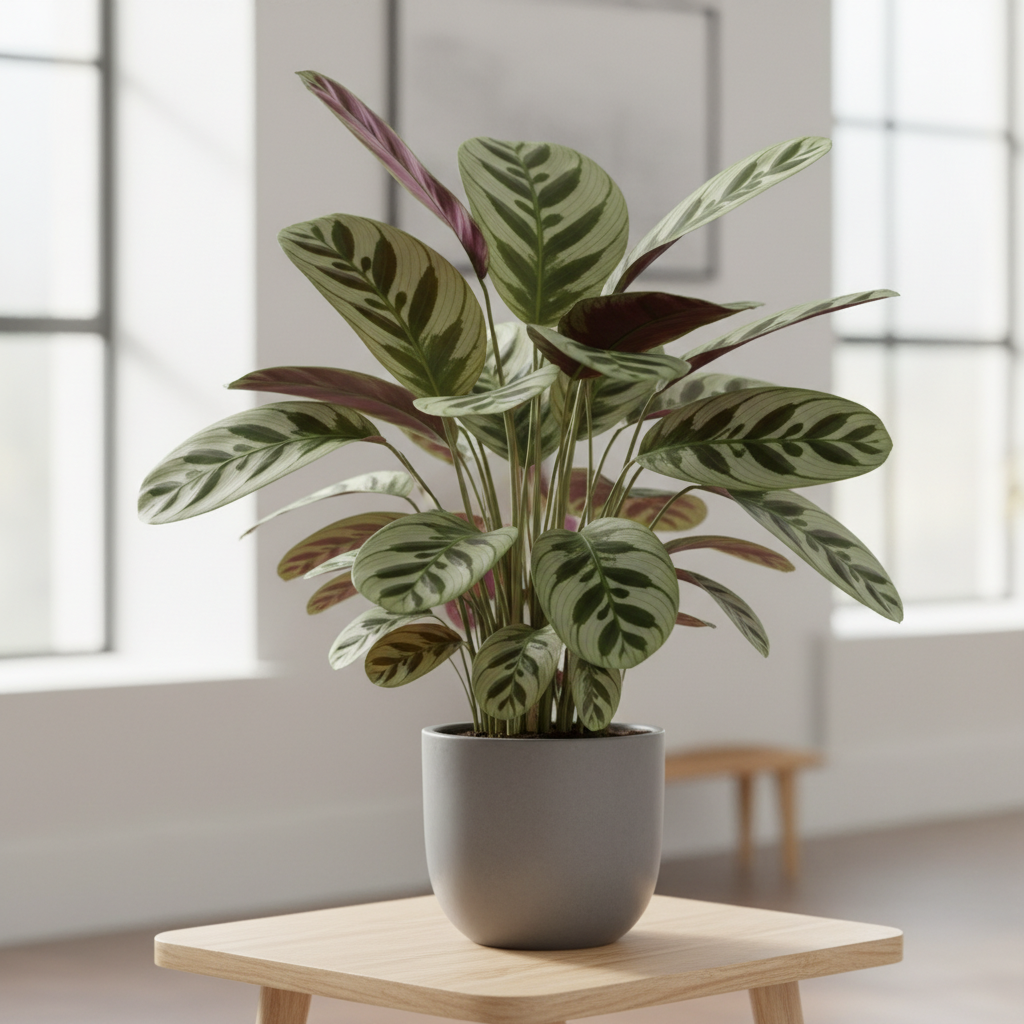
The Calathea, most often encountered in homes as the Peacock Plant (Goeppertia makoyana, formerly Calathea makoyana), is one of the most visually arresting houseplants in cultivation. Native to the humid lowland rainforests of eastern Brazil, it produces large oval leaves painted with such an intricate pattern of dark green feathering on a paler silvery-green ground that the foliage genuinely looks hand-illustrated. The undersides are flushed a deep burgundy purple, and because the plant performs a daily nyctinastic movement, raising its leaves vertically at dusk and lowering them again at dawn, the colours of a Calathea collection shift visibly through the course of an evening.
Calatheas have a reputation as drama queens, and that reputation is at least partially earned. A neglected pothos pouts. A neglected Calathea curls, crisps, browns at the edges and drops leaves in protest, all within the same week. The good news is that the species has very specific and very consistent preferences, which means that once you understand what it actually wants, keeping it healthy becomes a routine rather than a battle. This guide covers everything from quick reference numbers and ideal light placement to the fine points of substrate composition, watering chemistry, fertilising cadence, division propagation and the pests most likely to find their way to those tender leaves. Calatheas don’t simply survive in average rooms; with the right setup they become showpieces, and that gap between surviving and thriving is what we focus on below.
Contents
- Quick Reference
- Why Calathea Makes a Showpiece Houseplant
- Light Requirements
- Watering and Humidity
- Soil, Potting and Repotting
- Fertilising
- Propagation
- Pests and Diseases
- Popular Varieties
- Frequently Asked Questions
Quick Reference: Calathea at a Glance
| Light | Bright indirect light; tolerates medium light; no direct sun |
| Watering | Keep the top 2 cm (0.8 in) of soil lightly moist; never bone dry, never waterlogged |
| Temperature | 18 to 27 °C (65 to 80 °F); avoid drafts and anything below 13 °C (55 °F) |
| Humidity | 60 percent or higher; will tolerate 50 percent, sulks below 40 percent |
| Fertiliser | Balanced liquid feed at quarter strength every 4 weeks in spring and summer; pause in winter |
| Toxicity | Non-toxic to cats, dogs and humans according to the ASPCA database |
Why Calathea Makes a Showpiece Houseplant
There is a particular category of houseplant that earns its place on the strength of foliage alone, and the Calathea sits firmly at the top of that category. The leaves of Goeppertia makoyana are large, paper-thin and almost translucent when backlit. Each leaf carries a brushstroke pattern of dark, narrow ovals laid down between the lateral veins on a paler silvery-green background, and the contrast between the patterned upper surface and the wine-coloured underside gives the plant a constantly shifting palette as the foliage rises and falls. Few other indoor plants reward close attention so generously.
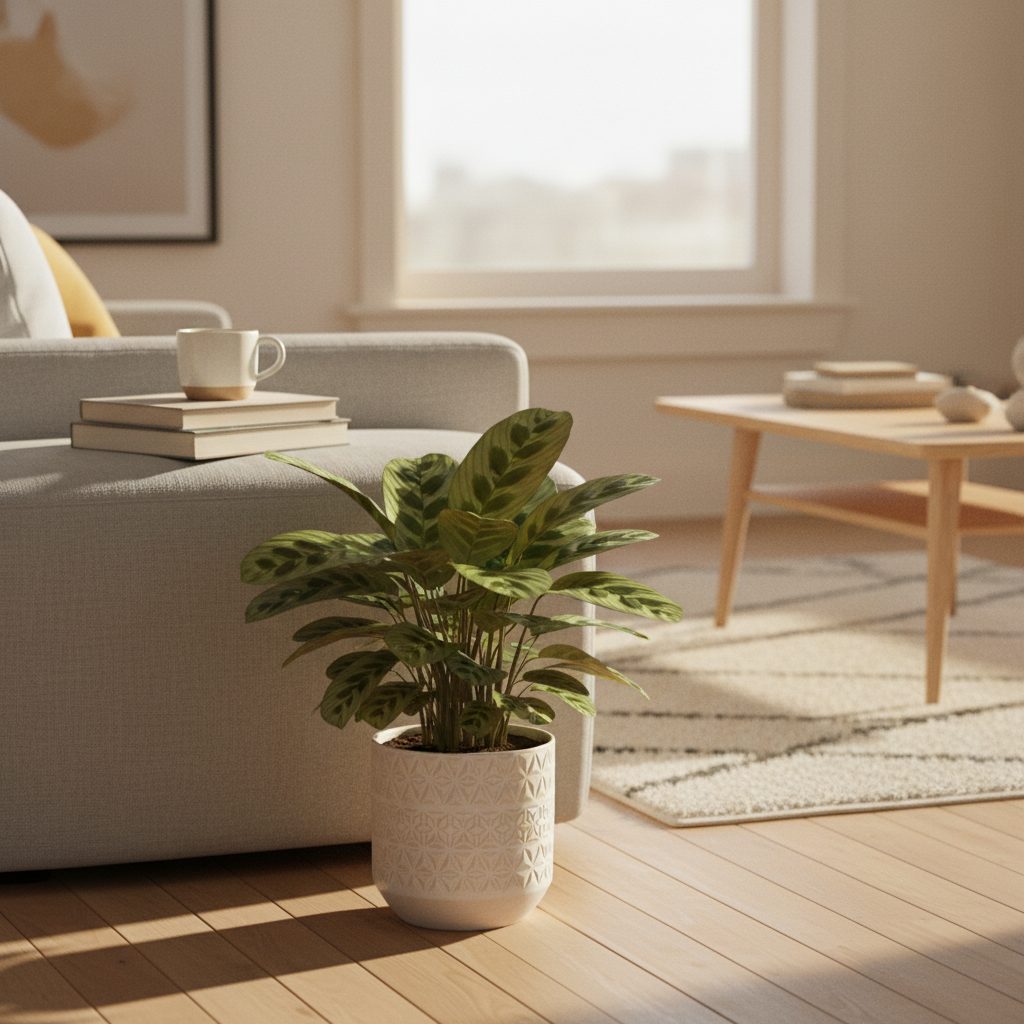
Beyond aesthetics, Calatheas earn their keep in two practical ways. First, they belong to a small group of houseplants that genuinely tolerate, and even prefer, the medium and lower light levels found away from windows. Most pretty foliage plants demand a bright sill; the Calathea is happy on a console table, a bedroom dresser or a bathroom shelf, provided the room itself is reasonably bright. Second, they are entirely non-toxic. The ASPCA lists Calathea and its close relatives as safe for cats, dogs and horses, which removes a major worry for households with curious pets. The plant is not safe in the sense that any chewed leaf is good for an animal, but it will not cause poisoning if a leaf is sampled.
The Marantaceae family, to which the Calathea belongs, is sometimes called the prayer plant family because of the leaf movement. At the base of every leaf stalk is a small swollen joint called a pulvinus, packed with cells that change shape rapidly when the plant adjusts its internal water pressure. As daylight fades, the pulvini contract and the leaves fold upwards toward the central stem in a posture that looks distinctly like clasped hands. By morning the leaves are open again and oriented to catch the new day’s light. The movement is not metaphor; it is real, mechanical and visible across a single evening.
Pro Tip — Living art: Place a small lamp on a timer near your Calathea and set it to switch off at dusk. The contrast between daylight and the brief darkness triggers a visible prayer movement, turning the plant into a quiet evening ritual you can watch unfold.
Light Requirements
In its natural habitat the Calathea grows on the floor of the Brazilian Atlantic rainforest, beneath several storeys of canopy that filter the sun before it ever reaches a leaf. The patterned upper surface is in many respects an adaptation to that low, dappled light; the dark zones may help the plant absorb the wavelengths it does receive, while the silvery areas reduce glare. Indoors, the practical translation is that Calatheas want bright indirect light and reject direct sunlight outright. A spot two or three metres back from an east-facing window, or beside a north-facing window, suits them almost perfectly.
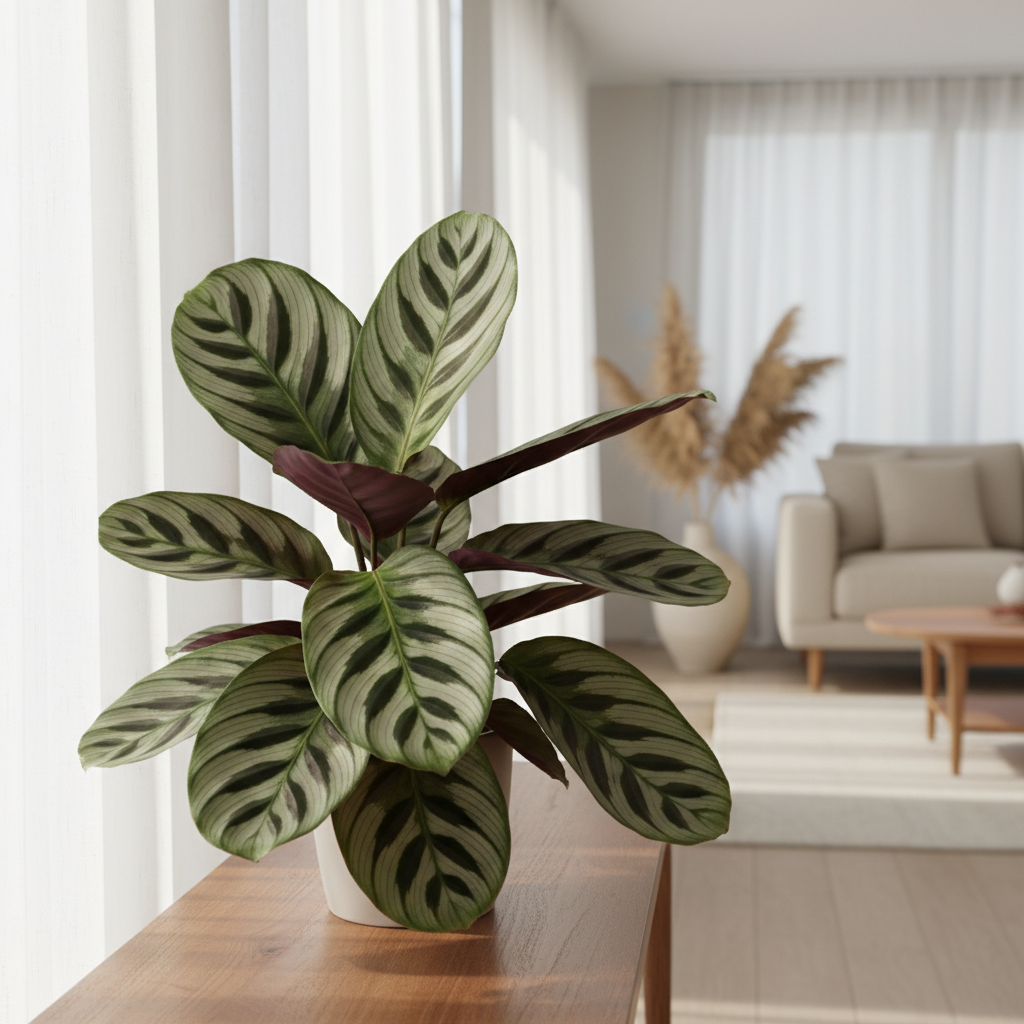
Direct sun, even for an hour or two on a summer morning, is too much. The leaves are thin and unprotected by the heavy cuticle of more sun-tolerant species, and direct rays will bleach the patterns first and then scorch through to brown crisped patches. If your only available window is a south-facing one, position the plant well back into the room, or fit a sheer curtain that knocks down the intensity without dimming the room as a whole. A north-facing window in the northern hemisphere is the safest unfiltered exposure; in the southern hemisphere a south-facing window plays the same role.
Many growers underestimate how much medium-light tolerance the Calathea offers in exchange for its other demands. A spot that reads 100 to 300 foot-candles on a light meter, which is roughly what you get a couple of metres back from an east window or in a hallway with a bright skylight, is enough to keep growth steady and patterns vivid. Below that, growth slows dramatically, new leaves come up smaller and the patterns fade. If the only suitable corner of your home is very dim, a single broad-spectrum LED grow bulb on a timer for ten to twelve hours a day is a clean and discreet fix.
Rotate the pot a quarter turn each week. The Calathea reaches for light just like any other plant, and an unrotated specimen develops a noticeable lean over a couple of months. The same rotation also helps balance the leaf-movement response, since the plant orients its prayer position with respect to its primary light source.
Watering and Humidity
If there is a single area where Calathea reputations are made or broken, it is watering. The plant comes from a habitat that is rarely bone dry and rarely flooded, and replicating that middle ground indoors takes some attention. The standing instruction is to keep the top 2 cm (0.8 in) of substrate lightly moist at all times. In practice this usually means watering every five to seven days in spring and summer, and every seven to twelve days in autumn and winter, but the calendar is a poor substitute for the finger test. Push a finger or a wooden chopstick into the soil; if it comes out with damp particles clinging to it from the top centimetre, the plant is fine. If the chopstick comes out clean and dry to that depth, it is time to water.
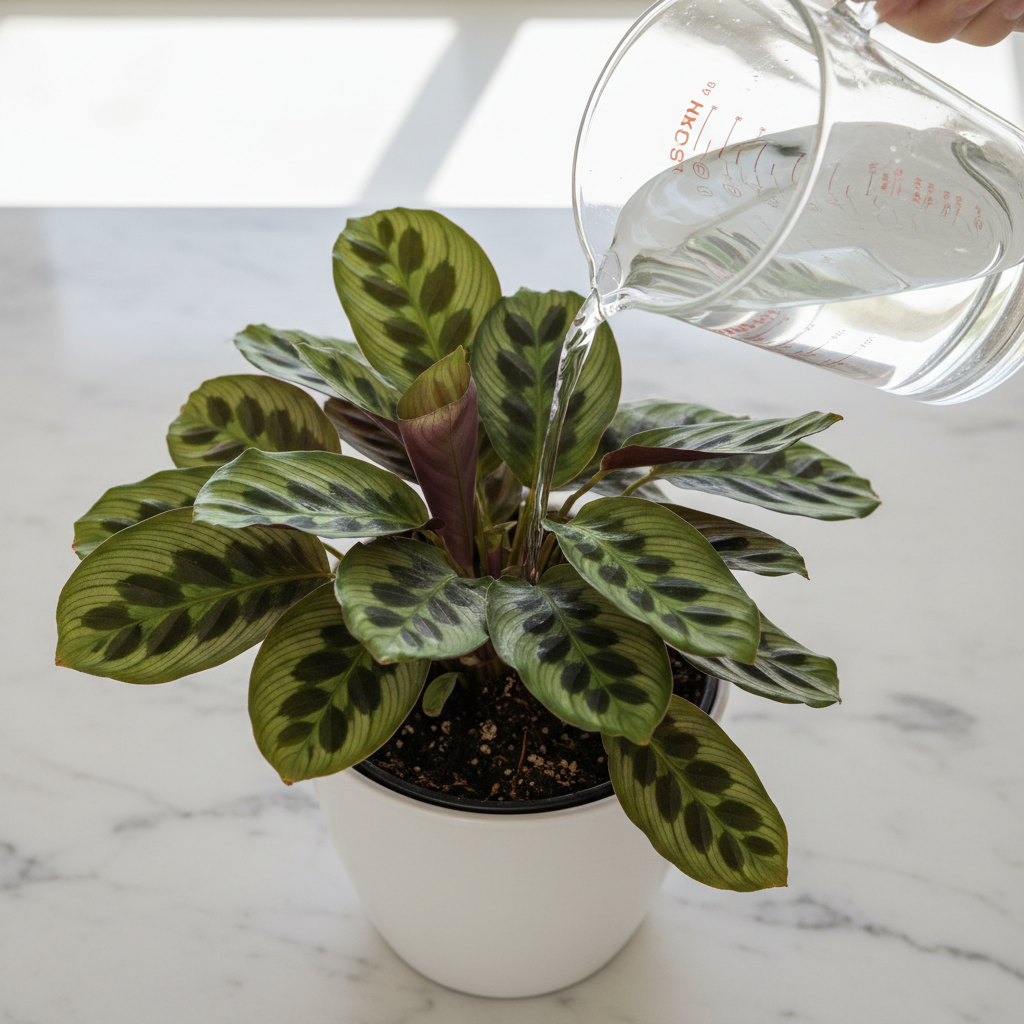
When you water, do it thoroughly. Pour evenly across the soil surface, ideally with a narrow-spout can or a glass jug, until water runs freely from the drainage holes. Wait for the pot to stop draining, then tip out anything that has collected in the saucer. A Calathea left to sit in standing water for more than a few hours runs a real risk of root rot, and root rot in this species is rarely recoverable once it has taken hold.
Water chemistry matters too, and this is where many otherwise diligent owners are surprised. Calatheas are sensitive to the minerals and chlorine compounds present in many municipal tap waters. Hard water leaves visible deposits on the leaf edges; chlorinated water tends to scorch new growth. There are three easy solutions, ranked from least to most thorough. The first is to fill the watering can the night before and leave it uncovered, which allows chlorine to dissipate. The second is to use cooled boiled water, which removes some of the dissolved minerals. The third, and the most reliable for serious collectors, is to water with collected rainwater or filtered water. The plant will indicate within a few weeks which approach is working: stable, evenly green margins mean the water is fine.
Humidity is the other half of the watering equation. Calatheas thrive at 60 percent relative humidity and above, will accept 50 percent for long periods, and become genuinely unhappy below 40 percent. Crisp brown edges on otherwise healthy leaves are almost always a humidity signal rather than a watering signal. The most effective intervention is a small ultrasonic humidifier placed within a metre of the plant and run on a timer for several hours each day; this consistently lifts local humidity by ten to twenty percentage points. Pebble trays help only modestly. Misting helps only briefly and, if done too generously on cool evenings, can promote fungal spots on the leaf surface. Grouping plants together raises the microclimate humidity around the group as a whole, which is one reason Calatheas often look better in a collection than as singletons.
Warning — Tap water trouble: If the leaf margins develop a thin brown line within a few millimetres of the edge while the centre of the leaf stays green, the cause is almost always fluoride or hard-water minerals in your tap. Switch to rainwater or filtered water for a month and observe the new leaves.
Temperature works hand in hand with watering. Calatheas are warm-loving plants, comfortable between 18 and 27 °C (65 to 80 °F) and quite intolerant of cold. Anything below 13 °C (55 °F) damages the leaves, and a cold draft from a poorly sealed window in winter will brown the foliage on the draft side within days. Avoid placing the plant near radiators or heating vents, where the air is hot and dry, and keep it well away from open windows in winter.
Soil, Potting and Repotting
A Calathea wants soil that holds moisture without ever becoming sodden. This is the same balance that aroid growers chase for monsteras and philodendrons, and it is achieved the same way: by lightening a peat-based or coir-based potting mix with chunky inorganic and organic amendments. A good working recipe is two parts standard houseplant compost, one part orchid bark, one part perlite, and a small handful of horticultural charcoal. The bark provides air pockets that prevent compaction, the perlite breaks up moisture-holding pockets so excess water can escape, and the charcoal helps keep the substrate sweet between waterings.
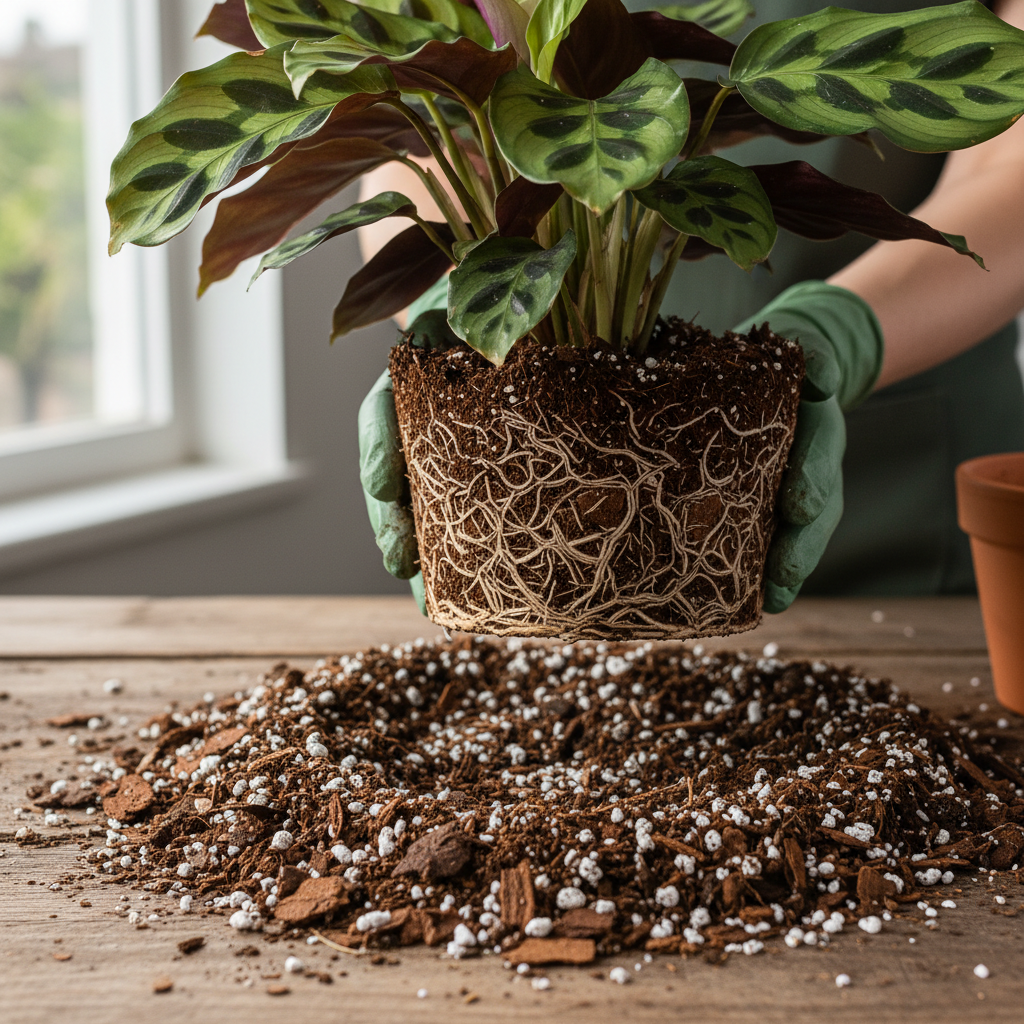
If you would rather not mix your own, a pre-blended “houseplant” or “aroid” mix from a reputable brand is a serviceable substitute, although most off-the-shelf bags are heavier than ideal. Stir in an extra one part perlite per two parts of bagged mix and the proportions move into the right range. Avoid any substrate marketed for cactus or succulent use; the porosity is appropriate but the water-holding capacity is too low for a Calathea, and you will find yourself watering daily during summer.
Pot choice matters less than substrate choice, but a few small decisions help. Calatheas are happiest slightly potbound. Step up only one pot size, from say a 15 cm (6 in) pot to a 17 cm (7 in) pot, never two. An overlarge pot holds more wet substrate than the root ball can use, and the soggy zone around the root mass is exactly where rot starts. Terracotta breathes and dries out faster, which forgives mistakes on the wet side; glazed ceramic and plastic hold moisture longer and forgive mistakes on the dry side. Either works, provided the pot has a drainage hole.
Repot every eighteen to twenty-four months, preferably in spring when the plant is moving back into active growth. The most reliable indicator that repotting is overdue is roots circling visibly at the base of the root ball or pushing through the drainage holes. Lift the plant out, tease loose any encircling roots gently with the fingers, trim away any that are blackened or hollow-feeling, and settle the plant into fresh mix at the same depth it sat previously. Water thoroughly, then keep the freshly repotted plant in slightly brighter than usual conditions for a fortnight, since the new substrate dries more evenly than the depleted old one.
Old soil loses structure over time. Even if you have not repotted, top-dressing once a year by scraping off the top 2 to 3 cm (0.8 to 1.2 in) of substrate and replacing it with fresh mix refreshes the root environment without disturbing the plant. This is particularly useful for a Calathea that has finally settled into a corner and is producing good new growth; full repotting can set such a plant back by a month or more, while top-dressing causes essentially no disturbance.
Fertilising
Calatheas are light feeders. The combination of soft thin leaves and sensitivity to salts in the substrate means that the cardinal sin of fertilising this species is enthusiasm. A balanced liquid houseplant feed, diluted to one quarter of the strength printed on the bottle and applied every four weeks during the spring and summer growing season, is plenty. Stop entirely from late autumn through the end of winter when the plant naturally slows down. Anything stronger or more frequent than that, and the salts begin to accumulate in the root zone, where they show up as brown leaf tips and faded patterns weeks before the rest of the plant looks unwell.
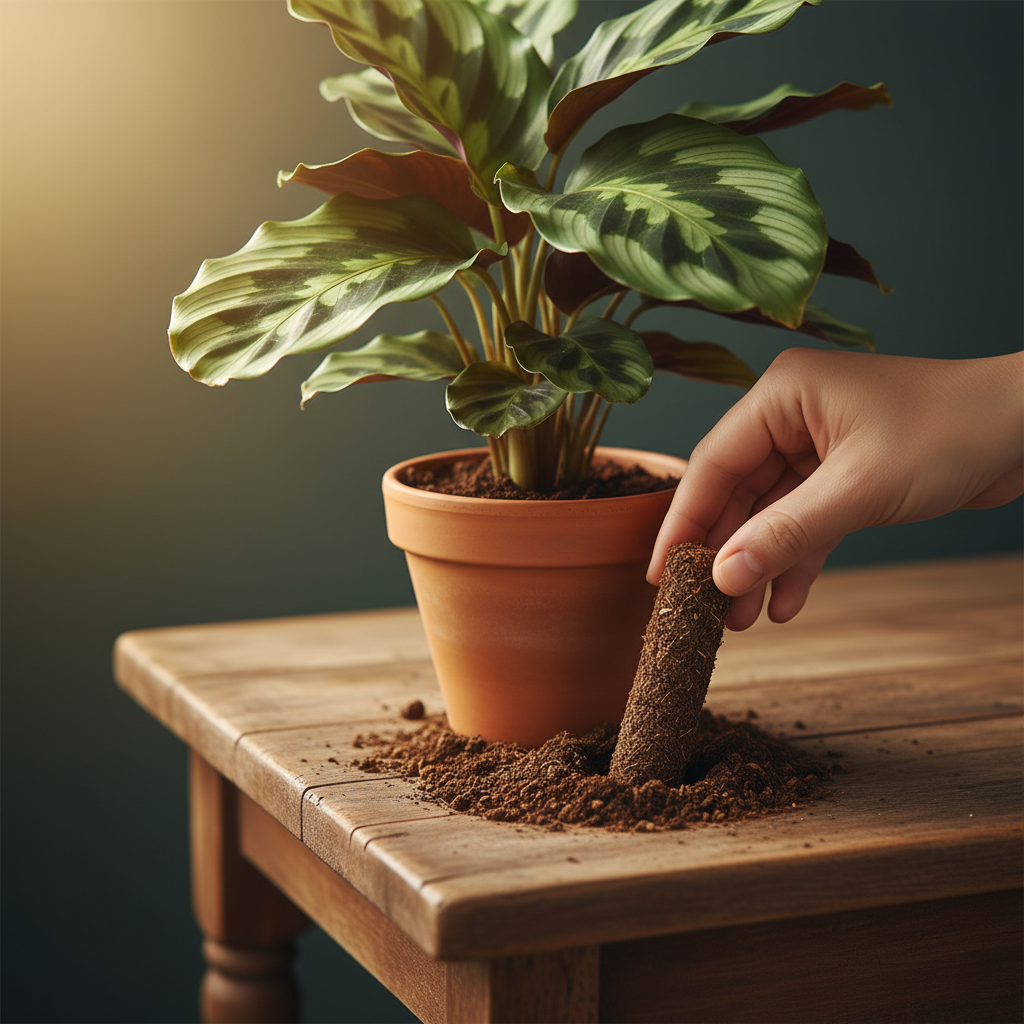
The choice between liquid feeds, fertiliser sticks and slow-release granules is one of personal preference. Liquid feeds give the greatest control over dose and timing, which is why most experienced growers prefer them. Sticks and granules are convenient but harder to dial in, and a single stick rated for an average houseplant is usually too much for a Calathea unless you break it into pieces and bury just one segment at the edge of the pot. Slow-release prills sprinkled at half the rated dose work well for hands-off owners; the cooler indoor temperatures slow the release naturally, which suits the plant.
Whatever product you choose, build a flush into the routine. Every third or fourth watering during the growing season, water with plain water until two or three pot volumes have run through the drainage holes. This rinses out accumulated fertiliser salts that would otherwise build up in the substrate and burn the fine root hairs. The flush is not optional in hard-water areas; without it, brown tip damage becomes nearly inevitable by late summer.
If you prefer organic feeding, dilute worm-casting tea or a high-quality fish emulsion to roughly half the standard strength and apply at the same monthly cadence. Organic feeds tend to be gentler on the root system and provide a slower, broader spectrum of micronutrients. The downside is the smell, which is brief but noticeable, and the slightly higher risk of fungus gnat populations establishing in the moist surface layer.
Propagation
The Calathea propagates almost exclusively by division of the rhizomatous root mass. Stem cuttings will not root; water rooting from a snipped leaf will not produce a new plant. Instead, a mature specimen produces multiple growth points or crowns that share an underground rhizome system, and once two or more of these crowns are well established, the whole plant can be lifted and split. The technique sounds drastic but the species takes it well, and a successful division is the single most reliable way to multiply this plant.
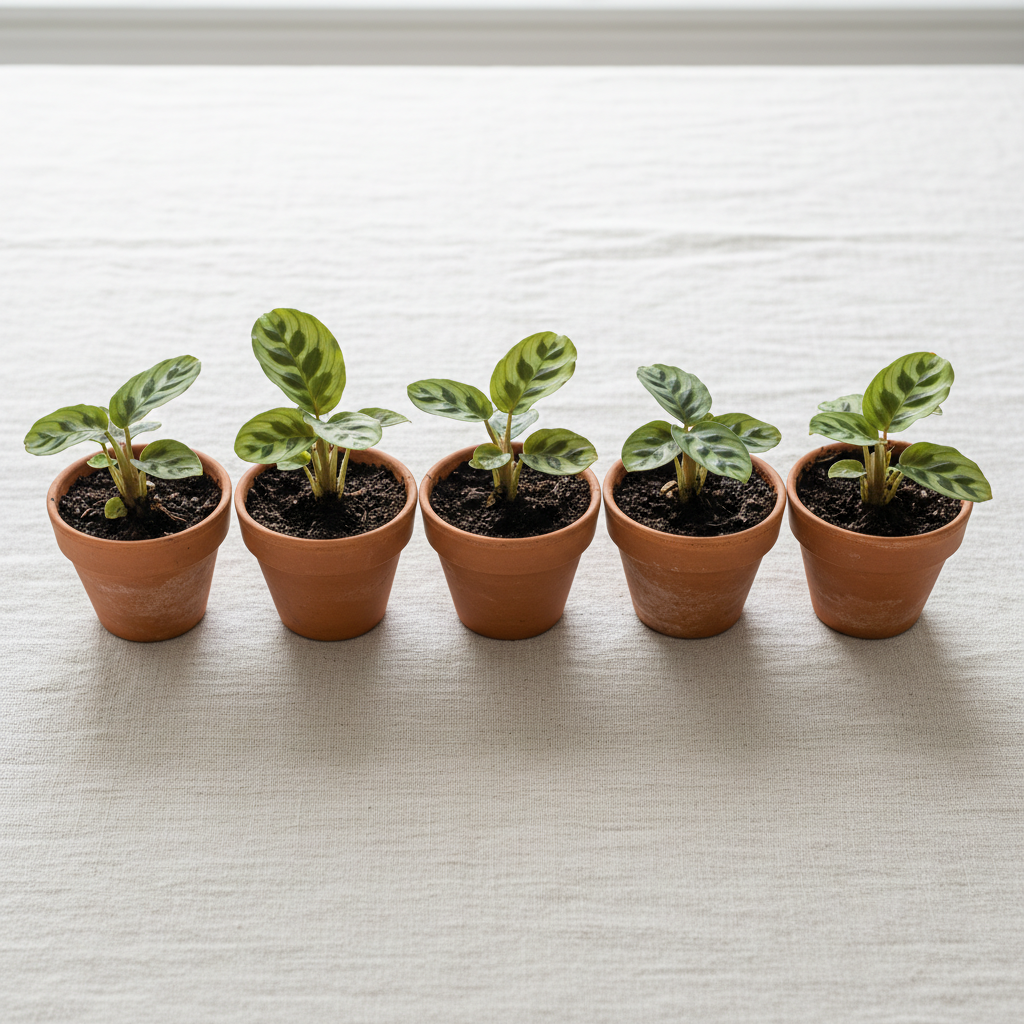
The best time to divide a Calathea is in spring, ideally combined with a planned repot. The active growth season ahead helps the new divisions recover quickly, and the disturbance is absorbed into the repotting process rather than being a separate shock. Choose a parent plant that has at least three or four distinct crowns visible at the soil surface; younger plants with only one crown should be left to mature for another year.
To divide, follow these steps:
- Water the plant the day before so the substrate clings together and the roots are turgid rather than dry and brittle.
- Lift the plant out of its pot in one piece and lay it on its side on a clean work surface lined with newspaper or a tarpaulin.
- Gently tease away the loose outer substrate with your fingers until you can see where the individual crowns join at the rhizome.
- Using a clean sharp knife or sterilised secateurs, cut through the rhizome between two adjacent crowns. Each division should retain at least two or three leaves and a healthy section of root.
- Pot each division into a slightly smaller pot than the parent occupied, filled with the standard Calathea mix, settling the rhizome at the same depth it sat before.
- Water thoroughly until the substrate is evenly moist and the new pots drain freely.
- Place the divisions in a warm, brightly lit spot away from direct sun, covered loosely with a clear plastic bag or set inside a propagation tent for the first two weeks to maintain high humidity.
Expect the new divisions to look slightly sulky for a fortnight. A drooping leaf or two is normal as the plant rebalances its root-to-foliage ratio. After two weeks, gradually open the humidity tent over the course of a few days, and resume normal care. New growth usually appears within four to six weeks, at which point the division is firmly established and can be treated as a full adult plant.
If a crown does not produce new growth within two months, gently lift it again and check the rhizome. A firm, pale rhizome means the plant is still alive and needs more time; a soft, brown, hollow rhizome means rot has set in and the division is unlikely to be saved. Discard such crowns and refocus on the divisions that took successfully.
Pests and Diseases
Calatheas attract the same handful of indoor plant pests that bother any soft-leaved tropical, with one notable specialist. Spider mites are by some distance the most serious threat. They thrive in dry indoor air, exactly the conditions a Calathea already finds uncomfortable, and the fine stippling of pale dots on the upper leaf surface, followed by webbing between leaves and stems, is the unmistakable signature. Because the plant lives close to its humidity tolerance limit, any environmental dip that lets the room dry out is also an environmental nudge that helps spider mites establish.
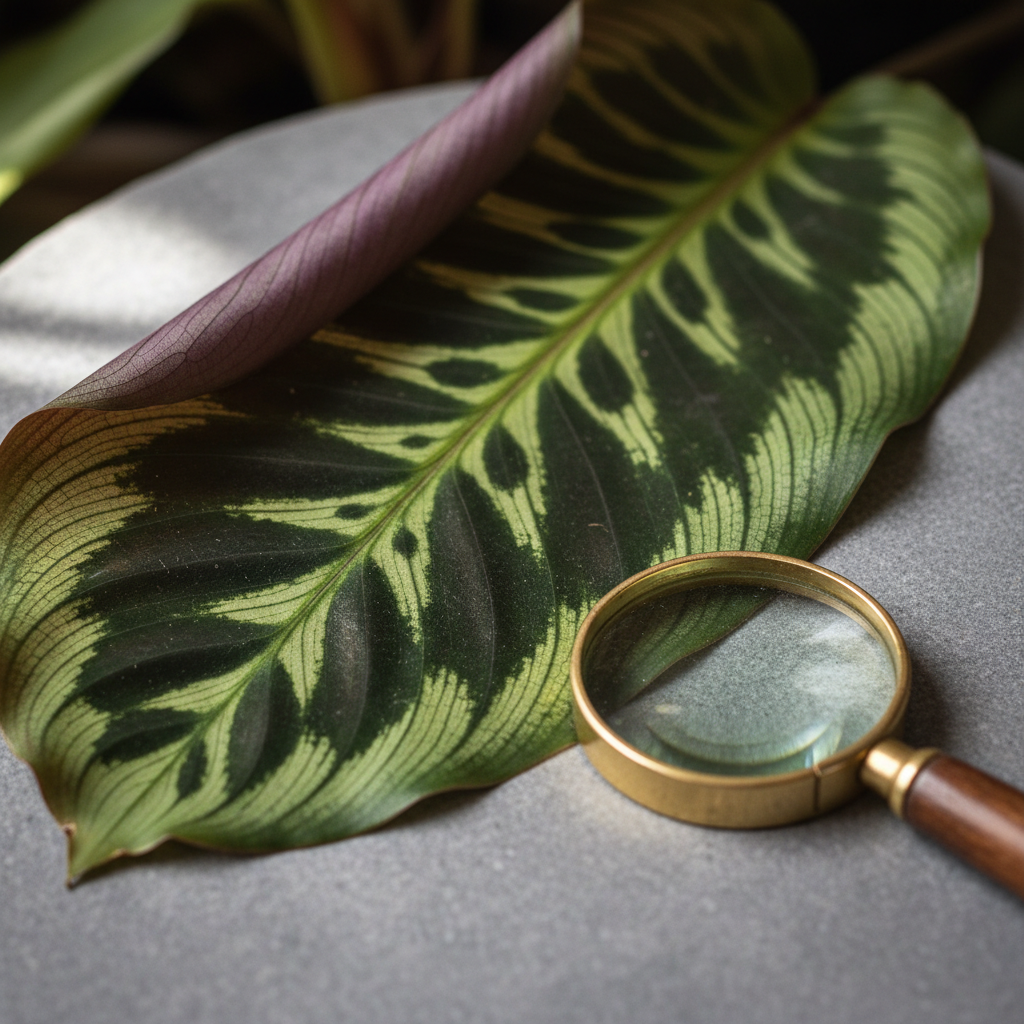
Treat spider mite outbreaks early and aggressively. The first response is a thorough shower, holding the plant on its side under a gentle lukewarm spray to dislodge as much of the population as possible. Follow with a weekly application of a horticultural soap or neem oil solution, sprayed carefully on both leaf surfaces and especially the leaf undersides where mites feed and lay eggs. Three consecutive weeks of treatment is the minimum, since one application kills the active adults but not the eggs, and a second-generation flare-up almost always follows a single treatment.
Thrips are the second persistent threat. They show up as fine pale streaks along the leaf veins and small black specks of frass on the underside. A neem oil regimen handles them in the same way it handles mites. Mealybugs are less common but distinctive when they arrive: white cottony tufts clustered at the leaf axils. Dab each one with a cotton bud soaked in isopropyl alcohol and follow with a soap spray a few days later. Scale insects appear occasionally as small immobile bumps on stems and leaf undersides; they respond to the same alcohol and soap treatment, though they take longer to clear.
Fungus gnats are an annoyance rather than a real threat. Their larvae feed on decaying organic matter in the top layer of soil and do little damage to healthy roots. The adults are mostly a nuisance. Reduce them by letting the top centimetre of substrate dry out fully between waterings, by top-dressing with a thin layer of horticultural sand or grit that physically blocks egg-laying, and by setting yellow sticky traps to catch flying adults. A drench with diluted Bt-based mosquito bits clears the larvae completely within a fortnight.
Among diseases, root rot is by far the most likely problem, and it follows a single recognisable cause: standing water in the pot or saucer combined with cool indoor temperatures. The early symptoms are yellowing lower leaves and a sour smell from the substrate; by the time the leaves are limp despite moist soil, the rot is advanced. Lift the plant, wash all soil from the roots, trim every soft black root back to white living tissue, repot into fresh dry mix in a smaller pot, and withhold water for a week. Recovery is possible but slow. Prevention, in the form of well-draining substrate and careful watering, is far easier than cure.
Leaf-spot fungal infections occasionally appear, usually as small dark spots with a yellow halo, in conditions where leaves stay wet overnight. Improve air circulation, avoid misting in the evenings, and remove affected leaves with sterilised scissors. A copper-based fungicide is rarely necessary for indoor specimens.
Popular Varieties
The plant most people call “the Calathea” in conversation, Goeppertia makoyana, is just one species in a large and visually diverse group. The wider Calathea-Goeppertia complex contains around three hundred species, most of which were reclassified from Calathea into Goeppertia in 2012 on the basis of molecular evidence. For everyday purposes the common name “calathea” is still widely used and understood, and the care requirements across the popular ornamental species are similar enough that mastering one is mastering most.
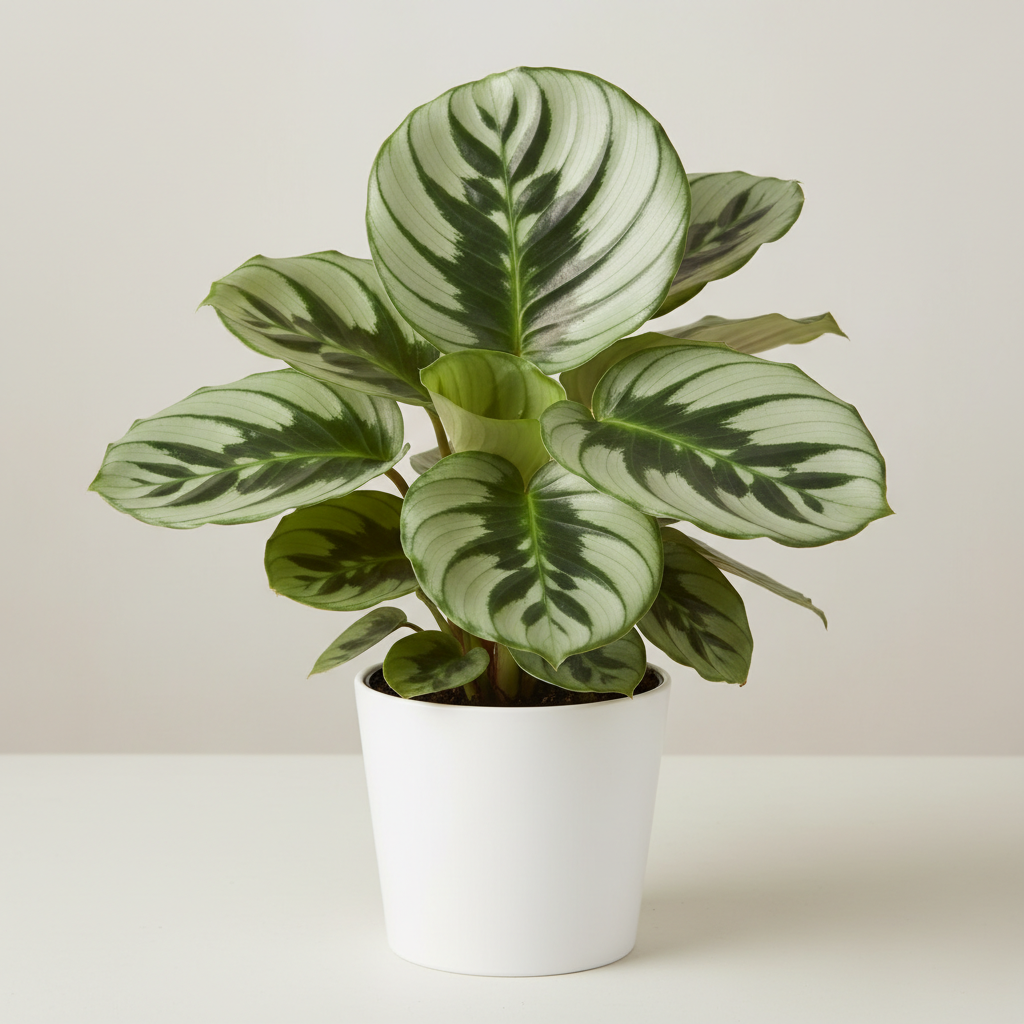
Calathea orbifolia (Goeppertia orbifolia) is the species most often paired with makoyana in display groupings. Its leaves are nearly circular and substantially larger than those of the Peacock Plant, sometimes reaching 30 cm (12 in) across on a well-established specimen. The colour is a paler silvery-green, scored by broad dark green stripes that radiate outwards from the central vein, and the surface has a faint metallic sheen under raking light. It is slightly slower to grow than the Peacock Plant and slightly more tolerant of lower humidity, which makes it a sensible second Calathea for owners who have succeeded with makoyana.
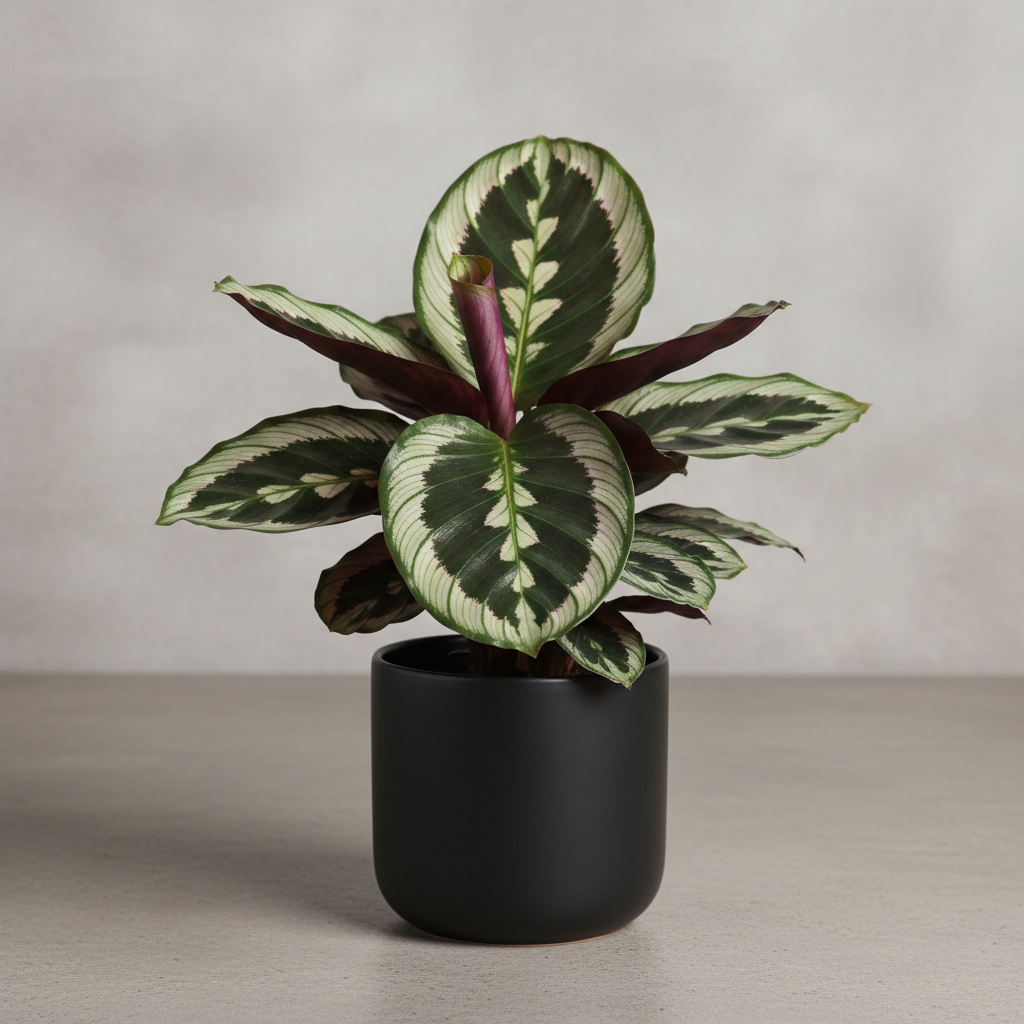
Calathea ‘Medallion’ (Goeppertia roseopicta ‘Medallion’) is one of the most striking cultivars in the group. The broad oval leaves carry a wide cream-pink feathered band down the centre, bordered by a deep green margin and a delicate silver outline, with a dramatic purple-red underside that flashes whenever the foliage rises in its evening prayer. It is more demanding than either makoyana or orbifolia, particularly around humidity and water quality, but the visual reward is substantial. Growers often consider it a milestone plant in the genus.
Other widely available cultivars worth knowing include the Rattlesnake Plant (Goeppertia lancifolia), with its elongated, undulating leaves marked in alternating dark and pale green; the Pinstripe Plant (Goeppertia ornata), whose dark green leaves are crossed by thin pink or cream pinstripes; the Velvet Calathea or Furry Feather (Goeppertia rufibarba), whose long, narrow leaves are softly hairy on the underside and burgundy in colour; and the much-photographed ‘White Fusion’ (Goeppertia lietzei ‘White Fusion’), whose green leaves are streaked with bright white variegation. ‘White Fusion’ is notably more sensitive than the others and is generally a plant for experienced collectors.
Across the group, the care fundamentals stay constant: bright indirect light, gently moist substrate, high humidity, mineral-low water and modest feeding. The differences between species are largely matters of degree, and an owner comfortable with the Peacock Plant can confidently expand the collection.
Frequently Asked Questions
Why are my Calathea’s leaves curling?
Curling leaves on a Calathea almost always indicate that the plant has lost more water than it can replace. The two main causes are underwatering and low humidity. Check the soil first: if the top 2 cm (0.8 in) feels dry, water thoroughly and see whether the leaves rebound overnight. If the soil is moist but the leaves are still curling, humidity is the culprit. Add a humidifier or move the plant into a more sheltered, less drafty spot. Direct sun and excessive heat also cause curling and should be ruled out by checking the placement.
Why are the leaf edges turning brown and crispy?
Crisp brown edges are the classic symptom of an unhappy Calathea, and there are typically three causes acting alone or together. Low humidity is the most common single cause. Hard or chlorinated tap water is the second. Over-fertilising, leading to a build-up of salts in the substrate, is the third. Address them in that order: lift humidity first, switch to rainwater or filtered water for new growth, and flush the substrate thoroughly every third watering during the growing season.
Why has my Calathea stopped moving its leaves?
The nyctinastic prayer movement depends on functioning pulvini and on the plant being able to perceive a consistent day-night cycle. A Calathea that has stopped moving is usually one of three things: dehydrated, growing in poor light, or stressed by cold temperatures. Restore consistent watering, check that the plant is getting at least medium ambient light during the day, and make sure the room is staying above 16 °C (61 °F) overnight. Leaf movement typically resumes within a fortnight of the underlying issue being resolved.
Are Calatheas safe around cats and dogs?
Yes. The ASPCA lists Calathea and the closely related Maranta as non-toxic to cats, dogs and horses. The leaves are safe in the sense that they do not contain the calcium oxalate crystals or alkaloids that cause poisoning in many other popular foliage plants. Pets can still suffer mild stomach upset from chewing leaves of any plant, and persistent chewing is a sign of behaviour worth addressing for the pet’s sake, but a curious nibble carries no real danger.
How fast does a Calathea grow?
Calatheas are moderate growers under ideal conditions. Expect three to five new leaves per growing season from a healthy single-crown plant, and a mature specimen to fill out to roughly 50 to 60 cm (20 to 24 in) tall and wide within three or four years. Growth essentially halts in winter at temperatures below 18 °C (65 °F), and resumes in spring. Plants in lower light or with care gaps grow noticeably more slowly; plants given consistent humidity, gentle feeding and warm bright conditions grow toward the upper end of that range.
Do Calatheas flower indoors?
Some species flower indoors, but few are kept for their flowers. Goeppertia makoyana rarely produces flowers in domestic settings; when it does, the blooms are small, white and tucked low in the foliage, and the plant is fundamentally a foliage subject. A few species, notably Goeppertia crocata, the Eternal Flame, are grown specifically for their bright orange flower bracts, but these are exceptions in the genus.
Can a Calathea live in a bathroom?
A bathroom with a window and consistent warmth is often the single best room in a home for a Calathea. The naturally high humidity from showers and baths suits the plant, and the low to medium light typical of bathroom windows matches its preferences well. The two conditions to watch for are a bathroom that stays cold in winter, which can chill the leaves, and a bathroom without any natural light at all, where you will need to supplement with a grow bulb. Otherwise, the bathroom is a natural home for this species.
Why are some leaves yellowing and dropping?
A small amount of leaf yellowing and shedding is normal in a mature Calathea, particularly of the oldest lower leaves as the plant directs resources to new growth. Excessive yellowing, especially of multiple leaves at once, points to overwatering and the beginning of root issues. Check the substrate; if it feels constantly wet and smells sour, lift the plant, inspect the roots, and repot into fresh dry mix in a smaller pot with improved drainage. Reducing watering frequency and improving drainage almost always resolves the issue if caught early.
For more on related prayer-family plants, the Maranta and Stromanthe guides on this site cover species with very similar care requirements and complement a Calathea collection well.






