
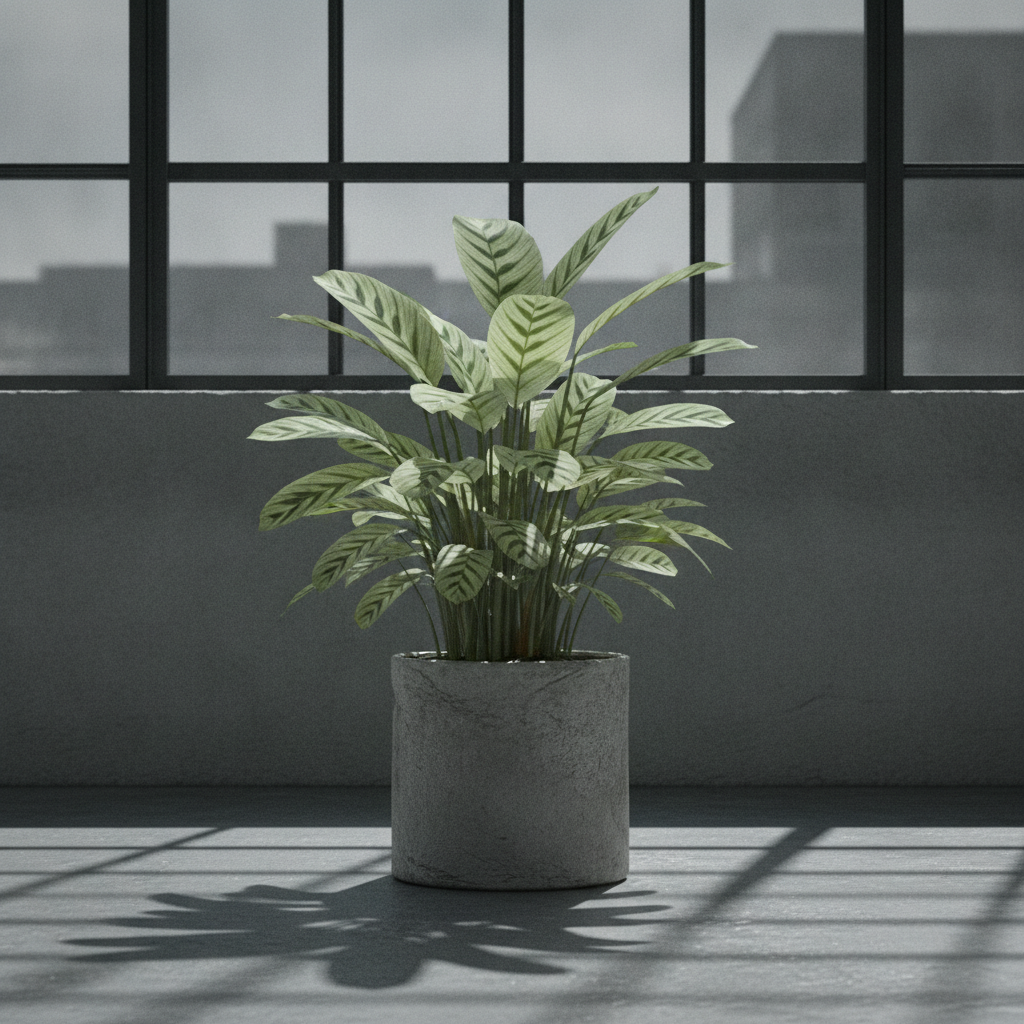
Few prayer plants carry themselves with the upright, fountain-like poise of the Freddie plant, a slender Brazilian beauty whose pale apple-green leaves are scored with fine, dark feathery bands that fan out from the midrib like the bones of a fish. Known botanically as Goeppertia concinna (and still widely sold under its older name, Calathea concinna), this member of the family Marantaceae has become a fixture of houseplant collections thanks to its graceful habit, its forgiving pet-safe foliage, and the quiet theatre of leaves that lift and fold each evening.
The Freddie has a reputation, partly deserved, for being fussy. Like most calatheas it responds quickly and visibly to neglect, with crisping leaf edges and faded markings that broadcast every mistake. Yet the gap between a Freddie that merely survives and one that genuinely thrives comes down to a small number of well-understood factors: steady humidity, clean water, consistent moisture, and bright light that never becomes direct sun. This guide walks through every one of those factors in detail, from the science of why its leaves move to the practical mechanics of dividing a mature clump, so that you can keep a Freddie not just alive but lush, full and unblemished.
Contents
- Quick Reference
- Why the Freddie Plant Makes a Rewarding Houseplant
- Light Requirements
- Watering & Humidity
- Soil, Potting & Repotting
- Fertilising
- Propagation
- Pests & Diseases
- Popular Varieties
- Frequently Asked Questions
Quick Reference: Freddie Plant at a Glance
| Light | Medium to bright indirect light; no direct sun |
| Watering | Keep evenly moist; water when the top 2 to 3 cm (1 in) feels barely dry |
| Temperature | 18 to 27 degrees C (64 to 81 degrees F); avoid below 15 degrees C (59 degrees F) |
| Humidity | High, ideally 60 per cent or above |
| Fertiliser | Balanced feed at quarter to half strength, monthly in spring and summer |
| Toxicity | Non-toxic and pet-safe for cats, dogs and humans |
Why the Freddie Plant Makes a Rewarding Houseplant
The Freddie earns its place in a collection on the strength of its silhouette as much as its markings. Where many calatheas spread broad, paddle-shaped leaves, Goeppertia concinna produces long, narrow, lance-shaped blades on upright petioles, building into a dense, vase-shaped clump that can reach 60 to 75 cm (24 to 30 in) tall indoors. The effect is airy and architectural, a plant that fills vertical space without sprawling, which makes it a natural choice for a shelf, a plant stand, or a bright corner where a fuller, bushier species would feel crowded.
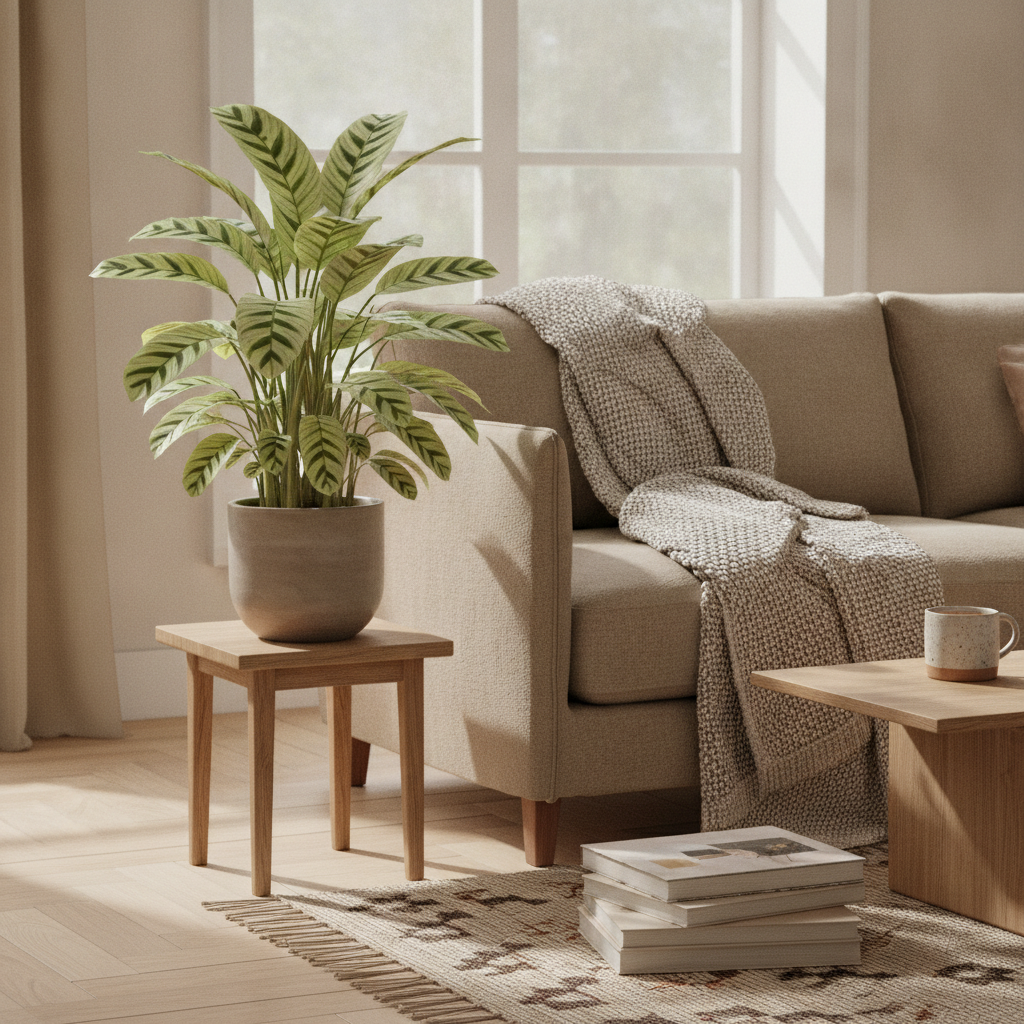
Beyond looks, the Freddie offers two practical advantages that matter in a home. First, it is genuinely pet-safe: like all members of the Marantaceae family, it contains none of the calcium oxalate crystals that make so many popular houseplants hazardous to curious cats and dogs, so a nibbled leaf is a cosmetic problem rather than a veterinary one. Second, it belongs to the prayer plant group, meaning it performs nyctinasty, the daily raising and lowering of its leaves in response to light. Each evening the foliage tilts upward as if in prayer, and each morning it relaxes open again, a slow living rhythm that gives the plant a presence few others can match.
Important — Toxicity: The Freddie plant is considered non-toxic to cats, dogs and humans, and is listed as pet-safe by major animal welfare bodies. Even so, any plant material can cause mild stomach upset if a pet eats a large quantity, so it is still sensible to discourage persistent chewing.
Light Requirements
In its native Brazilian understorey the Freddie grows beneath a canopy of taller trees, bathed in light that has been filtered, scattered and softened long before it reaches the forest floor. Recreating that quality of light indoors is the single most important thing you can do for the plant. It wants brightness without intensity: plenty of ambient light to fuel growth and hold the contrast in its markings, but never the unfiltered glare of direct sun, which scorches the thin leaves within hours.
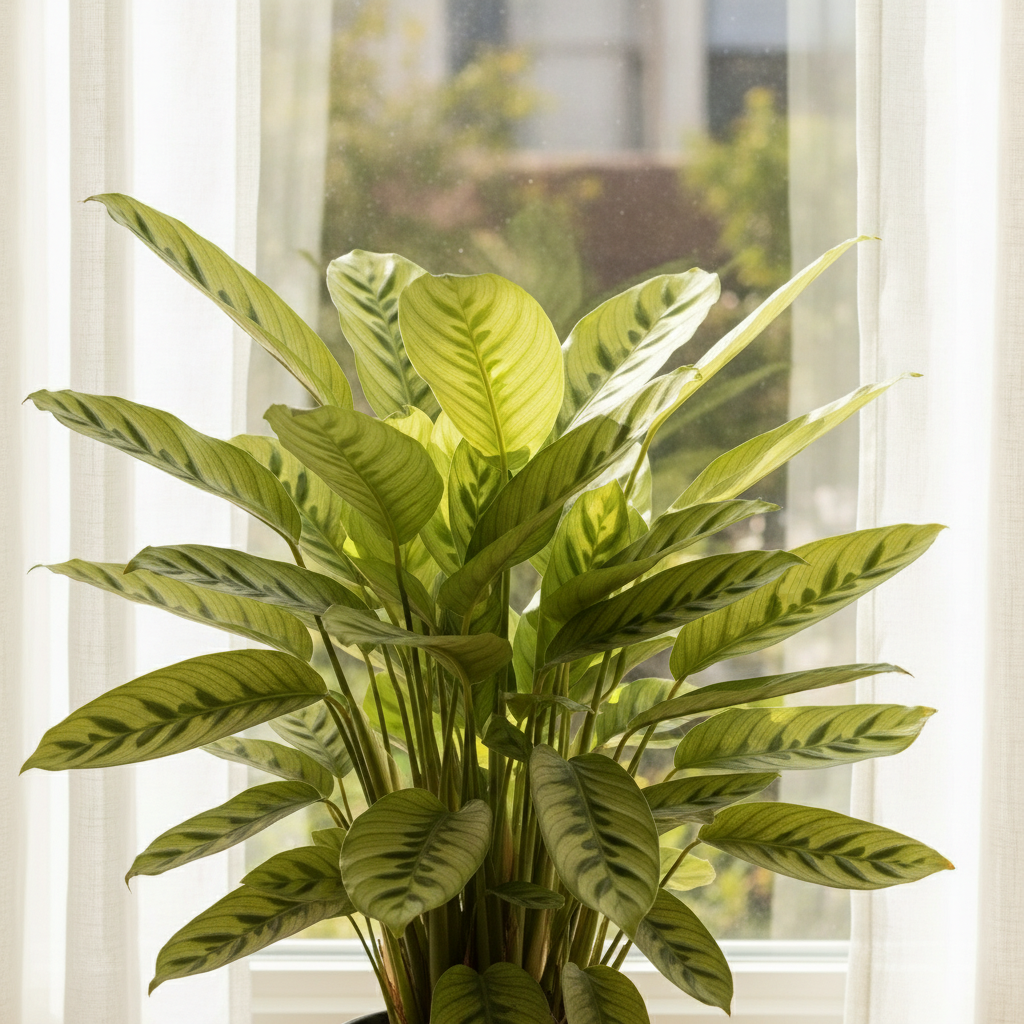
The ideal position is a spot that receives bright, indirect light for most of the day, such as a couple of metres back from a large window or directly beside one screened with a sheer curtain. In this kind of light the Freddie holds its colour, keeps its leaves evenly spaced, and lifts and lowers them on a reliable daily cycle. Too little light and the plant slows almost to a halt, producing small, dull leaves on lengthening stems; too much and the markings bleach out while the edges crisp.
Light Levels Explained
Light is easy to misjudge by eye, because the human visual system adjusts automatically and makes a dim room feel brighter than it is. The table below translates the broad light categories into rough lux values and typical positions, along with the outcome you can expect for a Freddie in each.
| Light Category | Approx. Level | Typical Location | Outcome |
|---|---|---|---|
| Direct sun | 50,000 lux and above | On an unscreened south or west sill | Leaves scorch and bleach; avoid entirely |
| Bright indirect | 10,000 to 20,000 lux | Beside an east window or behind a sheer curtain | Best growth, strong markings, reliable leaf movement |
| Medium | 5,000 to 10,000 lux | A metre or two back from a bright window | Healthy but slower growth; perfectly acceptable |
| Low | 1,000 to 5,000 lux | A north room or a dim corner | Sparse, leggy growth and faded colour |
| Very low | Below 1,000 lux | An interior hallway with no window | Slow decline; not sustainable long term |
Window Orientation and Placement
South-facing window: The brightest aspect in the northern hemisphere and the one that demands the most caution. A Freddie can do well here only if it is set well back from the glass or shielded by a sheer curtain, blind or another plant, so that the strong midday light is diffused before it reaches the leaves.
East-facing window: Often the sweet spot for this plant. The gentle direct light of early morning is mild enough to be tolerated, and for the rest of the day the plant sits in the bright, indirect light it loves, with little risk of scorching.
West-facing window: Workable, but the strong afternoon sun is harsher than morning light, so position the plant slightly back from the glass or filter the window during the hottest part of the day.
North-facing window: The safest aspect for avoiding scorch, and acceptable in summer when daylight is long and strong. In winter, however, a north window may not supply enough light to keep growth going, so be prepared to move the plant or supplement with a grow light.
Pro Tip — Read the Leaf Movement: A well-lit Freddie raises its leaves noticeably at night and lowers them by day. If the nightly movement becomes weak or stops, the plant is usually telling you it is not receiving enough light, so try a brighter position before assuming a watering or humidity problem.
How Light Affects Leaf Colour and Markings
The Freddie’s signature contrast, the dark feathered bands against a pale green ground, is partly light-dependent. In the right brightness the markings stay crisp and well defined, and the overall colour holds a fresh, light green. In excessive light the pale areas wash out toward yellow and the pattern flattens, while in shade the whole leaf darkens and the contrast fades as the plant produces extra chlorophyll to capture what little light it can. Finding the brightness that keeps both the pattern and the ground colour looking their best is largely a matter of patient adjustment over a few weeks.
Warning — Direct Sunlight: The thin leaves of a Freddie have very little tolerance for direct sun. Even an hour of unfiltered midday light through glass can leave permanent bleached or scorched patches that will not recover, so always diffuse strong light rather than exposing the plant to it.
Artificial Lighting
The Freddie responds well to supplementary lighting, which makes it a good candidate for rooms that are short on natural daylight or for keeping growth steady through a dark winter. A full-spectrum LED grow light positioned 30 to 45 cm (12 to 18 in) above the foliage and run for 10 to 12 hours a day will comfortably substitute for a bright window. Because the plant naturally experiences a day and night cycle, put the light on a timer rather than leaving it on continuously, which also lets the leaves keep their normal nightly movement.
Seasonal Adjustments
Light levels indoors swing dramatically between summer and winter, and a position that is perfect in July can become too dim by December. As the days shorten, move the Freddie closer to its window or add a grow light to compensate, then ease it back again in spring as the sun strengthens. Make these moves gradually, over a week or two, so the plant has time to acclimatise rather than suffering a sudden shift in conditions.
Watering & Humidity
Watering is where most Freddie plants are won or lost. This is a species that wants its soil to stay evenly, lightly moist at all times, neither drying out into a dusty crust nor sitting in a waterlogged mire. It dislikes extremes in either direction, and because its thin leaves show stress so quickly, getting the rhythm right is the difference between full, unblemished foliage and a plant edged in brown.
When to Water
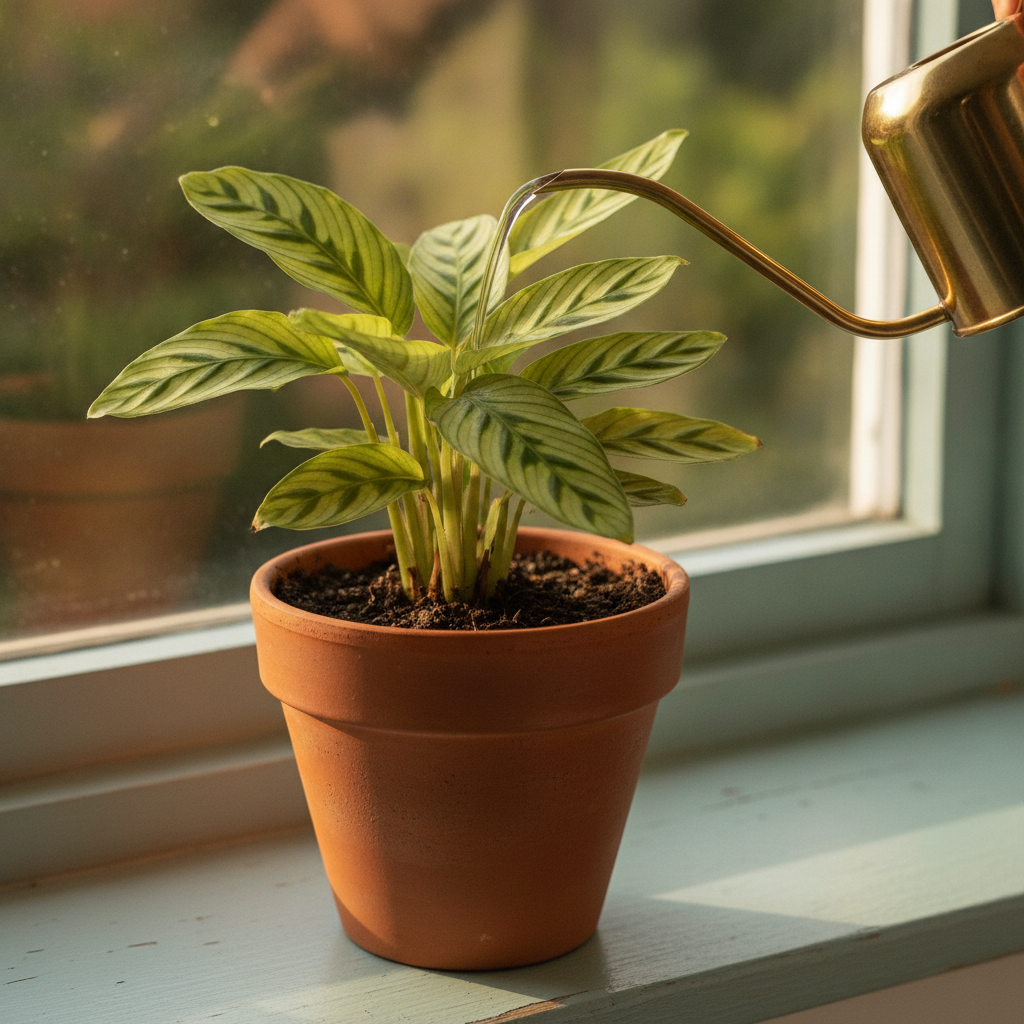
The best guide is your finger. Push it into the top of the pot, and when the top 2 to 3 cm (about 1 in) of soil feels barely dry to the touch, it is time to water again. You are aiming to top up moisture before the root zone dries out, not to let the mix dry completely as you would for a succulent. In a bright, warm spot during the growing season this often means watering once or twice a week, though the only reliable schedule is the one your own conditions dictate.
Frequency shifts with the seasons. Through spring and summer, when the plant is actively growing and transpiring fast, it will drink steadily and the soil will dry more quickly. In autumn and winter, growth slows and the mix stays damp far longer, so cut back to avoid leaving the roots cold and wet. Always let the plant and the pot, rather than the calendar, tell you when to water.
Pro Tip — Lukewarm Water Only: Cold water straight from the tap can shock the roots of a tropical plant like the Freddie and contribute to leaf curl. Let water come to room temperature, or mix in a little warm water, before pouring, and the plant will take it up far more comfortably.
How to Water Correctly
- Check the soil first, watering only when the top 2 to 3 cm (1 in) is barely dry.
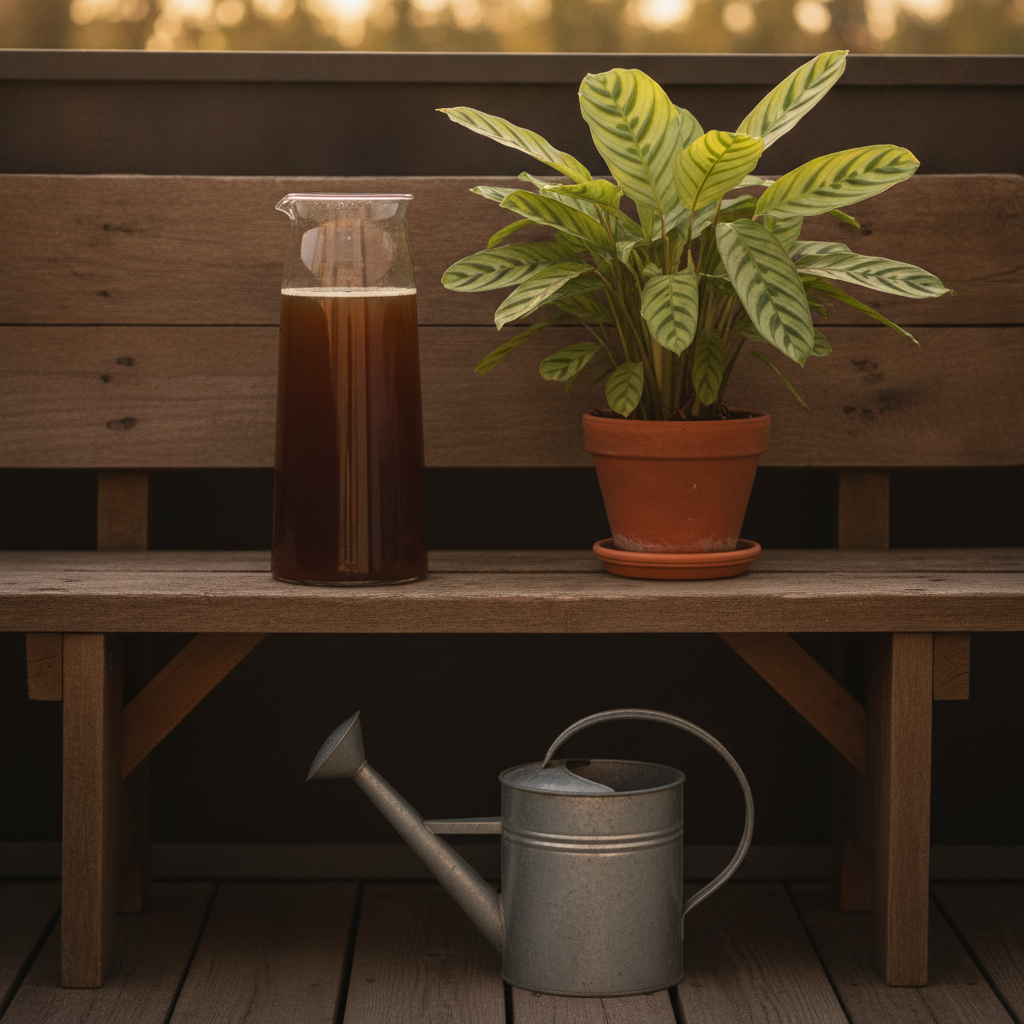
- Use room-temperature water that is low in minerals, such as rainwater, distilled water or filtered water.
- Pour slowly and evenly across the whole surface until water runs freely from the drainage holes.
- Let the pot drain completely for several minutes so no excess remains in the bottom.
- Empty the saucer or cache-pot afterward, never leaving the plant standing in collected water.
- Return the plant to its spot and wait until the top layer dries slightly before the next watering.
Signs of Overwatering vs. Underwatering
| Symptom | Overwatering | Underwatering |
|---|---|---|
| Leaf colour | Yellowing, often starting with lower leaves | Edges and tips browning and crisping |
| Leaf texture | Soft, limp and translucent | Dry, papery and curling inward |
| Soil | Constantly wet, sometimes sour-smelling | Dry, shrinking away from the pot edge |
| Roots | Brown, mushy and easily detached | Dry, brittle and pale |
| Stem base | Soft, darkened or collapsing | Firm but with drooping foliage above |
Warning — Root Rot: Persistently soggy soil starves the roots of oxygen and invites the fungal decay known as root rot, the most common killer of calatheas. If the base of the plant turns soft and the soil smells musty, unpot immediately, trim away any brown mushy roots with sterile scissors, and repot into fresh, barely moist mix.
Humidity Requirements
If watering is the first pillar of Freddie care, humidity is the second, and the two are closely linked. As a rainforest understorey plant, the Freddie evolved in air that rarely drops below 60 per cent relative humidity, and it shows its displeasure with dry indoor air faster than almost any other complaint. The crisp brown leaf edges that plague so many calatheas are very often a humidity problem first and a watering problem second.
When the air is too dry, the plant cannot replace moisture lost through its leaves quickly enough, and the thinnest tissue at the leaf margins dries out and dies back. The result is a fine brown rim, sometimes with curling, that no amount of careful watering will reverse on the affected leaves. Catching the trend early and raising the ambient humidity is the only real fix.
The most reliable way to raise humidity is a small room humidifier running near the plant, which holds the air consistently moist without the fuss of other methods. Grouping plants together helps, as their combined transpiration lifts the local humidity, and a pebble tray filled with water beneath the pot adds a little more. Misting offers only a brief, marginal benefit and, on a plant prone to fungal leaf spots, can do more harm than good, so it is the least dependable option.
Water Quality
The Freddie is notably sensitive to the minerals and additives in ordinary tap water. Fluoride, chlorine and the dissolved salts in hard water accumulate in the leaf tissue over time and surface as browned tips and edges, a problem so common with this group that it has its own folklore among growers. Wherever possible, water with rainwater, distilled water or filtered water. If you must use tap water, let it stand uncovered overnight so some of the chlorine can dissipate, though this does nothing for fluoride or hardness, which is why collected rainwater remains the gold standard.
Soil, Potting & Repotting
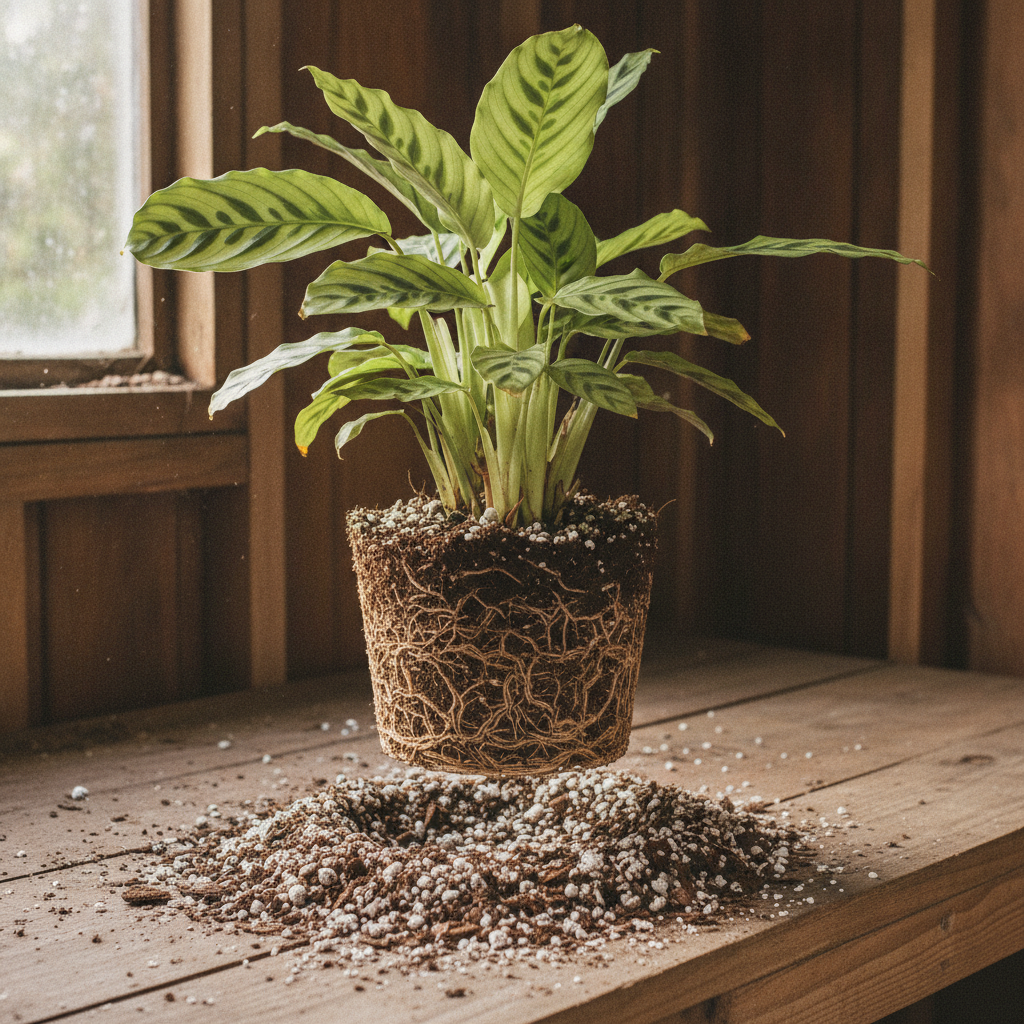
The Freddie asks for a growing medium that performs a careful balancing act: it must hold enough moisture to keep the roots evenly damp, yet drain freely enough that water never pools and excludes oxygen. A heavy, dense soil that stays sodden is a fast route to root rot, while a coarse, fast-draining cactus mix dries out far too quickly for a plant that hates to go dry. The aim is an open, moisture-retentive blend somewhere in between.
Ideal Soil Composition
A dependable Freddie mix starts with a quality peat-free or coir-based potting compost for moisture retention, lightened with materials that create air pockets and improve drainage. The combination below holds water without becoming heavy, and the addition of fine bark or coir keeps the structure open so the roots can breathe.
| Component | Proportion | Function |
|---|---|---|
| Coir or peat-free compost | 50 per cent | Holds moisture evenly and forms the body of the mix |
| Perlite or pumice | 25 per cent | Opens the structure and improves drainage and aeration |
| Fine orchid bark | 15 per cent | Adds air pockets and prevents compaction |
| Worm castings or compost | 10 per cent | Supplies gentle, slow-release nutrition |
The Freddie prefers a slightly acidic to neutral root environment, roughly pH 6.0 to 6.5, which a coir or peat-free base naturally provides. There is no need to test or adjust pH for an ordinary houseplant, but it is worth knowing that very alkaline tap water used over a long period can nudge the soil out of this comfortable range, another reason to favour rainwater.
Pro Tip — Quick Mix Recipe: If you want a simple blend, combine two parts standard peat-free houseplant compost with one part perlite and a generous handful of fine orchid bark. It takes minutes to mix and gives the open, moisture-retentive texture a Freddie needs.
Choosing the Right Pot
The container matters as much as what goes in it. The right pot helps regulate moisture and gives the roots room to develop without leaving an excess of wet soil around them.
Drainage holes are non-negotiable. Whatever the material or style, the pot must have holes in the base so excess water can escape. Without them, water collects unseen at the bottom and the roots sit in a reservoir that quickly turns to rot, no matter how carefully you water.
Pot material: Plastic and glazed ceramic both suit the Freddie well because they hold moisture in the soil rather than wicking it away. Unglazed terracotta, by contrast, breathes through its walls and dries the mix faster, which can work against a plant that likes to stay damp, so if you use terracotta be prepared to water a little more often.
Pot size: Choose a pot only 2 to 3 cm (1 in) wider in diameter than the current root ball. An oversized pot holds a large volume of soil that stays wet long after the roots have taken what they need, raising the risk of rot, so size up modestly and only when the plant has genuinely outgrown its home.
When to Repot
The Freddie is a slow, steady grower and does not need frequent repotting, typically only once every one to two years. The signs that it is ready include roots emerging from the drainage holes, soil that dries out unusually fast because the pot is full of root, or a plant that has visibly stopped putting on new growth despite good care. The best time to repot is in spring, as the plant enters its active growing season and can recover quickly from the disturbance.
How to Repot: Step-by-Step
- Water the plant a day beforehand so the root ball is hydrated and slides out cleanly.
- Ease the plant from its pot by tipping it and supporting the base, rather than pulling on the stems.
- Gently tease away some of the old soil and inspect the roots, trimming any that are brown or mushy.
- Add a layer of fresh mix to the base of a pot only slightly larger than the last one.
- Set the plant in at the same depth it grew before, then fill around it with fresh mix, firming lightly.
- Water thoroughly to settle the soil and eliminate air pockets around the roots.
- Return the plant to a warm, bright, indirect spot and hold off on feeding for a few weeks.
Warning — Transplant Shock: Calatheas can sulk for a week or two after repotting, drooping or curling their leaves while the roots re-establish. Resist the urge to fix this with extra water or feed; keep conditions stable and warm, and the plant will usually settle on its own.
Fertilising
The Freddie is a light feeder, and restraint serves it better than generosity. A modest, regular supply of nutrients through the growing season keeps the foliage full and well coloured, but this is a plant that suffers more from overfeeding than from going hungry, because its sensitive roots are easily burned by a build-up of fertiliser salts.
The cardinal rule is to feed weakly and to feed only when the plant is actively growing. A balanced houseplant fertiliser diluted to a quarter or half of the recommended strength, applied roughly once a month in spring and summer, is all a Freddie asks for. In autumn and winter, when growth naturally slows, stop feeding altogether and let the plant rest.
Understanding Plant Nutrients
Houseplant fertilisers are built around three primary nutrients, listed on the label as the N-P-K ratio: nitrogen, phosphorus and potassium. For a foliage plant like the Freddie, nitrogen is the most important of the three because it drives leaf growth and the rich green colour, but a genuinely balanced feed that also supplies the secondary nutrients and trace elements will keep the plant in better all-round health than any single-nutrient product.
| Nutrient | Symbol | Primary Function | Deficiency Symptoms |
|---|---|---|---|
| Nitrogen | N | Drives leaf growth and green colour | Pale, yellowing older leaves and stalled growth |
| Phosphorus | P | Supports root development and energy transfer | Weak roots and sluggish establishment |
| Potassium | K | Regulates water use and overall vigour | Browning leaf edges and weak stems |
| Calcium | Ca | Builds strong cell walls and new tissue | Distorted or hooked new leaves |
| Magnesium | Mg | Central atom of the chlorophyll molecule | Yellowing between the veins of older leaves |
| Iron | Fe | Needed for chlorophyll production | Yellowing between the veins of new leaves |
Types of Fertiliser
Liquid fertilisers: The easiest type to control for a Freddie, because you can dilute them precisely and adjust from feed to feed. A balanced liquid houseplant feed mixed into the watering can at quarter to half strength gives you complete command over how much the plant receives.
Slow-release granular: Convenient but harder to fine-tune, as the prills release nutrients with every watering whether the plant wants them or not. If you use them, choose a formulation for foliage houseplants and apply at the lower end of the recommended rate to avoid overfeeding.
Organic fertilisers: Gentle options such as diluted worm-casting tea or a mild seaweed feed suit the Freddie’s sensitive roots well, releasing nutrients slowly and improving the soil’s biology. They are very forgiving and hard to overdo, which makes them a sensible default for a plant that bridles at chemical salts.
Feeding Schedule
Feed roughly once a month from the first flush of spring growth through to the end of summer, always with a diluted solution and always onto soil that is already damp rather than bone dry. Skip feeding entirely through autumn and winter. If you ever see a white crust forming on the soil surface or around the pot rim, that is accumulated fertiliser salt, a sign to ease off and flush the pot through with plain water.
Pro Tip — Feed Onto Moist Soil: Always water lightly before applying liquid feed, or feed straight after a normal watering. Pouring fertiliser onto dry soil concentrates the salts against thirsty roots and is a common cause of the browned tips that growers often mistake for a humidity problem.
How to Fertilise
- Dilute a balanced liquid fertiliser to a quarter or half of the label strength.
- Water the plant lightly first if the soil is dry, so the feed never hits parched roots.
- Apply the diluted solution evenly across the soil until it just begins to drain.
- Let the pot drain fully and empty any liquid that collects in the saucer.
- Every few months, flush the pot with plain water to wash out accumulated salts.
Warning — Salt Build-Up: A white or yellowish crust on the soil or pot rim signals a build-up of fertiliser salts that can scorch the roots. Flush the pot thoroughly with several pot-volumes of plain water, let it drain completely, and reduce how often or how strongly you feed.
Propagation
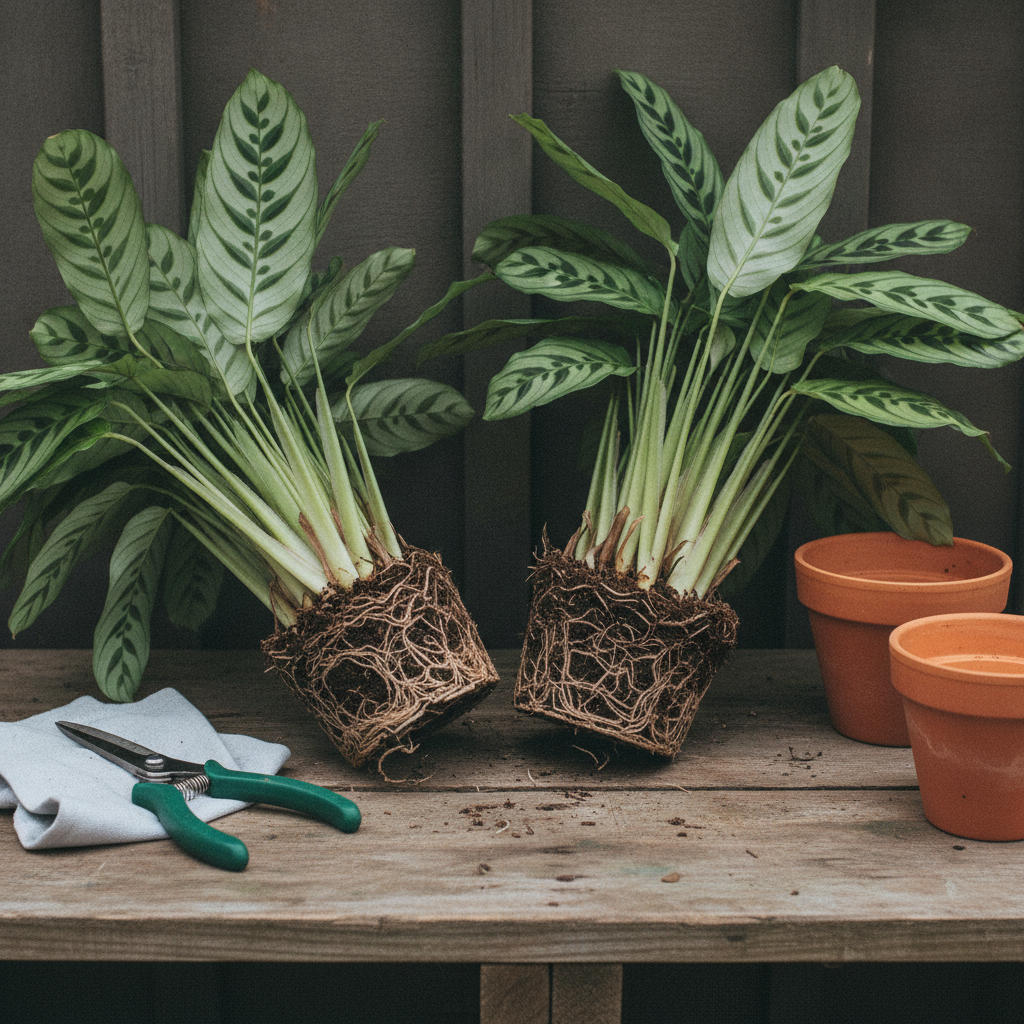
Unlike the trailing vines and stem-cutting houseplants that root readily in a jar of water, the Freddie cannot be propagated from a leaf or a length of stem. It grows from an underground clump of roots and rhizomes, and the only reliable way to make more plants is to divide that clump, separating an established plant into two or more smaller ones, each with its own roots and leaves.
This means propagation goes hand in hand with repotting. The ideal moment is spring, when you are repotting a mature, congested plant anyway and the warm, lengthening days give each division the best chance to establish. A plant needs to be a decent size with several distinct clumps of growth before it is worth dividing, so resist the temptation to split a young specimen too soon.
Understanding the Rhizome and Clump
A Freddie is not a single stem but a colony of growth points rising from a shared mass of roots and rhizomes below the soil. Each cluster of leaves is connected to its own portion of this root system, which is what makes division possible: when you separate the clump, you are not wounding a single plant so much as parting a community into independent members. The key to success is making sure every division you take away carries both a healthy section of root and at least a few leaves to sustain it.
Division: Step-by-Step
Division is straightforward as long as you are gentle and keep the new plants warm and humid while they recover. Work on a clean surface with everything you need to hand, and have pots and fresh mix ready before you start.
- Water the parent plant a day ahead, then slide it out of its pot and lay it on its side.
- Gently brush and tease away the loose soil until you can see the natural divisions in the root mass.
- Identify sections that each have their own roots and a healthy cluster of leaves above.
- Ease these sections apart with your fingers, using a clean, sharp knife only where roots will not pull free.
- Pot each division into its own small container of fresh, lightly moist Freddie mix.
- Water in well, then place the divisions somewhere warm, bright and indirect.
Pro Tip — Cover for Humidity: Fresh divisions establish fastest in high humidity. Loosely covering each new pot with a clear plastic bag or propagator lid for the first week or two traps moisture and eases the transition, just remember to open it daily for air and to avoid trapped damp on the leaves.
Aftercare: Step-by-Step
The weeks immediately after division decide whether your new plants thrive or stall. Each division has lost some of its root system and will sulk briefly, so the goal is to keep conditions as stable and gentle as possible while the roots regrow.
- Keep the soil lightly and evenly moist, never letting it dry out completely while roots are re-establishing.
- Maintain warmth and high humidity, and keep the divisions out of direct sun and cold draughts.
- Hold off on fertiliser for at least a month, as feeding stressed roots can scorch them.
- Expect some drooping or curling at first, and be patient as new growth signals that the division has taken.
Troubleshooting Propagation
| Problem | Likely Cause | Solution |
|---|---|---|
| Division wilts badly | Too few roots taken, or air too dry | Raise humidity and keep warm; trim a leaf or two to reduce demand |
| Leaves yellow and drop | Transplant shock or overwatering | Keep conditions stable; ensure soil is moist, not soggy |
| No new growth after weeks | Roots damaged or temperature too low | Provide steady warmth of 20 degrees C or more and be patient |
| Soft, blackened base | Rot from overwatering the division | Unpot, trim rotten tissue and repot into fresh, barely damp mix |
Pests & Diseases
A healthy, well-cared-for Freddie is reasonably resistant to pests, but the same warm, humid conditions it loves can also favour certain insects, and the dry air of a heated room leaves it especially vulnerable to spider mites. The thin leaves also make it prone to fungal trouble if water is allowed to sit on the foliage. Prevention through good culture is far easier than cure, and a weekly habit of turning over a few leaves to inspect them catches most problems before they take hold.
When you do find an infestation, act quickly and isolate the plant from your other houseplants to stop the spread. Most common pests can be managed with simple, low-toxicity methods if caught early, and the sections below cover the culprits you are most likely to meet.
Common Pests
Spider Mites (Tetranychus urticae)
By far the most frequent pest on calatheas, spider mites thrive in dry air and are easy to miss until the damage is done. Look for fine pale stippling across the leaves, a faint dusty look, and the telltale wisps of fine webbing in the leaf axils and along the margins. They multiply explosively in warm, dry rooms.
Treatment: Rinse the foliage thoroughly, including the undersides, then treat with insecticidal soap or a diluted neem oil solution every five to seven days until clear. Raising the humidity makes the environment far less hospitable to them and is the best long-term defence.
Fungus Gnats (Bradysia species)
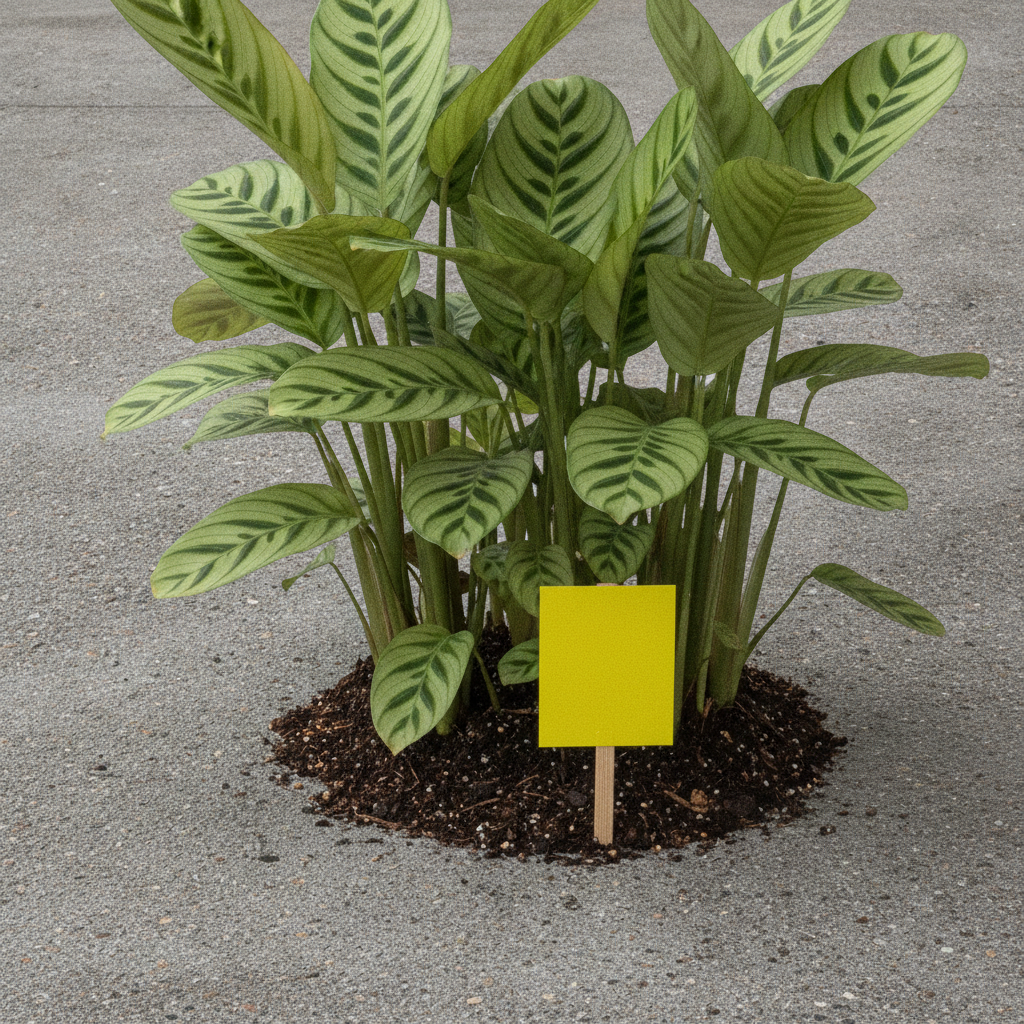
The small black flies that drift up from the soil when you water are fungus gnats, drawn to the consistently moist compost a Freddie requires. The adults are merely a nuisance, but their larvae feed on organic matter and fine roots in the soil, which can weaken a young or freshly divided plant.
Treatment: Let the very top layer of soil dry slightly between waterings to disrupt their breeding, set yellow sticky traps to catch the adults, and treat persistent cases with a biological control or a soil drench. A surface layer of fine grit also deters egg-laying.
Mealybugs (Pseudococcus species)
Mealybugs appear as small, white, cottony tufts tucked into leaf axils and along the stems, where they suck sap and excrete sticky honeydew. Left unchecked they sap the plant’s vigour and can spread to neighbouring plants, so a thorough inspection at the first sign is worthwhile.
Treatment: Dab each insect directly with a cotton bud dipped in diluted isopropyl alcohol, then follow up with insecticidal soap or neem oil to catch any you missed. Repeat weekly until no new tufts appear, as the eggs hatch in stages.
Common Diseases
Root Rot (Pythium and Phytophthora species)
The most serious threat to a Freddie, root rot sets in when soil stays waterlogged and the roots, starved of oxygen, are colonised by fungal pathogens. Above ground it shows as yellowing, wilting and a soft, darkened base, while below the soil the roots turn brown, mushy and foul-smelling.
Treatment: Unpot the plant at once, wash the roots and cut away every soft or brown section with sterile scissors. Repot into fresh, free-draining mix in a clean pot, water sparingly until recovery is clear, and correct the overwatering that caused it.
Leaf Spot (various fungal and bacterial pathogens)
Leaf spot appears as brown or rust-coloured blotches, sometimes ringed with a yellow halo, and it spreads when water is left sitting on the foliage in still, humid air. It is more a symptom of careless watering and poor airflow than an aggressive disease in its own right.
Treatment: Remove the affected leaves, improve air circulation around the plant, and water at the soil rather than over the leaves so the foliage stays dry. Avoid misting until the problem has cleared, and the new growth should come through clean.
Pest and Disease Summary
| Pest / Disease | Identification | Treatment |
|---|---|---|
| Spider mites | Fine stippling and webbing; dry, dusty leaves | Rinse, apply neem or insecticidal soap, raise humidity |
| Fungus gnats | Small black flies rising from moist soil | Dry the topsoil, sticky traps, biological soil drench |
| Mealybugs | White cottony tufts in axils and on stems | Alcohol on a cotton bud, then neem oil weekly |
| Root rot | Yellowing, soft base, brown mushy roots | Trim rotten roots, repot in fresh mix, water less |
| Leaf spot | Brown blotches, sometimes haloed | Remove leaves, improve airflow, water at the soil |
Prevention Strategies
The strongest defence against both pests and disease is a plant grown well in the first place. Steady humidity, clean water, even moisture and good light keep a Freddie vigorous enough to shrug off most minor invasions, while the conditions that stress it, dry air, soggy soil and stagnant warmth, are exactly the ones that invite trouble. Get the basics right and you will rarely face a serious outbreak.
Beyond good culture, a few simple habits go a long way. Inspect new acquisitions before bringing them near your collection, and isolate any plant showing signs of pests. Keep the leaves clean by wiping them gently, which removes both dust and the first scouts of an infestation, and quarantine any plant under treatment until it is fully clear.
Pro Tip — Wipe and Inspect Weekly: Make a weekly habit of wiping the leaves with a soft, damp cloth and turning a few over to check the undersides. It keeps the foliage glossy and, more importantly, catches spider mites and mealybugs while they are still a handful of insects rather than a colony.
Popular Varieties
The Freddie itself is a selection of the species Goeppertia concinna, and it is the form almost always sold under the Freddie name, with its slender pale leaves and fine dark fishbone striping. There are no widely traded cultivars of the species in the way that, say, the pothos has its many sports, so the plant you buy as a Freddie is essentially the species in its standard form.
What the Freddie does have is a host of close relatives within the calathea and Goeppertia group that share its care needs and are often shelved beside it. Knowing these neighbours helps you tell the Freddie apart from the lookalikes it is frequently confused with, and lets you build a coordinated group of prayer plants that all want the same humid, shaded conditions. The table below sets the Freddie alongside several of these relatives.
| Variety | Leaf Appearance | Light Needs | Growth Rate | Availability |
|---|---|---|---|---|
| Freddie (Goeppertia concinna) | Slender, pale green with fine dark fishbone bands | Bright indirect | Slow to moderate | Common |
| Vittata (Goeppertia elliptica) | Oval, deep green with crisp white pinstripes | Bright indirect | Moderate | Common |
| Rattlesnake (Goeppertia insignis) | Wavy, light green with alternating dark blotches | Bright indirect | Moderate | Common |
| Pinstripe (Goeppertia ornata) | Dark green with thin pink-to-white stripes | Bright indirect | Moderate | Common |
| Network (Goeppertia musaica) | Mosaic of fine green tessellation | Bright indirect | Moderate | Occasional |
| Medallion (Goeppertia veitchiana) | Rounded, with bold feathered patterning | Bright indirect | Moderate | Common |
Featured Varieties
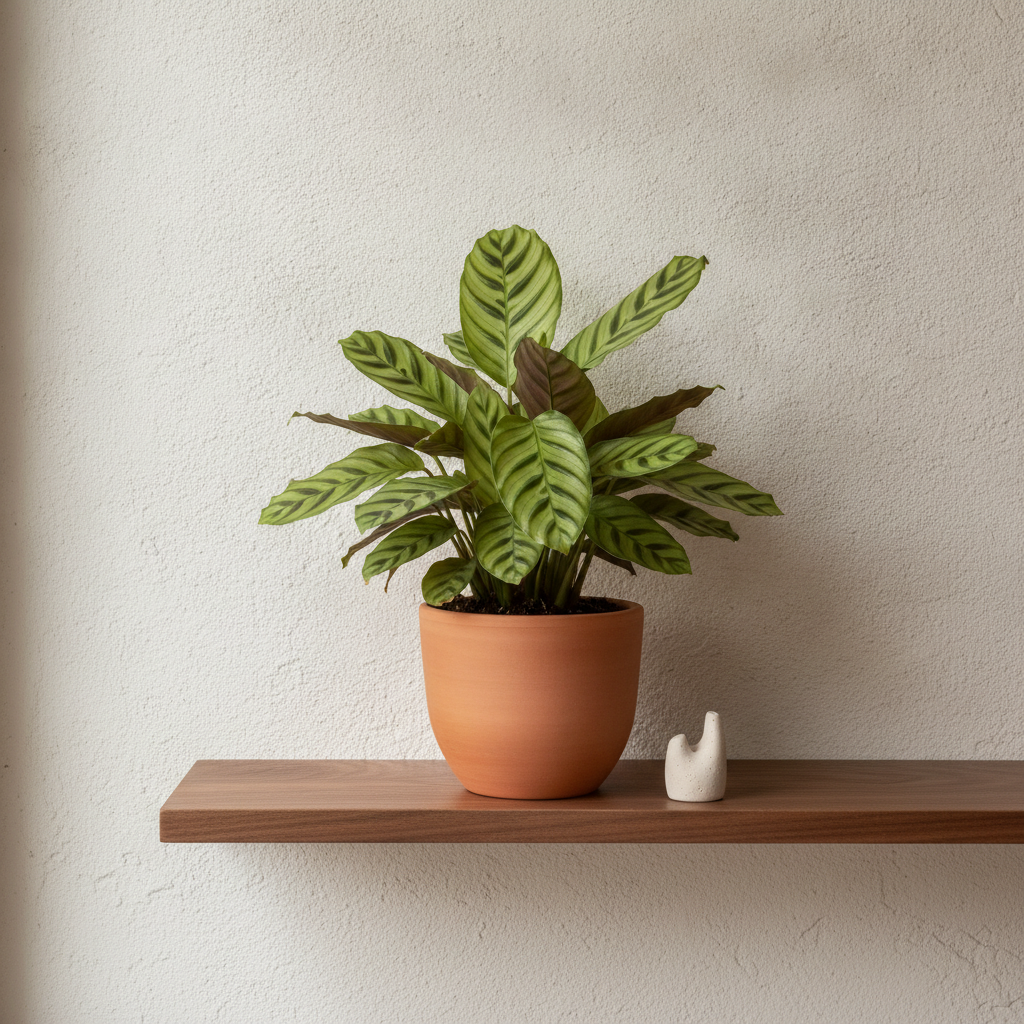
Freddie
The classic form and the one you will almost always find for sale, with long, lance-shaped leaves in pale apple-green marked by fine dark-green bands fanning out from the midrib. Its upright, clumping habit and gentle colouring make it one of the more understated and elegant prayer plants.
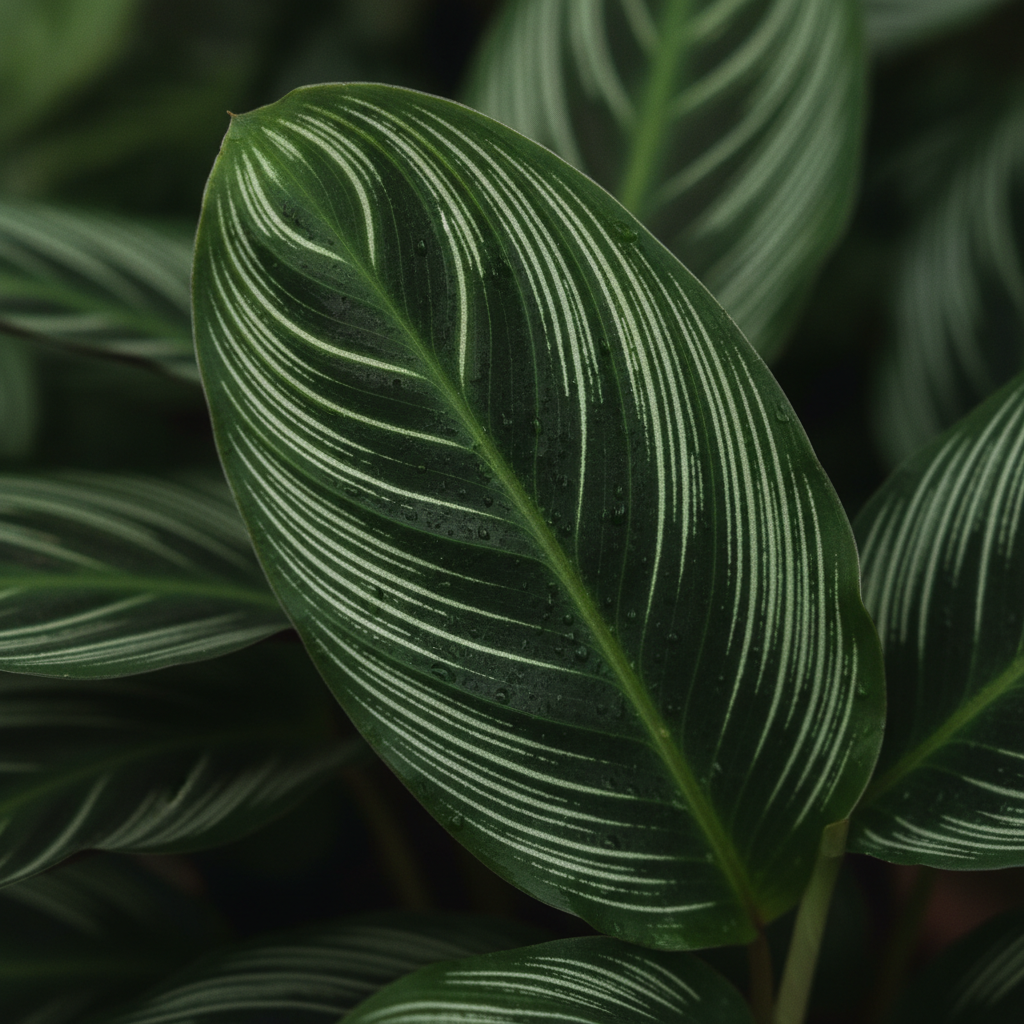
Vittata
A close relative often mistaken for the Freddie, the Vittata calathea carries broader, more oval leaves in a deeper green, crossed by crisp, thin white-to-pale stripes that are bolder and brighter than the Freddie’s softer feathering. It shares the same care needs and makes a natural companion on the same shelf.
Variety Profiles in Detail
Freddie (Goeppertia concinna)
Native to Brazil and reaching 60 to 75 cm (24 to 30 in) indoors, the Freddie is prized for its slim, upright leaves and the fine, regular fishbone pattern that gives it a more delicate look than the bolder-leaved calatheas. Its pale undersides, rather than the purple flush common in the group, are one of the easiest ways to confirm you have the true species.
Vittata (Goeppertia elliptica)
Sometimes sold as Calathea vittata, this relative is the Freddie’s most common lookalike. Its leaves are broader and more rounded, in a darker green, and the markings read as clean parallel pinstripes rather than the Freddie’s feathered bands. Side by side the two are easy to separate, but in a shop they are routinely muddled.
Rattlesnake Plant (Goeppertia insignis)
A close cousin with long, narrow, wavy-edged leaves patterned in alternating large and small dark blotches, and rich maroon undersides. It shares the Freddie’s love of humidity and indirect light, and its more dramatic markings make it a striking companion in a grouped prayer-plant display.
Choosing the Right Variety for Your Space
Because the Freddie and its relatives all share the same fundamental needs, the choice between them comes down to look and scale rather than care. The Freddie’s slim, upright form suits a position where height matters more than spread, such as a shelf or a narrow corner, while the broader-leaved Vittata, Medallion or Pinstripe make a fuller, more sculptural statement in an open spot. Whichever you choose, grouping several together not only looks generous but raises the local humidity, helping every plant in the cluster look its best.
Frequently Asked Questions
Why are the edges of my Freddie’s leaves turning brown and crispy?
Crispy brown edges are the classic Freddie complaint, and they almost always come down to one of three things: air that is too dry, water that is too high in minerals, or soil that has been allowed to dry out too far between waterings. Raise the humidity to 60 per cent or more, switch to rainwater or distilled water, and keep the soil evenly moist, and new leaves should emerge clean.
Is the Freddie plant safe for cats and dogs?
Yes. Like all prayer plants in the family Marantaceae, the Freddie is non-toxic and considered pet-safe, so it is a sound choice for homes with cats and dogs. A pet that eats a large amount of any plant may get a mild stomach upset, but there is no risk of the serious poisoning associated with many other common houseplants.
Why do my Freddie’s leaves move up and down during the day?
This daily movement, called nyctinasty, is a natural behaviour of prayer plants. The leaves rise toward vertical in the evening and relax open again in the morning, driven by changes in water pressure in a swollen joint at the base of each leaf. It is a sign of a healthy, responsive plant, and weak or absent movement usually means it needs more light.
How often should I water my Freddie plant?
There is no fixed schedule, because watering needs change with light, warmth and season. Instead, check the soil and water when the top 2 to 3 cm (1 in) feels barely dry, which often works out to once or twice a week in spring and summer and noticeably less in winter. The goal is soil that stays lightly moist, never soggy and never bone dry.
Can I propagate a Freddie from a leaf or stem cutting?
No. The Freddie does not root from leaf or stem cuttings the way vining plants do, because it grows from a clump of roots and rhizomes rather than from rooting nodes along a stem. The only reliable method is division, separating a mature plant into smaller clumps, each with its own roots and leaves, ideally when you repot in spring.
Why is my Freddie’s foliage looking faded and washed out?
Faded markings and a bleached, yellowish cast usually mean too much light, especially if the plant has been moved into direct sun. Pull it back from the window or add a sheer screen so the light is bright but indirect. If, on the other hand, the whole leaf has darkened and lost contrast, the cause is the opposite, too little light, and the plant should be moved somewhere brighter.
What temperature does a Freddie plant prefer?
The Freddie is happiest in the steady warmth of 18 to 27 degrees C (64 to 81 degrees F) that suits most tropical houseplants. Keep it away from anything below about 15 degrees C (59 degrees F), as well as cold draughts, heating vents and radiators, all of which cause stress, curling and browning. Stable, room-temperature conditions year round are ideal.
Should I mist my Freddie to raise humidity?
Misting gives only a brief lift in humidity and, because it leaves water sitting on the leaves, it can encourage fungal leaf spot on a plant as prone to it as the Freddie. A room humidifier is far more effective and reliable, with grouping plants together and using a pebble tray as useful supporting measures. If you do mist, do it early in the day so the foliage dries before nightfall.
Why are the lower leaves on my Freddie turning yellow?
An occasional yellowing lower leaf on an otherwise healthy plant is just normal ageing, nothing to worry about. If several leaves yellow at once and the soil is constantly wet, however, the likely cause is overwatering and the early stages of root rot, so check the roots and let the mix dry a little more between waterings before damage spreads.






