
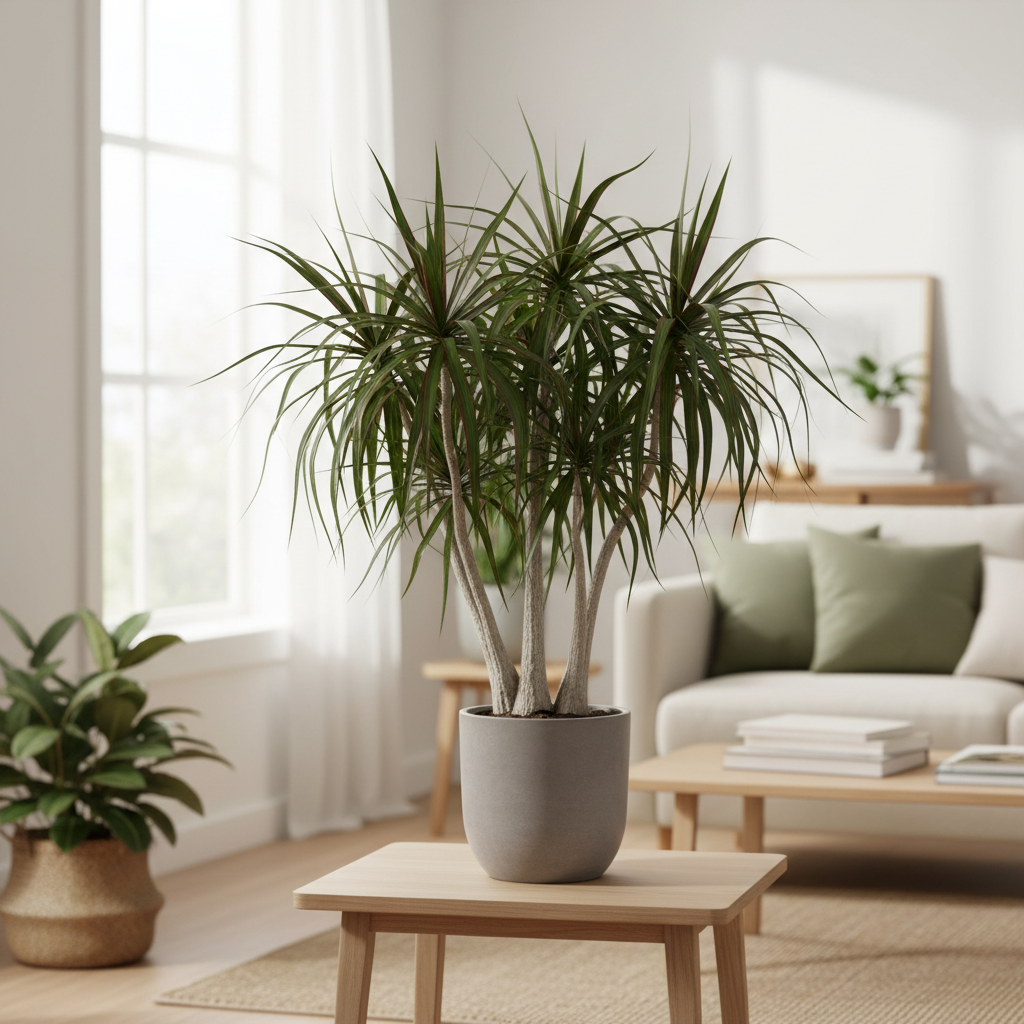
Few houseplants look as architectural with so little effort as the dragon tree. Known botanically as Dracaena marginata, and sold under common names that include Madagascar dragon tree, red-edged dracaena and simply marginata, this slow-growing evergreen has been a favourite in living rooms and office foyers since the 1960s. Native to the dry, rocky highlands of Madagascar, it has the relaxed personality of a plant that grew up rationing its own water, which is exactly why it tends to forgive the kind of inconsistent care that kills fussier species.
Its reputation as a beginner-friendly plant is well deserved, but there is a meaningful gap between a dragon tree that is merely surviving and one that is genuinely thriving. A neglected specimen tends to drift along with a sparse crown, bare lower stem and dull, fluoride-burnt leaf tips. A thriving one builds dense tufts of glossy foliage on slender, gracefully branching stems, eventually growing into a small indoor tree of two to three metres (six to ten feet). The aim of this guide is to bridge that gap, walking through every aspect of its care in the order you actually need it, so you can grow a sculptural, long-lived dragon tree rather than just keeping one alive.
Contents
- Quick Reference
- Why Dragon Tree Makes an Excellent Houseplant
- Light Requirements
- Watering and Humidity
- Soil, Potting and Repotting
- Fertilising
- Propagation
- Pests and Diseases
- Popular Varieties
- Frequently Asked Questions
Quick Reference: Dragon Tree at a Glance
| Light | Bright indirect light is ideal; tolerates medium light but variegation fades and growth slows. Avoid harsh direct midday sun. |
| Watering | Allow the top 3 to 5 cm (1 to 2 inches) of soil to dry out between waterings. Typically every 10 to 14 days in summer, every 3 to 4 weeks in winter. |
| Temperature | Ideal range 18 to 27 °C (65 to 80 °F). Avoid temperatures below 15 °C (59 °F) and any sustained cold draught. |
| Humidity | Tolerates average household humidity of 30 to 50 percent; happier at 40 to 60 percent. Brown tips often indicate dry air or fluoride rather than under-watering. |
| Fertiliser | Balanced liquid houseplant feed at half strength every 4 to 6 weeks during spring and summer. None in autumn or winter. |
| Toxicity | Toxic to cats and dogs. Contains saponins; ingestion can cause vomiting, drooling, depression and dilated pupils in cats. Keep out of reach. |
Why Dragon Tree Makes an Excellent Houseplant
The appeal of Dracaena marginata rests on a rare combination of dramatic appearance and undemanding care. As a young plant it looks rather like a tropical pineapple top, with a dense rosette of arching, ribbon-thin leaves emerging from a short stem. Given time, those leaves drop away from the base and the stem lignifies into a slim, knobbly grey trunk that often branches in interesting Y-shapes after the growing tip is pruned. The result is a sculptural houseplant that reads as a small indoor tree without occupying much floor space, even at full size.

Behind the looks is a constitution built for inconsistency. Dragon trees evolved on Madagascar’s rocky scrubland, where soils are thin, rainfall is unpredictable and humidity is moderate rather than tropical. They store water in their thick stems, tolerate weeks without irrigation and shrug off the swings in light and temperature that characterise an ordinary home. They have also been studied as part of NASA’s clean-air research, which found that several Dracaena species help remove formaldehyde, benzene and trichloroethylene from indoor air, although the practical effect at room scale is modest. For anyone learning to read a plant’s signals for the first time, marginata is patient, communicative and slow enough to recover from mistakes that would finish off a calathea or fiddle leaf fig.
Important — Toxicity: The dragon tree is toxic to cats and dogs. Its leaves and stems contain saponins, which can cause vomiting (sometimes with blood), excessive drooling, loss of appetite, depression and, in cats, dilated pupils. Symptoms are rarely life-threatening but call for a vet visit if ingestion is suspected. Place plants out of reach of curious pets, particularly cats that view long, dangling leaves as toys.
Light Requirements
Light is the single biggest lever you have over how a dragon tree looks. Marginata will hang on for years in a dim corner, but it will not look like the same plant you bought. Foliage thins, internodes stretch and the iconic red leaf margins lose their definition. Give it real light and you get the opposite: a compact, densely tufted crown that holds its colour and slowly builds a stout woody stem.
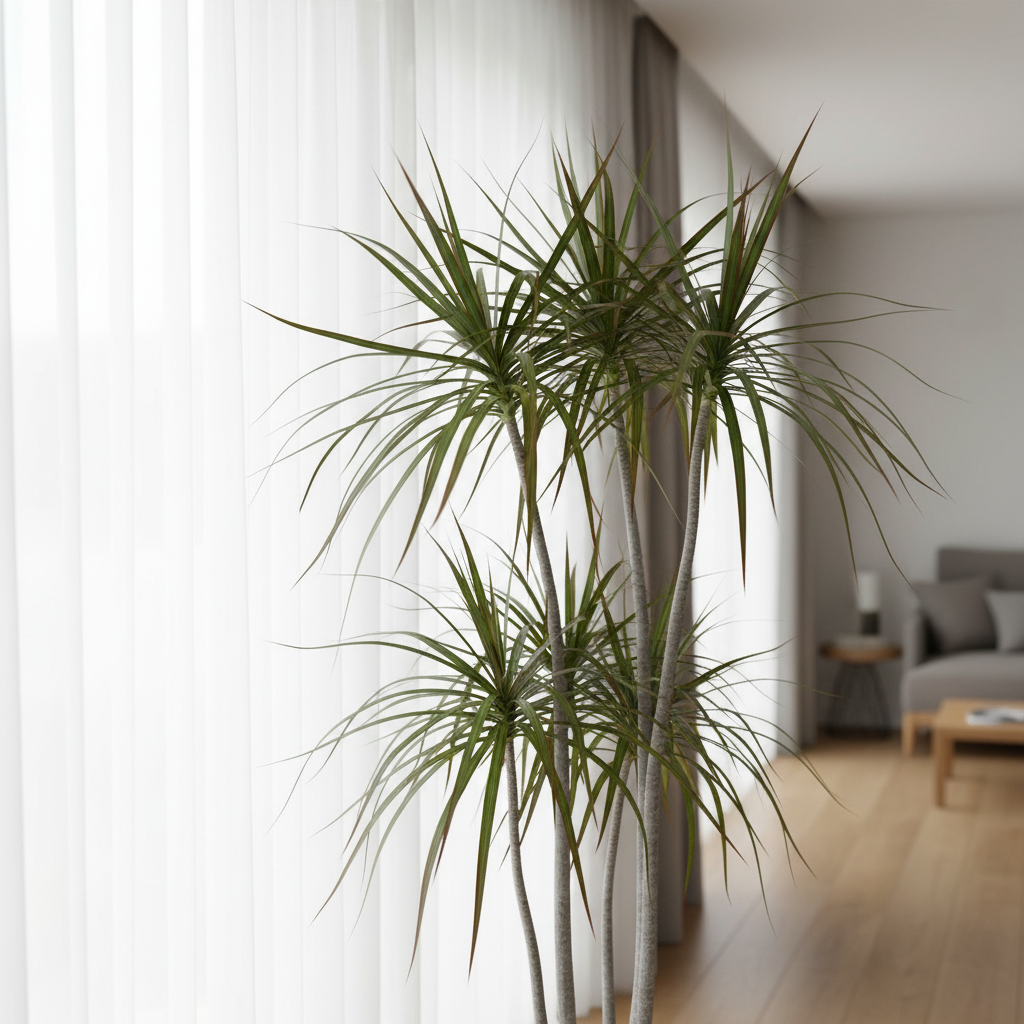
The sweet spot is bright, indirect light. In practical terms that means a position with a clear view of the sky, roughly one to two metres back from an east, west or south-facing window, or right up against a north-facing window in temperate latitudes. A few hours of soft direct sun in the morning or late afternoon is welcome and brings out the red edging. Hours of fierce midday sun behind glass, on the other hand, will scorch the leaves and bleach the variegation.
Light Levels Explained
The categories houseplant growers use map roughly to measurable light intensity. The table below describes each tier and what to expect from a dragon tree placed there. Lux readings assume a clear day around midday; readings will be much lower in winter and on overcast days.
| Light Category | Approx. Level | Typical Location | Outcome |
|---|---|---|---|
| Direct sun | 50,000 lux and above | On a sunny south-facing windowsill with no curtain | Risk of leaf scorch and bleaching; only acceptable for short morning or late-afternoon spells |
| Bright indirect | 10,000 to 25,000 lux | One to two metres back from a bright window, or beside a sheer curtain | Ideal; produces dense, well-coloured foliage and steady growth |
| Medium | 2,500 to 10,000 lux | Middle of a well-lit room; off to the side of an east or west window | Acceptable; growth slows and red margins narrow but the plant looks healthy |
| Low | 500 to 2,500 lux | Interior hallways, bathrooms with frosted glass, north-facing rooms | Survival mode; expect slow leaf loss and no new growth for long stretches |
| Very low | Below 500 lux | Windowless offices, corridors lit only by lamps | Not viable long term; foliage thins and the plant declines |
Window Orientation and Placement
South-facing window: Excellent if filtered. Place the plant a metre back from the glass, or use a sheer curtain to soften the midday rays. Direct summer sun behind clear glass can scorch foliage within an afternoon, particularly on the youngest leaves.
East-facing window: Arguably the ideal position. The plant receives a couple of hours of gentle morning sun followed by bright indirect light for the rest of the day. Red leaf margins develop reliably and growth is steady.
West-facing window: Also very good, though the afternoon sun is hotter and may need diffusing in midsummer. A west-facing windowsill can produce some of the most colourful foliage you will see on a marginata.
North-facing window: Workable in a bright room with no obstructions outside the window, especially in summer. In a darker interior, supplement with a small grow light or move the plant closer to the glass to keep it ticking over.
Pro Tip — Read the leaves, not the calendar: A dragon tree tells you whether the light is right. Healthy leaves are stiff, evenly spaced and brightly edged in red. Soft, drooping leaves with long gaps between them suggest the plant is reaching for more light; rotate weekly and consider moving it closer to a window. Pale, washed-out leaves with crisp brown patches on the upper surface mean the sun is too direct.
How Light Affects Leaf Colour and Shape
The trademark red margin on a marginata leaf is the pigment anthocyanin, produced as the leaf matures and intensified by bright light. In low light the plant produces less anthocyanin, so the margins appear thin and dull. Variegated cultivars such as Tricolor and Colorama push this further: their cream, pink and yellow stripes only develop fully under bright indirect light. Move a Colorama into a darker room and the pink fades to pale green over a few months as the plant reverts to chlorophyll-heavy leaves to compensate for the reduced light. Move it back into brighter conditions and new foliage will return to its proper colour, although existing leaves will not change.
Warning — Direct Sunlight: An hour of hot summer sun directly through clear glass can leave permanent bleached patches on the upper surface of dragon tree leaves. Acclimatise plants gradually to brighter conditions over two to three weeks; never move a plant from a shady room straight onto a sunny windowsill in summer.
Artificial Lighting
Dragon trees respond well to full-spectrum LED grow lights, which makes them a good candidate for windowless offices or dim corners. A 20 to 30 watt LED panel positioned 30 to 60 cm (12 to 24 inches) above the crown, running 10 to 12 hours a day on a timer, will keep a plant in active growth all year. Choose lamps with a colour temperature around 4,000 to 6,500 K and look for a photosynthetic photon flux density (PPFD) of at least 100 to 200 micromoles per square metre per second at the top of the plant. Combining a grow light with whatever ambient light the room provides usually gives the best results.
Seasonal Adjustments
Light levels in temperate climates can fall by 80 percent between midsummer and midwinter. A position that is bright and indirect in June may be marginal by December. Shift the plant 30 to 50 cm closer to its window for the dark months, clean the leaves and the glass to maximise transmission, and consider switching on a grow light through the winter. Conversely, a south-facing window that is comfortable in winter can become too hot in summer; pull the plant back from the glass, or add a sheer curtain, as the days lengthen. Quarter-turn the pot once a week so the crown stays symmetrical rather than bending towards the light source.
Watering and Humidity
If you only remember one rule about watering a dragon tree, make it this one: the plant tolerates drought far better than soggy soil. Marginata stores water in its thick stems and waxy leaves, so a week or two of dryness causes no real harm. A week or two with the roots sitting in damp compost, on the other hand, sets root rot in motion and can kill an otherwise healthy specimen within a single season. The discipline is to water thoroughly when the plant is genuinely thirsty, then to leave it alone until it is thirsty again.
When to Water
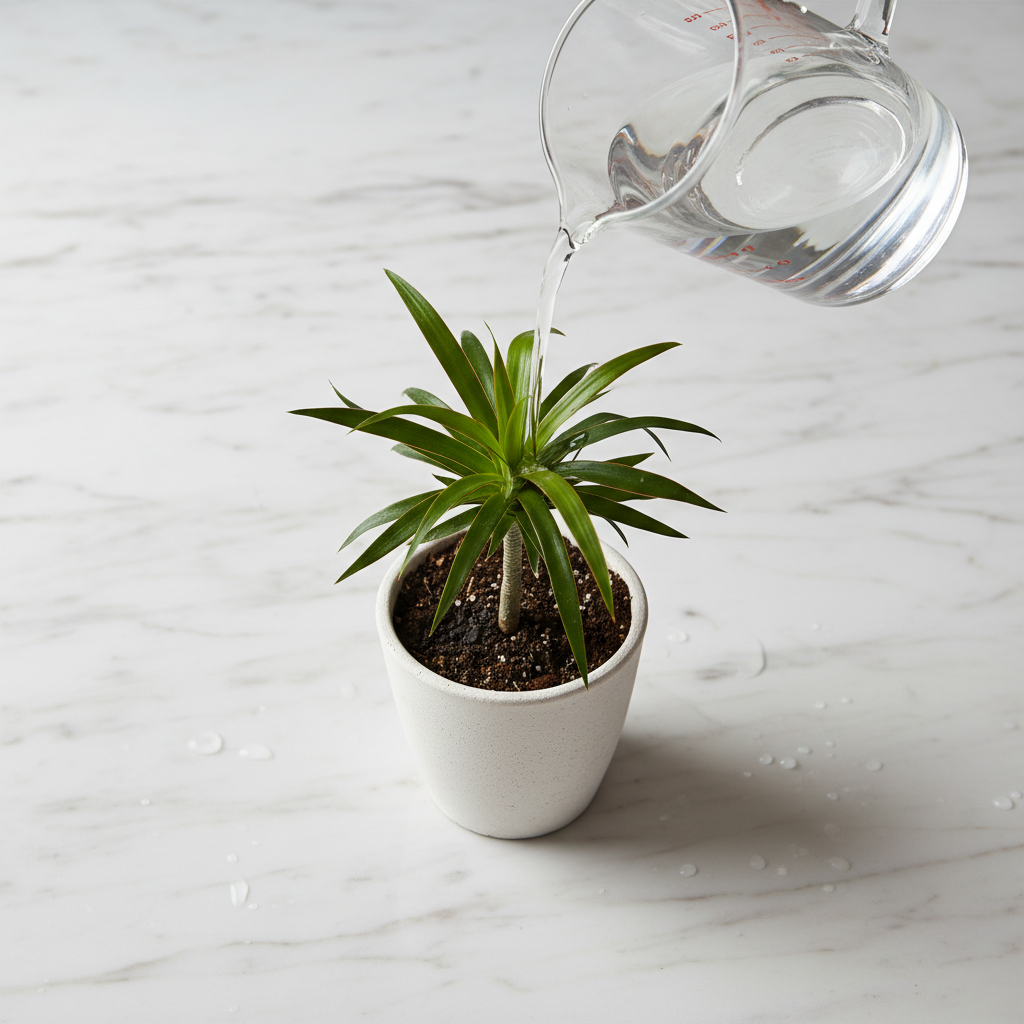
The reliable indicator is the soil itself rather than the calendar. Push a clean finger into the compost up to the second knuckle, or use a slim wooden skewer. If the top 3 to 5 cm (1 to 2 inches) feel dry and powdery, and the skewer comes out clean with no damp soil clinging to it, the plant is ready for water. If the soil is still cool and crumbly, wait another two or three days and check again. In a typical living room a dragon tree might want water every 10 to 14 days in summer and every 3 to 4 weeks in winter, but the figure is only a starting point. Pot size, light intensity, pot material, room temperature and the size of the plant all change the timing.
A useful supplementary test is the weight of the pot. Lift the plant just after watering and again when the surface has dried; the difference is striking. Over a few weeks you will learn to judge thirst by weight alone, which is faster and more reliable than poking at the soil every day. A pot that feels reassuringly heavy is wet enough; one that lifts easily and feels almost hollow is asking for a drink.
Pro Tip — When in doubt, wait a day: Marginata recovers from a delayed watering far more readily than from one too many. If you genuinely cannot decide whether to water, give the plant another 48 hours and reassess. Overwatering kills more dragon trees than any other single mistake.
How to Water Correctly
- Move the plant to a sink, bath or large saucer; this is a soak-and-drain plant, not a dribble-and-leave one.
- Pour room-temperature water evenly across the soil surface, working slowly so the water has time to penetrate rather than running straight down the inside wall of the pot.
- Continue until water flows freely from the drainage holes for several seconds; this flushes accumulated salts and ensures the entire root ball is rehydrated.
- Let the pot drain for 10 to 15 minutes. Tip away any water that collects in the saucer; never let the pot stand in a pool.
- Return the plant to its display position only once dripping has stopped and the bottom of the pot feels dry to the touch.
- Note the date or, if you prefer, weigh the pot; both make it easier to predict the next watering.
Signs of Overwatering vs Underwatering
| Symptom | Overwatering | Underwatering |
|---|---|---|
| Leaf colour | Yellowing of older lower leaves, often with translucent patches | Pale or dull green overall, with brown crispy tips |
| Leaf texture | Soft, limp, sometimes mushy near the base of the leaf | Dry, papery, often curling along the length of the leaf |
| Soil | Damp for many days at a time, may smell sour, sometimes mouldy on the surface | Pulls away from the pot wall, dusty to the touch, water runs off rather than soaking in |
| Roots | Brown to black, soft and easily detached from the root ball | Pale, dry, brittle but still firm; healthy roots are firm and creamy white |
| Stem base | Mushy, dark or smelly where the stem meets the soil | Slightly shrivelled but otherwise firm and unchanged in colour |
Warning — Root Rot: Once the stem base feels soft or smells sour, the rot has spread beyond the roots and the plant may not recover. Act early: tip the plant out, cut away every black, mushy root with sterile scissors, dust the cuts with cinnamon or sulphur, and repot into fresh, dry, well-draining mix in a smaller pot. Do not water for a week, then resume with a much lighter hand.
Humidity Requirements
Dragon trees come from a part of the world where humidity is moderate, not tropical, which makes them better suited to centrally heated homes than most other dracaenas. Anything between 30 and 60 percent relative humidity is acceptable; the plant only really struggles below about 25 percent, which can happen in winter when radiators run continuously. The plant will not need a humidifier in most homes.
The most reliable humidity-related symptom is brown tips on the leaves, where the very ends of the long, narrow blades turn crispy and brown. Confusingly, identical-looking damage can be caused by fluoride or salt build-up in the soil, which we will return to in a moment. As a rough guide, if the brown tips appear on many leaves at once during winter and the rest of the room feels arid, dry air is probably the cause. If the tips appear gradually over weeks regardless of season, water quality is the more likely culprit.
To raise humidity around the plant, group it with other houseplants so they share transpired moisture, stand the pot on a tray of pebbles topped up with water that sits just below the base of the pot, or run a small ultrasonic humidifier nearby through the heating season. Misting feels productive but does little for ambient humidity and can actually encourage fungal spots on the leaves, so it is best avoided.
Water Quality
Dracaena marginata is one of the more famously fluoride-sensitive houseplants. Even at concentrations of 1 part per million, the level found in much municipal tap water, fluoride can accumulate in the leaf tips and cause the characteristic crispy brown ends that frustrate so many owners. The same plant is also sensitive to chlorine, chloramine and the boron found in some water softeners. If your tap water is heavily treated, the simplest fix is to switch to rainwater, distilled water or filtered water. Failing that, fill a watering can the night before and leave it uncovered; chlorine will dissipate overnight, although fluoride does not. Allowing the soil to drain freely with each watering and flushing the pot thoroughly once a month also helps prevent the slow build-up of harmful salts.
Soil, Potting and Repotting
The soil mix matters more for marginata than for most easy houseplants because of how forgiving the plant is in every other respect. A dense, water-retentive compost will undo good watering habits by keeping the root ball wet for far longer than the plant wants. A loose, airy, free-draining mix takes the guesswork out of watering and lets the plant build a strong, fibrous root system that supports the slowly thickening stem above.
Ideal Soil Composition
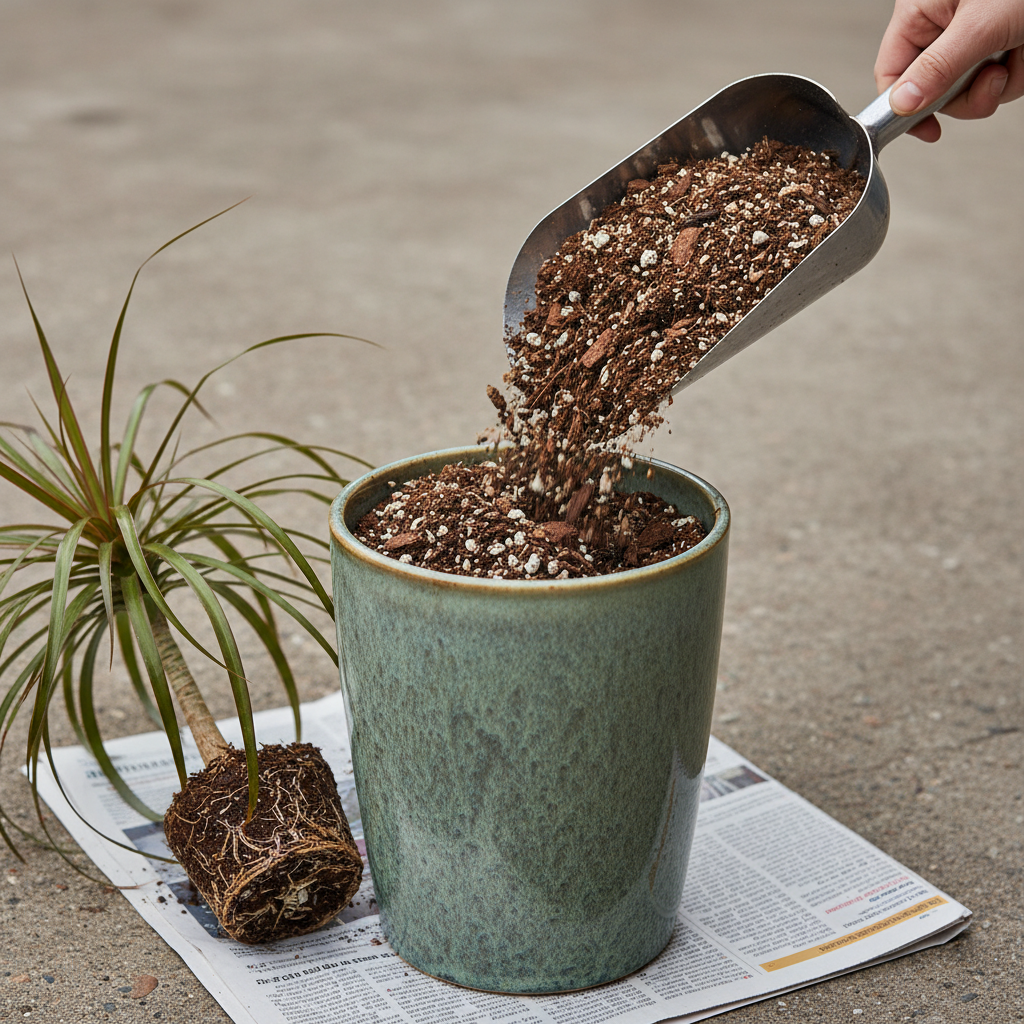
The aim is a mix that holds enough moisture to keep the plant ticking over between waterings, drains readily after each soak, and retains structure for two to three years before it breaks down into mush. A good general houseplant compost is the base; perlite or pumice opens it up; orchid bark adds long-lasting structure; and a small amount of coarse sand or fine gravel improves drainage at the bottom of the pot. The proportions below are a starting point that suits most marginatas in average indoor conditions.
| Component | Proportion | Function |
|---|---|---|
| Quality houseplant compost or peat-free multipurpose | 60 percent | Provides body, holds moisture and a baseline of nutrients |
| Perlite or pumice | 25 percent | Creates large air pockets, improves drainage and reduces compaction |
| Fine orchid bark | 10 percent | Maintains long-term structure as the compost breaks down |
| Coarse horticultural sand or fine gravel | 5 percent | Adds weight at the base and accelerates drainage |
Dragon trees prefer a slightly acidic to neutral soil with a pH between 6.0 and 7.0. Most general-purpose composts sit comfortably in this range, so there is rarely any need to adjust. If you are unlucky enough to have very alkaline water or a compost that has been heavily limed, leaf yellowing between the veins (interveinal chlorosis) can develop; switching to rainwater and a fresh, slightly acidic mix usually fixes the issue within a season.
Pro Tip — Quick Mix Recipe: If you want a no-measure starter mix, combine four parts of a quality houseplant compost with two parts perlite and one part fine orchid bark by volume. It drains well, ages slowly and works for most dracaenas, sansevierias and other forgiving foliage plants.
Choosing the Right Pot
Pot choice has a quiet but significant effect on how often you need to water and how well the plant grows. The right pot is small enough that the soil dries out within a couple of weeks, deep enough to anchor a tall plant, and heavy enough that a top-heavy crown does not topple a slim trunk.
Drainage holes are non-negotiable. A pot without holes will, sooner or later, kill a dragon tree. Even careful watering accumulates salts and excess moisture at the bottom, where the roots have no way to escape it. If you fall in love with a decorative cachepot that has no drainage, treat it as a cover only: plant the marginata in a smaller plastic nursery pot with holes and drop it inside.
Pot material: Terracotta is excellent for marginata because it breathes and wicks excess moisture from the soil, making overwatering harder. The drawback is that terracotta is heavy and breakable, and tall pots can be expensive. Plastic and glazed ceramic pots are perfectly fine if you adjust watering accordingly; the soil will stay damp for several days longer than in terracotta. Avoid metal pots, which heat up rapidly in sunlight and can cook the root ball.
Pot size: A pot 2 to 4 cm (1 to 1.5 inches) wider than the current root ball is plenty when stepping up. Resist the urge to plant a small marginata into a large pot in the hope of speeding growth; the extra soil simply holds water that the modest root system cannot use, and root rot follows. Mature dragon trees are happy growing in a pot that looks slightly too small for them.
When to Repot
Dragon trees are slow growers and dislike being disturbed, so frequent repotting is unnecessary and counterproductive. Most plants need a fresh pot every two to three years, sometimes longer for mature specimens. The telltale signs are roots circling at the bottom of the pot or pushing out of the drainage holes, water that runs straight through without wetting the soil, and a noticeable slowdown in new growth even though light and feeding are unchanged. Spring, just as growth begins, is the best time to repot; the plant recovers quickly and the disturbed roots regenerate before summer slows down.
How to Repot: Step-by-Step
- Water the plant the day before repotting. Damp soil holds together better than dry and reduces root tearing.
- Lay newspaper or a tarp over your work surface and assemble the new pot, fresh mix, scissors or secateurs, gloves and a watering can.
- Tip the plant onto its side and slide it out of its old pot. If it resists, run a long knife around the inside wall of the pot to free the root ball.
- Tease away the old compost gently from the outer roots, particularly the bottom inch where the most degraded mix sits. Trim any dark, mushy or noticeably long roots with sterile scissors.
- Place 3 to 5 cm of fresh mix in the bottom of the new pot, position the plant so the soil surface sits 1 to 2 cm below the rim, and back-fill around the root ball with fresh mix.
- Press the mix down firmly without compacting it, then tap the pot a few times on the bench to settle the soil into any air pockets.
- Water the plant lightly to settle the soil, then place it in a bright, indirect spot and resist the urge to water again for at least a week.
Warning — Transplant Shock: Marginata can drop a few leaves and look sulky for several weeks after repotting. This is normal and almost always recoverable. The single biggest mistake at this stage is to compensate by watering more or moving the plant somewhere brighter; both make things worse. Keep conditions stable, water sparingly and wait.
Fertilising
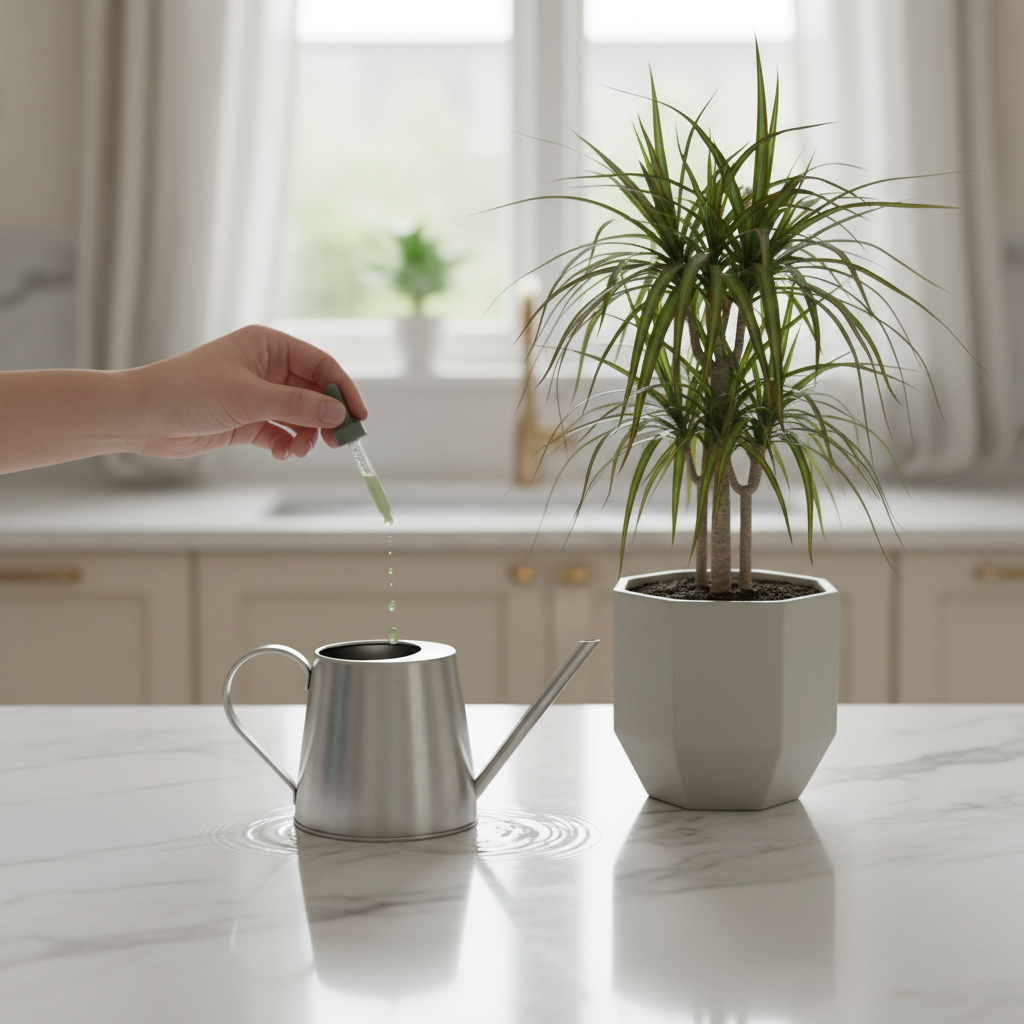
Dragon trees are not heavy feeders. In their native habitat they grow on poor, rocky soils where nutrients are scarce, and they have adapted to make do with very little. A modest, regular feeding routine through the growing season is more than enough to support healthy new leaves and slow, steady stem growth. The temptation, as always, is to overdo it: more feed does not mean more growth, and excess fertiliser actually does measurable damage to a marginata’s sensitive roots.
The single most useful rule is to dilute everything to half the label strength and feed less often than the bottle recommends. Houseplant fertilisers are formulated for hungry annuals and vegetables; the dosing on the back of the bottle assumes you are feeding a tomato. Halving it produces a much gentler nutrient drip that suits forgiving foliage plants like dracaena.
Understanding Plant Nutrients
The three numbers on a fertiliser label, often shown as 10-10-10 or 20-10-20, refer to the percentage of nitrogen (N), phosphorus (P) and potassium (K) by weight. For a foliage plant like a dragon tree, a balanced fertiliser with roughly equal numbers, or one slightly higher in nitrogen, is ideal. Phosphorus-heavy mixes labelled for flowering houseplants are unnecessary; marginata does flower occasionally as a mature plant but the small white blooms are not the main reason anyone grows it.
| Nutrient | Symbol | Primary Function | Deficiency Symptoms |
|---|---|---|---|
| Nitrogen | N | Drives leaf and stem growth, builds chlorophyll | Older leaves yellow uniformly and growth stalls |
| Phosphorus | P | Supports root development and energy transfer | Stunted growth, dull dark green or purplish foliage |
| Potassium | K | Regulates water balance and overall plant vigour | Brown leaf edges, weak stems and increased pest susceptibility |
| Calcium | Ca | Builds strong cell walls and supports new growth | Distorted or hooked new leaves, blackening shoot tips |
| Magnesium | Mg | Core of the chlorophyll molecule; essential for photosynthesis | Yellowing between the veins of older leaves while veins remain green |
| Iron | Fe | Required for chlorophyll synthesis and enzyme function | Yellowing between the veins of new leaves while veins stay green |
Types of Fertiliser
Liquid fertilisers: The most precise and the easiest to use on marginata. A balanced, urea-free liquid houseplant feed diluted to half strength gives you direct control over how much, and how often, the plant is fed. Liquid feeds are also easy to flush from the soil if you have overdone it, simply by watering the pot through with plain water.
Slow-release granular: Coated prills that release a small dose of nutrients each time the pot is watered. Useful for owners who travel or forget to feed, but the release rate is temperature-dependent, so they can deliver too much in a hot summer and too little in a cool spring. Use them at half the recommended rate, sprinkled across the soil surface in spring, and skip liquid feeding for the rest of the season.
Organic fertilisers: Worm castings, compost teas and seaweed-based feeds suit dragon trees well because they release nutrients slowly and improve soil structure without risk of burn. Top-dress the pot with a thin layer of worm castings each spring, or substitute a diluted seaweed solution for one of your half-strength liquid feeds each month.
Feeding Schedule
The growing season for indoor dragon trees runs from around April to September in the Northern Hemisphere, with a slightly different window in the Southern. During this period, feed with a balanced liquid fertiliser diluted to half strength every four to six weeks. Skip feeding entirely from October to March, when light levels are low and the plant naturally slows down. Feeding a dormant plant simply increases salt levels in the soil without producing any new growth, and the build-up shows up later as crispy leaf tips.
Pro Tip — Feed only when watering: Always apply liquid fertiliser to already moist soil rather than a bone-dry pot. Dry roots can be scorched by concentrated nutrients, even at half strength. Water the plant first with plain water, then come back twenty minutes later with the diluted feed.
How to Fertilise
- Check that the soil is already moist; if it is bone dry, water with plain water first and wait at least twenty minutes.
- Measure half the dose of a balanced houseplant fertiliser recommended on the label into a watering can of room-temperature water.
- Pour the solution evenly across the soil surface until you see it begin to drain from the bottom of the pot.
- Tip away any excess from the saucer so the roots do not sit in fertiliser solution.
- Once every three or four months during the growing season, flush the pot with two or three pot-volumes of plain water to wash out accumulated salts.
Warning — Salt Build-Up: A white crust on the soil surface or around the rim of the pot is a sign of fertiliser salt accumulation, which can damage roots and cause brown leaf tips. If you see it, flush the pot thoroughly with plain water until at least twice the pot’s volume has drained out the bottom, and ease off feeding for the next two months.
Propagation
Few plants are as straightforward to propagate as a dragon tree. Take a piece of stem, give it warmth and a little moisture, and it will obligingly produce roots. Better still, the parent plant rewards a careful cut by sending out new branches just below the wound, so what looked at first like a brutal pruning often turns a single-stemmed plant into a multi-headed specimen. This is the reason a leggy old marginata is rarely a lost cause: with one decision, you turn the top into a new plant and the bottom into a future Y-shape.
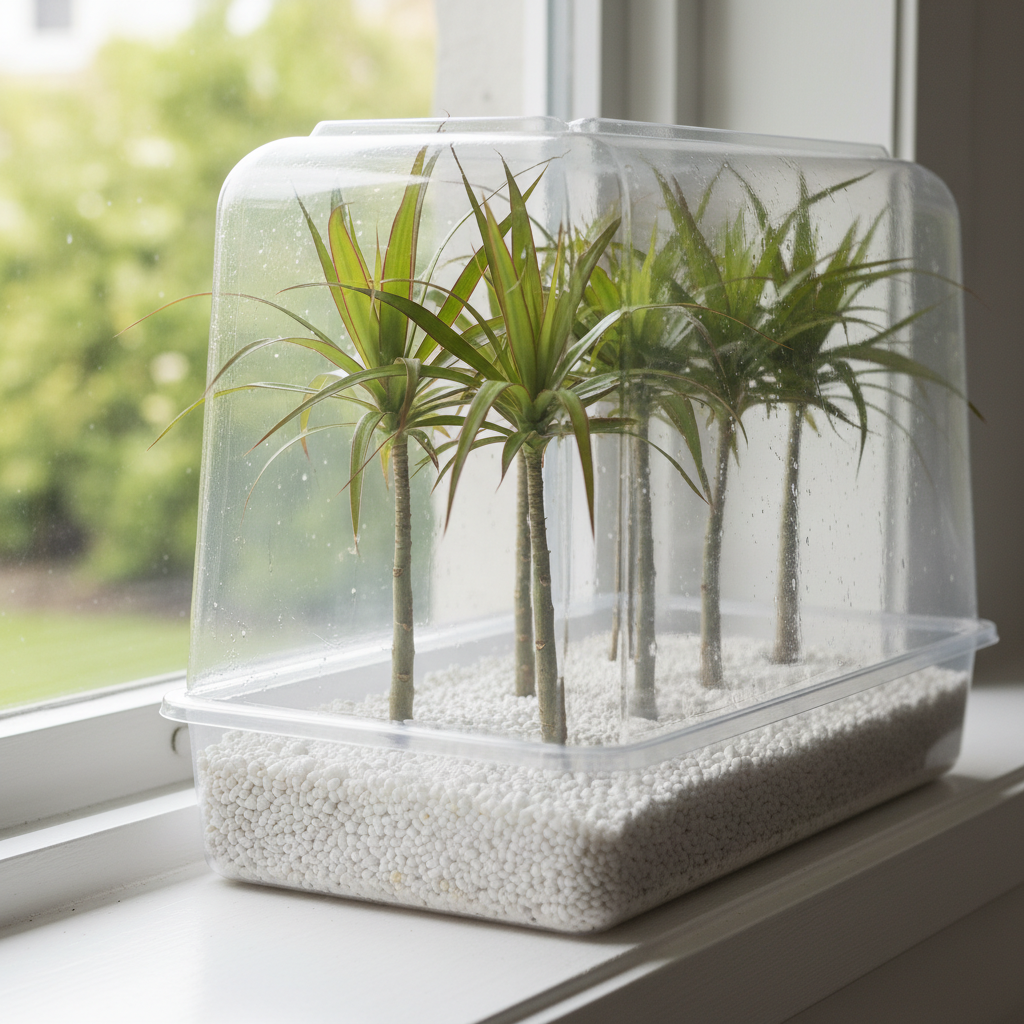
There are two reliable methods for amateur propagation: top cuttings, in which you remove and root the leafy crown, and stem section cuttings, in which you slice the bare lower stem into shorter lengths and root those too. Both work in either water or a damp, well-aerated medium. Air layering is a more advanced third option for owners who would rather not detach the crown until roots are already established.
Understanding Stem Nodes
The key to dragon tree propagation lies in the nodes scattered along the stem. Each node is a small, slightly raised ring of dormant tissue capable of producing either roots, when buried in damp medium, or new shoots, when exposed to light and warmth. Even a stem section that looks like a featureless brown stick will sprout from these nodes given the right conditions. Cut just below a node when taking the bottom end of a cutting so the section has the maximum number of root-producing sites available, and just above one when shaping the top of the parent plant so it has the maximum number of shoot-producing sites to branch from.
Top Cuttings: Step-by-Step
This is the simplest method and a natural fit for a marginata that has grown leggy and bare at the base. You sacrifice nothing in the long run, because the parent stump will usually push out two or three fresh branches within a few weeks. Spring or early summer is the best time, when the plant is in active growth and rooting is fastest.
- Identify a healthy crown with at least four to six leaves and choose a cutting point 15 to 20 cm (6 to 8 inches) below it, ideally just above a visible node.
- Sterilise a sharp pair of secateurs or a knife with isopropyl alcohol, then make a single clean diagonal cut. A jagged cut increases the risk of rot.
- Let the cut end air-dry on a paper towel for several hours to allow a thin callus to form; this protects against rot when the cutting goes into water or substrate.
- Optionally dip the cut end in rooting hormone powder, which speeds rooting but is not strictly necessary for dracaena.
- Stand the cutting upright in a glass of clean room-temperature water, with the bottom 3 to 5 cm submerged, or insert it into a small pot of damp perlite with a clear plastic bag loosely tented over the top.
- Place the cutting in bright, indirect light. Change the water every five to seven days, or mist the perlite to keep it just damp.
- Roots typically appear in three to six weeks. Once they are 3 to 5 cm long, pot the cutting up into a small pot of free-draining houseplant mix and treat it as a young dragon tree.
Pro Tip — Seal the parent’s wound: After taking a top cutting, dust the cut end of the parent stump with cinnamon powder or melted candle wax to prevent rot and discourage opportunistic insects. Keep the stump slightly drier than usual until you see new buds appear; sustained moisture on a fresh wound is the main risk.
Stem Section Cuttings: Step-by-Step
If you take a top cutting from a tall marginata, you are often left with a long stretch of bare stem between the cut and the soil. Rather than waste it, you can slice this stem into shorter sections and root each one separately. The technique multiplies a single plant into half a dozen identical babies in one afternoon and is the standard way nurseries propagate dracaena commercially.
- Cut the bare stem into sections 10 to 15 cm (4 to 6 inches) long, each containing at least two visible nodes.
- Mark the top end of each section clearly, perhaps with a diagonal cut, because dragon tree stem sections will not root if they are inserted upside down.
- Let the cuts air-dry for twenty-four hours so calluses form on both ends.
- Insert the bottom third of each section vertically into a tray of damp perlite, or lay them on their sides half-buried, which sometimes encourages multiple shoots from the upper nodes.
- Cover the tray with a clear plastic dome or loose plastic bag to maintain humidity around 70 to 80 percent, and place it in bright, indirect warmth around 22 to 25 °C (72 to 77 °F).
- Check weekly: roots typically appear at the base in four to eight weeks, and new shoots emerge from the top a few weeks after that. Once each section has both roots and shoots, pot it up into its own small container.
Troubleshooting Propagation
| Problem | Likely Cause | Solution |
|---|---|---|
| Cutting turns black and mushy at the base | Bacterial or fungal rot, usually from a dirty cut or stagnant water | Trim above the rot to clean tissue, sterilise tools, and start again with fresh water or perlite |
| No roots after eight weeks | Temperatures too cool or insufficient warmth around the base | Move to a warmer spot 22 to 25 °C, or place the propagation tray on a heated mat |
| Leaves drop from the cutting | Initial stress from being separated, often normal and not fatal | Continue with consistent care; if the stem stays firm, new leaves will appear |
| Stem section sprouts but never roots | Section may have been inserted upside down, blocking root formation | Mark top and bottom clearly next time; sections rooting solely from one end will not survive long term |
Pests and Diseases
Healthy dragon trees in well-ventilated rooms are rarely troubled by pests, but stressed plants in dry, still air are a different matter. The classic problem trio is spider mites, mealybugs and scale, all of which take advantage of the warm dry conditions that develop indoors over winter. None is hard to control if caught early, which is why a weekly habit of looking at the undersides of the leaves and around the leaf axils is the single most useful piece of pest management you can adopt.
The diseases that affect marginata are almost all moisture-related: root rot, leaf-spot fungi and the slow decline that follows a stressed, cold or waterlogged root system. Good cultural practice (well-draining soil, the right pot, decent light and restrained watering) is more important than any spray you might buy.
Common Pests
Spider Mites (Tetranychus urticae)
Spider mites are the single most common pest of indoor dragon trees. They are tiny, pinhead-sized arachnids that suck cell contents from the underside of leaves and thrive in dry, warm conditions. The first symptoms are subtle: a fine yellow or silver stippling on the upper surface of older leaves, followed by very fine webbing across the leaf axils and between leaves. Heavy infestations can defoliate a plant within weeks.
Treatment: Rinse the entire plant in a tepid shower, turning the leaves over to dislodge as many mites as possible. Follow up with a thorough application of insecticidal soap or a neem oil spray on the undersides of every leaf, repeating every five to seven days for three weeks to catch newly hatched mites. Raise local humidity around the plant to discourage further outbreaks.
Mealybugs (Pseudococcus spp.)
Mealybugs look like tiny tufts of white cotton wool tucked into the leaf axils, along the stems and around the soil line. They drain sap, weaken the plant and leave behind a sticky honeydew that often goes on to support sooty mould. They reproduce alarmingly quickly in warm rooms.
Treatment: Dab visible bugs with a cotton bud soaked in 70 percent isopropyl alcohol, which kills them on contact. Follow with a systemic insecticide or repeated neem oil sprays every seven days for a month. Inspect nearby plants, as mealybugs spread easily across a collection.
Scale Insects (Coccus spp.)
Scale insects look like small brown or tan oval bumps stuck firmly to the stems and the undersides of leaves. Young scales are mobile and easy to control; mature scales are sedentary and protected by a hard waxy shield that resists most sprays.
Treatment: Scrape off as many adult scales as you can with a fingernail or soft toothbrush, then spray the entire plant with horticultural oil or neem oil to smother any crawlers. Repeat treatments every ten days for several weeks; one spray rarely clears a scale infestation completely.
Thrips (Frankliniella spp.)
Thrips are slender, fast-moving insects only a couple of millimetres long. They rasp at leaf surfaces and feed on the released sap, leaving silvery streaks studded with tiny black flecks of excrement. Severely affected leaves become distorted and may drop.
Treatment: Hang blue sticky traps to monitor numbers, then treat with a systemic insecticide or repeated sprays of spinosad or neem oil at five to seven day intervals. Thrips often hide deep in leaf axils, so a thorough soak rather than a light mist is essential.
Common Diseases
Root Rot (Pythium and Phytophthora spp.)
Root rot is the most common and most lethal disease of dragon trees, caused by waterlogged soil that suffocates the roots and invites opportunistic fungi. Above ground, the symptoms are confusing: yellowing leaves, a soft stem base, drooping foliage and a vague feeling that the plant has stopped responding to care. Below the soil, the roots have turned brown, black or grey and slip easily from the root ball.
Treatment: Remove the plant from its pot, wash the roots clean, and cut away every affected root with sterile scissors. Dust the cuts with cinnamon or sulphur, repot into fresh dry mix in a smaller, well-draining pot, and withhold water for a week. From then on, water less than you think you should and never let the pot stand in water.
Leaf-Spot Diseases (Fusarium and Cercospora spp.)
Brown or tan spots with yellow halos, often appearing on lower leaves first, indicate a fungal leaf-spot infection. The fungi spread through splashed water and thrive in humid, still air. Spots may grow together and cause whole leaves to die back.
Treatment: Remove and bin affected leaves to reduce inoculum, improve airflow around the plant, and stop overhead watering. A copper-based fungicide or a neem-oil drench applied to the foliage every ten days for three rounds usually clears the infection. Long term, drier foliage and better ventilation prevent recurrence.
Fluoride and Salt Toxicity
Not a disease in the pathogenic sense, but a chronic stress disorder that mimics one. Brown, dry leaf tips that progress slowly down the leaf without affecting the whole leaf, often accompanied by a white crust on the soil, indicate fluoride or fertiliser-salt build-up. Symptoms develop gradually over months rather than days.
Treatment: Flush the pot with two to three pot-volumes of low-mineral water (rainwater, distilled or filtered) to leach accumulated salts, then switch permanently to a lower-mineral water source. Trim damaged leaf tips on a diagonal with sharp scissors to restore a tidy appearance; the leaves themselves will not regrow lost tissue.
Pest and Disease Summary
| Pest / Disease | Identification | Treatment |
|---|---|---|
| Spider mites | Fine yellow stippling and webbing under leaves, in dry conditions | Shower, then insecticidal soap or neem oil weekly for three weeks |
| Mealybugs | White cottony tufts in leaf axils and along stems | Spot-treat with isopropyl alcohol on a cotton bud, then systemic insecticide or neem |
| Scale insects | Brown or tan oval bumps stuck firmly to stems and leaves | Scrape off adults, then spray with horticultural oil every ten days |
| Thrips | Silvery streaks with tiny black specks of frass on leaves | Sticky traps plus repeated spinosad or neem oil sprays |
| Root rot | Yellow drooping foliage, soft stem base, brown mushy roots | Repot into fresh dry mix after cutting away affected roots |
| Leaf-spot disease | Brown spots with yellow halos, usually on lower leaves | Remove affected leaves, improve airflow, apply copper or neem fungicide |
| Fluoride or salt toxicity | Brown, dry leaf tips progressing slowly over months | Flush pot with low-mineral water, switch to rainwater or distilled long term |
Prevention Strategies
The most effective pest control on any houseplant is environmental. Stressed, dusty, dry plants invite trouble; clean, well-watered plants in good light very rarely have it. Wipe the leaves with a damp cloth every couple of weeks, both to remove dust that limits photosynthesis and to give yourself a close look at the undersides where most pests start. Maintain steady humidity in winter so spider mites have less of a foothold. Quarantine every new plant for two weeks before placing it near your collection, however reputable the nursery; this single habit prevents most infestations from ever reaching the rest of your plants.
Inspect your dragon tree once a week as part of a quick rotation through your plants. Most pest outbreaks announce themselves quietly through subtle leaf changes long before they explode. Catching mites at the stippling stage, before any webbing appears, makes them trivial to control; catching them three weeks later, after webs have formed, can mean weeks of repeated treatment to bring them under control again.
Pro Tip — Neem oil routine: A diluted neem oil spray, applied to the undersides of the leaves once a month during the growing season, works as both a treatment and a deterrent for nearly every common houseplant pest. Mix five millilitres of pure neem oil with a litre of warm water and a few drops of mild dish soap as an emulsifier, and apply with a fine-mist sprayer in the evening, never in direct sunlight.
Popular Varieties
The original wild Dracaena marginata has been cultivated long enough for breeders to select a handful of distinct cultivars, each with its own twist on the basic dragon tree silhouette. Some emphasise foliage variegation, others alter the shade of the iconic red margin, and a few play with leaf width or stem habit. Care requirements are broadly the same across all of them, though variegated forms generally need a touch more light to keep their patterning crisp.
The varieties listed below are the most commonly available in garden centres and online nurseries. A few are rare enough to count as collector plants; most can be found without much difficulty if you know the right cultivar name to ask for.
| Variety | Leaf Appearance | Light Needs | Growth Rate | Availability |
|---|---|---|---|---|
| Dracaena marginata (species) | Slim green leaves with thin red margins | Bright indirect to medium | Slow to moderate | Widely available |
| ‘Tricolor’ | Green, cream and red striped leaves | Bright indirect | Slow | Common in garden centres |
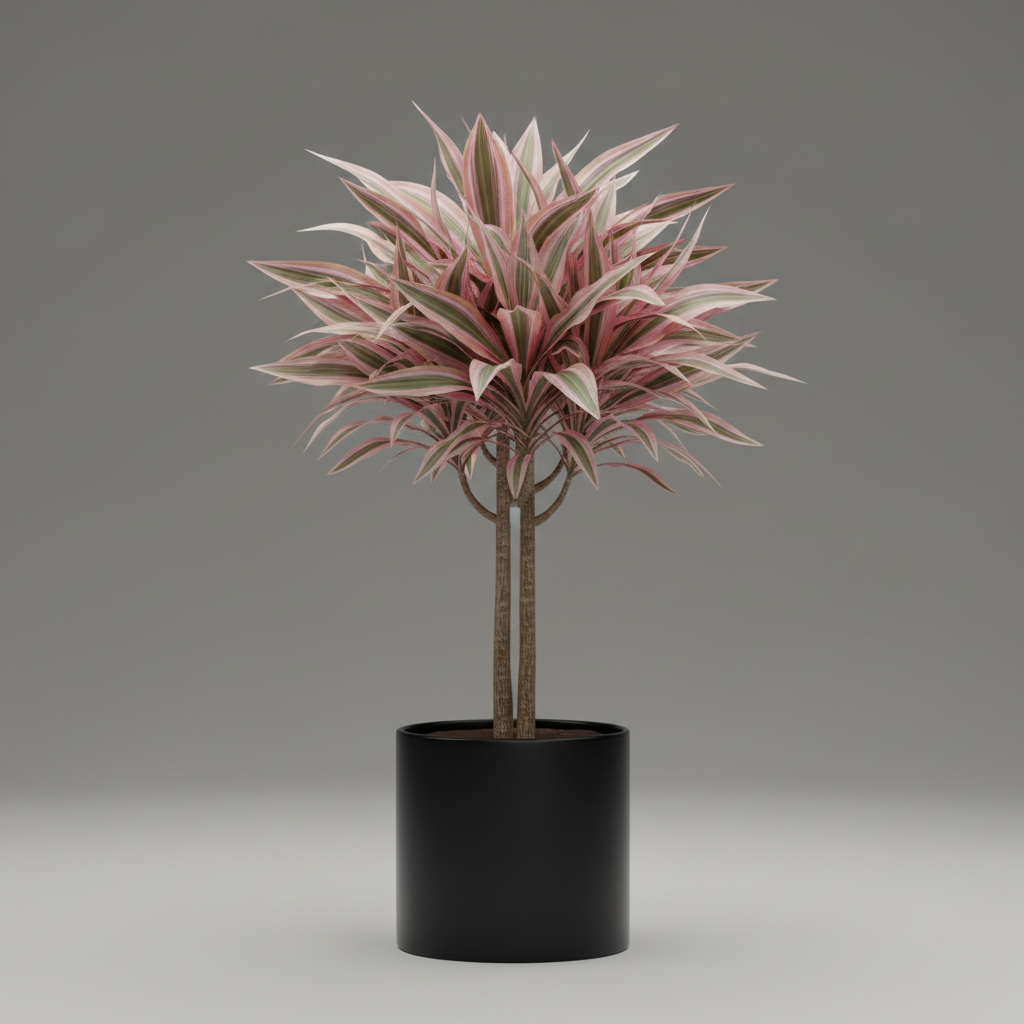
| ‘Colorama’ | Densely pink and cream striped, almost no green visible | Bright indirect, near direct preferred | Slow | Common online and in plant shops |
| ‘Tarzan’ | Broader, stiffer leaves with prominent red margins, dense crown | Bright indirect | Moderate | Increasingly common |
| ‘Magenta’ | Slim green leaves with bolder, wider red margins than the species | Bright indirect | Slow to moderate | Available from specialist nurseries |
| ‘Bicolor’ | Green leaves with a single cream-white central stripe and red margins | Bright indirect | Slow | Less common, found at larger garden centres |
| ‘Kiwi’ | Green leaves with broad lime-green central stripes and red margins | Bright indirect | Slow | Specialist availability |
Featured Varieties
‘Tricolor’
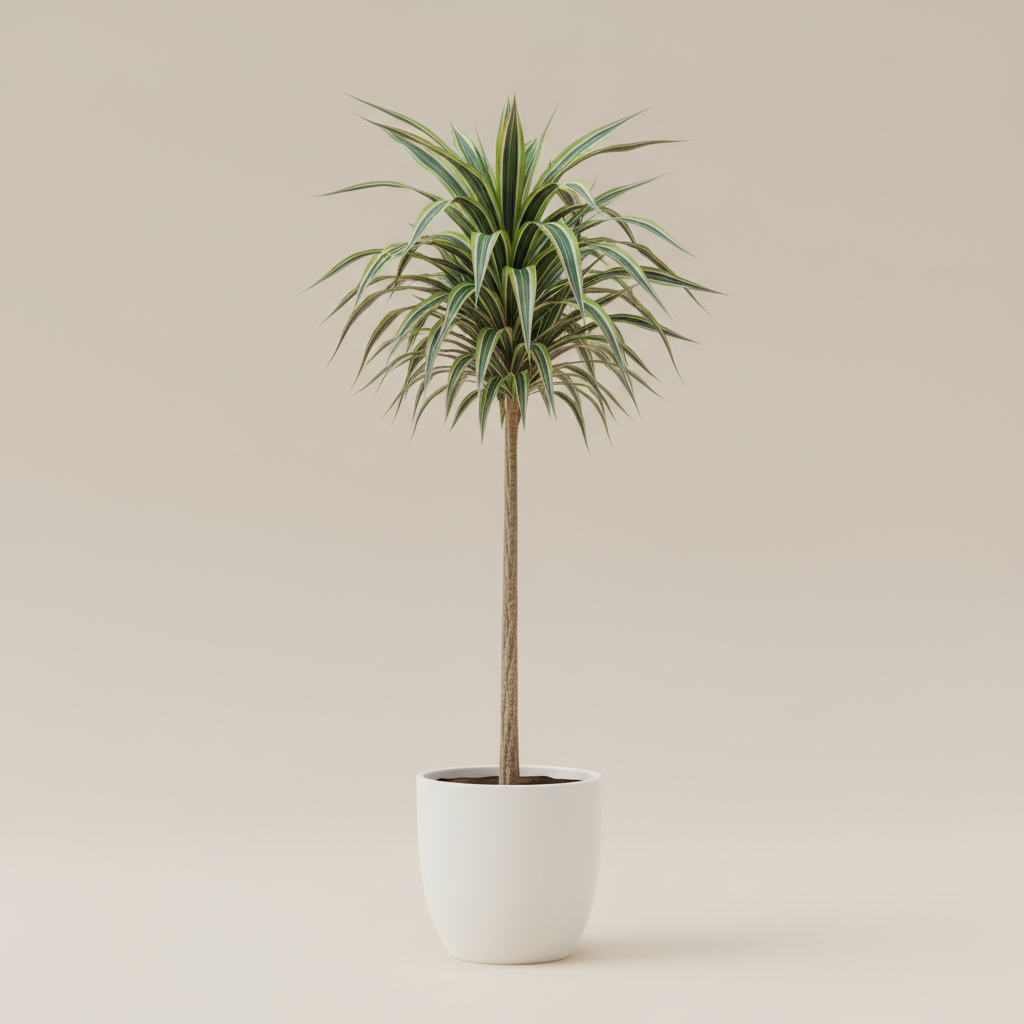
The classic variegated marginata, with each leaf carrying a delicate stripe of green, cream-yellow and a thin red margin. The combination gives the whole plant a soft, candy-cane appearance from a distance. Slightly slower-growing than the species but otherwise easy to care for; needs bright indirect light to keep the cream stripes from fading.
‘Colorama’
The boldest of the popular cultivars, with leaves so densely striped in pink and cream that from a distance the plant looks almost entirely pink. Loved by interior designers for its colour, but more demanding of light than the species. In low light the pink fades to pale green within months. Pairs beautifully with neutral-toned pots and rooms.
Variety Profiles in Detail
Tarzan (Dracaena marginata ‘Tarzan’)
A patented selection discovered as a sport in a Florida nursery, Tarzan has noticeably broader and stiffer leaves than the species, giving it a fuller, more architectural silhouette. The red margins are also more pronounced. It is a touch faster-growing than the species and tolerates slightly lower light, which makes it a popular choice for office settings.
Magenta (Dracaena marginata ‘Magenta’)
Magenta keeps the slim leaf shape of the original species but pushes the red margin much wider and brighter, so it appears almost as a deep wine-red stripe down each leaf edge. It is the variety to look for if you love the species form but want more colour without the variegation of Tricolor or Colorama. Care is identical to the species.
Bicolor (Dracaena marginata ‘Bicolor’)
Sometimes confused with Tricolor, Bicolor is a more subtle variegated form: each leaf carries one central cream-white stripe alongside the green leaf body and the usual red margin. The effect is cooler and more architectural than the warm-toned Tricolor and works well in minimalist interiors.
Kiwi (Dracaena marginata ‘Kiwi’)
A newer cultivar that emphasises green over cream, with bold lime-green central stripes on each leaf alongside the usual red margins. The overall effect is fresher and more uniformly green than either Tricolor or Colorama, with the bright lime catching the light beautifully near a window.
Choosing the Right Variety for Your Space
Light and aesthetic preference are the main decision factors. In a sunny room with good light all day, any variety will thrive and the more strikingly variegated forms like Colorama or Tricolor will reward you with the boldest colour. In a calmer interior with bright but indirect light from a single window, the species or Tarzan are the safest bets, holding their appearance reliably without the slow decline that can affect heavily variegated forms in marginal light. For an office with bright fluorescent or LED lighting overhead, the species and Tarzan again handle conditions well, while Colorama may slowly fade. As a starting point, a small Tarzan or species marginata in a 17 cm (7 inch) pot is hard to beat: tolerant, attractive and likely to grow into the sculptural floor-standing plant the species is famous for.
Frequently Asked Questions
Why are the tips of my dragon tree’s leaves turning brown?
Brown tips on a marginata almost always trace back to water rather than air. The most common cause is fluoride, chlorine or salt build-up in the soil from regular tap water and fertiliser; switching to rainwater or distilled water and flushing the pot every couple of months usually solves it within a season. Dry air is a secondary cause, particularly in winter; grouping plants together or running a small humidifier nearby helps. Under-watering produces brown tips alongside generally limp foliage, while over-watering tends to produce yellow leaves before brown ones.
How fast does a dragon tree grow?
Slowly, by houseplant standards. A young plant might add 15 to 25 cm (6 to 10 inches) of new growth a year in good light, and rather less in indifferent conditions. Mature plants slow further still, often putting on only a few new leaves a year. The pay-off is longevity: a well-cared-for marginata can easily live for 20 to 30 years indoors, gradually becoming an indoor tree.
Can I cut the top off my dragon tree?
Yes, and this is one of the most rewarding things you can do with the plant. A sharp, clean cut anywhere along the stem prompts the parent to push out two or three new branches just below the wound, which is how those handsome Y-shaped specimens are made. Spring is the best time, and the removed top can be rooted into a new plant. Cut just above a visible node and let the wound air-dry for a few hours before returning the plant to normal care.
Is the dragon tree safe for cats and dogs?
No. Dracaena marginata is toxic to both cats and dogs, due to saponins in the leaves and stems. Ingestion can cause vomiting (sometimes with blood), drooling, loss of appetite, depression and, in cats, dilated pupils. Symptoms are uncomfortable but rarely fatal. Position the plant on a high shelf or in a room your pets do not enter, and call your vet if you suspect ingestion.
Why are the lower leaves of my dragon tree falling off?
Some loss of older lower leaves is entirely normal as the plant matures and develops its characteristic bare stem. A dragon tree drops a handful of its oldest leaves each year as part of normal growth, and this is what gives the plant its slender tree-like silhouette over time. Rapid loss of many leaves at once, however, suggests stress (recent repotting, a draughty position, sudden temperature change or significant overwatering). Identify and address the stressor and the plant will usually recover.
How tall will my dragon tree grow?
Indoors, a well-cared-for marginata typically reaches 1.5 to 2.5 metres (5 to 8 feet) over many years, with very old specimens occasionally touching three metres (10 feet). In its Madagascan habitat it can grow taller still, but pot constraints and indoor light keep house specimens to a manageable size. If your plant grows taller than your room allows, simply cut it back and root the top as a new plant; the parent will branch from the cut.
Can I grow a dragon tree in low light?
Marginata tolerates lower light than most houseplants, which is part of its reputation as an easy plant. The honest answer is that it will survive in low light but will not look its best. Growth slows or stops, internodes stretch, the red margins fade and variegated cultivars revert towards plain green. If you want a thriving plant rather than a hanging-on one, give it bright indirect light or supplement with a grow light through the darker months.
Why is my dragon tree drooping?
Drooping leaves are usually one of three things. Soft, limp leaves on a heavy, soggy-feeling pot indicate overwatering and the early stages of root rot; tip the plant out and check the roots. Soft, limp leaves on a light, dry-feeling pot indicate severe under-watering; soak the root ball thoroughly and the plant should perk up within a day or two. Drooping accompanied by sudden leaf yellowing or stem softening usually points to cold damage from a draught, a chilly window in winter or a recent move; relocate to a warmer, more stable spot and reduce watering until growth resumes.
Should I mist my dragon tree?
Probably not. Misting feels productive but adds only a few minutes of higher humidity around the leaves and does nothing to address the ambient humidity of the room. Frequent misting also leaves water sitting in the leaf axils, which can encourage fungal leaf-spot diseases. If your home is genuinely dry, a small humidifier or a pebble tray is more effective and safer for the plant than misting.
Does my dragon tree need to be in a south-facing window?
Not necessarily, and direct south-facing sun behind clear glass can actually be too strong in midsummer. East and west-facing windows are arguably the best year-round positions for marginata, providing bright indirect light with gentle morning or evening sun. A south-facing window works well if filtered with a sheer curtain or if the plant is placed a metre or so back from the glass.






