
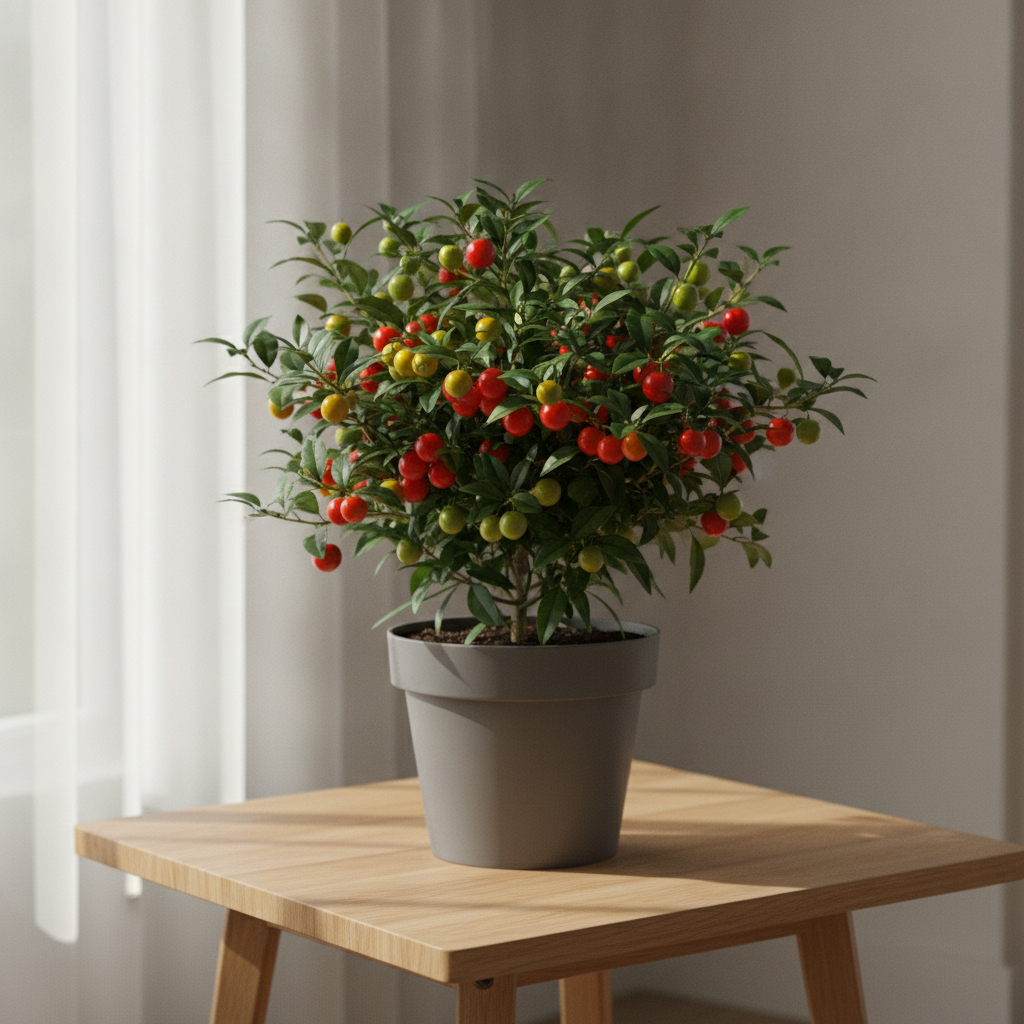
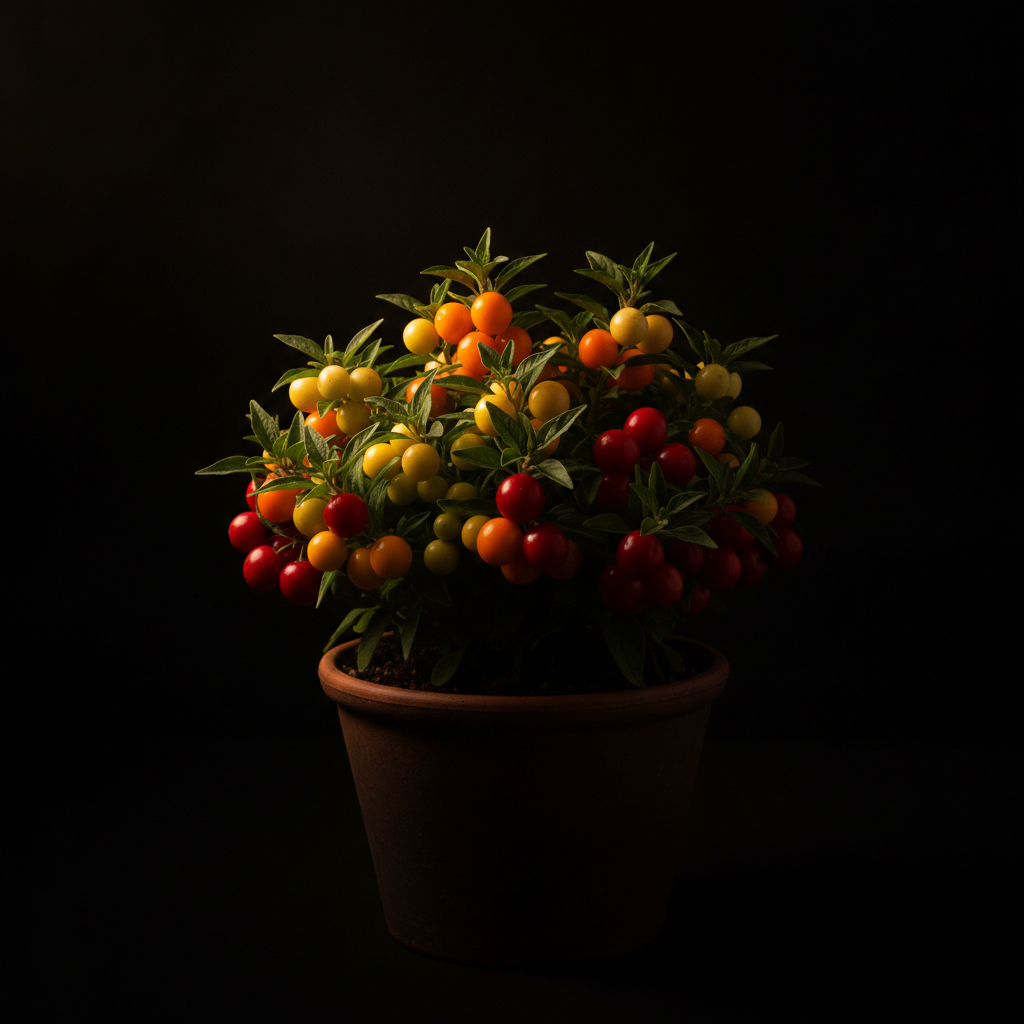
Few houseplants carry their decoration quite so boldly as the Jerusalem cherry (Solanum pseudocapsicum), a compact evergreen shrub of the nightshade family that smothers itself in round, glossy berries ripening through green and gold to a vivid scarlet. A relative of the tomato, potato and aubergine, it is native to South America and has naturalised across warm regions of the world. It arrives in shops in autumn and winter, often labelled winter cherry or Christmas cherry, and its fruit can hold its colour for months, which is exactly why it became a festive fixture on cool windowsills.
It has a reputation as a throwaway seasonal pot plant, but that sells it short. With cool temperatures, steady moisture and good light, a Jerusalem cherry is a true perennial that can be pruned and carried over from year to year. The catch, and it is an important one, is that every part of the plant is poisonous, and the cheerful fruit is the riskiest part of all. This guide covers everything from light and watering to propagation and pests, and draws a clear line between merely keeping the plant alive and getting it to flower, fruit and stay handsome through a long winter.
Contents
- Quick Reference
- Why Jerusalem Cherry Makes a Rewarding Houseplant
- Light Requirements
- Watering & Humidity
- Soil, Potting & Repotting
- Fertilising
- Propagation
- Pests & Diseases
- Popular Varieties
- Frequently Asked Questions
Quick Reference: Jerusalem Cherry at a Glance
| Light | Bright light with several hours of direct sun; essential for flowering and fruit set |
| Watering | Keep evenly moist in growth, never waterlogged; reduce in winter but do not let it dry out fully |
| Temperature | Cool-loving, 10 to 20°C (50 to 68°F); fruit lasts longest in cool rooms |
| Humidity | Moderate, around 40 to 60 percent; dry air encourages leaf drop and spider mite |
| Fertiliser | Balanced or high-potassium feed every two weeks from spring to early autumn |
| Toxicity | Highly toxic to people, cats and dogs; the berries are the greatest hazard |
Why Jerusalem Cherry Makes a Rewarding Houseplant
The appeal of Solanum pseudocapsicum is its sheer persistence. While most flowering pot plants offer a brief show and then fade, the Jerusalem cherry sets its fruit in late summer and holds it right through autumn and winter, the berries shifting slowly from green to yellow, orange and finally a deep glossy red. A single well-grown plant can carry dozens of fruit at once, often in several colour stages together, against neat dark foliage that stays evergreen all year. For a cool, bright room it provides colour in exactly the months when most houseplants have nothing to show.
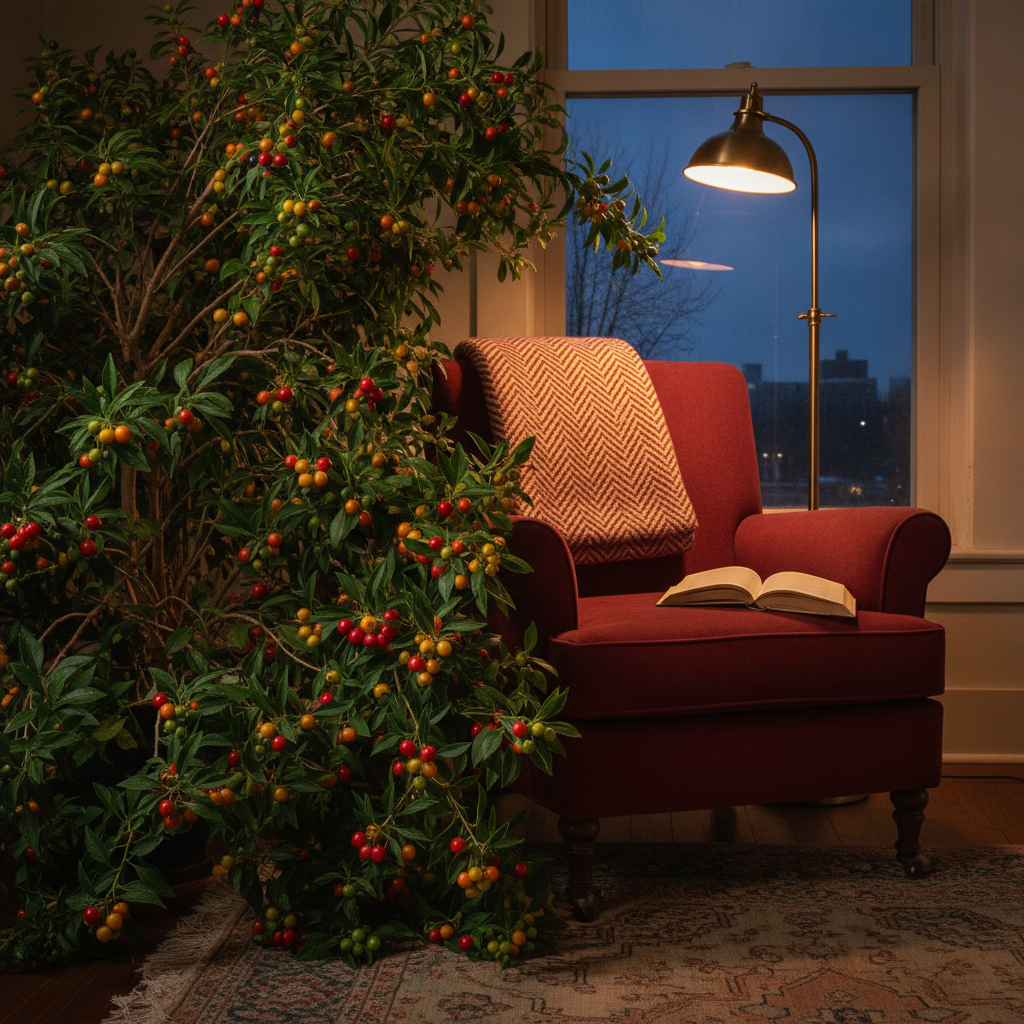
It is also genuinely undemanding once you understand what it wants, which is the opposite of most tropical houseplants. Rather than warmth and high humidity, it asks for cool air, bright light and honest watering, conditions that a chilly porch, conservatory or north-European windowsill supplies naturally. Treated as a perennial, it can be cut back hard in spring, fed through summer and brought back into fruit each winter for several years. The one thing every owner must take seriously is its toxicity, which shapes where the plant can safely live.
Important — Toxicity: All parts of the Jerusalem cherry contain the toxic glycoalkaloids solanine and solanocapsine, and the colourful berries, which look temptingly like cherry tomatoes, are the most dangerous part. Ingestion can cause vomiting, abdominal pain, drowsiness and, in severe cases, more serious effects in people and in cats and dogs. Keep this plant well out of reach of children and pets, and wash your hands after handling it. If a child or animal has eaten any part, contact a doctor, vet or poison helpline without delay.
Light Requirements
Light is the single biggest factor in whether a Jerusalem cherry merely survives or actually flowers and fruits. This is a sun-loving plant in the wild, growing in open, bright positions, and indoors it needs the brightest spot you can give it. Without enough light it will keep its leaves but produce few flowers, set little fruit, and gradually become thin and leggy as it stretches towards the window.
Aim for a position that receives several hours of direct sun each day alongside bright ambient light for the rest of the daylight hours. A sunny windowsill, conservatory bench or porch is ideal. Good light not only drives flowering but also deepens the colour of the ripening berries and keeps the plant compact and bushy rather than drawn and sparse.
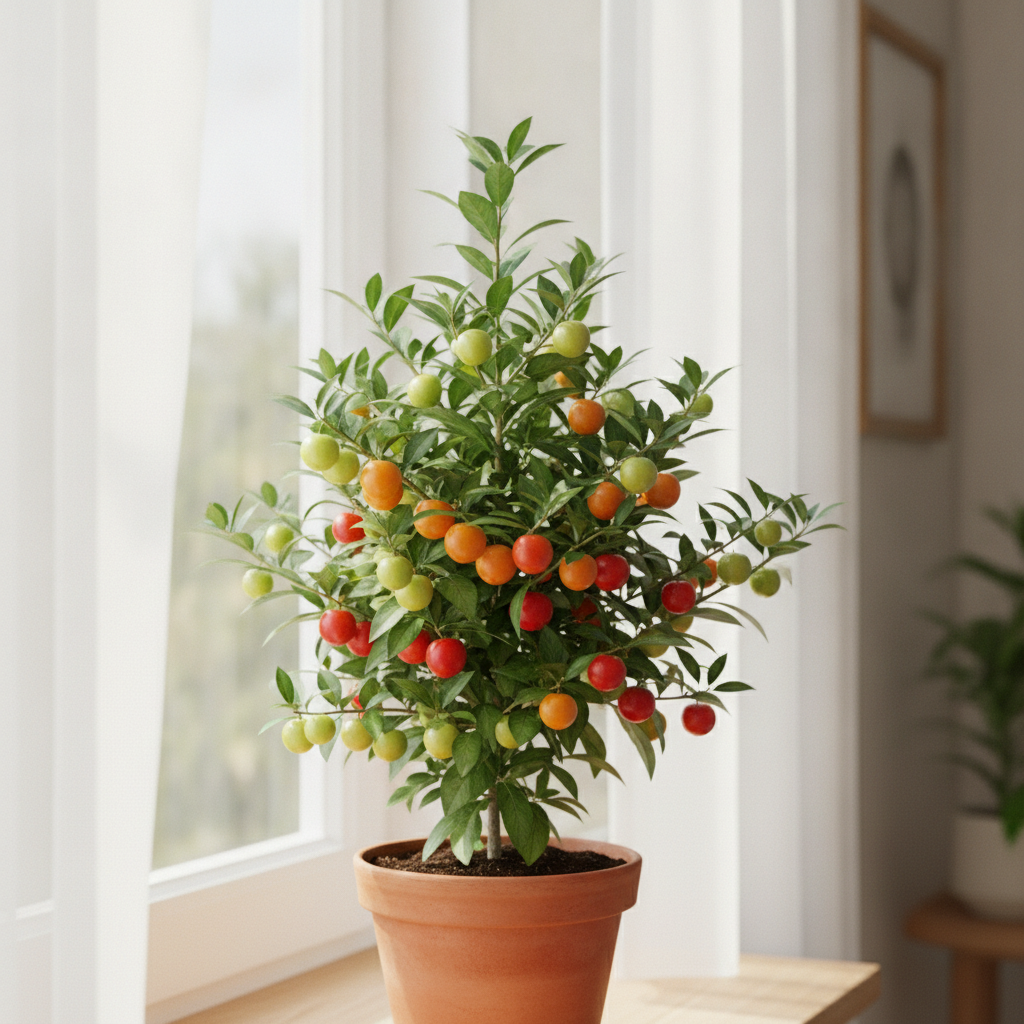
Light Levels Explained
The table below sets out how different indoor light levels translate into real outcomes for a Jerusalem cherry. Unlike many foliage houseplants that tolerate shade, this species genuinely needs to sit near the brighter end of the scale to perform.
| Light Category | Approx. Level | Typical Location | Outcome |
|---|---|---|---|
| Direct sun | 20,000 lux and up | On a south or west sill | Excellent flowering and rich berry colour; watch moisture in heat |
| Bright indirect | 10,000 to 20,000 lux | Just back from a sunny window | Good growth and reasonable fruiting |
| Medium | 5,000 to 10,000 lux | East window or a few feet from bright glass | Healthy foliage but sparse flowers and few berries |
| Low | 1,000 to 5,000 lux | North window or interior wall | Survives but grows leggy; little or no fruit |
| Very low | Under 1,000 lux | Dim corner or hallway | Gradual decline, leaf drop, no flowering |
Window Orientation and Placement
South-facing window: The best position in most homes. Plenty of direct light encourages heavy flowering and the brightest fruit. In a very hot, sunny room, keep the compost from drying out and provide a little ventilation.
East-facing window: A good choice, offering bright morning sun that is gentle on the foliage. Fruiting may be slightly lighter than at a south window but the plant will stay healthy and well coloured.
West-facing window: Also suitable, with strong afternoon light driving good flower and fruit production. Watch for heat build-up behind glass on summer afternoons.
North-facing window: Generally too dim for reliable fruiting. The plant will hang on but grow lank and produce little colour. If a north window is your only option, supplement with a grow light.
Pro Tip — Summer Outdoors: Moving your Jerusalem cherry outside to a sunny, sheltered spot for the summer pays real dividends. The extra light fuels strong flowering, and visiting insects pollinate the flowers far more reliably than they ever do indoors, which means more berries to enjoy through the following winter.
How Light Affects Flowering and Fruit
The whole point of growing this plant is the fruit, and fruit follows light. Small white star-shaped flowers appear through summer, and only well-lit plants produce them in any number. Each pollinated flower becomes a berry, so a plant kept too dark simply has nothing to ripen. Bright light also intensifies the final red of the mature berries; in poor light the fruit tends to stall at a dull orange. If your plant flowers but sets little fruit, light is usually the first thing to improve, followed by pollination.
Warning — Direct Sunlight: Although the Jerusalem cherry loves sun, a plant that has spent winter indoors can scorch if moved abruptly into full summer sun. Harden it off over a week or two, giving it gradually longer spells outside, so the foliage adapts without bleaching or developing dry brown patches.
Artificial Lighting
In a dim home, or through the short days of a northern winter, a full-spectrum LED grow light can make the difference between a sulking plant and a fruiting one. Position the light around 20 to 30cm (8 to 12in) above the canopy and run it for 12 to 14 hours a day. Supplementary light is most useful while flowers are forming, helping the plant set and ripen a good crop of berries even when natural daylight is weak.
Seasonal Adjustments
Light levels swing dramatically through the year, so move the plant to follow them. In summer it is happiest outdoors or at a bright window with a little protection from the fiercest midday heat. As autumn arrives and the berries colour up, shift it to the sunniest indoor spot you have to keep the fruit bright and the foliage dense. Turning the pot a quarter every week or two keeps growth even and stops the plant leaning hard towards the glass.
Watering & Humidity
The Jerusalem cherry likes consistency at the roots. Unlike a succulent that wants to dry out hard between drinks, this plant resents both extremes: standing water rots its roots, while a thorough drying out triggers a sudden and dispiriting drop of leaves and fruit. The aim throughout the growing season is compost that stays evenly moist, like a wrung-out sponge, never sodden and never dust-dry.
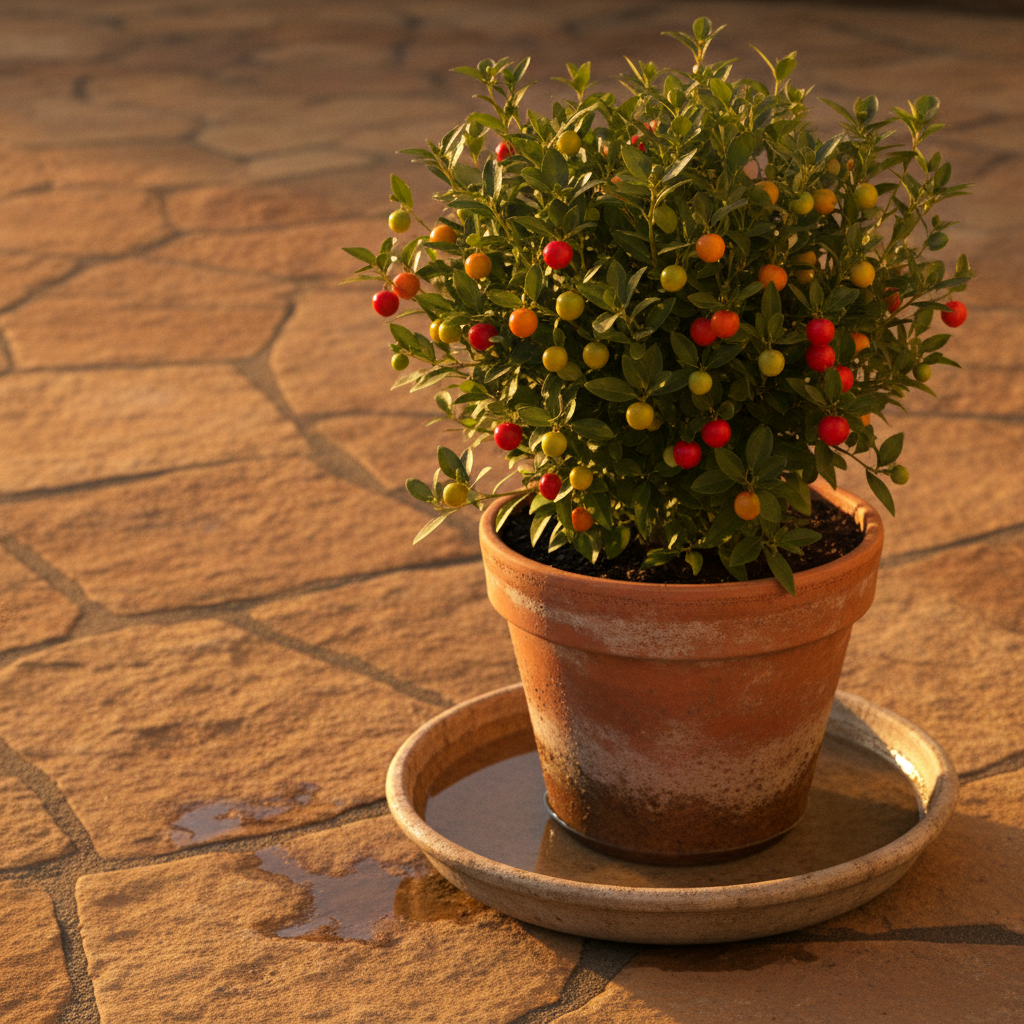
When to Water
Check the top of the compost with a finger. When the upper centimetre or two has just begun to dry, it is time to water again. During warm, bright summer weather a well-rooted plant in active growth may need watering every two to three days; the combination of sun, warmth and a full canopy of leaves draws moisture quickly.
In winter the plant slows down and the cool rooms it prefers dry out far more slowly, so cut back accordingly. Let the surface dry a little more deeply between waterings, but never allow the whole rootball to become bone dry, as that is the surest way to make a fruiting plant shed its berries. Tepid water is kinder than cold straight from the tap, especially in a chilly room.
Pro Tip — Weigh the Pot: Lifting the pot tells you more than poking the surface. Learn how heavy it feels just after watering and again when it is ready for more. A plant in fruit is working hard, so checking the weight every couple of days catches that critical point before the compost dries enough to drop leaves.
How to Water Correctly
- Check that the top of the compost has begun to dry before watering again.
- Water with tepid water, either over the surface or by standing the pot in a shallow dish.
- If watering from above, apply slowly until water runs freely from the drainage holes.
- Let the pot drain completely for several minutes so no water is left sitting at the base.
- Empty the saucer or cache-pot; never leave the plant standing in collected water.
- Return the plant to its bright spot and check again in a few days.
Signs of Overwatering vs. Underwatering
| Symptom | Overwatering | Underwatering |
|---|---|---|
| Leaf colour | Yellowing, often from the lower leaves upward | Dull, then yellowing with crisp brown edges |
| Leaf texture | Soft, limp and drooping | Wilting, then dry and papery |
| Fruit and flowers | Premature drop of berries and buds | Sudden drop of berries and leaves together |
| Soil | Constantly wet, sometimes a sour smell | Dry, shrunken and pulling away from the pot |
| Stem base and roots | Blackened, mushy roots; soft stem base | Firm but dry roots; brittle stems |
Warning — Root Rot: The fastest way to kill a Jerusalem cherry is to leave it standing in water. Waterlogged compost starves the roots of oxygen and invites rot, which shows first as yellowing, wilting leaves even while the soil is wet. Always use a pot with drainage holes and tip away any water that collects beneath it.
Humidity Requirements
Moderate humidity of roughly 40 to 60 percent suits the Jerusalem cherry well. It is far less fussy about moisture in the air than tropical foliage plants, but very dry conditions cause problems, especially indoors in winter when central heating strips the air. The plant copes best in the cool, slightly humid atmosphere of a porch or conservatory.
The clearest sign that the air is too dry is leaf drop combined with an outbreak of red spider mite, which thrives in hot, arid rooms. If leaves are falling and the foliage looks dull and finely mottled, suspect a combination of dry air and warmth and act on both.
To raise humidity, stand the pot on a tray of damp pebbles, group it with other plants, or mist occasionally in very dry spells. More importantly, keep the plant away from radiators and hot-air vents, and resist the urge to give it a warm room. A cooler position naturally holds more relative humidity and keeps the plant comfortable.
Water Quality
The Jerusalem cherry is not especially sensitive to water quality and tolerates ordinary tap water in most areas. If your supply is very hard, occasional use of rainwater or filtered water helps prevent a build-up of lime and minerals in the compost. Letting tap water stand overnight before use takes the chill off it and allows some chlorine to dissipate, which the plant appreciates in cold weather.
Soil, Potting & Repotting
Coming from the nightshade family, the Jerusalem cherry wants the same sort of fertile, free-draining medium that suits its cousin the tomato. A good general-purpose potting compost forms the base, opened up with extra drainage so the roots stay moist but never waterlogged. The balance to strike is moisture retention for a thirsty fruiting plant against the sharp drainage that keeps root rot at bay.
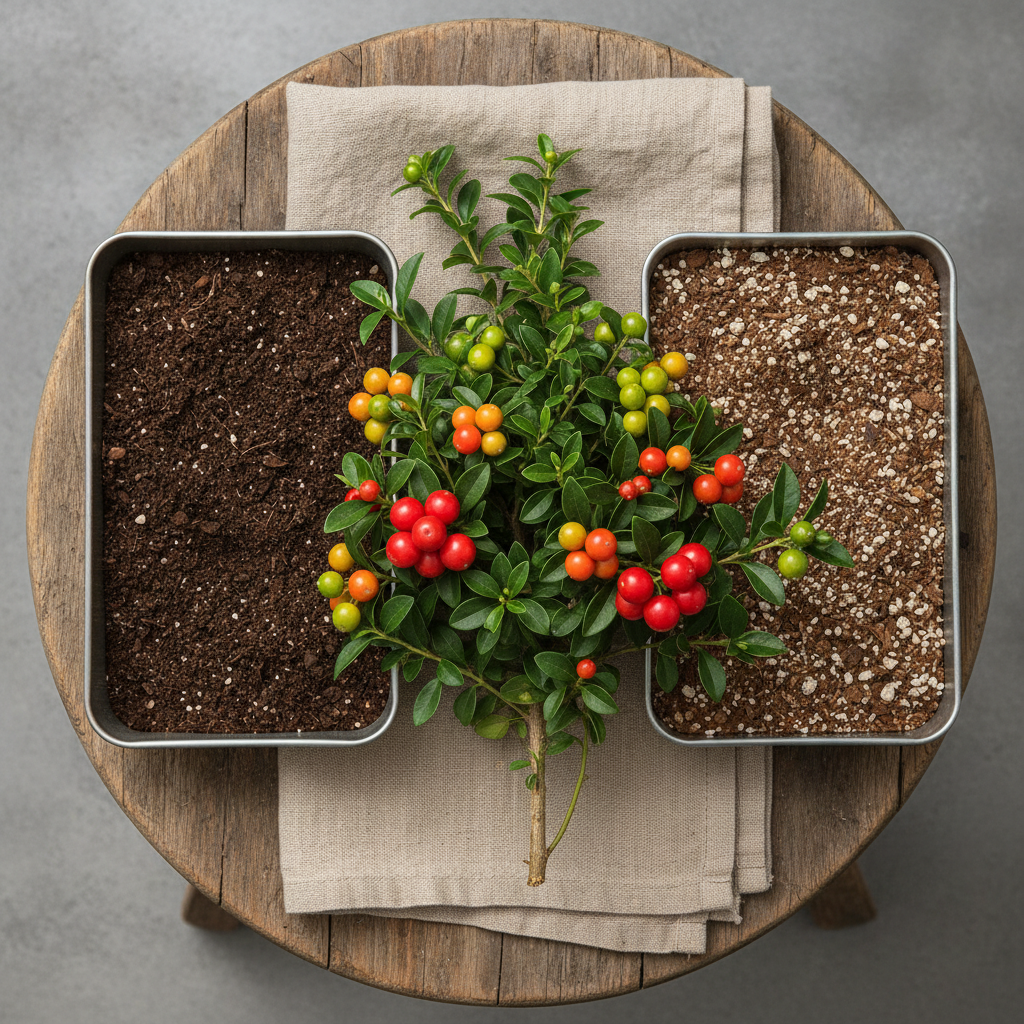
Ideal Soil Composition
A reliable mix is built around a quality peat-free multipurpose or loam-based compost, with grit or perlite added for drainage and a little organic matter for fertility. The blend below holds enough moisture for steady growth while still draining freely after each watering.
| Component | Proportion | Function |
|---|---|---|
| Peat-free multipurpose compost | 60 percent | Main body; holds moisture and nutrients |
| Loam or John Innes No. 2 | 20 percent | Adds weight, structure and slow-release fertility |
| Perlite or horticultural grit | 15 percent | Improves drainage and aeration |
| Worm castings or composted bark | 5 percent | Boosts fertility and microbial life |
The plant is easy-going about pH, thriving in anything from slightly acidic to slightly alkaline, around 6.0 to 7.5. A standard potting compost falls comfortably within this range, so there is no need to adjust it for a Jerusalem cherry.
Pro Tip — Quick Mix Recipe: If you want a simple working blend, combine four parts of any good peat-free potting compost with one part perlite and one part loam-based compost such as John Innes No. 2. That single recipe gives the moisture-holding fertility this fruiting shrub needs while keeping the drainage sharp.
Choosing the Right Pot
A pot that matches the size of the plant, with reliable drainage, will keep a Jerusalem cherry far healthier than an oversized or decorative container with no escape for excess water.
Drainage holes are non-negotiable. Whatever the material or style, the pot must have holes in the base. This plant will not forgive sitting in water, and a sealed cache-pot quietly collecting the runoff is one of the most common causes of root rot.
Pot material: Terracotta is an excellent choice because its porous walls let the compost breathe and dry a little between waterings, which suits a plant prone to overwatering. Glazed ceramic and plastic hold moisture longer, so if you use them, lean towards a grittier mix and water a touch more cautiously.
Pot size: Choose a container only a little larger than the rootball. Jerusalem cherries actually flower and fruit more freely when slightly snug at the roots, whereas a pot that is too big holds excess wet compost the roots cannot reach.
When to Repot
Repot in spring, as new growth begins and after any hard pruning, rather than in autumn or winter when the plant is fruiting and resting. A young plant in active growth may need moving up a size each spring, while an established specimen can go two years between repottings. Signs that it is time include roots emerging from the drainage holes, water running straight through without wetting the compost, and growth that has visibly slowed despite good care.
How to Repot: Step-by-Step
- Water the plant lightly the day before so the rootball holds together.
- Choose a clean pot one size larger, with drainage holes, and add a layer of fresh mix to the base.
- Ease the plant out and gently tease apart any tightly circling roots.
- Position it at the same depth as before, centred in the new pot.
- Fill around the rootball with fresh compost, firming gently to remove air pockets.
- Water thoroughly and let the pot drain completely.
- Return it to a bright but slightly sheltered spot for a week while it settles.
Warning — Transplant Shock: Repotting while the plant is in full fruit can cause it to drop berries and leaves as it reacts to disturbed roots. Wait until spring growth resumes, handle the rootball gently, and keep the freshly potted plant out of harsh direct sun for a week or so to let it recover without added stress. Wash your hands afterwards, as all parts are toxic.
Fertilising
A fruiting plant is a hungry plant. Producing a long succession of flowers and then ripening dozens of berries takes considerable energy, and regular feeding through the growing season is what keeps a Jerusalem cherry flowering freely rather than fading after a single flush.
Because the plant is so closely related to the tomato, the same feeding logic applies: a feed rich in potassium encourages flowers and fruit rather than just soft leafy growth. Many growers simply reach for a standard tomato fertiliser, and the plant responds well to it.
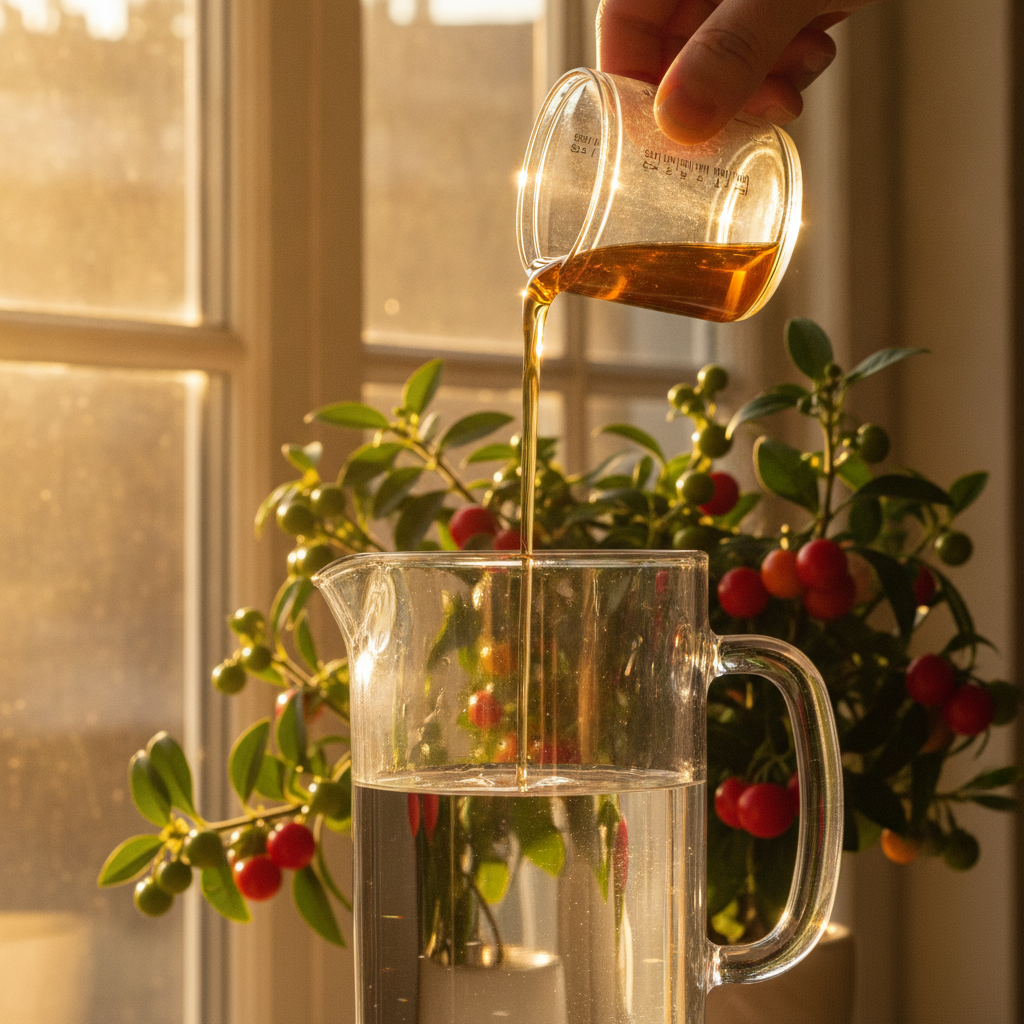
Understanding Plant Nutrients
Fertiliser labels carry an NPK ratio showing the proportions of nitrogen, phosphorus and potassium, the three nutrients plants need in the largest amounts. For a Jerusalem cherry, potassium deserves particular attention because it governs flowering and fruiting, but a healthy plant draws on a full range of nutrients, including several minor ones.
| Nutrient | Symbol | Primary Function | Deficiency Symptoms |
|---|---|---|---|
| Nitrogen | N | Leafy growth and rich green colour | Pale, yellowing older leaves; weak growth |
| Phosphorus | P | Root development and flowering | Poor roots; dull, purplish foliage |
| Potassium | K | Flowering, fruiting and overall vigour | Few flowers and fruit; scorched leaf edges |
| Calcium | Ca | Cell walls and new growth | Distorted young leaves; weak shoot tips |
| Magnesium | Mg | Core of the chlorophyll molecule | Yellowing between the veins of older leaves |
| Iron | Fe | Chlorophyll production in new leaves | Yellowing between veins of the youngest leaves |
Types of Fertiliser
Liquid fertilisers: The easiest option and the best match for this plant. A liquid tomato feed or balanced houseplant feed, diluted and applied with watering, delivers nutrients steadily and lets you fine-tune the amount through the season.
Slow-release granular: Pellets mixed into the compost or scattered on the surface in spring release nutrients gradually over months. Convenient, though they give you less control over feeding during the critical flowering period.
Organic fertilisers: Seaweed extract, worm castings and other organic feeds improve the compost and feed soil life as well as the plant. They tend to be gentler and lower in concentrated nutrients, so pair them with a potassium-rich feed when fruit is forming.
Feeding Schedule
Feed every two weeks from spring through to early autumn, while the plant is in active growth and producing flowers and fruit. As growth slows in autumn and the berries finish colouring, taper the feeding off, and stop altogether through winter when the plant is resting in its cool position. Resume in spring as new shoots appear.
Pro Tip — Switch to High Potassium: Use a balanced feed in spring to build up healthy leafy growth, then switch to a high-potassium tomato feed once flower buds appear. That seasonal change steers the plant away from soft foliage and towards the flowers and berries you actually want.
How to Fertilise
- Dilute the fertiliser to the strength recommended on the label, or slightly weaker.
- Water the plant first if the compost is very dry, to protect the roots.
- Apply the diluted feed evenly over the compost until it drains from the base.
- Feed during active growth only, on your regular two-week cycle.
- Flush the pot with plain water every month or so to clear any salt build-up.
Warning — Salt Build-Up: Feeding too often or too strongly leaves a crust of mineral salts on the compost and pot rim that can scorch the roots and brown the leaf edges. Stick to the recommended dilution, and once a month water with plain water alone to rinse accumulated salts out through the drainage holes.
Propagation
The Jerusalem cherry is easy to propagate, and there are two reliable routes: sowing seed from the ripe berries, and taking stem cuttings in summer. Seed is the traditional method and how the plant is raised commercially, while cuttings are quicker and produce a flowering plant sooner.
Both methods are straightforward, but the same warning runs through all of it: the berries and every other part of the plant are toxic. Handle seed and cuttings with care, keep them away from children and pets, and wash your hands when you have finished.
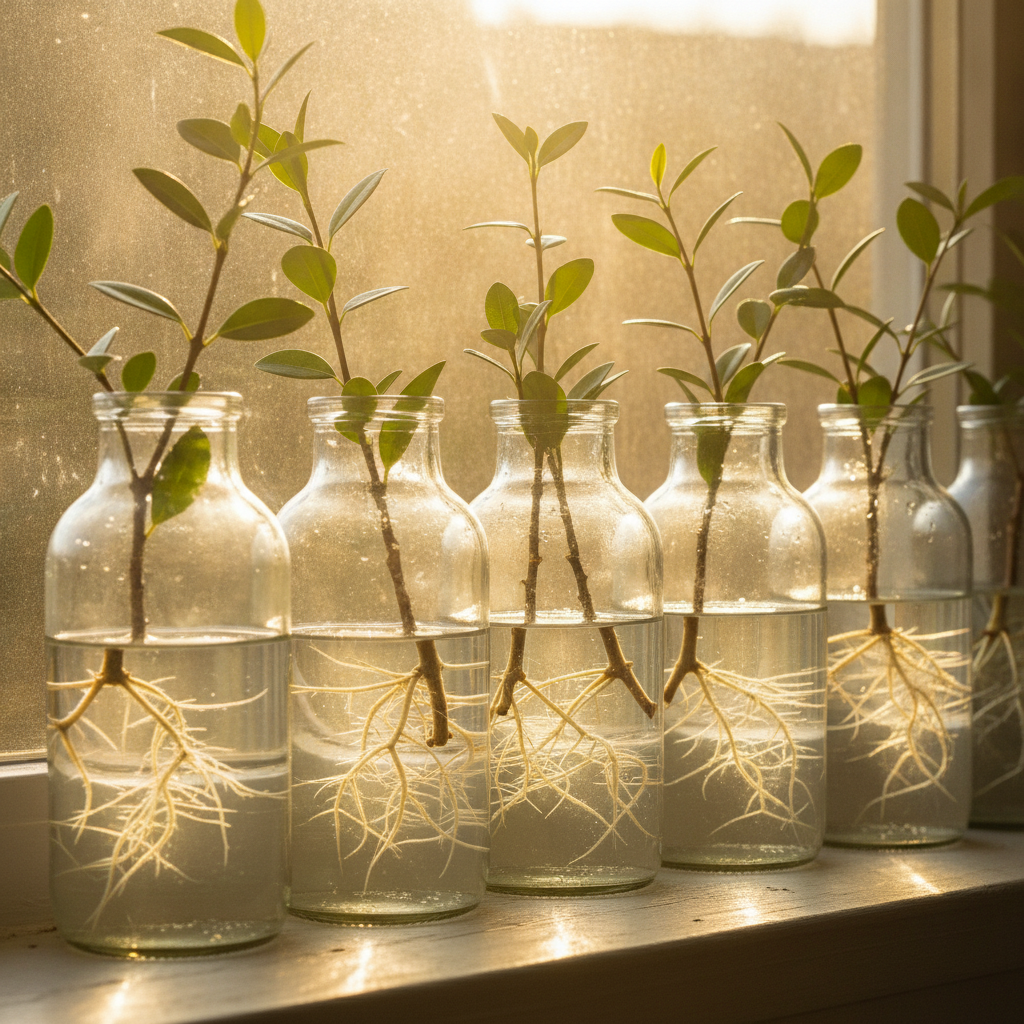
Understanding Seeds and Stem Nodes
Each ripe berry holds a number of small, flat seeds embedded in its flesh, and these germinate readily. For cuttings, the key structure is the node, the point on a stem where a leaf joins; this is where new roots form most readily. A healthy length of semi-ripe stem with a few nodes is all you need to start a new plant.
Stem Cuttings: Step-by-Step
Take cuttings in late spring or summer from semi-ripe growth, stems that are firm at the base but still soft at the tip. This is the faster way to a fruiting plant and reproduces named varieties exactly.
- Cut a healthy shoot around 8 to 10cm (3 to 4in) long, just below a node, using clean secateurs.
- Remove the lower leaves, leaving two or three at the tip, and pinch out any flowers or fruit.
- Dip the cut end in rooting hormone if you have it, then insert into a small pot of moist, gritty cutting compost, or stand it in a jar of water.
- Keep it warm, bright and out of direct sun, with the compost lightly moist or the water topped up.
- Roots usually appear within three to five weeks; pot up water-rooted cuttings once roots are a few centimetres long.
- Grow on in bright light and feed lightly once the cutting is established.
Pro Tip — Pinch for Bushiness: Once a young cutting or seedling has put on a few sets of leaves, pinch out the growing tip. This prompts the plant to branch from lower down, building the dense, well-furnished shape that later carries the heaviest crop of berries.
Growing from Seed: Step-by-Step
Sowing seed is cheap and produces plenty of plants, ideal if you want several or are replacing a tired specimen. Sow in late winter or early spring to give the young plants a full season to grow and fruit by the following winter.
- Squeeze the seeds from a fully ripe berry and rinse the flesh away, wearing gloves.
- Sow thinly on the surface of moist seed compost and cover with a light dusting of compost or vermiculite.
- Keep at around 18 to 21°C (64 to 70°F) in a propagator or covered tray, in bright indirect light.
- Germination takes roughly two to four weeks; remove the cover once seedlings appear.
- Prick out the seedlings into individual pots when they have two or three true leaves.
- Grow on in good light, potting up as they fill their containers and pinching tips to encourage branching.
Troubleshooting Propagation
| Problem | Likely Cause | Solution |
|---|---|---|
| Cuttings rot before rooting | Compost or water too wet and stagnant; warm, airless conditions | Use gritty compost or refresh the water; improve airflow and warmth |
| Seeds fail to germinate | Too cold, too dry, or sown too deep | Provide steady warmth, even moisture and only a light covering |
| Seedlings collapse at soil level | Damping-off fungus from overwatering | Sow thinly, water from below, and improve ventilation |
| Cuttings wilt badly | Too much leaf area losing water before roots form | Remove some leaves and keep humidity up with a clear cover |
Pests & Diseases
A Jerusalem cherry kept cool, bright and evenly watered is fairly resilient, but like all members of the nightshade family it attracts a familiar cast of sap-sucking pests, and the dry warmth of a heated room makes things worse. Most trouble can be headed off by good conditions and a regular close look at the foliage.
Inspect both sides of the leaves and the growing tips every week or two, particularly when the plant is indoors over winter. Catching an infestation early, while it is still a few insects rather than a colony, makes it far easier to clear without resorting to heavy treatment.

Common Pests
Red Spider Mite (Tetranychus urticae)
The most persistent enemy of the indoor Jerusalem cherry, thriving in hot, dry air. These tiny mites speckle the upper leaf surface with fine pale dots, and in bad cases spin delicate webbing between the leaves and stems while the foliage turns dull and drops.
Treatment: Raise the humidity and lower the temperature to make conditions hostile to them, rinse the plant under a gentle spray, and treat with insecticidal soap or a suitable miticide. Repeat every few days, as mites breed quickly in warmth.
Whitefly (Trialeurodes vaporariorum)
Tiny white moth-like insects that rise in a cloud when the plant is disturbed. They cluster on the undersides of leaves, sucking sap and excreting sticky honeydew that encourages sooty mould. Nightshades are a favourite host, so they appear readily on this plant.
Treatment: Hang yellow sticky traps to catch the adults, spray with insecticidal soap targeting the leaf undersides, and repeat regularly to break the breeding cycle. Outdoors in summer, natural predators often keep numbers down.
Aphids (Aphis and Myzus species)
Soft green or black insects that gather on tender new shoots and flower buds, distorting growth and spreading sticky honeydew. They can build up fast in spring as fresh growth appears, and may carry viruses between plants.
Treatment: Wipe or wash off small numbers, or spray with insecticidal soap for heavier infestations. Check regularly through spring, when soft new growth is most vulnerable.
Common Diseases
Grey Mould (Botrytis cinerea)
A fuzzy grey-brown mould that develops on flowers, fruit and leaves in cool, damp, stagnant conditions, exactly the winter conditions this plant can find itself in. It rots the affected tissue and spreads quickly if not checked.
Treatment: Remove and bin all affected parts, improve air circulation, avoid wetting the foliage, and water in the morning so the plant is dry by night. Space plants apart to keep air moving around them.
Root Rot (Pythium and Phytophthora species)
Caused by waterlogged compost, root rot turns the roots black and mushy and shows above ground as yellowing, wilting leaves that fail to recover after watering. It is the most serious problem the plant faces and is almost always down to overwatering or poor drainage.
Treatment: Catch it early, ease the plant from its pot, cut away blackened roots, and repot into fresh, free-draining compost. Water more sparingly thereafter and always ensure the pot drains freely.
Pest and Disease Summary
| Pest / Disease | Identification | Treatment |
|---|---|---|
| Red spider mite | Fine pale speckling and webbing; dull, dropping leaves | Raise humidity, rinse foliage, apply insecticidal soap or miticide |
| Whitefly | Clouds of tiny white insects; sticky honeydew | Yellow sticky traps and repeated soap sprays |
| Aphids | Clusters on new shoots and buds; distorted growth | Wash off or spray with insecticidal soap |
| Grey mould | Fuzzy grey-brown mould on flowers, fruit and leaves | Remove affected parts, improve airflow, keep foliage dry |
| Root rot | Yellowing, wilting leaves; black, mushy roots | Trim rotten roots, repot in fresh mix, water less |
Prevention Strategies
Prevention with this plant comes down to giving it the cool, bright, airy conditions it actually wants. Most pest outbreaks are linked to hot, dry, stuffy rooms, and most diseases to overwatering or stagnant damp air, so getting the basics right removes the root causes before they take hold.
Inspect new plants before bringing them home, and keep any new arrival apart from your other plants for a couple of weeks. Clear away fallen leaves and spent berries promptly, keep the foliage dry when you water, and make sure air can move freely around the plant. A summer spell outdoors also lets natural predators reset any pest populations that built up indoors.
Pro Tip — Stay Ahead of Spider Mite: Because spider mite is the number one indoor problem for this plant, prevention beats cure. Keeping the plant cool and the air humid through winter, and giving the foliage an occasional gentle shower, makes the dry, warm conditions mites love far harder to find.
Popular Varieties
Most Jerusalem cherries sold are simply the species, grown for their generous crop of round red berries, but a handful of named cultivars and a closely related species are worth seeking out. They vary mainly in size, foliage and the colour and shape of the fruit.
Compact, free-fruiting selections are the most useful for a windowsill, while the variegated form is grown as much for its marbled leaves as for its berries. The table and profiles below set out the choices you are most likely to encounter.
| Variety | Leaf Appearance | Light Needs | Growth Rate | Availability |
|---|---|---|---|---|
| Species (Solanum pseudocapsicum) | Glossy dark green, lance-shaped | Bright with direct sun | Moderate | Common |
| ‘Variegatum’ | Green marbled and edged with cream | Bright with direct sun | Moderate | Occasional |
| ‘Snowfire’ | Deep green, compact and dense | Bright with direct sun | Moderate, dwarf habit | Occasional |
| ‘Nanum’ | Dark green, small leaves | Bright with direct sun | Slow, very compact | Occasional |
| ‘Thurino’ | Mid-green, neat and bushy | Bright with direct sun | Moderate | Seed strains |
| False Jerusalem cherry (Solanum capsicastrum) | Greyish-green, downy, narrower | Bright with direct sun | Moderate | Common |
Featured Varieties
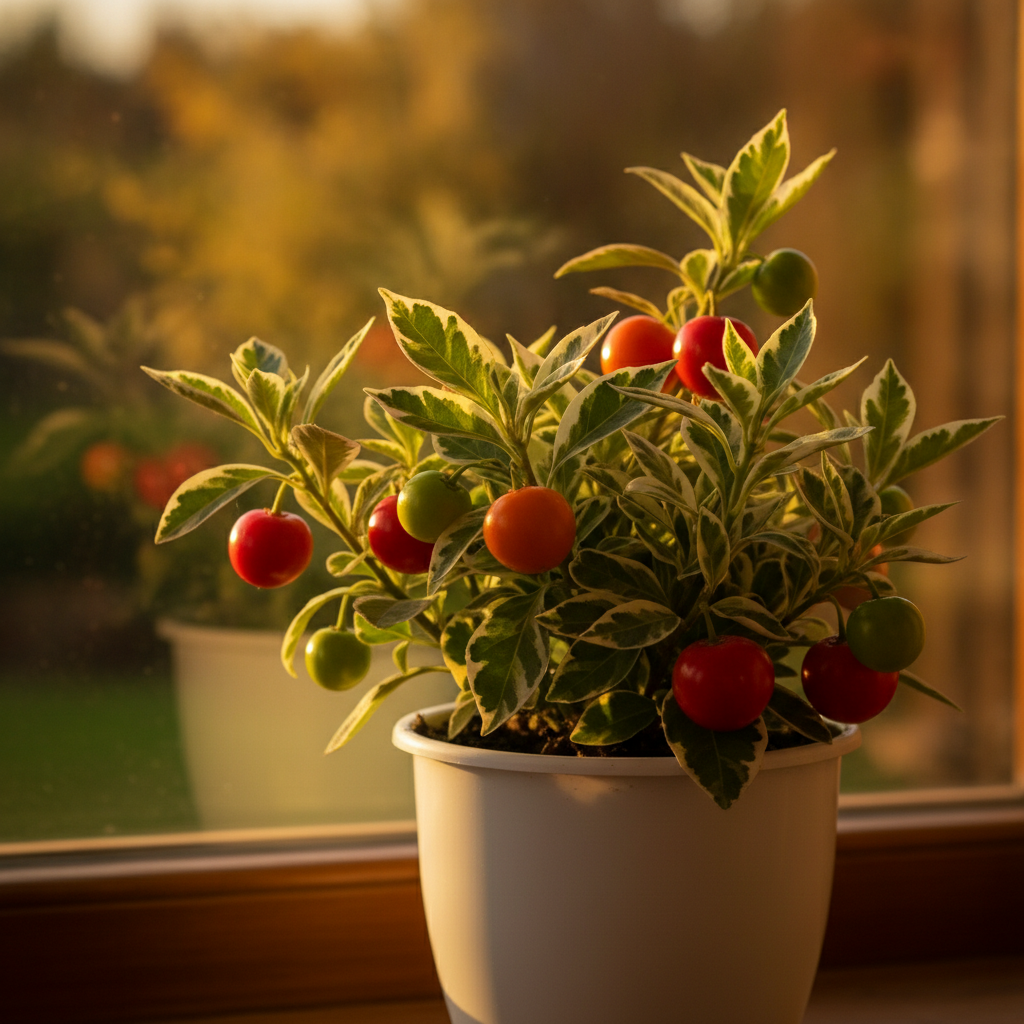
‘Variegatum’
The variegated Jerusalem cherry carries the same glossy lance-shaped leaves edged and marbled with creamy white, giving it ornamental value even between fruiting seasons. It bears the familiar round berries, ripening from green to orange-red, against its patterned foliage. Like all variegated plants it needs especially good light to keep the cream markings crisp.
‘Snowfire’
A compact, dwarf selection bred for heavy fruiting, ‘Snowfire’ packs itself with round berries showing every ripening stage at once, from cream and yellow through orange to deep scarlet, above neat deep green foliage. Its small, dense habit makes it one of the best forms for a bright windowsill where space is limited.
Variety Profiles in Detail
‘Nanum’ (Solanum pseudocapsicum ‘Nanum’)
A naturally dwarf form rarely exceeding 30cm (12in), ‘Nanum’ suits small spaces and looks especially neat as a festive tabletop plant. Despite its size it fruits generously, the small dark leaves setting off the bright berries well. Its slow, tidy growth means it needs little pruning to stay in shape.
False Jerusalem Cherry (Solanum capsicastrum)
Often sold interchangeably with the true Jerusalem cherry, this close relative has narrower, greyish-green downy leaves and slightly smaller, more pointed fruit that tends towards orange. Care is identical, and it is every bit as toxic. It shares the same winter cherry and Christmas cherry common names, which is a frequent source of confusion between the two species.
Choosing the Right Variety for Your Space
For most homes a compact, heavy-fruiting form such as ‘Snowfire’ or ‘Nanum’ is the most rewarding, giving maximum colour on a windowsill without taking over. If foliage interest matters to you, the variegated form earns its place even out of fruit. Whichever you choose, the growing requirements are the same: cool air, bright light with some direct sun, and steady moisture. And whichever you choose, the toxicity is identical, so place it with the same care.
Frequently Asked Questions
Is the Jerusalem cherry poisonous?
Yes, and seriously so. Every part contains toxic glycoalkaloids, and the bright berries, which resemble cherry tomatoes, are the most dangerous because they are so tempting to eat. The plant is poisonous to people, cats and dogs. Keep it well out of reach of children and pets, and seek medical or veterinary advice immediately if any part is swallowed.
Can you eat the berries?
No. Despite looking like miniature tomatoes, the berries are toxic and must never be eaten. The resemblance to an edible fruit is exactly what makes them hazardous, particularly to young children, so the plant is best avoided altogether in homes with curious toddlers.
Why is my Jerusalem cherry dropping its leaves and fruit?
Sudden leaf and berry drop almost always points to a stress, most often the compost drying out completely, but also a room that is too warm and dry, a draught, or a big change in conditions. Keep the plant cool, in steady light, and evenly watered, and avoid moving it between very different environments while it is in fruit.
How do I get it to produce more berries?
Berries follow flowers, and flowers follow light and pollination. Give the plant the brightest spot you can, including some direct sun, and feed with a high-potassium tomato feed once buds appear. Indoors the flowers often go unpollinated, so either move the plant outside while flowering or gently shake or brush the open flowers to transfer pollen yourself.
Is the Jerusalem cherry an annual or a perennial?
It is a true perennial, though it is frequently treated as a throwaway annual and discarded once the fruit fades. With care it lives for several years: cut it back by about a third to a half in spring, repot it, feed it through summer, and it will flower and fruit again the following winter.
What temperature does it need?
Cool conditions suit it best, ideally 10 to 20°C (50 to 68°F). Cool air makes the berries last far longer, whereas a hot room shortens the display and invites spider mite. It tolerates a brief dip towards freezing but is not reliably hardy, so protect it from frost and keep it away from radiators.
Can I grow it outdoors?
In mild, frost-free climates it can be grown outdoors year round, and in colder regions it makes an excellent patio plant for summer that is brought back inside before the first frost. A spell outside while it is flowering also improves pollination and fruit set, thanks to visiting insects. Site it where children and pets cannot reach the berries.
How big does a Jerusalem cherry grow?
As a houseplant it usually stays a tidy 30 to 45cm (12 to 18in), and dwarf forms remain smaller still. Given more root room and time it can reach a metre or more, but regular pruning in spring keeps it compact, bushy and well covered in fruit, which is how it looks its best indoors.






