
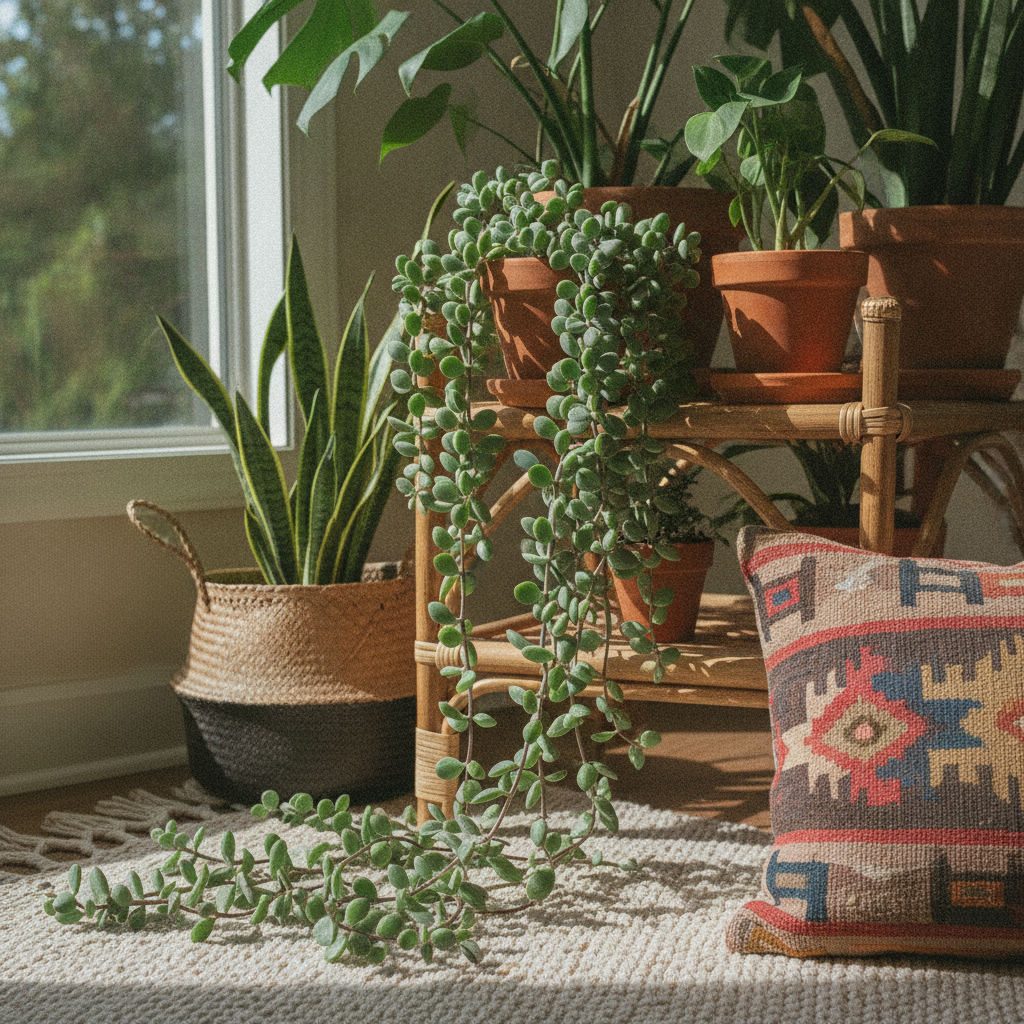
Few succulents earn their keep on a shelf edge quite like the trailing jade. Known botanically as Kleinia petraea, and still sold under its older name Senecio jacobsenii, this East African creeper sends out fleshy, blue-green stems that drape over the rim of a pot and flush a startling burgundy-purple when the light is bright. It belongs to the daisy family, Asteraceae, and originates from the rocky highland slopes of Kenya and Tanzania, where the species epithet petraea, meaning “of rocky places”, was earned among sun-baked outcrops and thin, fast-draining soil.
That heritage explains almost everything about how it behaves indoors. Trailing jade is forgiving enough to survive neglect that would kill a fussier plant, yet responsive enough that a little attention transforms it from a pale, leggy survivor into a compact cascade of colour. This guide covers the full picture, from light and watering through soil, feeding, propagation and pest control, with a clear distinction throughout between what keeps the plant merely alive and what makes it genuinely thrive.
Contents
- Quick Reference
- Why Trailing Jade Makes a Rewarding Houseplant
- Light Requirements
- Watering & Humidity
- Soil, Potting & Repotting
- Fertilising
- Propagation
- Pests & Diseases
- Popular Varieties
- Frequently Asked Questions
Quick Reference: Trailing Jade at a Glance
| Light | Bright indirect light with some direct sun; the more light, the deeper the purple colouring |
| Watering | Drench thoroughly, then allow the soil to dry out completely; roughly every 10 to 14 days in summer, monthly or less in winter |
| Temperature | 18 to 27 degrees Celsius (64 to 81 Fahrenheit); keep above 7 degrees Celsius (45 Fahrenheit) as it is not frost hardy |
| Humidity | Low to average; tolerates dry indoor air well and dislikes excess moisture |
| Fertiliser | Dilute succulent feed once a month during spring and summer only |
| Toxicity | Mildly toxic to pets and humans if ingested; keep out of reach of cats, dogs and children |
Why Trailing Jade Makes a Rewarding Houseplant
The appeal of trailing jade rests on a rare combination of toughness and drama. Its stems lengthen steadily through the growing season, spilling over the edge of a hanging basket or shelf to form a living curtain of plump, oval leaves. Each leaf carries a fine waxy bloom, a powdery coating known as farina that gives the foliage its soft blue-green cast and protects it from intense sun. When the plant is grown brightly, that blue-green deepens into rich purples and burgundies along the leaf margins and stems, a colour shift that no amount of artificial dye could match.
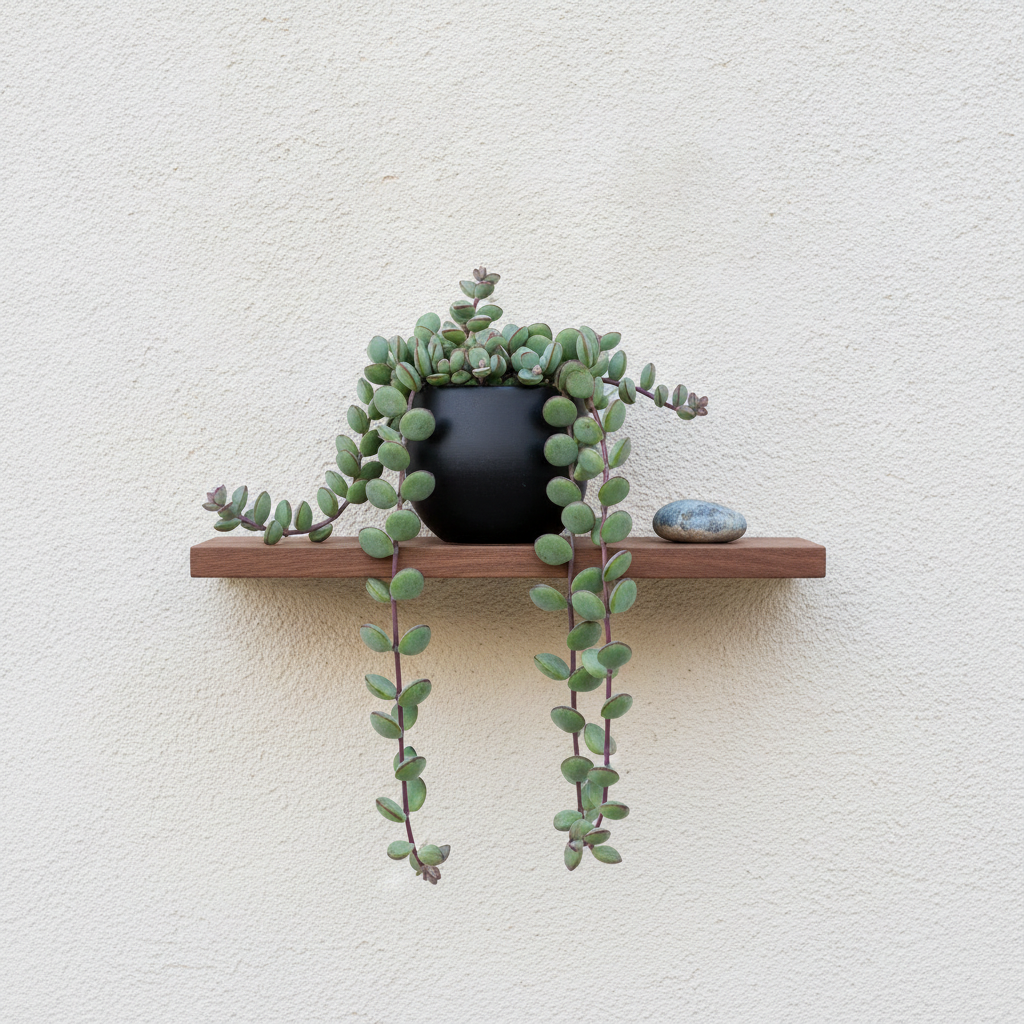
Beyond looks, this is one of the most low-maintenance trailing succulents available. It stores water in its leaves and stems, so it shrugs off the occasional missed watering, and it asks for none of the humidity or precise temperature control that tropical foliage plants demand. For anyone who has struggled with thirsty ferns or temperamental calatheas, the contrast is liberating. The hardest part of growing trailing jade well is resisting the urge to fuss over it, because the things that kill it almost always come from doing too much rather than too little.
Important — Toxicity: Like other members of the Senecio and Kleinia groups, trailing jade contains compounds that are mildly toxic if eaten, and the sap can irritate sensitive skin. Keep it away from curious cats, dogs and small children, and wash your hands after taking cuttings.
Light Requirements
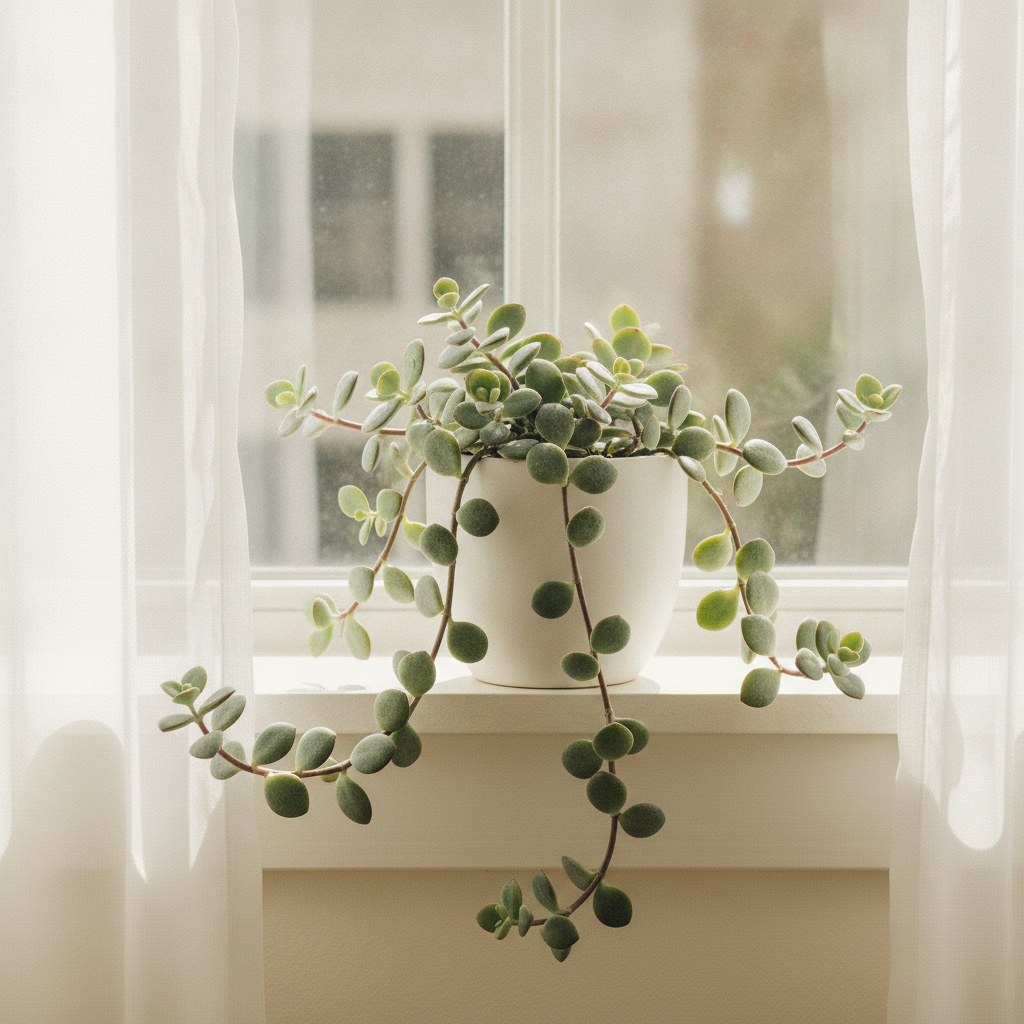
Light is the single most important factor in growing a good-looking trailing jade. In its native rocky habitat the plant grows fully exposed, so indoors it wants as much brightness as you can give it short of harsh, unfiltered midday sun through glass. A position that receives several hours of gentle direct sun each day, with bright ambient light the rest of the time, sits squarely in its comfort zone.
The difference between adequate and ideal light shows up directly in the plant’s colour and form. In merely adequate light the leaves stay a flat green, the gaps between them stretch out, and the stems grow thin and reaching. In ideal light the internodes stay short and packed, the foliage takes on its signature purple blush, and the whole plant looks dense and deliberate rather than scrawny.
Light Levels Explained
The table below sets out how trailing jade responds across the usual indoor light categories, so you can match the plant to the brightest spot you have available.
| Light Category | Approx. Level | Typical Location | Outcome |
|---|---|---|---|
| Direct sun | Over 50,000 lux | Unobstructed south window | Excellent colour and compact growth, but acclimatise slowly to avoid scorch |
| Bright indirect | 20,000 to 50,000 lux | Near a sunny window, lightly filtered | The ideal range; strong colour, tight habit |
| Medium | 10,000 to 20,000 lux | A metre or two back from a bright window | Survives and grows, but greener and slightly stretched |
| Low | 2,000 to 10,000 lux | North-facing room, interior wall | Etiolation, weak stems, loss of purple tones |
| Very low | Under 2,000 lux | Hallway, far from any window | Decline over time; not sustainable |
Window Orientation and Placement
South-facing window: In the northern hemisphere this is the best position, delivering the long hours of bright light the plant craves. In high summer, a sheer curtain softens the fiercest midday rays and prevents the waxy bloom from being scorched.
East-facing window: An excellent choice. Gentle morning sun brings out good colour without the heat stress of afternoon exposure, and the plant rarely needs shading here.
West-facing window: Also very suitable, offering strong afternoon light. Watch for heat build-up close to the glass on hot days, as trapped warmth can dehydrate the leaves faster than expected.
North-facing window: The weakest option. The plant will hang on but tends to stretch and fade, losing the compactness and purple colouring that make it worth growing. Supplementary lighting helps considerably in this position.
Pro Tip — Rotate for Even Growth: Trailing jade leans hard towards its light source. Give the pot a quarter turn every week or two so the stems lengthen evenly all the way around rather than crowding to one side.
How Light Affects Leaf Colour
The purple flush that makes trailing jade so distinctive is a stress response, produced by pigments called anthocyanins that the plant builds up under strong light and cool nights. This is the same mechanism that turns many succulents red or orange when they are “sun-stressed”. The colour is harmless and, in fact, a sign of a happy, well-lit plant. If your trailing jade is uniformly green with no hint of burgundy, it is telling you that it would prefer a brighter spot.
Warning — Direct Sunlight: A plant moved suddenly from a dim corner into full sun can scorch, leaving bleached or brown patches that never recover. Always increase light gradually over a week or two, lengthening the exposure a little each day so the leaves can build up their protective bloom.
Artificial Lighting
Where natural light is limited, trailing jade responds well to a full-spectrum LED grow light. Position the light 20 to 40 centimetres (8 to 16 inches) above the plant and run it for 10 to 12 hours a day. Artificial light will not usually produce the same intense purple as strong sun, but it keeps growth compact and prevents the weak, stretched stems that develop in genuinely dim rooms during winter.
Seasonal Adjustments
Light intensity drops sharply indoors through autumn and winter, even on a sunny windowsill. Move the plant to your brightest available position for the darker months, and do not be alarmed if the purple tones fade slightly as growth slows. As the days lengthen again in spring, ramp up exposure gradually rather than throwing a winter-adjusted plant straight into strong spring sun.
Watering & Humidity
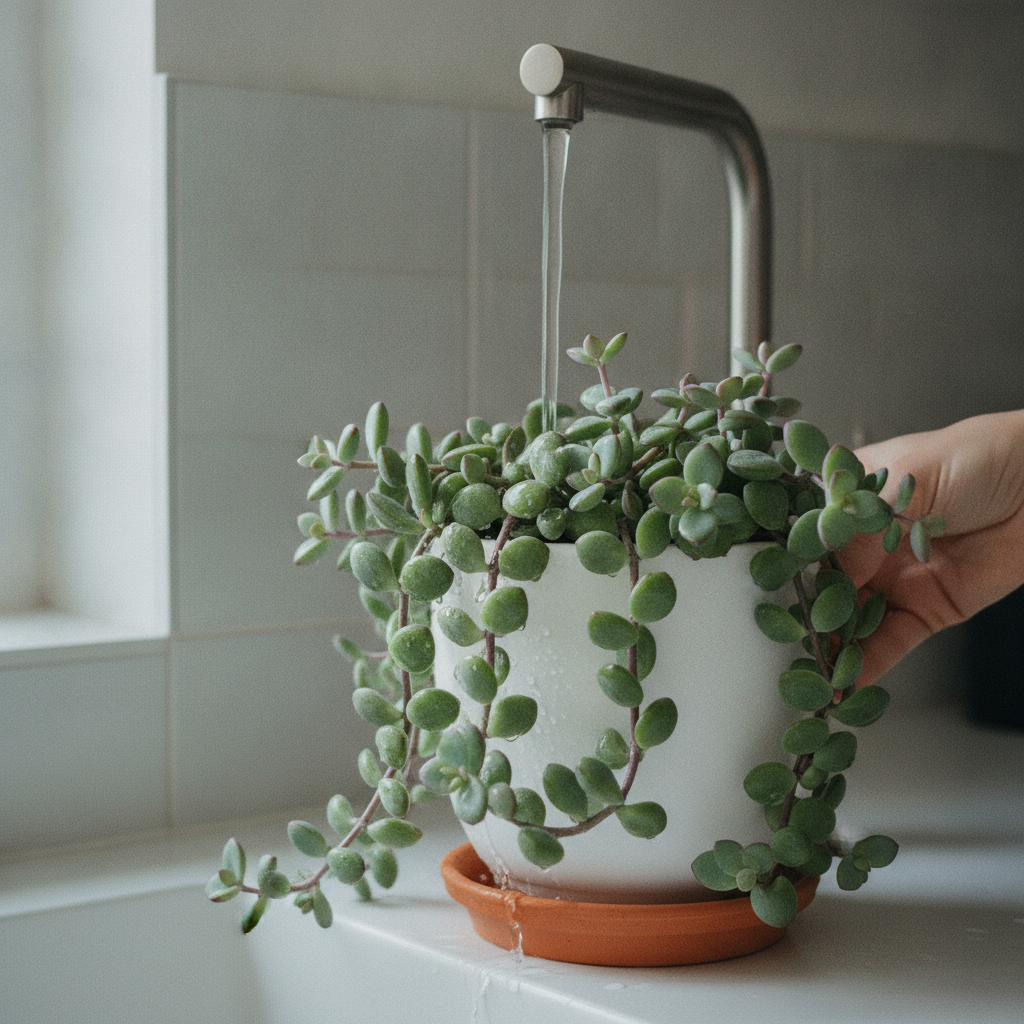
Watering is where most trailing jades are lost, and almost always to too much rather than too little. As a succulent that evolved on free-draining rock, this plant is built to endure drought and to rot quickly if its roots sit in moisture. The guiding principle is simple: water generously, then wait until the soil is bone dry before watering again.
When to Water
The most reliable test is your finger. Push it a few centimetres into the mix, and only water when it feels completely dry all the way down. During the active growth of spring and summer this typically means watering every 10 to 14 days, though the exact interval depends on your light, warmth and pot size. The plant itself also gives clear signals: firm, plump leaves mean it is well hydrated, while leaves that look slightly soft or wrinkled are an early request for a drink.
In autumn and winter, when growth naturally slows, cut watering back dramatically to roughly once a month or even less. A cool, resting plant uses very little water, and the wet-and-cold combination is the surest route to root rot. When in doubt during the colder months, wait another week.
Pro Tip — Read the Leaves: Trailing jade is one of the easiest plants to read. Plump, taut leaves mean all is well; soft, slightly puckered leaves mean it is thirsty; and translucent, mushy, yellowing leaves mean it has had far too much. Let the foliage, not the calendar, set your schedule.
How to Water Correctly
- Check that the top several centimetres of soil, and ideally the whole pot, are completely dry before you begin.
- Water at the soil level rather than over the foliage, to keep the waxy bloom intact and avoid trapping moisture in the leaf joints.
- Add water slowly and steadily until it flows freely from the drainage holes, ensuring the entire root ball is moistened.
- Let the pot drain fully for several minutes, then tip away any water collected in the saucer or cachepot.
- Wait until the mix has dried out entirely before repeating, adjusting the interval with the seasons.
Signs of Overwatering vs. Underwatering
| Symptom | Overwatering | Underwatering |
|---|---|---|
| Leaf colour | Yellowing, translucent or blackened leaves | Dull, slightly faded green or muted purple |
| Leaf texture | Soft, mushy, swollen and squishy to the touch | Wrinkled, deflated and thin |
| Soil | Stays damp for many days, may smell sour | Bone dry and pulling away from the pot sides |
| Roots | Brown, slimy and falling apart | Dry but intact and pale |
| Stem base | Soft, dark and collapsing | Firm, perhaps slightly shrivelled |
Warning — Root Rot: Soft, blackening stems and a sour smell from the soil signal root rot, which can kill a trailing jade within days. Act fast: unpot the plant, cut away all mushy tissue with a clean blade, take healthy cuttings from the firm growth, and start again in fresh, dry, gritty mix. Saving cuttings is often easier than saving the original root system.
Humidity Requirements
Humidity is refreshingly uncomplicated with this plant. Trailing jade is perfectly content in the dry air of a centrally heated home and has no need for misting, pebble trays or humidifiers. Average household humidity of around 40 to 50 percent suits it well, and it copes happily with much lower levels.
If anything, excess humidity works against it. Damp, stagnant air encourages fungal problems and slows the drying of the soil between waterings, both of which the plant dislikes. There is no humidity-related symptom to watch for in normal indoor conditions, which is part of what makes it such a relaxed companion.
The one thing worth providing is gentle air movement. A little circulation, from an open door or a nearby fan on warm days, helps keep the foliage dry and discourages the moulds that occasionally trouble crowded succulents.
Water Quality
Trailing jade is not fussy about water quality and tolerates ordinary tap water in most areas. In regions with very hard water, mineral salts can gradually build up in the soil and leave a pale crust on the surface, so occasional flushing with rainwater or filtered water is beneficial. Room-temperature water is gentler on the roots than water straight from a cold tap.
Soil, Potting & Repotting
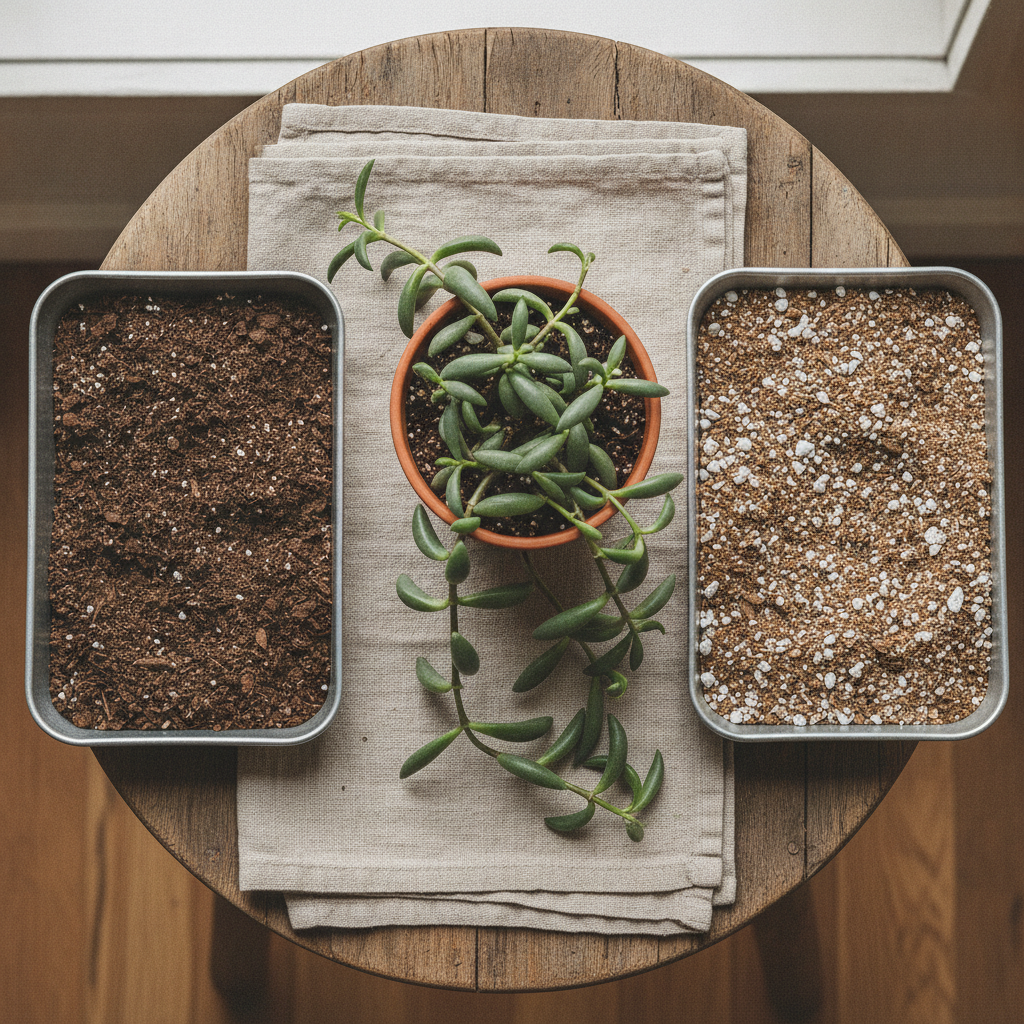
Get the soil right and most other problems take care of themselves. Trailing jade needs a substrate that drains almost instantly and holds very little moisture, mirroring the gritty, rocky ground of its native slopes. A standard houseplant compost, which stays wet for days, is the wrong choice and a common cause of failure.
Ideal Soil Composition
A good mix balances a small amount of organic matter, to hold a little moisture and nutrition, with a large proportion of coarse mineral grit that creates the air pockets and rapid drainage succulent roots demand. The aim is a substrate that water passes straight through, leaving the mix barely damp rather than soggy.
| Component | Proportion | Function |
|---|---|---|
| Cactus or succulent compost | About one third | Provides light structure and modest nutrition |
| Coarse grit or pumice | About one third | Creates rapid drainage and root aeration |
| Perlite or coarse sand | About one third | Keeps the mix open and prevents compaction |
The plant prefers a neutral to slightly acidic soil, roughly pH 6.0 to 7.0, which most commercial succulent mixes provide without any adjustment. There is no need to chase a precise figure; the drainage matters far more than the exact pH.
Pro Tip — Quick Mix Recipe: For a reliable blend, combine two parts of a bagged cactus and succulent compost with one part pumice or perlite. If your home runs cool or you tend to water generously, push the grit even higher to be safe; it is almost impossible to make this mix too sharp.
Choosing the Right Pot
Because trailing jade trails, it is naturally suited to a hanging pot, a wall planter or a position on a high shelf where the stems can cascade freely. Whatever style you choose, the practical requirements matter more than the aesthetics.
Drainage holes are non-negotiable. The pot must have at least one drainage hole. Without it, water collects unseen at the base and the roots rot, no matter how careful your watering. Decorative pots without holes should only ever be used as outer cachepots, with the plant in a draining inner liner.
Pot material: Terracotta is an excellent match for this plant. Its porous walls wick moisture out of the soil and let it dry faster, providing a useful safety margin against overwatering. Glazed ceramic and plastic both work too, but hold moisture longer, so you must be more disciplined about letting them dry.
Pot size: Choose a pot only slightly larger than the root ball. Trailing jade has a relatively small root system and dislikes swimming in a large volume of damp soil, which stays wet too long. Snug is better than spacious.
When to Repot
This is a slow-rooting, undemanding plant that only needs repotting every two to three years, or when roots begin to emerge from the drainage holes and the mix has broken down and stopped draining freely. Spring, at the start of the growing season, is the ideal time, giving the plant the warmth and light to recover quickly. Avoid repotting in winter, when the plant is resting and least able to heal disturbed roots.
How to Repot: Step-by-Step
- Water lightly a day or two beforehand if the mix is dust dry, which makes the root ball easier to handle, though many growers prefer to repot dry to reduce rot risk.
- Ease the plant from its pot, supporting the trailing stems gently to avoid snapping the brittle leaves.
- Tease away the old, spent soil from the roots and inspect them, trimming off any that are brown, soft or dead.
- Add a layer of fresh gritty mix to the base of the new pot, then settle the plant at the same depth it grew before.
- Fill around the root ball with more mix, firming it gently so the plant sits stable without being packed tight.
- Hold off on watering for several days to let any disturbed roots callous over, then resume your normal dry-out routine.
Warning — Transplant Shock: Repotting into fresh, damp soil and watering immediately is a classic way to rot a freshly disturbed plant. Always wait at least three to five days after repotting before the first watering so that any nicked roots can seal over.
Fertilising
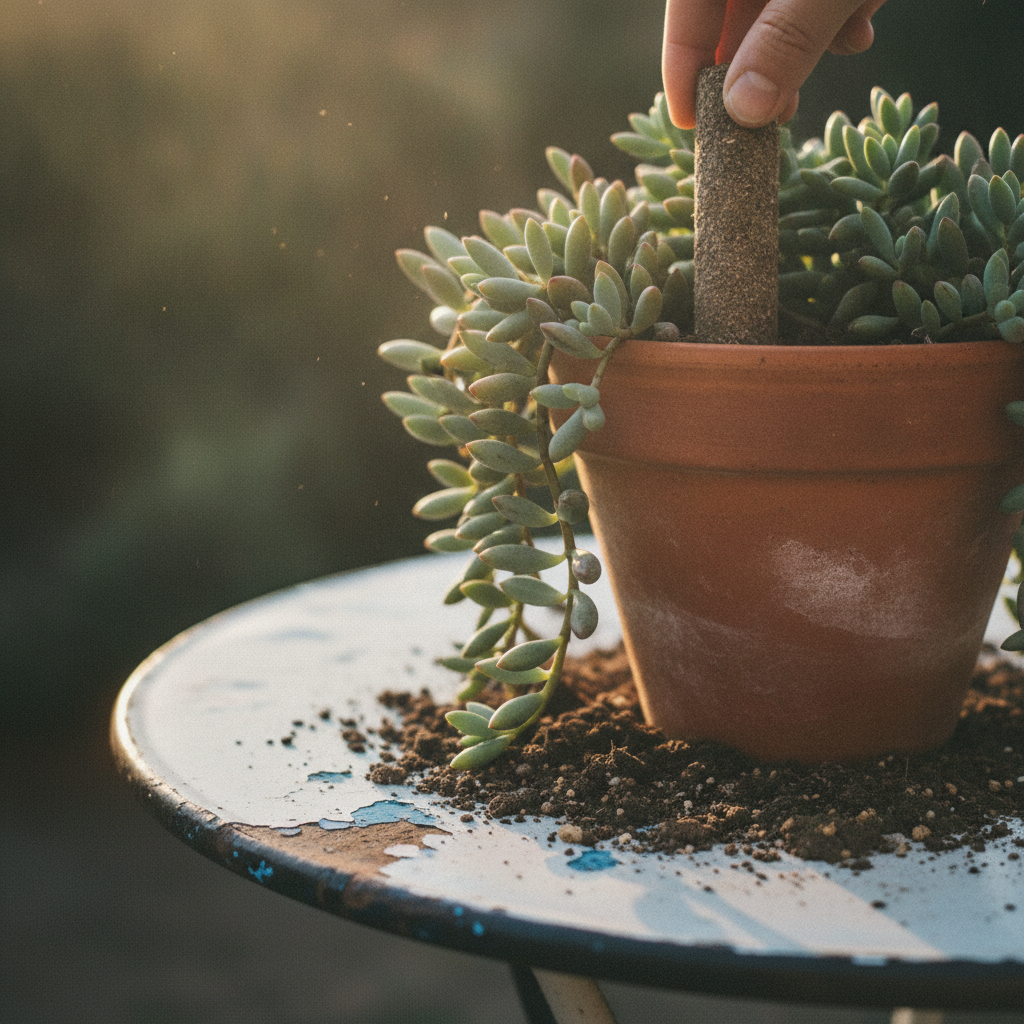
Trailing jade is a light feeder by nature, adapted to thin, nutrient-poor soils. It does not need rich feeding and is easily harmed by too much, so the watchword here is restraint. A little dilute fertiliser during the growing season encourages steady growth and good colour, while heavy feeding produces soft, weak, rot-prone tissue.
Feed only in spring and summer, when the plant is actively growing, and stop entirely through autumn and winter. A dormant plant cannot use the nutrients, and unused fertiliser salts simply accumulate in the soil where they can scorch the roots.
Understanding Plant Nutrients
Fertilisers are labelled with their ratio of three main nutrients, nitrogen, phosphorus and potassium, often shown as an N-P-K figure. For a succulent like trailing jade, a balanced or slightly low-nitrogen feed is ideal, as too much nitrogen forces lush, soft growth at the expense of compactness and colour. A handful of secondary nutrients round out a plant’s needs.
| Nutrient | Symbol | Primary Function | Deficiency Symptoms |
|---|---|---|---|
| Nitrogen | N | Leaf and stem growth | Pale, slow, weak growth |
| Phosphorus | P | Root development and flowering | Poor roots, dull foliage |
| Potassium | K | Overall vigour and stress resistance | Yellow leaf edges, weak stems |
| Calcium | Ca | Cell wall strength | Distorted new growth |
| Magnesium | Mg | Chlorophyll production | Yellowing between leaf veins |
| Iron | Fe | Healthy green colour | Pale new leaves with green veins |
Types of Fertiliser
Liquid fertilisers: The easiest option for this plant. A liquid succulent or cactus feed, diluted to half the recommended strength, can be added to your watering can once a month in the growing season, giving you precise control over how much the plant receives.
Slow-release granular: A small amount of slow-release fertiliser mixed into the soil at repotting releases nutrients gradually over months. Use a light hand, as it is easy to over-apply, and choose a formulation intended for succulents rather than leafy foliage plants.
Organic fertilisers: Gentle options such as diluted worm-casting tea suit the plant’s preference for lean conditions and carry little risk of scorching. They release nutrients slowly and improve the soil’s biology, though they provide a milder feed than synthetic products.
Feeding Schedule
A simple rhythm works best: feed once a month with a half-strength succulent fertiliser from early spring through to late summer, then stop completely. That is genuinely all this plant requires. There is no benefit to feeding more often, and plenty of risk, so resist the temptation to do more.
Pro Tip — Less Is More: When it comes to feeding succulents, under-doing it always beats over-doing it. If you are unsure whether to feed, skip it. A slightly hungry trailing jade stays compact and colourful, while an over-fed one grows soft and loses its character.
How to Fertilise
- Dilute a succulent or cactus liquid feed to half the strength stated on the label.
- Water the plant with plain water first if the soil is completely dry, to avoid fertiliser burn on parched roots.
- Apply the diluted feed to the soil at the base of the plant, not over the foliage.
- Allow the pot to drain fully and tip away any runoff, then return to your normal dry-out cycle.
Warning — Salt Build-Up: Over time, fertiliser salts can accumulate and form a white crust on the soil surface or pot rim, damaging the roots. Once or twice a year, flush the pot through with plenty of plain water, letting it drain fully, to wash these salts away.
Propagation
If trailing jade has one party trick, it is how absurdly easy it is to propagate. Stem cuttings root almost without effort, which makes the plant ideal for filling out a sparse pot, sharing with friends or rescuing the healthy growth from a specimen that has begun to rot. A single long stem can yield several new plants.
The best time to propagate is during the active growth of spring and summer, when cuttings root fastest, though the plant is so willing that cuttings taken at almost any time of year will usually succeed given warmth and light.
Understanding Stem Nodes
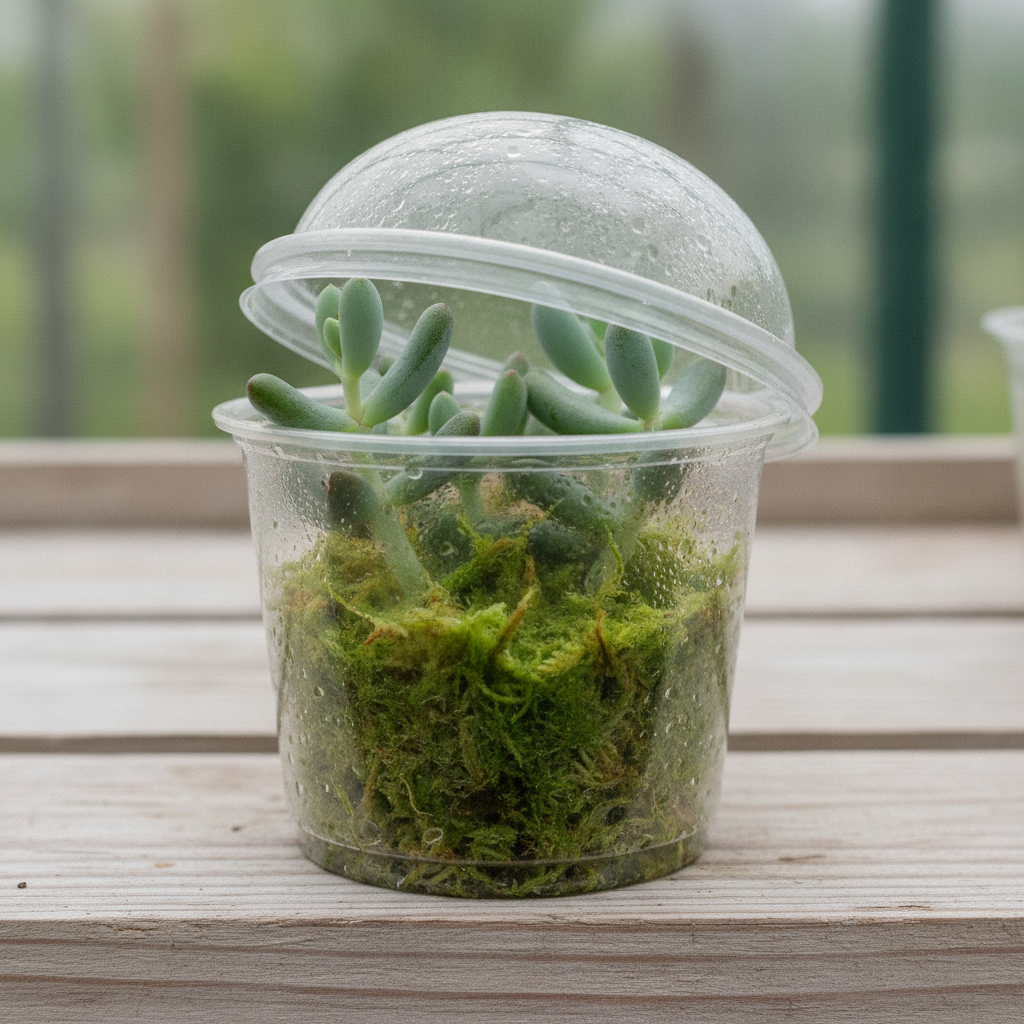
New roots emerge from the nodes, the points along a stem where leaves attach. A successful cutting needs at least one or two nodes, because that is where rooting hormones concentrate and where new roots will form. Knowing this, you can take a long trailing stem and cut it into several shorter sections, each with a couple of nodes, and grow a whole tray of new plants from a single length.
Stem Cuttings in Soil: Step-by-Step
Rooting directly in soil is the most straightforward method and avoids the transition shock that water-rooted cuttings sometimes suffer when potted up.
- Using clean, sharp scissors, cut a healthy stem section 8 to 12 centimetres (3 to 5 inches) long, just below a node.
- Strip the leaves from the lowest two or three centimetres of the cutting to expose the bare nodes.
- Set the cutting aside in a dry, shaded spot for two to three days so the cut end forms a callus, which guards against rot.
- Insert the calloused end into barely moist gritty succulent mix, deep enough that the bare nodes are buried.
- Place the pot in bright, indirect light and keep the soil almost dry, misting the surface only very lightly every few days.
- After two to four weeks, a gentle tug that meets resistance confirms that roots have formed, at which point you can water normally.
Pro Tip — Let It Callus: The single most important step is allowing the cut end to dry and callus before planting. Skipping this and pushing a fresh, wet cut straight into damp soil is the main reason succulent cuttings rot instead of root.
Stem Cuttings in Water: Step-by-Step
Water rooting is slightly less reliable for succulents but lets you watch the roots develop, which many growers enjoy.
- Take a cutting as above and let the cut end callus for a day or two.
- Place the cutting in a small glass so that the bare nodes sit just above or at the water line, keeping the remaining leaves dry.
- Stand the glass in bright, indirect light and refresh the water every few days to keep it clean and oxygenated.
- Once roots reach two to three centimetres long, pot the cutting up into gritty mix and keep it on the dry side while it adjusts.
Troubleshooting Propagation
| Problem | Likely Cause | Solution |
|---|---|---|
| Cutting turns soft and black | Rot from too much moisture or no callus | Let cuttings callus first and keep the medium barely damp |
| No roots after many weeks | Too cold or too dark | Move to a warmer, brighter spot and be patient |
| Leaves shrivelling on the cutting | Normal moisture loss before rooting | Usually recovers once roots form; mist very lightly |
| Cutting topples over | Inserted too shallow | Bury at least one extra node or stake gently |
Pests & Diseases
A healthy, well-grown trailing jade is rarely troubled by pests, and the bulk of the problems it does encounter trace back to overwatering rather than to insects. Even so, a few opportunists can take hold, especially on plants that are stressed, crowded or kept too wet, so it pays to know what to look for.
The best defence is regular observation. Glance over the leaves and stem joints whenever you water, and isolate any new plant for a couple of weeks before introducing it to your collection. Catching an infestation early, when it is just a few insects, makes treatment quick and painless.
Common Pests
Mealybugs (Pseudococcus species)
The most frequent pest of trailing jade, mealybugs appear as small, white, cottony tufts tucked into the leaf joints and along the stems. They suck sap, weakening the plant and leaving sticky honeydew that attracts sooty mould.
Treatment: Dab each insect directly with a cotton bud dipped in isopropyl alcohol, which dissolves their waxy coat on contact. For wider infestations, follow up with an insecticidal soap or a neem oil spray every week until they are gone.
Spider Mites (Tetranychus urticae)
These tiny mites thrive in hot, dry conditions and are most easily spotted by the fine webbing they spin between leaves and stems, along with faint stippling or speckling on the foliage. They are barely visible to the naked eye.
Treatment: Rinse the plant to dislodge the mites, then treat with neem oil or a miticide, repeating every few days to break the rapid breeding cycle. Improving air circulation helps prevent their return.
Fungus Gnats (Bradysia species)
Small black flies hovering around the pot are fungus gnats, whose larvae live in consistently damp soil and feed on organic matter and tender roots. Their presence is usually a sign that the mix is being kept too wet.
Treatment: Let the soil dry out fully, which alone kills most larvae, and use yellow sticky traps to catch the adults. Correcting your watering habits removes the conditions they need to breed.
Common Diseases
Root Rot (Pythium and Phytophthora species)
By far the most serious threat to trailing jade, root rot is a fungal and water-mould complex that takes hold when roots sit in wet soil. Symptoms include soft, blackening stems, yellowing translucent leaves and a sour smell from the pot.
Treatment: Unpot the plant immediately, cut away all soft and discoloured tissue with a sterile blade, and take healthy cuttings to start afresh. Replant any salvageable portion in dry, gritty mix and water sparingly. Prevention through careful watering is far easier than any cure.
Botrytis Grey Mould (Botrytis cinerea)
A fuzzy grey mould that develops on leaves and stems in cool, damp, poorly ventilated conditions, often on tissue already damaged or decaying. It spreads through still, humid air.
Treatment: Remove and discard affected parts promptly, improve air circulation around the plant, and reduce humidity and watering. A fungicide can help in stubborn cases, but better ventilation usually solves the problem.
Pest and Disease Summary
| Pest / Disease | Identification | Treatment |
|---|---|---|
| Mealybugs | White cottony tufts in leaf joints | Alcohol on a cotton bud, then insecticidal soap or neem |
| Spider mites | Fine webbing and stippled leaves | Rinse, then neem oil or miticide; improve airflow |
| Fungus gnats | Small black flies around damp soil | Let soil dry, use sticky traps, water less |
| Root rot | Soft black stems, sour smell | Cut away rot, take cuttings, replant dry |
| Botrytis mould | Fuzzy grey growth on tissue | Remove affected parts, improve ventilation |
Prevention Strategies
Almost every problem on this list is prevented by the same handful of habits: water only when the soil is bone dry, use a fast-draining gritty mix, give the plant plenty of light and a little air movement, and avoid letting it sit in standing water. A trailing jade grown this way is remarkably resilient.
Quarantine is the other key habit. New plants are the usual way pests enter a home, so keep any new acquisition separate for two to three weeks and inspect it closely before it joins your other plants. A few minutes of caution saves a great deal of trouble later.
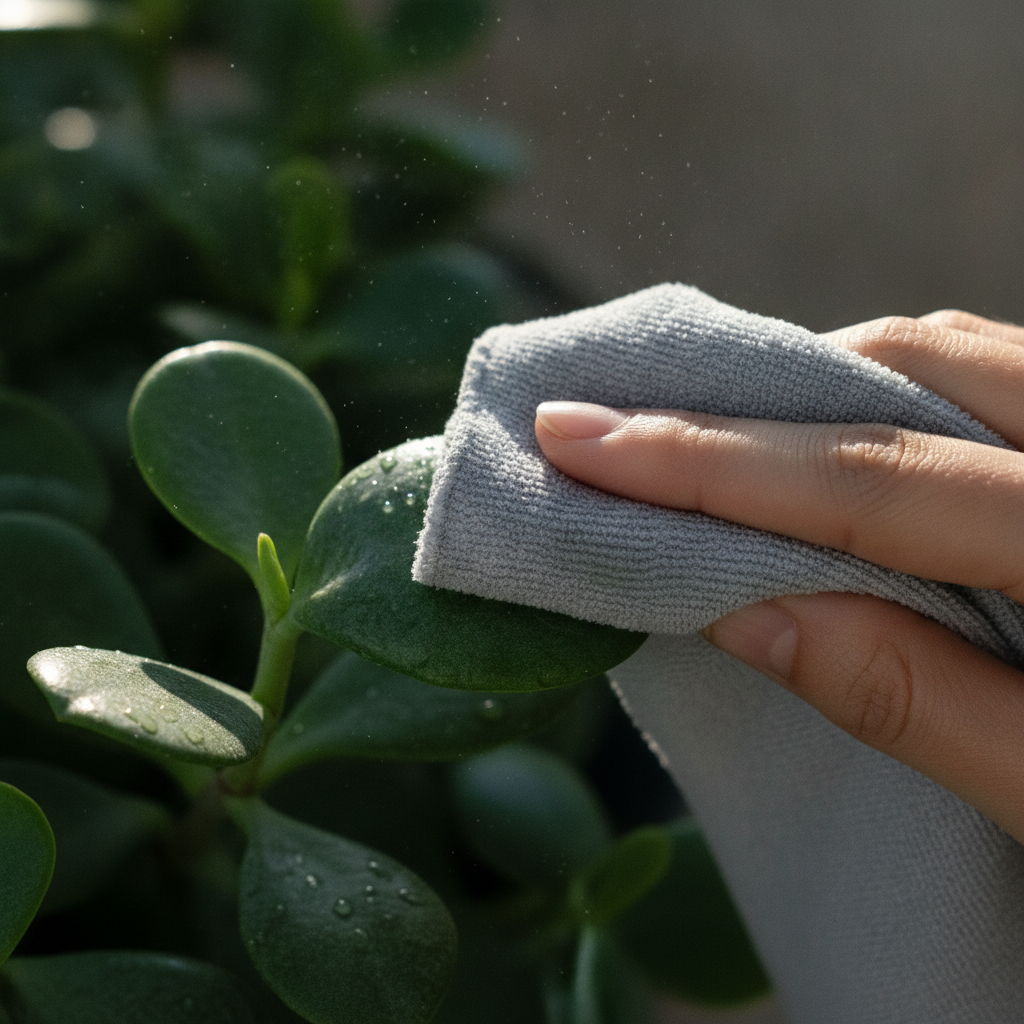
Pro Tip — Neem as Routine: A monthly preventative spray of diluted neem oil, applied in the evening so the sun does not scorch the treated leaves, keeps the common sap-suckers at bay before they ever become an infestation. Wipe it gently over the foliage and stems where pests like to hide.
Popular Varieties
Trailing jade is grown as the wild species rather than as a long list of named cultivars, so the variation you are most likely to encounter comes from how the plant is grown and from a couple of closely related lookalikes that share the same common name. Understanding these distinctions helps you know exactly what you are buying.
The most dramatic difference is simply down to light. The very same plant can look soft and blue-green in gentle conditions or flush an intense burgundy-purple in strong sun, which is why two trailing jades from the same cutting can appear so different on a shop bench.
| Variety | Leaf Appearance | Light Needs | Growth Rate | Availability |
|---|---|---|---|---|
| Green-form trailing jade | Plump blue-green leaves, faint red edges | Bright indirect | Moderate | Common |
| Sun-stressed trailing jade | Deep burgundy-purple leaves and stems | Direct sun | Moderate | Common (same plant, brighter grown) |
| Weeping jade (Senecio jacobsenii) | Larger, flatter overlapping oval leaves | Bright indirect to direct | Vigorous | Common, often sold under the same name |
| Variegated forms | Cream or pink margins on the leaves | Bright indirect | Slow | Rare and collectible |
Featured Varieties
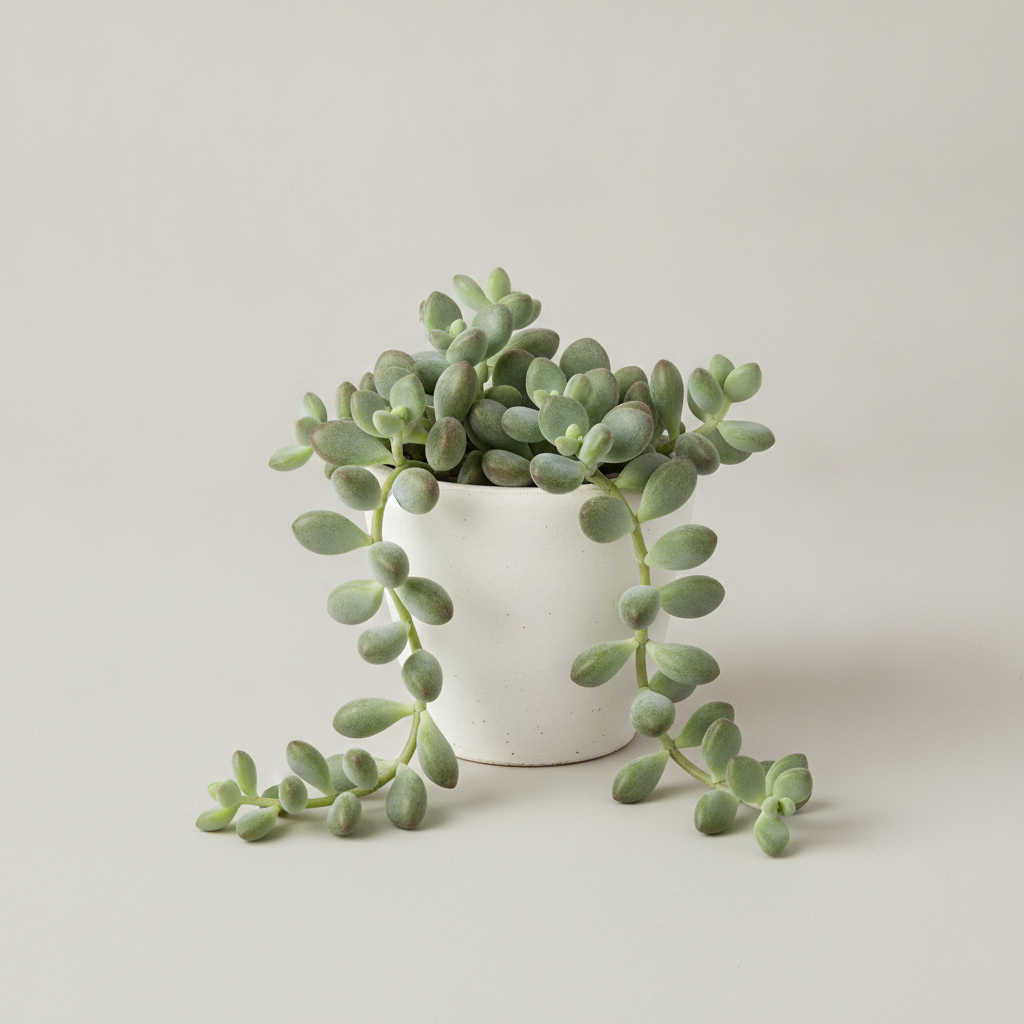
Green-Form Trailing Jade
Grown in bright but indirect light, the plant keeps plump, rounded blue-green leaves with a soft powdery bloom and only a faint red flush. This is the relaxed, cooler-toned look that many growers prefer for a calm, foliage-led display.
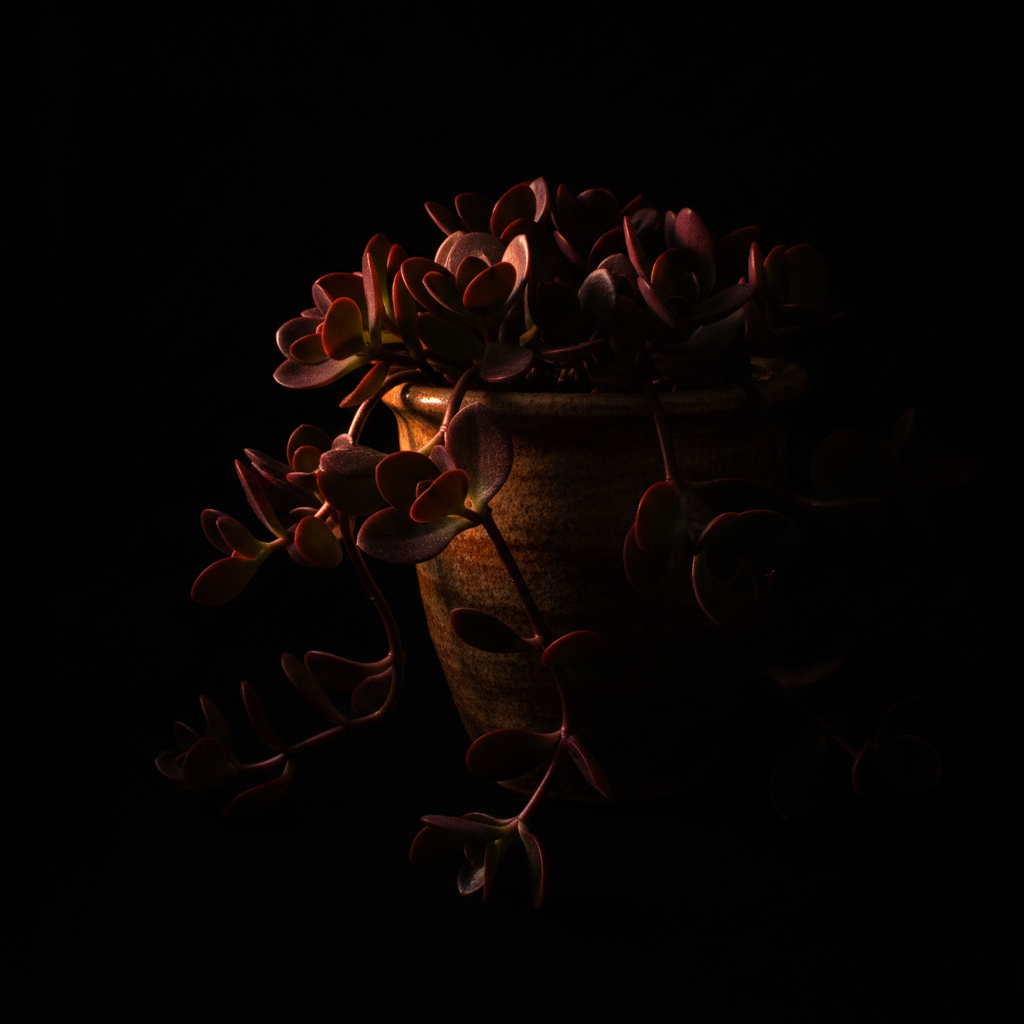
Sun-Stressed Trailing Jade
Given strong light and cool nights, the same plant transforms, flushing deep burgundy-purple across both leaves and trailing stems. The colour is a healthy stress response and the main reason many people seek this succulent out.
Variety Profiles in Detail
Trailing Jade (Kleinia petraea)
The true species, still widely catalogued under its synonym Senecio jacobsenii, carries thick, obovate leaves arranged spirally along sprawling reddish stems that can trail to 60 centimetres (24 inches) or more. In autumn and winter it may produce small clusters of orange disc flowers, which some growers find pleasant and others remove for their faintly musky scent.
Weeping Jade (Senecio jacobsenii)
Botanically tangled with the trailing jade and frequently sold under the identical common name, this closely allied succulent tends towards larger, flatter, overlapping oval leaves that shingle along the stem. Its care is effectively identical, so any confusion at the point of sale is of little practical consequence to the grower.
Choosing the Right Variety for Your Space
Since the colour is dictated mainly by light rather than genetics, the most important decision is not which form to buy but where to put it. If you have a bright, sunny window and want the dramatic purple display, almost any trailing jade will deliver it. If your light is gentler, accept and enjoy the cooler blue-green look, and consider supplementing with a grow light through winter to keep growth compact whichever form you choose.
Frequently Asked Questions
Why is my trailing jade losing its purple colour?
The purple flush is a response to bright light, so a plant that has turned uniformly green is almost always receiving too little of it. Move it closer to a sunny window, increasing the exposure gradually, and the colour will return as the plant builds up its protective pigments again.
How often should I water my trailing jade?
Water only when the soil has dried out completely, which in summer is usually every 10 to 14 days and in winter as little as once a month. Rather than following a fixed schedule, check the soil and the firmness of the leaves each time, since light, warmth and pot size all change how fast the mix dries.
Why are the leaves going soft and mushy?
Soft, translucent, mushy leaves are the classic sign of overwatering, and they often accompany the early stages of root rot. Stop watering at once, let the soil dry fully, and if the stems are softening too, take healthy cuttings to propagate as insurance against losing the plant.
Is trailing jade safe for cats and dogs?
No. Like other plants in the Senecio and Kleinia groups, it is considered mildly toxic if eaten and can cause stomach upset, so it is best kept well out of reach of pets and children. Hanging it high or placing it on a tall shelf, where its trailing habit looks its best anyway, neatly solves the problem.
Why is my trailing jade growing long and leggy?
Stretched stems with wide gaps between the leaves, a condition called etiolation, are caused by insufficient light. The plant is reaching for a brighter source. Move it to a sunnier spot, and prune back the leggy growth, using the trimmings as cuttings to fill out the pot with denser new shoots.
Does trailing jade flower indoors?
It can. Mature, well-lit plants often produce small clusters of orange, rayless disc flowers in autumn and winter. The blooms are modest and carry a slightly musky scent, so some growers leave them for novelty while others simply pinch them off; either choice is fine for the plant’s health.
How do I make my trailing jade fuller and bushier?
The trick is to prune and replant. Trim back long stems to encourage branching, then root the cuttings and tuck them back into the same pot. Combined with bright light to keep new growth compact, this builds a dense, full cascade rather than a few thin, straggly strands.
What temperature does trailing jade need?
It is happiest between 18 and 27 degrees Celsius (64 to 81 Fahrenheit) and must be kept above about 7 degrees Celsius (45 Fahrenheit), as it has no frost tolerance. Average warm room temperatures suit it perfectly, though slightly cooler nights in winter can actually intensify the purple colouring.






