
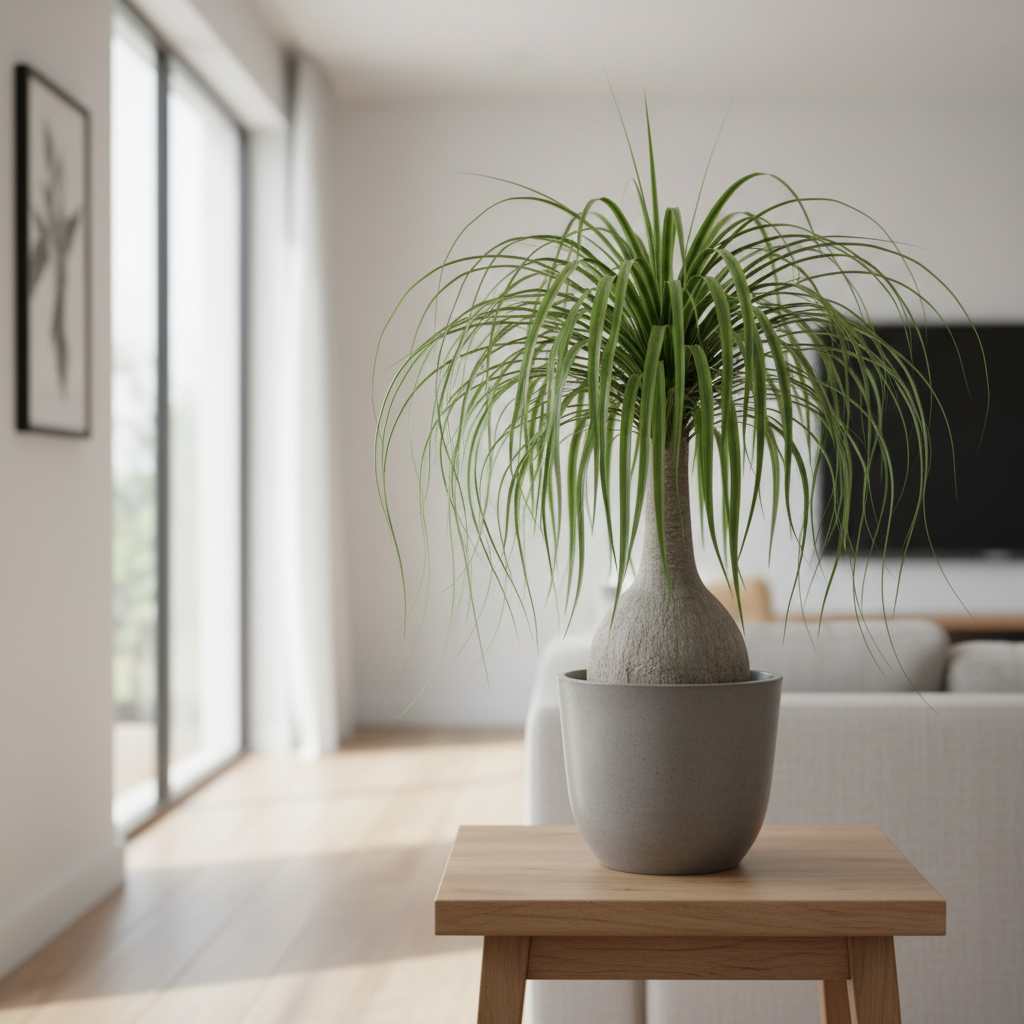
The ponytail palm (Beaucarnea recurvata) is one of the most distinctive plants you can keep on a sunny windowsill, and one of the most misnamed. Despite the common name, it is neither a palm nor a true tree but a succulent member of the asparagus family, native to the semi-desert hills of eastern Mexico in Veracruz, Tamaulipas and San Luis Potosí. Mature specimens build a swollen, bottle-shaped grey caudex at the base, sometimes called an elephant’s foot, topped by a fountain of long, narrow, leathery green leaves that arch and cascade like a head of hair tied at the top. In its native range the plant can climb to eight metres (26 feet) over a century or more; in a typical living room it tops out at around one to two metres (three to six feet), growing slowly enough to occupy the same pot for years on end.
Few houseplants are as well suited to forgetful owners. The caudex acts as a built-in reservoir, holding enough water to carry the plant through weeks or even months of drought, and the leathery foliage shrugs off the dry indoor air that wilts more tropical species. That said, surviving and thriving are different things. A ponytail palm parked in a dim corner and watered on a calendar will plod on for years without dying and without obviously growing either; the same plant given strong direct light, free-draining gritty soil and a properly deep soak followed by a long dry spell will widen its base, push out new flushes of glossy leaves every spring and, in time, develop the gnarled architectural trunk that makes the species so collectible. This guide covers everything that separates one outcome from the other.
Contents
- Quick Reference
- Why Ponytail Palm Makes a Brilliant Houseplant
- Light Requirements
- Watering & Humidity
- Soil, Potting & Repotting
- Fertilising
- Propagation
- Pests & Diseases
- Popular Varieties
- Frequently Asked Questions
Quick Reference: Ponytail Palm at a Glance
| Light | Bright direct to bright indirect; tolerates several hours of unfiltered sun |
| Watering | Soak thoroughly, then let the soil dry out completely; typically every 2 to 4 weeks indoors |
| Temperature | 15 to 27°C (59 to 81°F); avoid prolonged exposure below 10°C (50°F) |
| Humidity | Indifferent; happy in dry indoor air of 20 to 40 percent RH |
| Fertiliser | Half-strength balanced liquid feed two or three times during spring and summer; none in winter |
| Toxicity | Non-toxic to cats, dogs and humans according to the ASPCA, though leaf fibres can irritate if chewed |
Why Ponytail Palm Makes a Brilliant Houseplant
The case for the ponytail palm rests on three qualities that almost no other indoor specimen combines: extreme drought tolerance, genuine architectural presence, and a lifespan measured in human generations rather than seasons. The caudex at the base is a true water storage organ, swelling slightly after a thorough drink and contracting visibly during long dry spells, which means the plant essentially carries its own emergency reserve. Owners who travel for weeks at a time, who forget the watering can for a fortnight or who simply prefer plants that do not demand constant attention will find that Beaucarnea recurvata rewards a hands-off approach in a way that almost no popular tropical houseplant does.
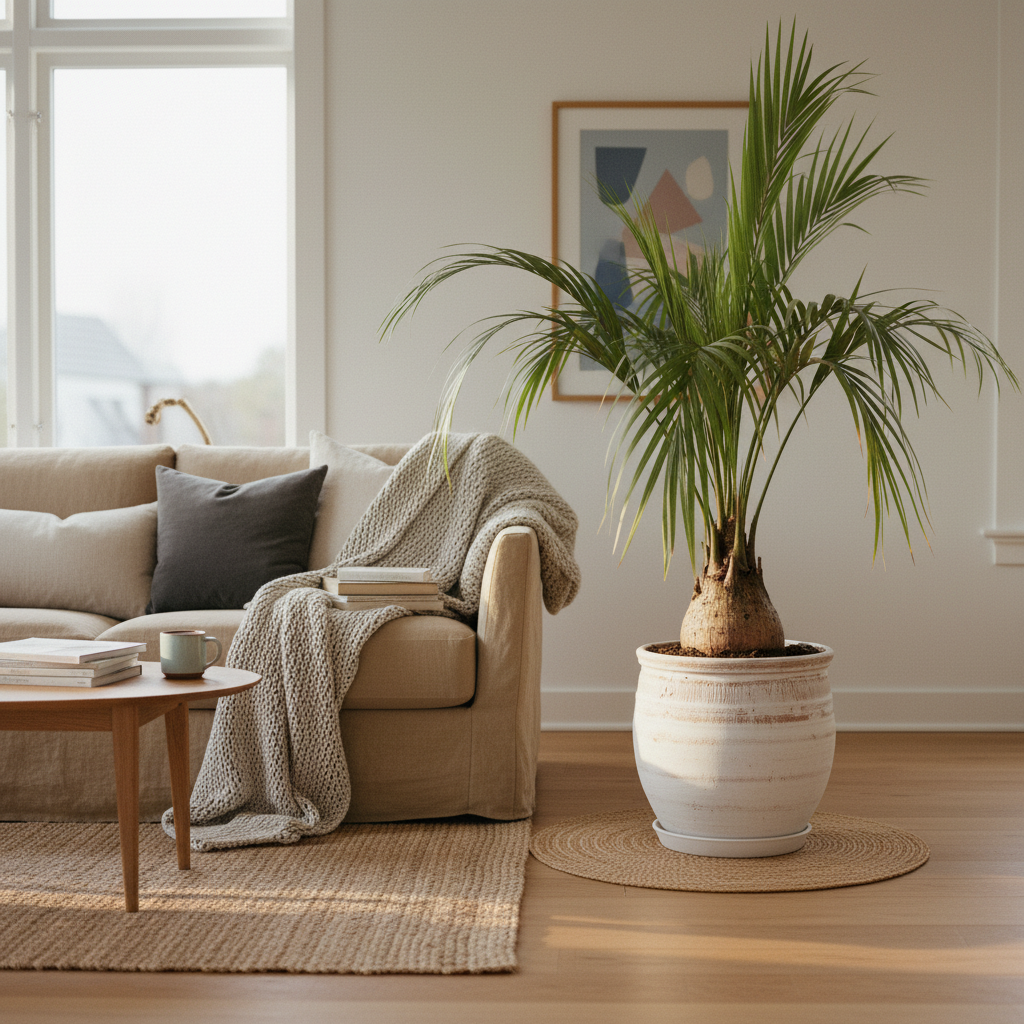
The visual identity is just as compelling. A ficus or a monstera reads as foliage; a ponytail palm reads as a small tree, complete with a trunk that thickens and corks over the years into something resembling driftwood. Specimens in cultivation routinely live for 50 to 100 years, and well-tended indoor plants commonly outlive the rooms they were bought for. Because the plant grows so slowly, that long lifespan is not a maintenance burden. A ponytail palm bought as a 30-centimetre (12-inch) youngster will typically still fit a tabletop a decade later, only with a noticeably fatter base and a fuller skirt of leaves. The combination of low fuss, longevity and sculptural form is what has made it a standard fixture of mid-century, Scandinavian and contemporary interior design alike.
There is one more advantage worth flagging for households with curious pets. The ASPCA lists Beaucarnea recurvata as non-toxic to cats, dogs and horses, which is unusual among the large-leaved indoor plants in this size class. Cats in particular are drawn to the swaying, hair-like leaves and will sometimes chew the tips, which can cause mild stomach upset from the rough leaf fibres rather than from any actual toxin, but the plant itself poses no chemical hazard.
Important — Toxicity: The ponytail palm is classed as non-toxic to cats, dogs and humans, but the strap-like leaves are tough and fibrous. Pets that chew on them can experience mild gastrointestinal irritation from the fibres themselves, not from any poisonous compound. Place the plant out of easy reach if you have a determined chewer.
Light Requirements
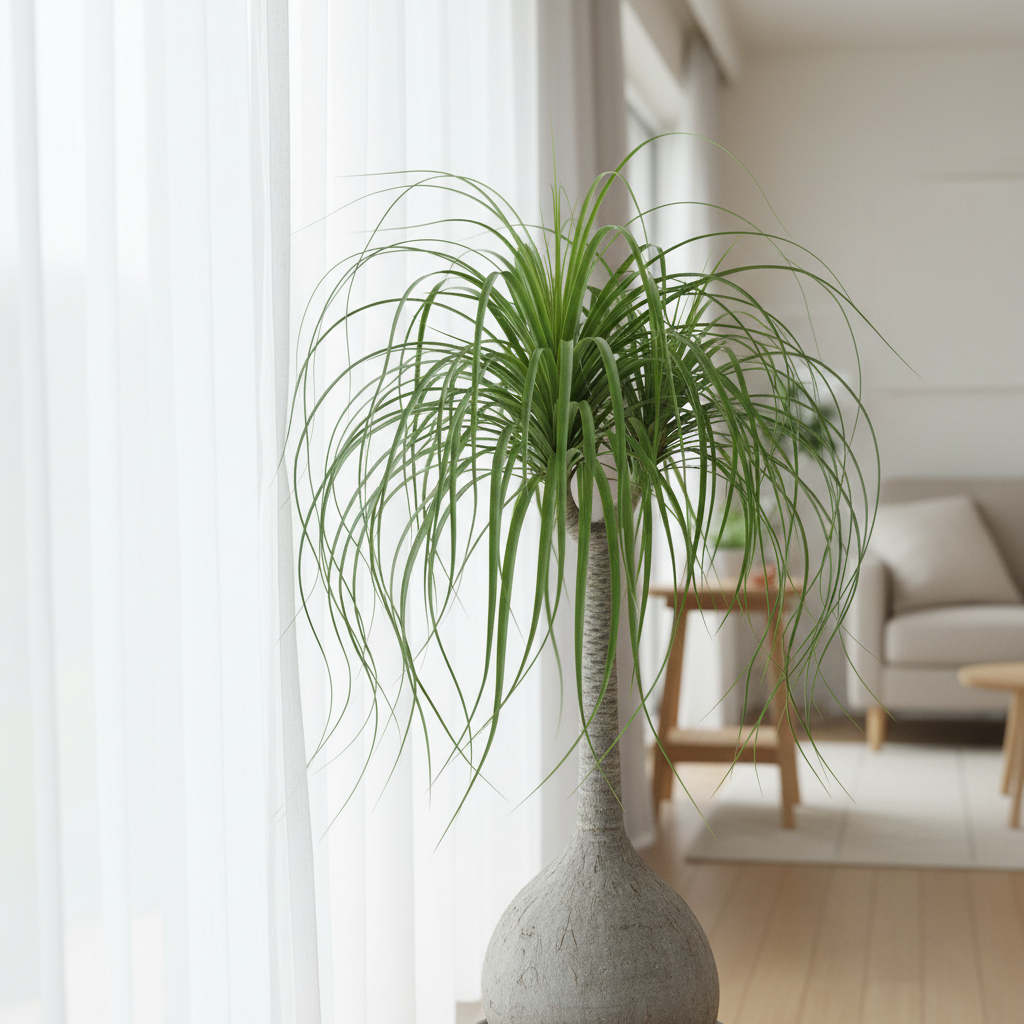
Light is the single biggest factor separating a thriving ponytail palm from a plant that merely persists. Coming from the open, rocky hillsides of north-eastern Mexico, Beaucarnea recurvata evolved under unfiltered sun for most of the day and only token shade from neighbouring scrubland, which is roughly the opposite of the dim corners many indoor specimens find themselves in. Indoors, the plant will accept a wide range of light levels, but its growth rate, leaf density and trunk development scale almost linearly with the amount of light it receives.
The ideal placement is the brightest spot the room offers: directly in front of a south-facing window, or within a metre of a large east or west window with little to no curtain in the way. In those conditions the plant will push new leaves through spring and summer, the caudex will broaden each year and the overall posture stays upright. Tucked further into the room, behind sheers or in a north-facing location, the plant slows down but does not visibly suffer; it simply stalls, with older leaves replaced one by one as new ones emerge.
Light Levels Explained
Houseplant light is usually described in vague terms, but for a sun-loving species like the ponytail palm it pays to be specific. The table below translates the broad categories into approximate illuminance values and practical room locations, so you can match the plant’s placement to what it actually needs rather than what sounds right.
| Light Category | Approx. Level | Typical Location | Outcome |
|---|---|---|---|
| Direct sun | 30,000 to 100,000 lux | Pressed against an unobstructed south or west window | Strongest growth, fattest caudex, slight risk of leaf-tip scorch in summer heat |
| Bright indirect | 10,000 to 20,000 lux | Within a metre of a sunny window, behind sheers, or in front of an east window | Steady annual growth, dense leaf crown, ideal balance |
| Medium | 2,500 to 10,000 lux | Two to three metres back from a window, or beside a north window | Plant survives and slowly replaces leaves, growth nearly stops |
| Low | 500 to 2,500 lux | Interior corner, hallway, room with one small window | Long-term decline; older leaves not replaced, caudex shrinks |
| Very low | Under 500 lux | Windowless office, basement | Not viable without supplemental lighting |
Window Orientation and Placement
South-facing window: The textbook position. A ponytail palm placed within a metre of a south window in the Northern Hemisphere (or a north window south of the equator) receives several hours of direct sun and bright indirect light for the rest of the day. Mature specimens handle this without flinching; newly bought plants from a shaded nursery should be eased in over a week or two to avoid scorch.
East-facing window: Excellent. Morning sun is gentler than afternoon sun, and the plant can sit right on the sill or on a stand directly in front of it with no curtains. East light alone is enough to keep a ponytail palm in active growth through the warm months.
West-facing window: Also very good, with the caveat that summer afternoon sun in a hot climate can be intense enough to bleach leaf tips. In northern Europe and similar latitudes, a west window is essentially a second south window and the plant thrives in it.
North-facing window: The marginal case. In a bright north room with no overhanging trees or buildings, a ponytail palm will hold its own but not progress much. In a dim north room, supplemental light becomes worth considering.
Pro Tip — Rotate the Pot: Ponytail palms grow towards their strongest light source, and the long arching leaves exaggerate any lean. A quarter turn of the pot every two to three weeks keeps the canopy symmetrical and the caudex centred.
How Light Affects Caudex and Crown Development
Light shapes a ponytail palm in two visible ways. The first is the rate at which the caudex thickens. Plants in strong light add measurable girth each year as they store more carbohydrate during long photosynthetic days; plants in dim conditions essentially stop bulking and may even thin slightly as stored reserves are spent on leaf maintenance. The second is the density and length of the crown. Bright light produces shorter, stiffer, more upright leaves packed closely together, while low light pushes the plant to produce longer, floppier, more widely spaced leaves as it stretches towards what little illumination it can find. If your ponytail palm has started developing increasingly long and sparse leaves with bare gaps between them, it is asking for more light, not more water.
Warning — Direct Sunlight: Plants that have been growing indoors in moderate light should not be moved to a sunny windowsill or outdoors in summer without a gradual transition. Move them in stages over seven to ten days, lengthening the daily exposure to direct sun. Otherwise the leaves can develop pale, papery scorch patches that do not recover.
Artificial Lighting
Because ponytail palms appreciate high light levels, they respond well to grow lights in rooms that simply do not receive enough natural sun. A single full-spectrum LED panel rated at around 30 to 50 watts placed 30 to 60 centimetres above the canopy and run for ten to twelve hours a day will keep a small to medium plant in active growth. The plant’s slow metabolism means it does not need the intense PAR levels demanded by flowering or fruiting plants, so even modest desk-style grow lamps can make the difference between stasis and slow but steady progress.
Seasonal Adjustments
In winter the sun moves lower in the sky and shines less intensely through the glass. A ponytail palm that summered happily in the middle of a sunny room may need to be moved closer to the window from late autumn to early spring to maintain similar light levels. In summer the opposite applies: a plant pressed against a south-facing window in July may benefit from a small step back, or from a thin diffusing curtain during the hottest part of the day, to prevent the leaf-tip scorch described above.
Watering & Humidity
If light is what makes a ponytail palm thrive, watering is what most often kills it. The single most common cause of ponytail palm death in cultivation is overwatering, and overwatering rarely looks like watering too often in the short term. It is the slow, compounding effect of soil that never fully dries between drinks, of pots that hold standing water and of substrates that pack too tightly around a root system evolved for arid scrub. The caudex makes the plant look thirsty in a way that it almost never actually is; that bulging base contains weeks of stored water, and the roots have no real strategy for coping with prolonged moisture.
The correct rhythm is the desert rhythm: a thorough soak that wets every part of the root ball and drains freely from the bottom, followed by a long dry spell during which the soil becomes bone-dry at least the top half of the pot and ideally throughout. Depending on pot size, light levels and time of year, that cycle typically takes two to four weeks indoors, sometimes longer in winter. There is no fixed schedule; check the soil first and water only when it is actually dry.
How to Tell When Watering Is Needed
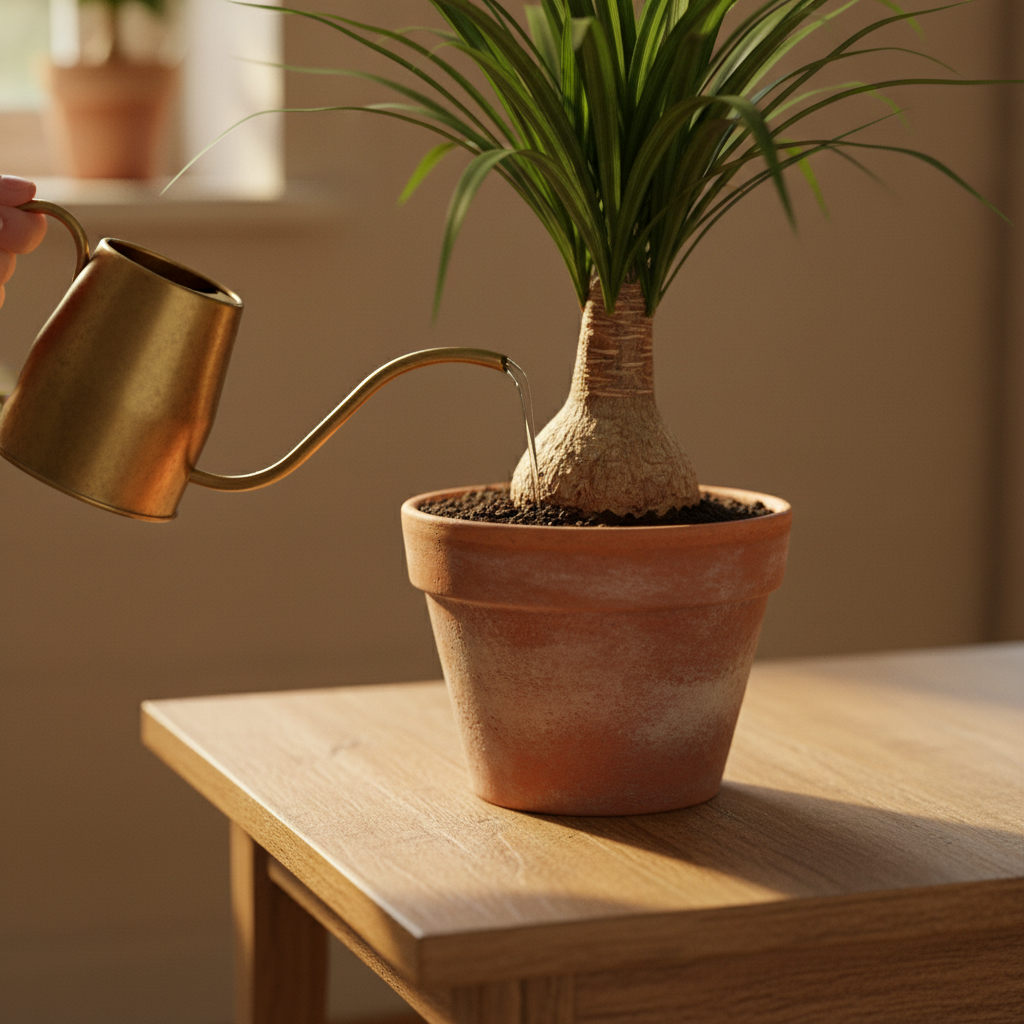
The most reliable test is also the simplest. Push a finger or a wooden chopstick into the soil to a depth of about five centimetres (two inches). If anything sticks to it or the soil feels cool and slightly moist, wait. Only when the probe comes out completely dry, and the surface of the soil has lightened in colour and started to pull away from the pot rim, is it time to water. For larger pots, a long bamboo skewer pushed almost to the drainage hole gives a more accurate reading of the whole root zone. A wireless moisture meter is unnecessary for this species; the dry-out is so pronounced that the manual test is rarely ambiguous.
The pot also offers a clue. A terracotta pot containing a thoroughly dry root ball feels noticeably lighter than the same pot soaked through. Once you have lifted a freshly watered ponytail palm and a bone-dry one a few times, the weight difference becomes obvious and you can decide without probing.
How to Water Correctly
The technique matters as much as the timing. A few teaspoons trickled onto the surface only wet the top layer of soil and leave the lower roots dry, which encourages shallow rooting and creates a deceptive moisture pattern that looks fine on the surface while the centre of the pot is parched. Instead, water the plant in stages:
- Move the plant to a sink or place a deep saucer underneath. Tepid water at room temperature is best.
- Pour slowly and evenly across the entire soil surface until water begins running out of the drainage holes.
- Stop, wait two or three minutes for the substrate to absorb fully, then water again until water runs through.
- Allow the pot to drain for at least 15 to 20 minutes before returning it to its decorative cover or saucer. Empty any remaining water in the saucer; the plant should not stand in water.
That double-soak ensures the root ball is fully rehydrated and that any salt build-up from fertiliser is flushed downwards through the substrate. Done every two to four weeks in active growth, it is the single most important habit you can develop with this plant.
Seasonal Watering
Watering frequency drops sharply in autumn and winter. Lower light levels and cooler temperatures slow the plant’s metabolism, soil dries more slowly and the caudex is content to draw on stored reserves. Many indoor ponytail palms can go six to eight weeks between drinks in midwinter without any sign of stress, particularly if the room is cool. Resist the urge to water on a calendar through this period; check the soil and let the plant tell you when it is ready.
Pro Tip — When in Doubt, Wait: A ponytail palm will recover quickly from a week of being slightly too dry but slowly, or not at all, from chronic overwatering. If you are unsure whether to water, give it three more days and check again.
Humidity and Air
Almost alone among large indoor plants, the ponytail palm is genuinely indifferent to humidity. The leathery, waxy leaves are built to resist dehydration and need none of the misting, pebble trays or humidifiers that more tropical species crave. Typical indoor humidity of 20 to 40 percent, the dry range that withers calatheas and ferns, is exactly the band it evolved in. Owners who like the look of misting a plant should be aware that water sitting in the leaf crown can encourage rot at the growing point; it is not actively harmful, but it offers no benefit either.
Good air movement, on the other hand, is welcome. A gentle breeze from an open window or a quiet fan helps the soil dry between waterings and discourages the fungal problems that occasionally appear on plants kept in stagnant corners. The plant can be moved outdoors to a sheltered patio for the warmer months in temperate climates, then returned indoors before night temperatures fall below 10°C (50°F).
Soil, Potting & Repotting
The substrate decision matters more for a ponytail palm than for almost any other popular houseplant. Because the plant is watered infrequently and dries down hard between drinks, the soil needs to do two opposing jobs well: absorb enough moisture during the brief watering event to hydrate the root ball, then release that moisture and air out completely over the following weeks. A standard peat-based houseplant compost does the first job but fails badly at the second, retaining moisture deep in the pot long after the surface has dried and slowly suffocating the roots.
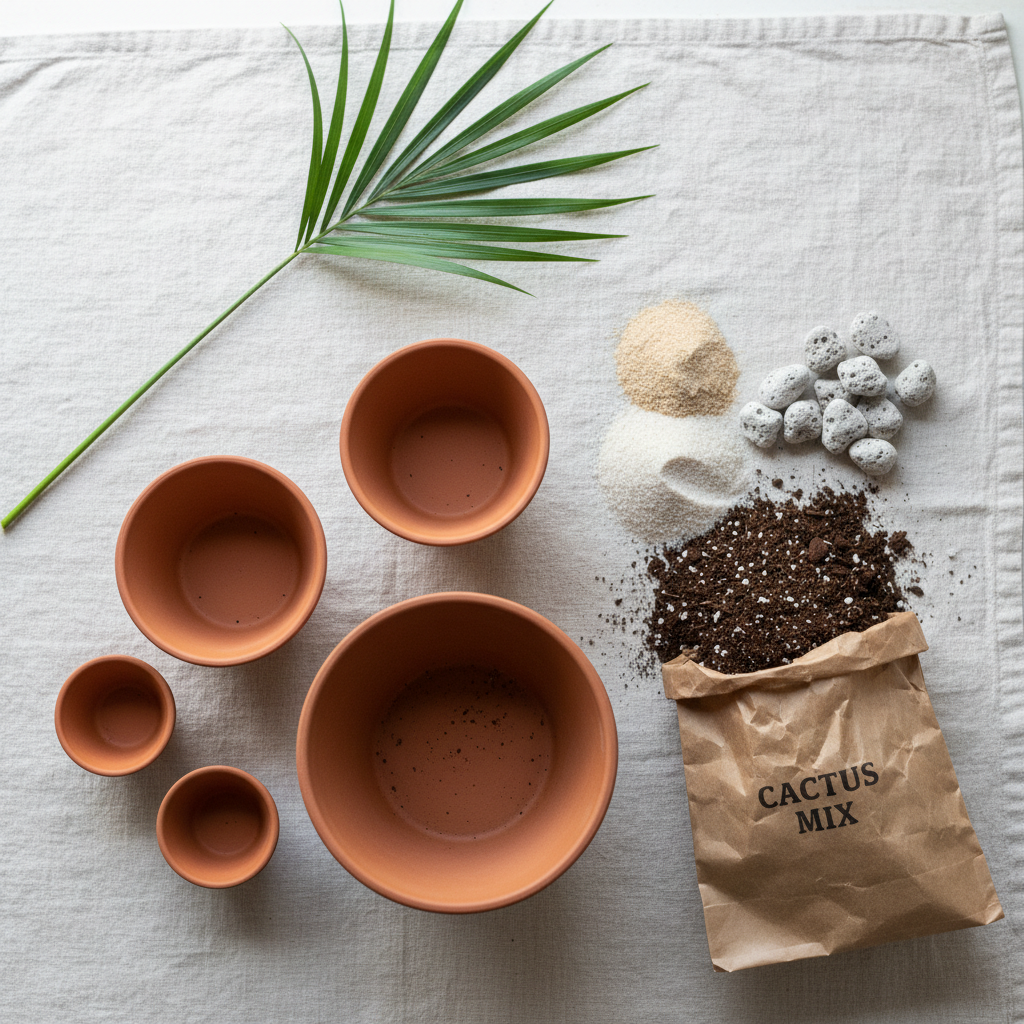
An Ideal Potting Mix
A good starting point is a commercial cactus or succulent compost amended with additional grit. As a rule of thumb, blend two parts cactus mix with one part coarse perlite or pumice and, if you can find it, one part horticultural grit or coarse sand (not builder’s sand, which is too fine and packs solid). The resulting substrate should feel chunky in the hand, with visible mineral particles between the organic crumbs, and water should run straight through a handful held in a sieve rather than puddling on top. If you prefer to mix from scratch, an equivalent blend is three parts good loam-based houseplant compost, two parts perlite or pumice and one part coarse grit.
The aim is a substrate that wets quickly when watered, dries from the bottom upwards over the following two to three weeks and never compacts into an airless mass around the roots. A small amount of organic matter is helpful for water holding and nutrient supply; large amounts of peat or coir are not, and should be diluted with mineral grit before use.
Choosing a Pot
Two features matter more than aesthetic. The pot must have at least one large drainage hole, ideally several, so excess water exits within seconds rather than minutes; and it should be modestly proportioned to the plant rather than oversized. Ponytail palms appreciate slight root restriction and will sit happily in the same pot for three to five years, sometimes longer. A pot that is too large holds a reservoir of moist soil around the roots which the plant cannot use up quickly enough, and the wet zone in the middle of the pot becomes a slow trap.
Terracotta is the classic choice for the species. The porous clay wall wicks moisture out of the substrate, accelerating the dry-out cycle and giving the roots a generous safety margin against overwatering. Glazed ceramic and plastic pots are perfectly usable; they simply demand a sharper eye on watering frequency and a slightly grittier mix to compensate for the slower drying.
When and How to Repot
Repotting a ponytail palm is an event measured in years, not seasons. The plant is happiest when slightly pot-bound and grows slowly enough that a young specimen may only need its first repot after two or three years, and a mature one only every four to seven. Signs that a repot is overdue include roots growing out of the drainage holes, the caudex itself starting to bulge against the pot rim, the pot tipping over because the plant has become top-heavy, or water running straight through without being absorbed because the substrate has broken down.
- Choose a pot only one size larger than the current one, typically two to four centimetres wider in diameter. Going bigger almost always backfires.
- Wait until the soil is dry, then ease the plant out by tipping the pot sideways and tapping the rim against a hard edge. Pulling on the caudex will rarely free a stuck plant and can damage the trunk.
- Inspect the roots. Healthy ponytail palm roots are firm and pale tan; soft, dark or musty-smelling roots should be trimmed back to clean tissue with sterilised shears.
- Add a layer of fresh gritty mix to the new pot, position the plant at the same depth as before (never bury the caudex any deeper than it sat previously), and fill around the root ball with substrate, tamping gently to remove large air pockets.
- Wait at least a week before watering. This gives any trimmed roots time to seal and reduces the chance of rot in the freshly disturbed root ball.
Warning — Don’t Bury the Caudex: The swollen base of the plant must remain at or just above soil level. Burying the caudex when repotting traps moisture against the trunk and is one of the fastest ways to rot a ponytail palm. If the plant is wobbly in a new pot, stabilise it with rocks or a stake rather than packing soil higher.
Fertilising
Ponytail palms are slow growers from nutrient-poor soils and need far less fertiliser than most indoor plants. Overfeeding is more damaging than underfeeding: excess nutrients build up in the substrate as soluble salts that can scorch root tips and cause brown leaf ends, while the plant’s capacity to actually use those nutrients is limited by its modest growth rate. Modest, occasional feeding through the warm months is plenty; nothing is needed in winter.
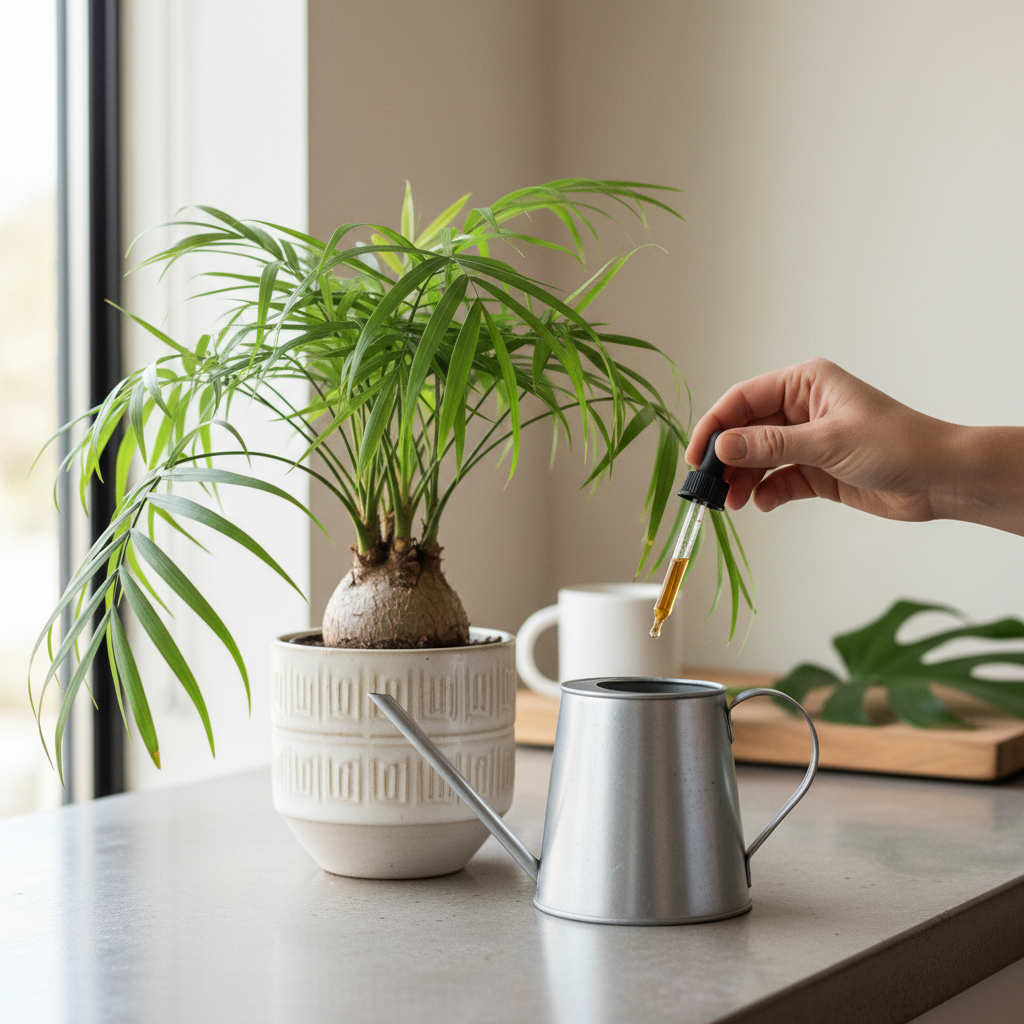
What to Feed
A balanced general-purpose houseplant fertiliser with an NPK of roughly 10-10-10 or 20-20-20, diluted to half the manufacturer’s recommended strength, suits the species well. Cactus-specific fertilisers, usually formulated with slightly lower nitrogen, also work and arguably match the plant’s needs more closely. If you prefer organic feeds, a half-strength solution of seaweed or fish emulsion has the same effect, with the bonus of a slower nutrient release. Avoid high-nitrogen lawn or foliage feeds; they push soft, weak leaf growth that the plant cannot support and can encourage rot at the growing point.
When to Feed
The active growing season for an indoor ponytail palm runs roughly from late April to early September in the Northern Hemisphere. During that window, fertilise just two or three times in total, not monthly as some general houseplant guides suggest. A single feed in late spring as new growth appears, a second in midsummer and an optional third in early autumn is enough to support a year’s leaf production and modest caudex thickening. Always apply fertiliser to soil that has already been watered; feeding bone-dry soil concentrates the solution against the roots and risks scorching them.
Signs of Over- and Under-feeding
An overfed ponytail palm develops crispy brown leaf tips that progress slowly down the blade, sometimes accompanied by a whitish crust on the soil surface or around the rim of the pot. The fix is to flush the pot with two or three times its volume of plain water, letting it drain fully each time, and to skip the next planned feed. Underfeeding, on the other hand, is much rarer and presents as uniformly pale, slightly yellowed leaves with stalled new growth despite adequate light. A single half-strength feed usually corrects it within a few weeks.
Propagation
Propagating Beaucarnea recurvata is not as straightforward as taking cuttings from a pothos or a philodendron. The plant has no true stems that can be rooted in water, and its strap-like leaves cannot regenerate a new plant from a leaf cutting in the way a sansevieria or a peperomia can. The two practical home methods are separating offsets, sometimes called pups, that form at the base of a mature caudex, and growing fresh plants from seed. A third method, decapitating an unhealthy specimen above the caudex to force basal sprouts, is occasionally used as a salvage operation and is described at the end of this section.
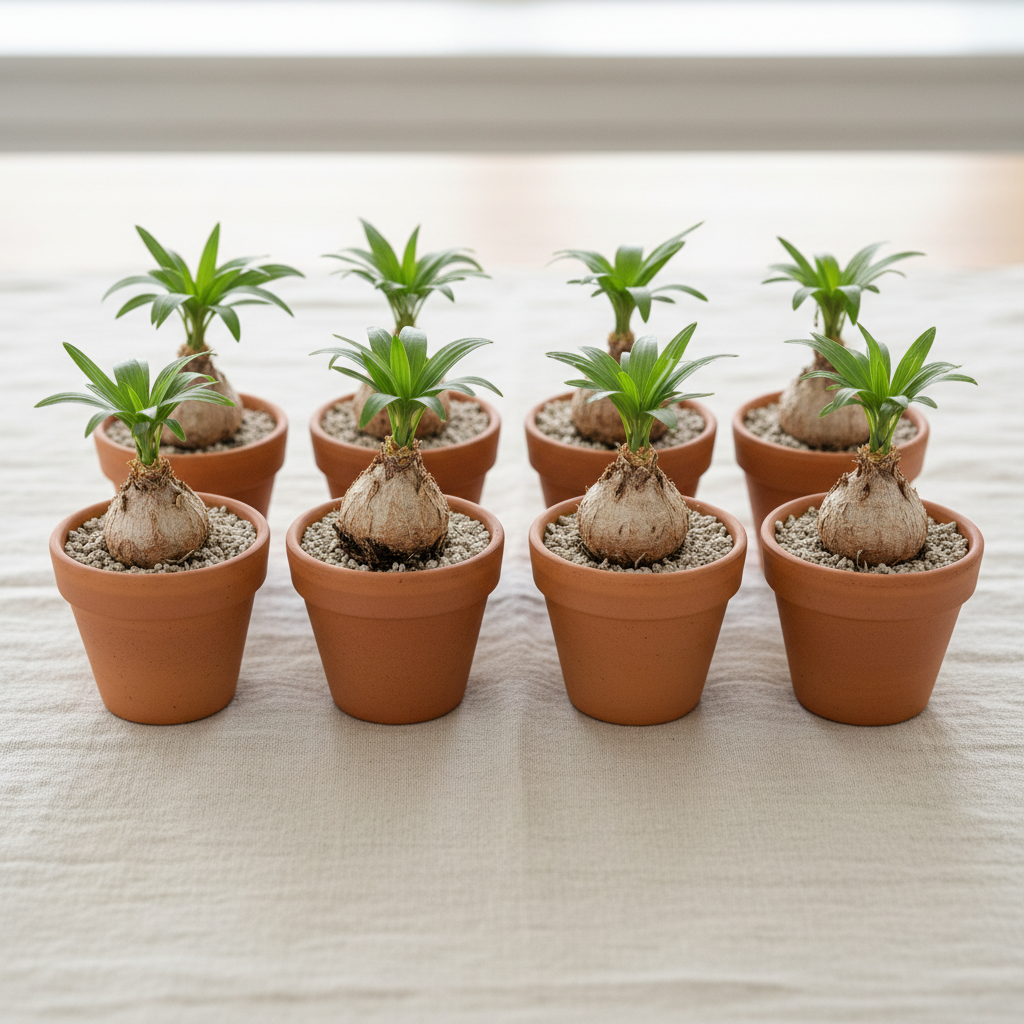
Separating Offsets (Pups)
Older, well-grown ponytail palms sometimes produce small offsets at the base of the caudex, particularly after the parent has been in the same pot for several years and is comfortably established. The pups look like miniature versions of the adult, with a tiny swelling and a fan of strap-like leaves, and they are attached to the parent by a section of the woody caudex itself. Once a pup has reached around 10 centimetres (four inches) tall and has produced several mature leaves, it can be separated.
- Unpot the parent during the warm months when it is in active growth. Brush soil away from the base so you can see where the pup attaches.
- Using a clean, sharp knife, cut the pup away from the parent, taking a small portion of caudex tissue and as many of its own roots as possible. A clean cut heals more reliably than a tear.
- Let the cut surfaces callus over for two to three days in a warm, dry, shaded place. Skipping this step is the most common reason pups rot.
- Pot the pup into a small container of the same gritty cactus mix described above, with the cut surface sitting just at soil level and the offset stable but not buried deeply.
- Wait a full week before the first watering. Thereafter water sparingly, allowing the soil to dry between drinks, and keep the pup in bright but indirect light until new growth confirms that roots have established.
Establishment typically takes one to three months, during which the pup may not produce any visible new growth at all. Patience here pays off; new leaves emerging from the centre of the rosette are the signal that propagation has worked.
Growing From Seed
Seed-grown ponytail palms are slow to start but produce uniquely characterful plants with the caudex developing naturally from day one. Fresh seed germinates best, ideally within a year of being harvested, and is sown on the surface of a moist, gritty seed-raising mix in a propagator at around 24°C (75°F). Germination typically takes four to eight weeks and is uneven; a tray of 20 seeds may produce its first seedlings well before the last appears. Seedlings spend their first two years looking like small grassy tufts and only begin to develop a visible swollen caudex in their third year. For most home growers, buying a young nursery-grown plant is a more realistic path than seed.
Decapitation as a Salvage Method
If the top of a ponytail palm has rotted or been irreparably damaged but the caudex remains firm and healthy, the trunk can be sliced cleanly above the affected tissue and the cut surface dusted with cinnamon or a horticultural sealing compound. With the leafless caudex kept warm, bright and very dry, new growth points usually emerge from the top within several months, often producing two or three new heads where there had been one. This is a last-resort technique rather than a routine propagation method, but it can save a beloved specimen that has suffered crown rot.
Pests & Diseases
The good news is that ponytail palms are remarkably pest-resistant. The leathery, waxy leaves are unappealing to most sucking insects, and the dry conditions the plant prefers also discourage the moist-loving fungi and bacteria that plague more humidity-dependent species. The bad news is that when problems do arise, they almost always trace back to cultural mistakes rather than to outside infestation, which means the fix is usually a change in how the plant is grown rather than a one-off treatment.
Spider Mites
The most common genuine pest is the two-spotted spider mite (Tetranychus urticae), drawn to the dry indoor conditions the plant otherwise enjoys. Look for tiny pale stippling on the leaves, fine webbing at the base of the foliage and a dull, dusty look to the canopy. Treatment is straightforward: a thorough shower under tepid water rinses most of the population off, after which weekly applications of insecticidal soap or a neem oil spray for two to three weeks should clear the rest. Increasing air movement around the plant helps prevent re-infestation, since spider mites prefer still air.
Mealybugs and Scale
Mealybugs occasionally appear as small white cottony tufts at the base of the leaves or in the leaf axils. Scale insects look like small flat brown or tan bumps on the undersides of leaves and along the trunk. Both are easiest to control when caught early. Dab small infestations with a cotton bud soaked in 70 percent isopropyl alcohol, then follow up a week later to catch any survivors. Larger infestations respond well to a thorough wipe-down with insecticidal soap and a careful inspection of the rest of the room, since both pests spread between plants.
Root Rot
By far the most serious problem affecting ponytail palms is root and caudex rot caused by prolonged overwatering. Early signs are a slight softening of the caudex when pressed gently with a thumb, yellowing of the lower leaves and a faintly musty smell coming from the soil. If caught early, the plant can be unpotted, the rotten tissue cut back to firm, pale wood with a sterilised knife, the wounds dusted with cinnamon or fungicide, and the plant repotted in fresh dry gritty mix. Watering is then withheld for two weeks. If the rot has reached the upper caudex, the decapitation method described in the propagation section is sometimes the only option. Prevention is enormously easier than cure: free-draining soil, an appropriately small pot and disciplined dry-outs between watering essentially eliminate the risk.
Brown Leaf Tips
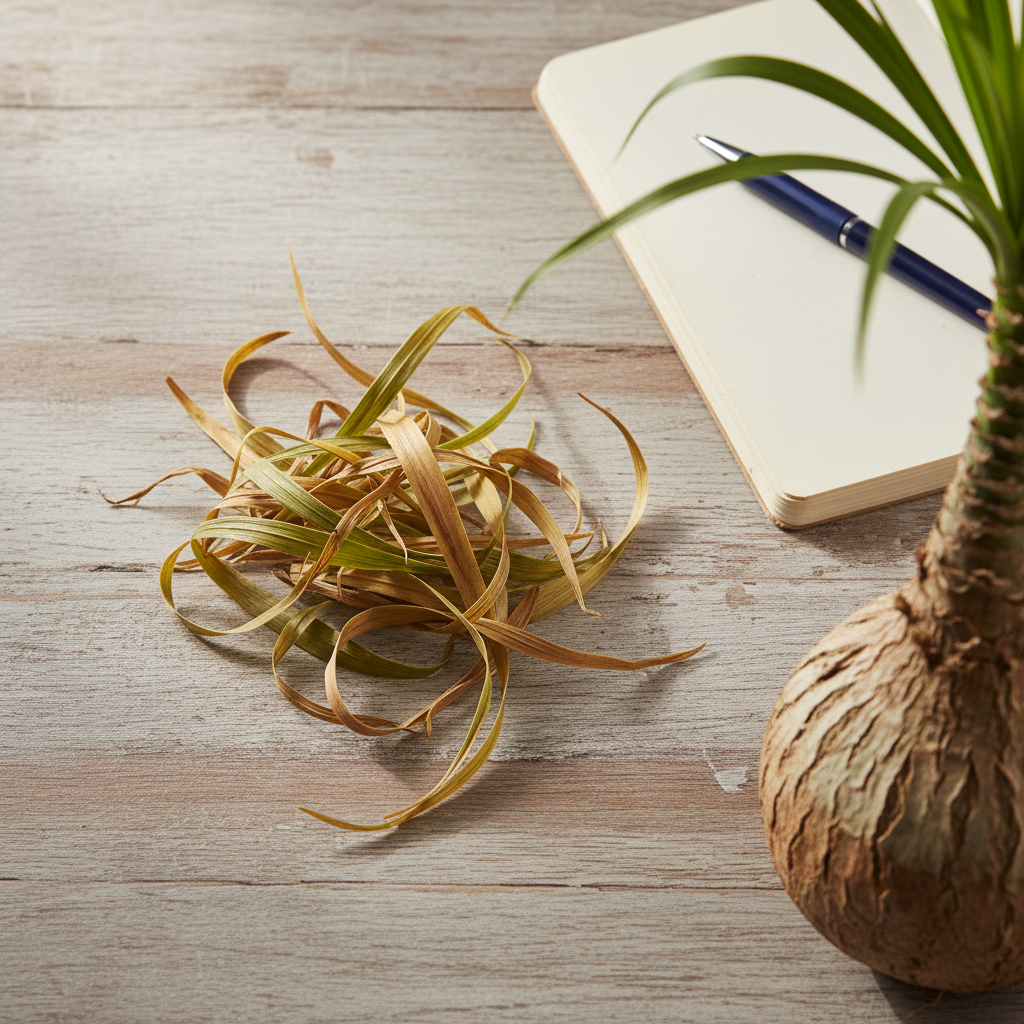
Crispy brown tips on otherwise healthy leaves are common and almost never serious. The usual causes, in rough order of frequency, are accumulated fertiliser salts in the soil, occasional acute drought after a long forgotten period, fluoride or chlorine sensitivity in tap water and proximity to a heat source. The fix is to flush the pot, water more consistently going forward, switch to filtered or rainwater if your tap supply is heavily treated, and move the plant away from radiators and heating vents. Existing brown tips do not regreen; trim them off following the natural pointed shape of the leaf if the appearance bothers you.
Pro Tip — Inspect on Watering Day: A two-minute check of the leaves and caudex every time you water catches almost every emerging pest or rot problem at the earliest possible stage, when treatment is still simple.
Popular Varieties
The ponytail palm is not a heavily hybridised species. Most plants sold are the straight species Beaucarnea recurvata, with variation coming from the form of the caudex (single-trunk versus multi-trunk specimens) and from a small number of closely related species occasionally sold under the same common name. The two cards below cover the most commonly encountered forms.
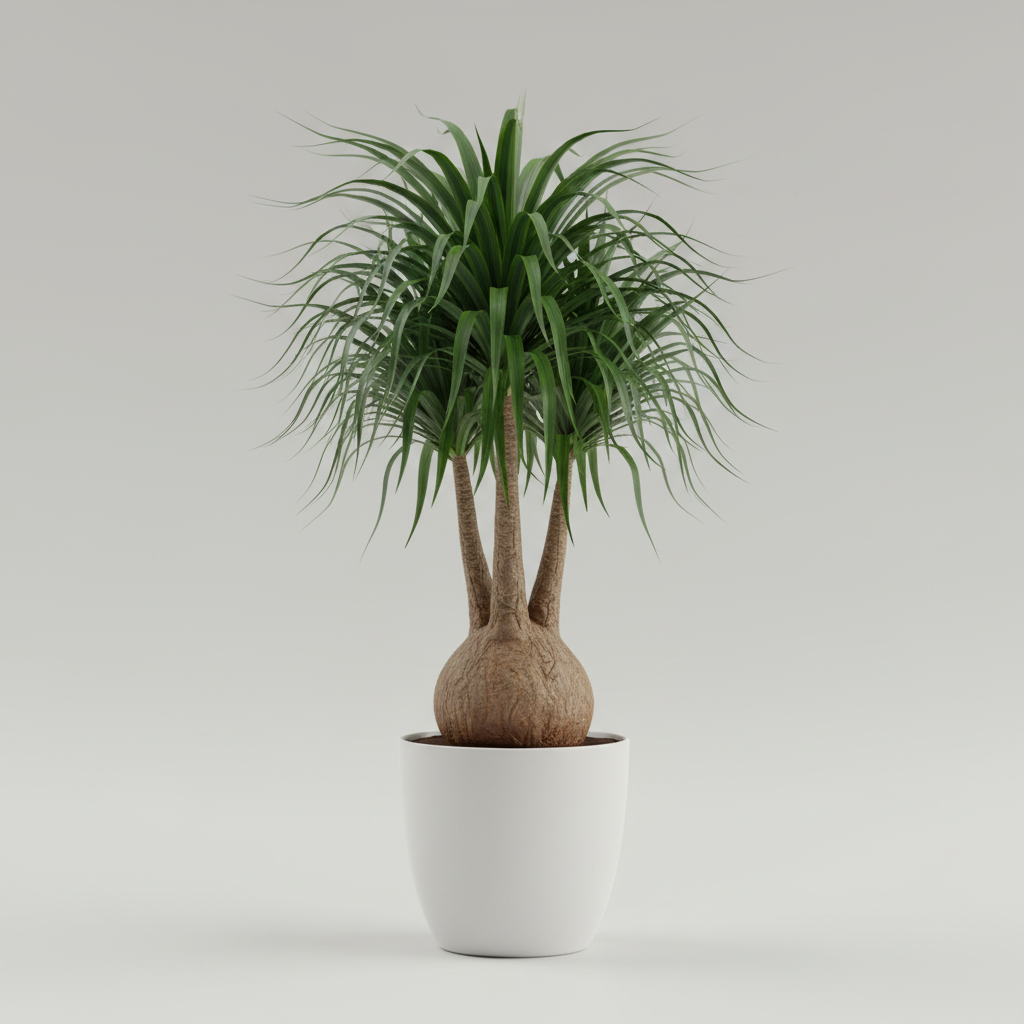
Multi-Trunk Ponytail Palm
A mature form of the straight species in which the caudex has split into two or more stems near the top, each carrying its own crown of leaves. Multi-trunk plants typically result from damage to the original growing point earlier in the plant’s life, or from intentional decapitation in cultivation, and they command a premium because of the more sculptural silhouette. Care is identical to the single-trunk form; the only practical difference is that the canopy is wider and the plant occupies more floor space.
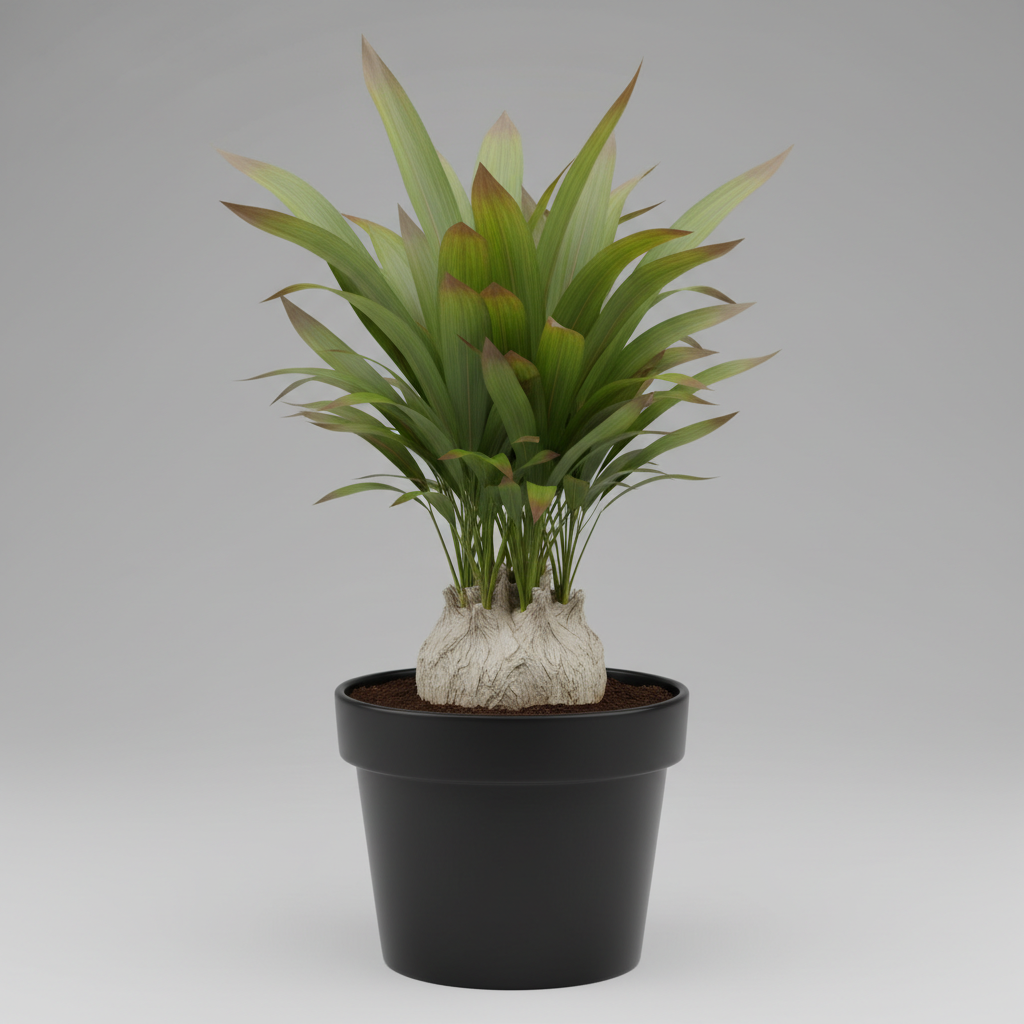
Beaucarnea guatemalensis
A closely related species native to Guatemala, sometimes sold as a Guatemalan ponytail palm or simply under the trade name without distinction. The leaves are slightly broader, stiffer and more upright than those of B. recurvata, and can take on a subtle reddish flush at the tips in strong light. Care requirements are essentially identical to those of the more familiar species, and the two are best distinguished by leaf carriage: cascading and grass-like in recurvata, more upright and slightly stiffer in guatemalensis.
Two other species are worth knowing about. Beaucarnea stricta has very straight, stiffly upright leaves rather than the recurving cascade of the more familiar plant; it tends to be sold as a specimen rather than a houseplant in this size class. Beaucarnea gracilis is a smaller, more delicate species with finer leaves and a slower growth rate, occasionally available from specialist nurseries. All members of the genus respond to the same broad care regime described in this guide.
Frequently Asked Questions
Is the ponytail palm actually a palm?
No. Despite the common name, Beaucarnea recurvata belongs to the asparagus family (Asparagaceae) and is more closely related to agaves and yuccas than to true palms. It earned the palm nickname purely from the loose visual resemblance of its leafy crown to a palm tree’s fronds.
How fast does a ponytail palm grow?
Slowly, by any houseplant standard. Indoor plants in good conditions typically add 5 to 15 centimetres (two to six inches) of height per year and a similar small increase in caudex girth. Plants in lower light, smaller pots or cool rooms may grow noticeably less. The slow rate is part of the appeal; a ponytail palm bought today will still suit the same shelf in a decade.
How long do ponytail palms live?
Specimens routinely live 50 years or more in cultivation, and well-tended indoor plants commonly outlive their original owners. Wild plants in Mexico have been reported at well over a century. They are genuinely a heirloom plant in the strict sense.
Why are the tips of my ponytail palm’s leaves turning brown?
The four common causes, roughly in order of frequency, are accumulated fertiliser salts in the soil, occasional acute drought after a long forgotten spell, sensitivity to fluoride or chlorine in tap water and proximity to a radiator or heating vent. Flush the pot with plain water, water more consistently going forward, switch to filtered or rain water, and move the plant away from heat sources.
Can I keep my ponytail palm outdoors in summer?
Yes, and many specimens benefit from a summer break outdoors in a sheltered, sunny spot. Acclimatise the plant to direct sun over a week or two to avoid scorch, and bring it back indoors before night temperatures fall consistently below 10°C (50°F). In USDA zones 9b and warmer, ponytail palms can be grown permanently outdoors.
My ponytail palm caudex is soft. What does that mean?
A soft, spongy or wrinkly caudex is almost always a sign of advanced overwatering and incipient rot. Unpot the plant immediately, cut away any soft tissue back to firm pale wood, dust the wounds with cinnamon or fungicide and repot dry in fresh gritty mix. Withhold water for at least two weeks. A slightly soft caudex caught early often recovers; a fully mushy one may not.
Should I mist my ponytail palm?
No. Unlike most large indoor plants, the ponytail palm is genuinely indifferent to humidity and gains nothing from misting. Water sitting in the leaf crown can in fact encourage rot at the growing point, so misting is mildly counterproductive rather than beneficial.
Is the ponytail palm safe for cats and dogs?
Yes. The ASPCA lists Beaucarnea recurvata as non-toxic to cats, dogs and horses. The strap-like leaves are tough and fibrous, so a determined chewer may experience mild stomach upset from the fibres themselves, but the plant contains no toxic compounds.
Why are no new leaves appearing?
The most likely explanation is insufficient light. Move the plant to the brightest position the room offers and wait for the new growth cycle in spring. Other contributing factors include cool temperatures, a recent repot the plant is still recovering from, or a pot so large that the roots have not yet filled the substrate.
Can I prune a ponytail palm?
Light cosmetic pruning is fine. Trim brown leaf tips back to healthy tissue following the natural pointed shape of the leaf, and remove fully dead lower leaves at the base. Cutting the main growing point will halt vertical growth and sometimes triggers the plant to produce two or more new heads, which some growers do deliberately to create a multi-trunk specimen; this is a permanent change and should be done only on a healthy plant in active growth.






