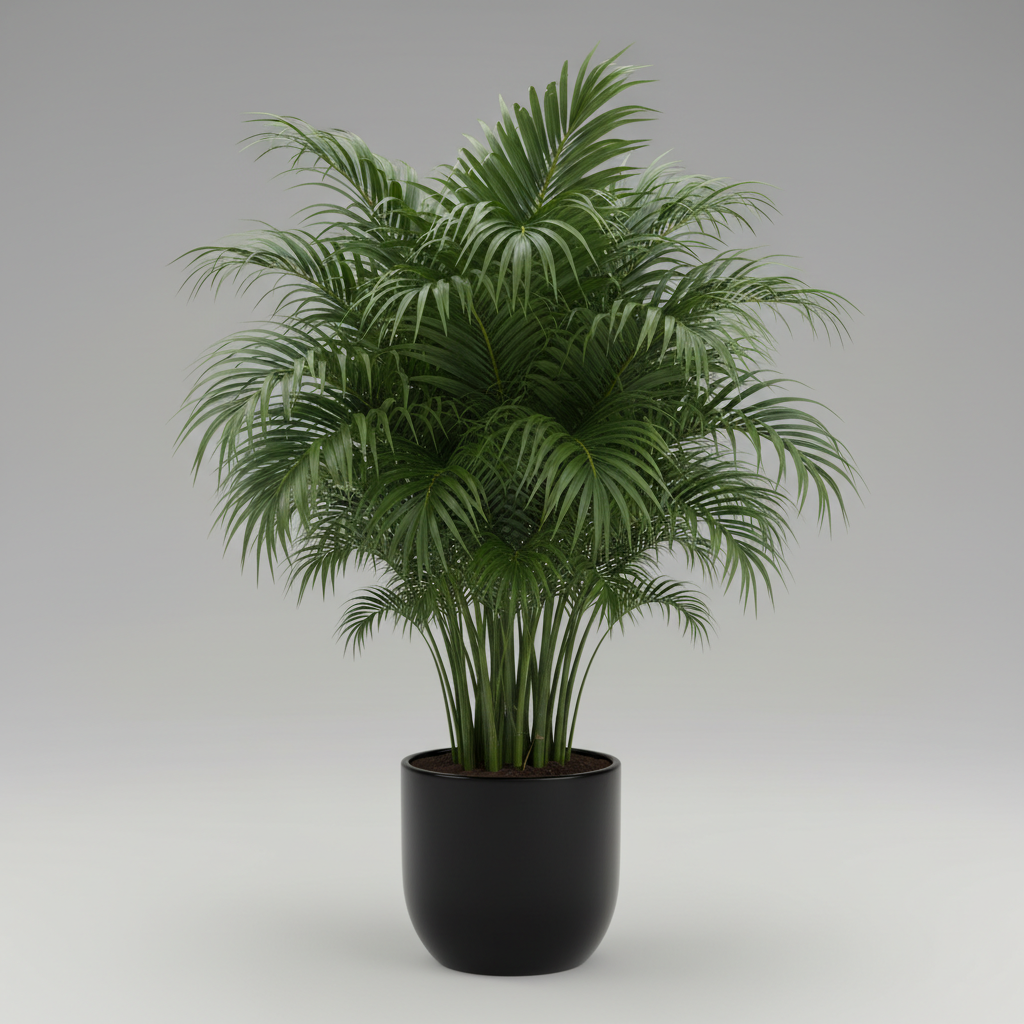
The kentia palm (Howea forsteriana) is the unfussy, slow-growing parlour palm that thrives in low light, tolerates neglect, and gives any room an effortlessly elegant tropical silhouette.
Few houseplants carry the quiet sophistication of the kentia palm. From Victorian conservatories to grand hotel lobbies, Howea forsteriana has been the palm of choice for over a century, and the reasons have not changed: it tolerates dim corners that defeat almost every other indoor palm, accepts cool draughty rooms, drinks unevenly without complaint, and turns even the most ordinary apartment into something that feels considered. It is, by some margin, the easiest tall palm you can keep alive indoors.
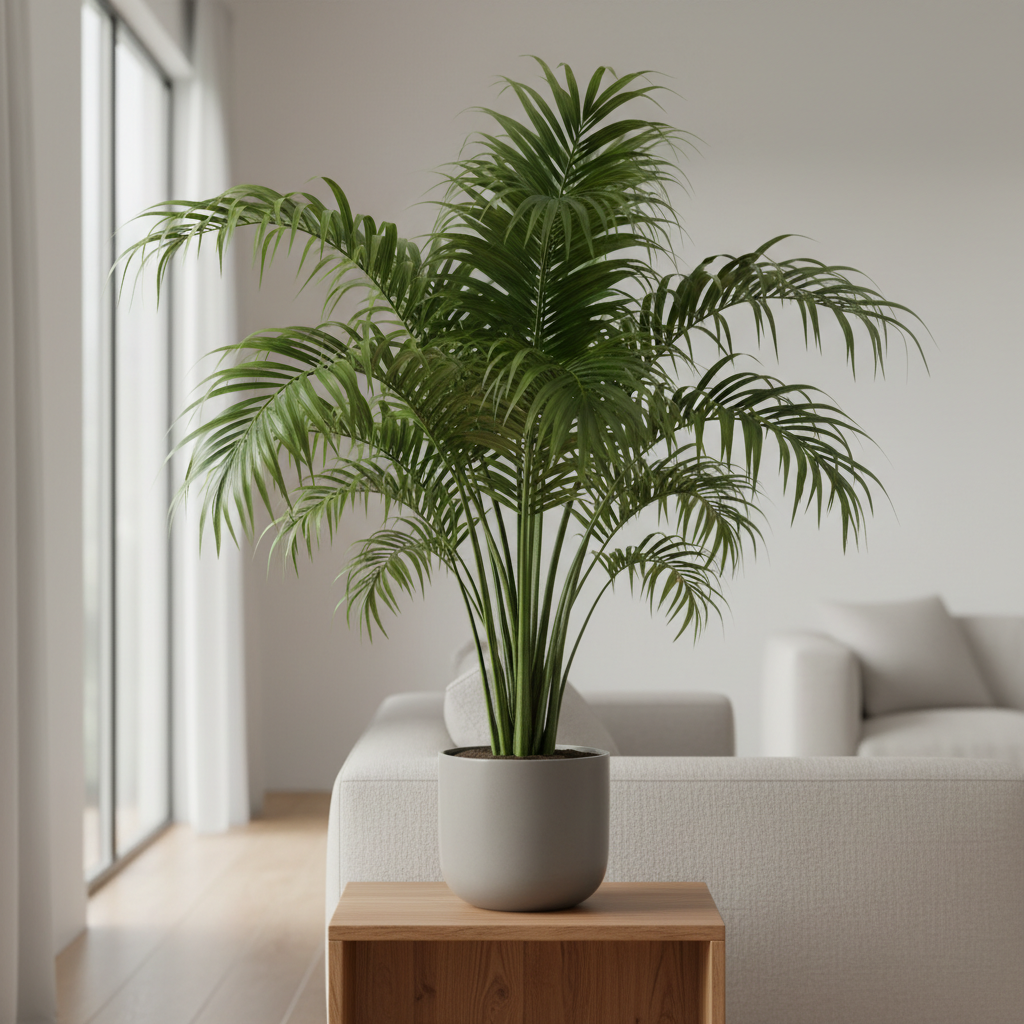
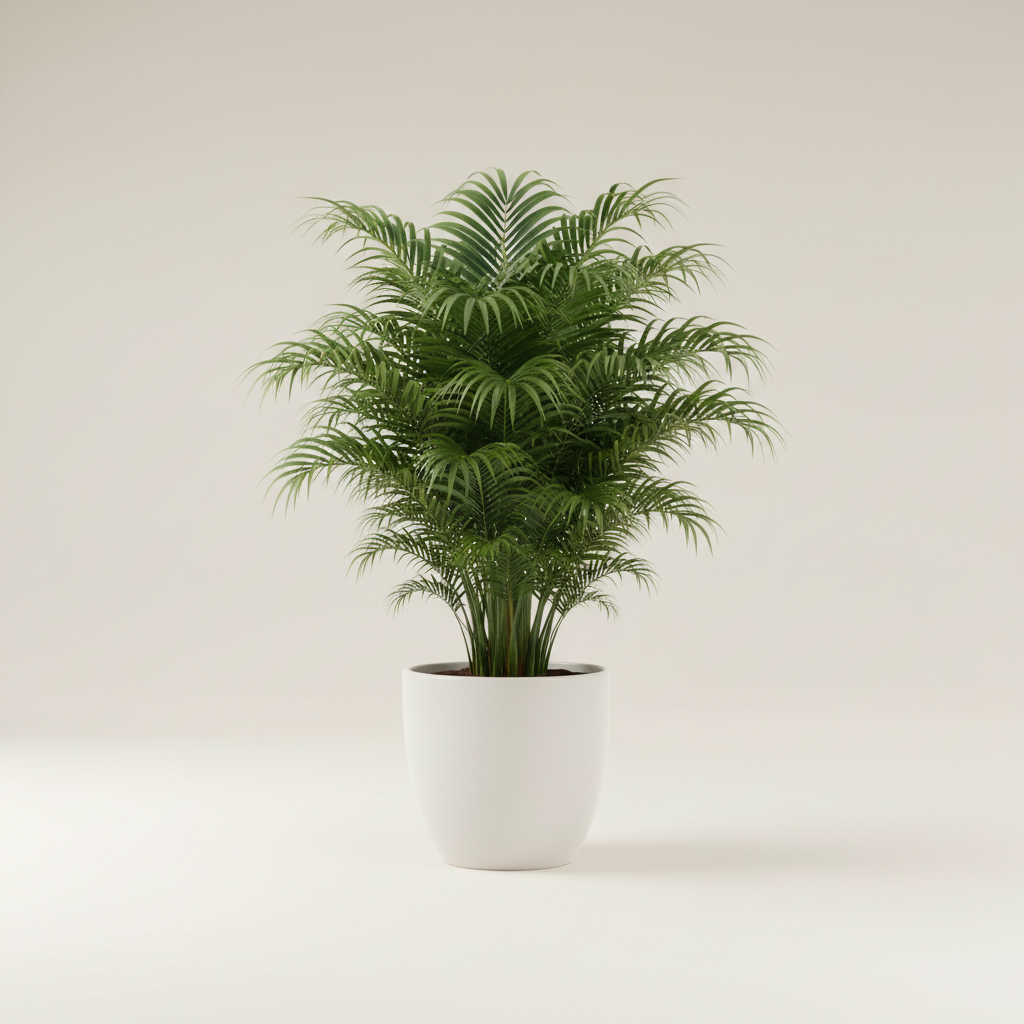
A mature kentia palm (Howea forsteriana) in a bright modern living room — the classic indoor palm silhouette.
This guide covers everything a home grower needs to take a kentia palm from nursery purchase to decades-long centrepiece. Where many palm guides treat dozens of species interchangeably, the advice below is specific to Howea forsteriana: how its slow growth shapes feeding and repotting decisions, why it forgives low light better than nearly any tall palm, and which common care mistakes shorten its lifespan in the home. The framing throughout is “survive versus thrive” — a kentia palm will survive in conditions that kill an areca palm, but a thriving specimen looks markedly different, and the gap between the two is mostly about light quality, watering rhythm, and patience.
Quick Reference
The table below is the at-a-glance summary. The rest of the guide explains the reasoning behind each line and how to adapt the numbers to your specific home.
Lord Howe Island, Australia (endemic to a single small island)
Mature size indoors
2 to 3 metres (6.5 to 10 feet) tall, very slowly
Growth rate
Slow — roughly one or two new fronds per cane per year indoors
Light
Bright indirect; tolerates medium and even low light better than any other tall palm
Water
Let the top 3 to 5 cm (1 to 2 inches) of soil dry between waterings; reduce sharply in winter
Humidity
Average household (40 to 60 percent) is fine; benefits from occasional misting
Temperature
16 to 24 degrees Celsius (60 to 75 degrees Fahrenheit); minimum 10 degrees Celsius (50 degrees Fahrenheit)
Soil
Free-draining loam-based mix with added perlite or pumice
Fertiliser
Balanced liquid feed at half strength every 4 to 6 weeks in spring and summer
Propagation
From fresh seed only; nursery clusters can sometimes be separated
Toxicity
Non-toxic to cats, dogs and humans
Difficulty
Beginner-friendly; one of the most forgiving indoor palms in cultivation
Why the Kentia Palm Is Such a Good Houseplant
Most palms sold as houseplants are tropical understory or coastal species that grow quickly, demand bright direct light, and resent the dry, draughty conditions of a centrally heated home. The kentia palm is the rare exception. It comes from Lord Howe Island, a small subtropical island roughly 600 kilometres east of mainland Australia, where it grows under a cool, breezy maritime climate with mild winters and overcast skies for much of the year. That climate matters: the kentia evolved to handle exactly the conditions a typical living room provides — moderate light, cool nights, and steady but unspectacular warmth.
Kentia palms thrive as long-term decor anchors in calm, low-traffic interiors.
The species is also exceptionally slow-growing. Wild specimens take decades to reach their full height of around 12 metres (40 feet), and indoor plants typically add only one or two new fronds per cane each year. While this can feel like a drawback in the first season, slow growth becomes a feature over time: a well-grown kentia keeps its shape and proportions for years, rarely needs repotting, and does not outgrow its position. A 1.5 metre (5 foot) plant purchased today may take five years to reach 2 metres (6.5 feet), giving it a stability and presence that fast-growing palms cannot match.
Then there is the reputation. The kentia palm was the signature plant of the Victorian and Edwardian interior — the palm in the corner of every grand drawing room, every steamship lounge, every hotel restaurant. That popularity was not nostalgia; it was practicality. Victorian rooms were dim, cool, draughty, dusty and full of coal smoke, and the kentia palm survived where every other palm failed. Modern homes are kinder, but the kentia retains the same tolerance for adversity. Its non-toxic status — confirmed safe for cats, dogs and humans by the ASPCA — completes the picture: it is the rare large-format houseplant that suits households with pets and young children without compromise.
Pro Tip — Buying a kentia palm: Pots of kentia at garden centres typically contain three to seven seedlings planted together to create a fuller silhouette. This is normal nursery practice and the cluster should usually be kept intact — the seedlings have grown together for years and separating them is stressful. Buy the fullest, healthiest cluster you can afford, and resist the temptation to divide.
Light
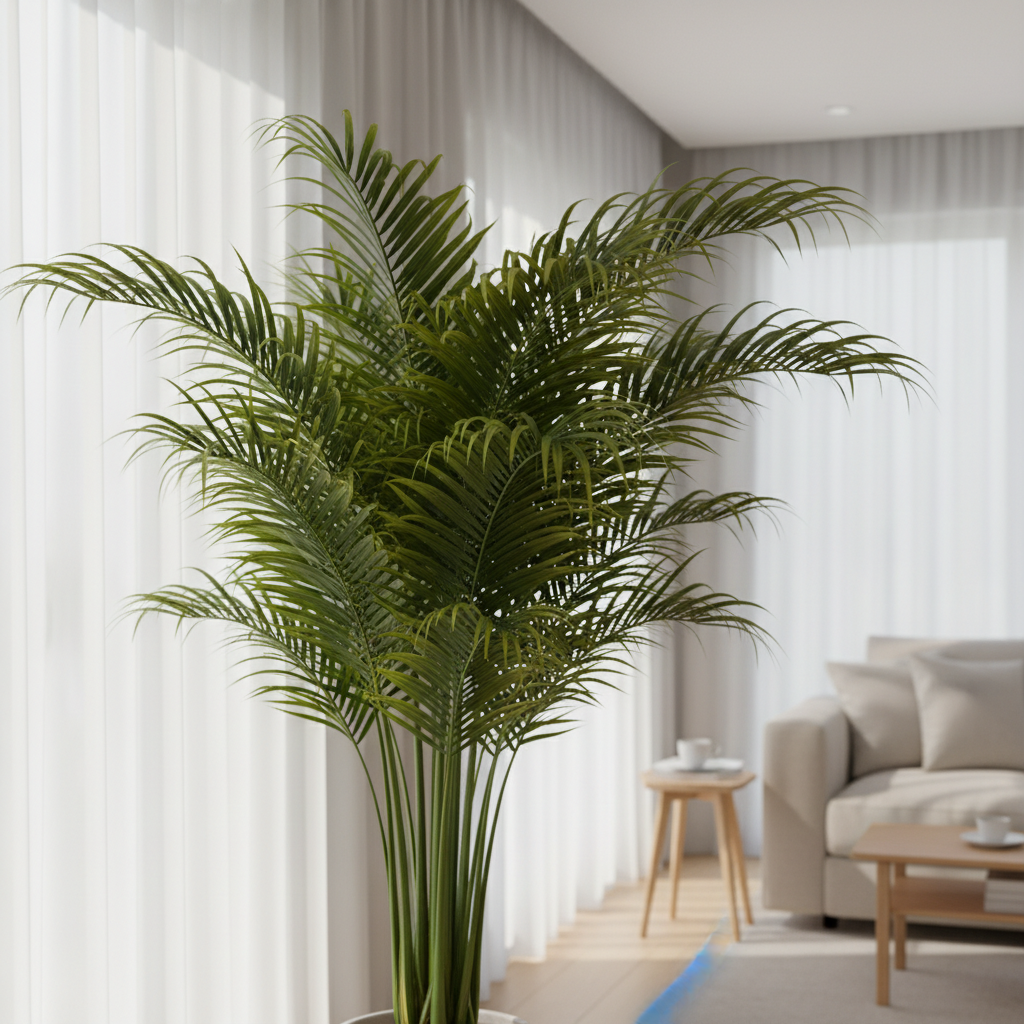
A bright, filtered light position a few metres from a window is the kentia palm’s sweet spot.
The kentia palm is famously low-light tolerant, and that single quality drives nearly every placement decision. In the wild, juvenile Howea forsteriana grow as understorey plants, sheltered by the canopy of mature palms above, and only push into brighter light as they mature. Indoors, this means a young to medium-sized kentia will accept a position several metres from a window where almost no other tall palm would survive. It is the palm for north-facing rooms, deep corners, and tall offices with frosted glass.
That said, tolerance and preference are different things. A kentia palm survives in low light, but it thrives in bright indirect light. The ideal position is roughly 1 to 3 metres (3 to 10 feet) from an east-facing or north-facing window, or further back from a south or west window where direct afternoon sun is filtered through sheer curtains. In these conditions, new fronds emerge a richer green, hold their shape better, and the plant pushes out one or two fronds per cane per year rather than one every other year.
Direct midday sun is the one light condition to avoid. Howea forsteriana evolved under canopy shade and its fronds scorch readily when exposed to several hours of unfiltered sun, especially behind glass where temperatures climb. Scorched fronds develop dry, pale bronze or yellow patches that do not green up again, and badly burned fronds may need to be removed entirely. If your only available position is a sunny south-facing window, set the palm back 2 metres (6.5 feet) from the glass, or hang a sheer curtain to diffuse the light.
Rotate the pot a quarter turn every two to three weeks to encourage even growth. Kentia palms grow towards their light source, and an unrotated plant develops a noticeable lean over a year or two — easy to prevent, hard to correct once established. If the plant is too heavy to rotate, sit the pot on a flat lazy Susan or wheeled saucer so a quarter turn takes seconds.
Pro Tip — Light test: If you can read a paperback comfortably during the day in the position you have in mind, a kentia palm will accept it. If you need to switch a lamp on to read, the palm will survive but grow extremely slowly and lower fronds may yellow over time.
Watering
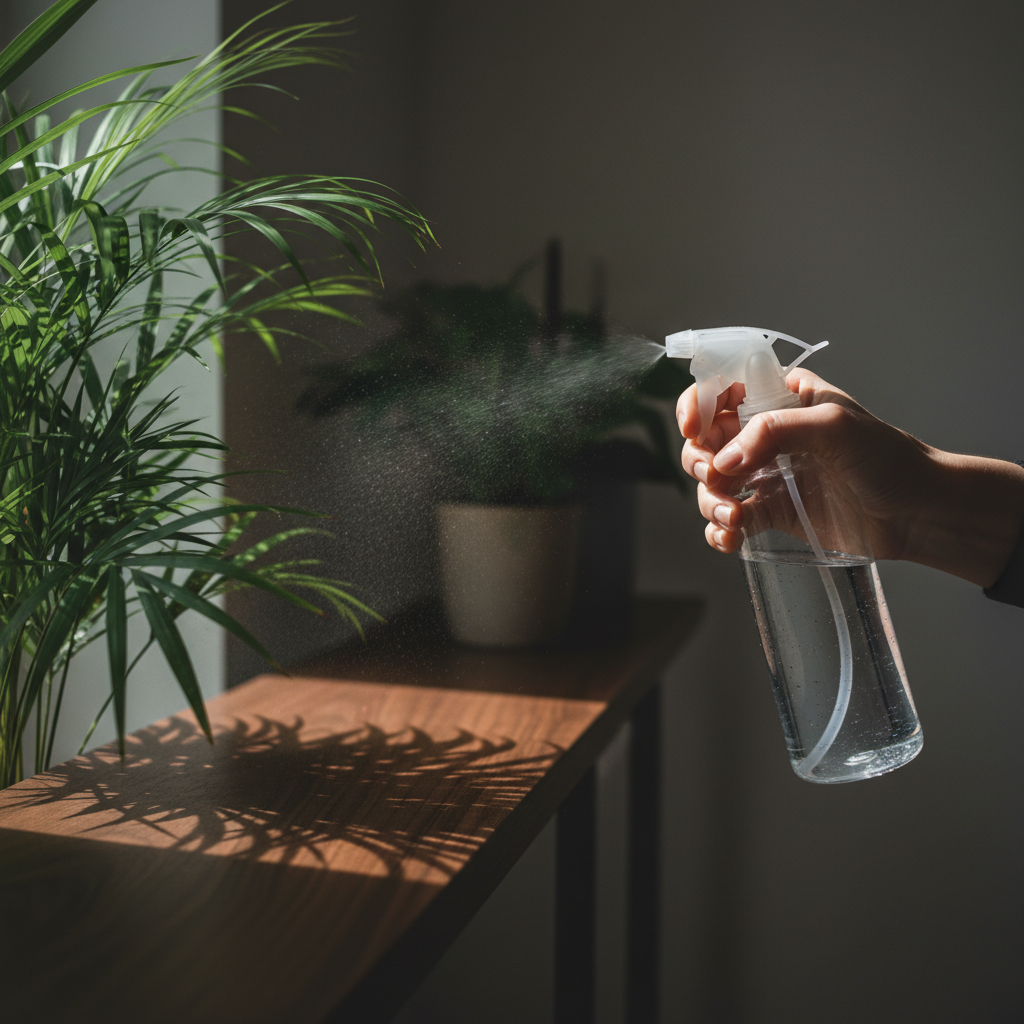
An occasional misting freshens dusty fronds and lifts ambient humidity briefly, though it is no substitute for a proper soak.
If anything kills a kentia palm in the home, it is overwatering. The species evolved on free-draining sandy island soils and its root system rots quickly when kept persistently wet. The general principle is straightforward: water thoroughly, then wait until the top 3 to 5 centimetres (1 to 2 inches) of soil are dry to the touch before watering again. A finger pushed into the mix at two knuckles’ depth is the most reliable check; if the soil feels cool and damp, wait.
“Thorough” watering means flooding the surface until water runs freely from the drainage holes for several seconds, then letting the pot drain fully before returning it to its decorative cover or saucer. A kentia palm hates standing in water, and a saucer left full will reliably rot the roots within weeks. The reason for soaking is that palm roots fan out widely and shallowly, and a light surface watering only moistens the top 2 to 3 centimetres of soil while the lower roots stay parched. This produces a plant that looks thirsty no matter how often you water.
The frequency depends entirely on temperature, light and pot size. As a starting point, a medium kentia palm in a 25 to 30 centimetre (10 to 12 inch) pot in average household conditions typically needs watering once every 7 to 10 days in spring and summer, and once every 14 to 21 days in autumn and winter. Reduce sharply when temperatures fall below 18 degrees Celsius (65 degrees Fahrenheit) — a cool kentia in dim winter light barely transpires and is easy to overwater.
Water quality matters less for kentia palms than for many tropical houseplants. They tolerate moderately hard tap water reasonably well, though long-term use of very hard or fluoridated water can produce slow leaf-tip browning. If your tap water leaves heavy limescale on kettles, consider letting tap water stand uncovered for 24 hours before use, or alternate with collected rainwater every few months.
Reading the plant takes practice. A thirsty kentia palm shows it by drooping the lower fronds slightly and developing crisp brown tips on the oldest leaflets. An overwatered kentia shows it differently: fronds yellow uniformly from the base of the plant upwards, often with soft black spots on the leaf stems, and the soil smells sour. Yellowing is almost always too much water, never too little. When in doubt, wait another two or three days.
Warning — The “weekly schedule” trap: Do not water on a fixed calendar. The same kentia palm that needs a weekly drink in July may only need water every three weeks in January. Check the soil, not the date. Plants on a rigid schedule fail almost as reliably as plants on no schedule at all.
Soil and Repotting
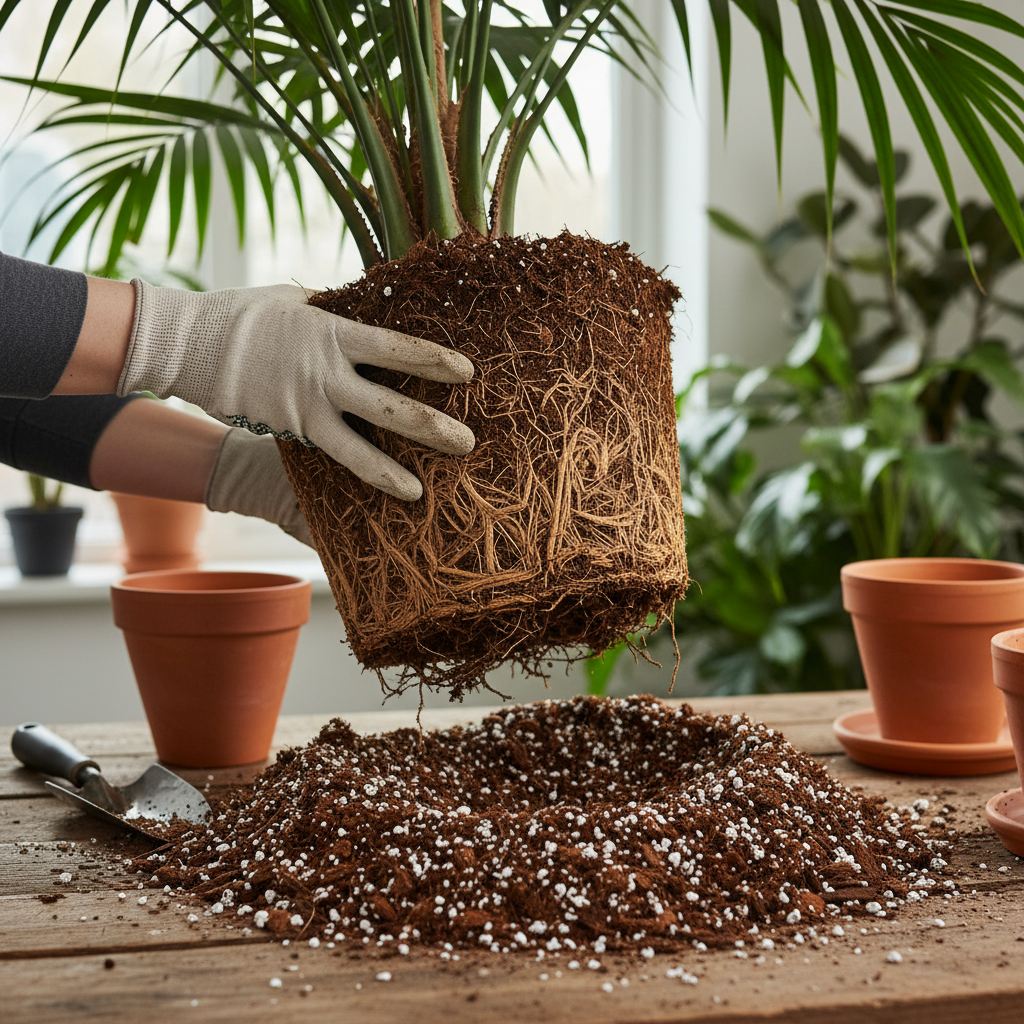
When repotting, lift the entire root mass intact — kentia palms resent root disturbance.
Kentia palms need a soil mix that drains freely while still retaining moderate moisture between waterings. A reliable home recipe is two parts good-quality loam-based potting compost (such as a John Innes No. 2 in the UK or any commercial indoor plant compost elsewhere), one part coarse perlite or pumice, and half a part orchid bark. This produces a chunky open mix that holds enough water for the roots but never becomes waterlogged. A commercial palm or cactus mix straight from the bag is a perfectly acceptable shortcut, especially if you add an extra handful of perlite per litre of compost.
What to avoid: pure peat-based compost, which holds far too much water and collapses into a dense airless mass within a year; mixes containing water-retaining gel crystals, which encourage rot; and any soil that feels like a smooth, fine paste rather than a crumbly chunk. If the mix sticks to your fingers like dough, it is wrong for a kentia.
Repotting is needed far less often than for most houseplants. A kentia palm should be repotted only every three to four years, and even then only when roots are clearly circling the pot or pushing out of the drainage holes. The species genuinely prefers being slightly root-bound, and frequent repotting stresses the plant and often triggers a season of dropped fronds. When you do repot, go up just one pot size — typically 5 centimetres (2 inches) wider — and use a heavy pot that can ballast the tall canopy.
The mechanics of repotting matter. Water the plant thoroughly the day before to make the root ball cohesive. Lay newspaper on the floor and tip the pot on its side, easing the root ball out with gentle pressure on the pot rim rather than pulling on the canes (the canes are not load-bearing and pulling can snap them at the base). Place the root ball into the new pot at the same depth as before — never bury the base of the canes — and pack fresh mix around the sides, tapping the pot to settle the soil rather than pressing it down hard. Water thoroughly to settle, top up any depressions with mix, and keep the plant in shadier conditions for a fortnight while the roots re-establish.
If your kentia is too large to repot easily, top-dressing is the alternative. Once a year in spring, scrape off the top 3 to 5 centimetres of old soil with a small hand fork, taking care not to damage surface roots, and replace with fresh mix enriched with a slow-release palm fertiliser. This refreshes the substrate, replenishes nutrients, and can extend the interval between full repottings by several years.
Pro Tip — Drainage is non-negotiable: Always pot a kentia palm in a container with drainage holes. If you love a particular decorative pot that has no holes, keep the palm in a plain plastic nursery pot and slip it inside the decorative cover. Empty the cover of standing water within an hour of every watering.
Fertilising
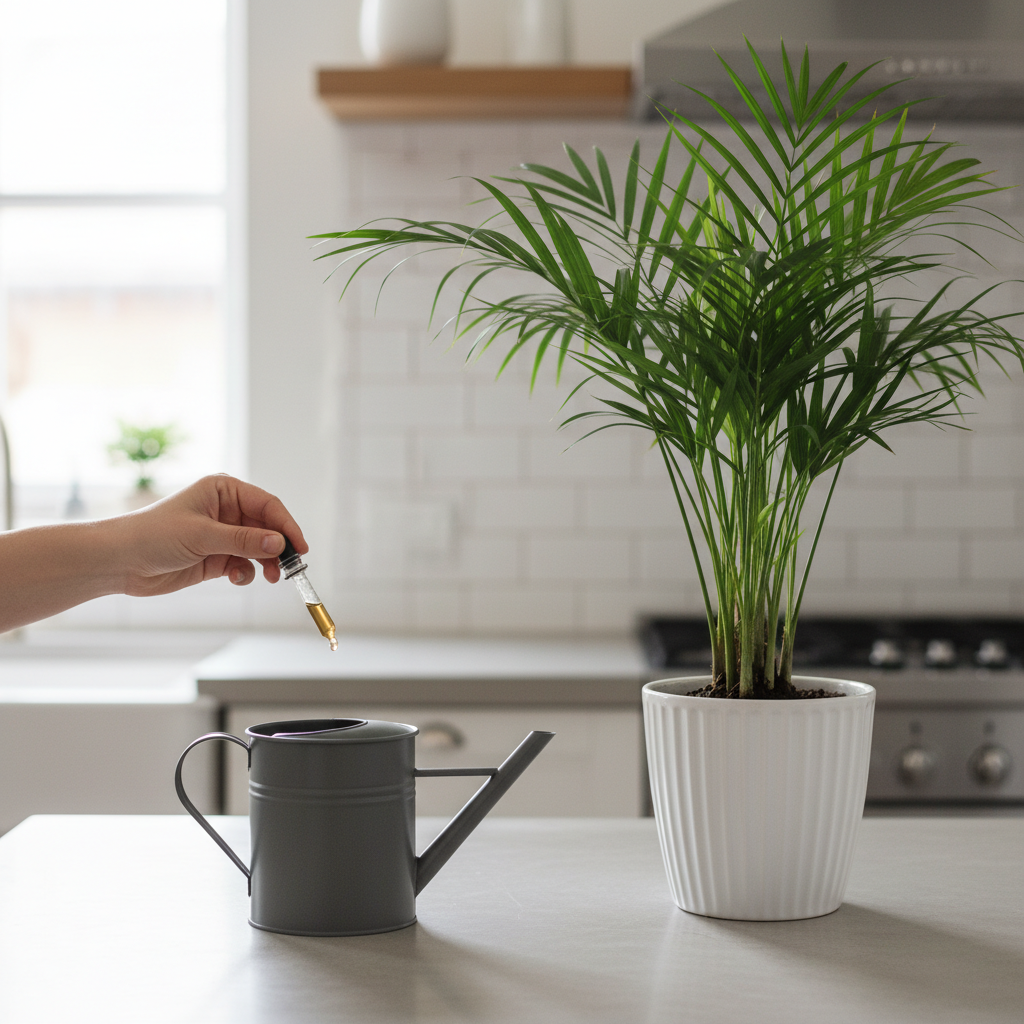
Dilute liquid feed by half before adding it to the watering can — kentia palms are sensitive to over-feeding.
Slow growth and modest demands make feeding straightforward but easy to overdo. A kentia palm benefits from regular but very gentle feeding during the active growing season (roughly March to September in the northern hemisphere), and no feeding at all through autumn and winter. The general rule is little and often, and always dilute.
A balanced liquid houseplant fertiliser at half the strength recommended on the bottle, applied every four to six weeks from spring to early autumn, is plenty. Look for an N-P-K ratio close to 3-1-2 or 5-2-3 — palms benefit from slightly higher nitrogen than the typical houseplant feed, which supports the production of dark green new fronds. Specialist palm fertilisers exist and are excellent if available, particularly those that include magnesium and manganese, two micronutrients to which kentia palms are sensitive.
The signs of magnesium deficiency are distinctive and worth knowing: older fronds develop bright yellow bands along the leaflets, while the central leaflet rib stays green. If you see this pattern on a plant that is otherwise healthy, switch to a palm-specific fertiliser or supplement with a teaspoon of Epsom salts (magnesium sulphate) dissolved in a litre of water, applied as a normal watering once in spring and once in midsummer.
The much more common problem is over-fertilising. Symptoms include crisp brown leaf tips spreading inward, a white salt crust on the soil surface or pot rim, and occasionally a sudden flush of yellowed fronds. The remedy is to flush the pot thoroughly: take the plant to a sink or shower, water it generously with plain water until clear water runs from the drainage holes for a full minute, allow it to drain completely, and skip the next two scheduled feeds.
Slow-release granular fertilisers are an alternative for growers who prefer to feed once and forget about it. Sprinkle a small handful (following the package rate for the pot size) onto the soil surface in early spring; the granules will release nutrients gradually over three to four months. Do not use slow-release feed in winter, when the plant cannot take up the nutrients fast enough and they accumulate as harmful salts.
Pro Tip — Newly repotted plants: Skip fertilising for the first two to three months after repotting. Fresh commercial potting mix usually contains enough background nutrients to carry the plant for that period, and recently disturbed roots are easily burned by extra feed.
Propagation
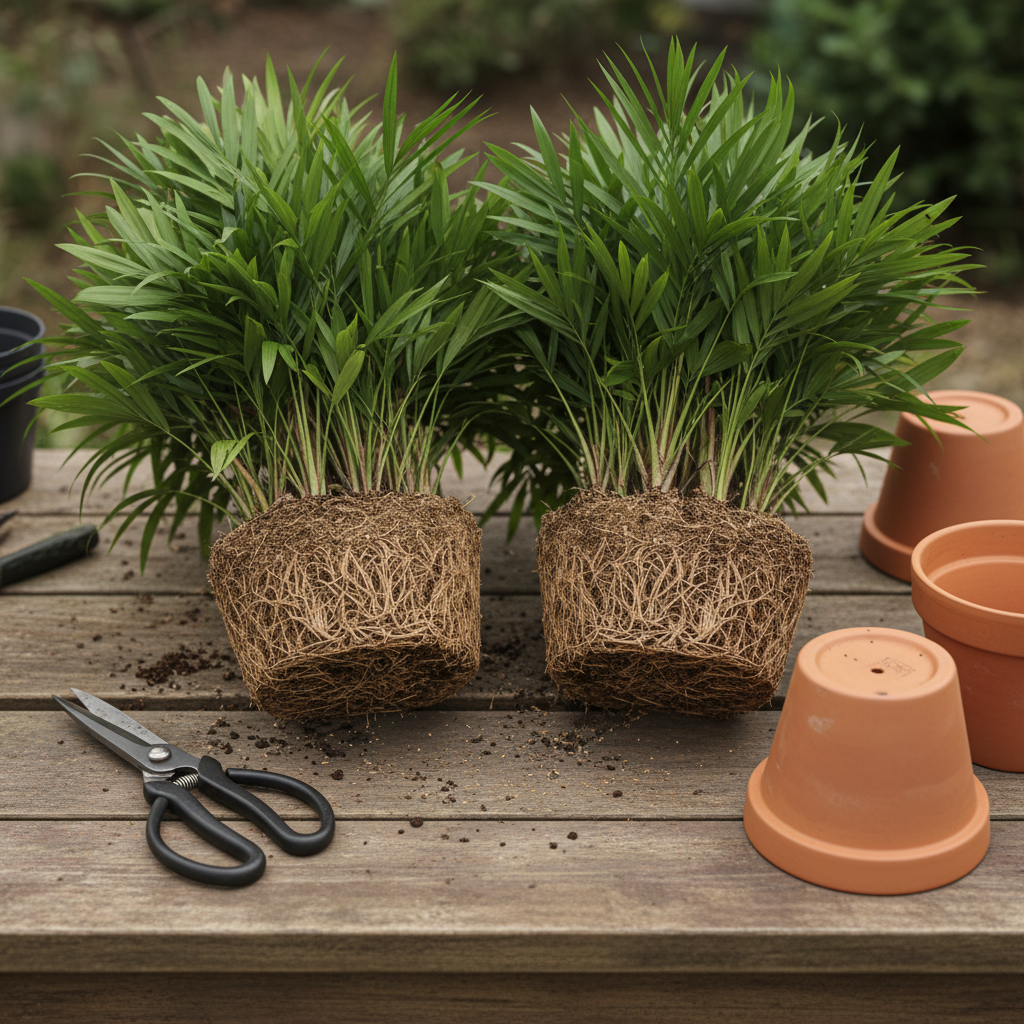
A nursery cluster of kentia palm seedlings being carefully separated for repotting.
Honesty matters here: the kentia palm is one of the harder houseplants to propagate at home. The species does not produce side shoots, runners, suckers or pups. It does not root from cuttings of any kind. Each cane is a single growth point, and removing it kills that cane. The only true method of propagation is from fresh seed, and that requires conditions and patience few homes can supply.
Kentia seeds are commercially harvested almost exclusively on Lord Howe Island under a tightly regulated quota system, then shipped worldwide to wholesale nurseries. The seeds have an erratic and famously slow germination period of three months to a full year, and require consistent warmth of around 27 to 30 degrees Celsius (80 to 86 degrees Fahrenheit) with high humidity throughout. A home grower with a heated propagator and a year of patience can succeed, but the venture is for the genuinely curious rather than the practically minded.
The accessible alternative for most home growers is to separate a multi-stem nursery cluster. A typical kentia bought at a garden centre contains anywhere from three to seven seedlings that have grown side by side in the same pot since infancy. Their root systems are intertwined but, with care, the cluster can be divided into smaller groups. This is the only realistic way to produce new plants from an existing kentia, and even this is stressful for the plants — many growers prefer to leave clusters intact for life.
Separating a Nursery Cluster
If you have decided to divide, the work is best done in late spring or early summer, when the plant is in active growth and recovers most quickly. Follow these steps:
Water the plant thoroughly 24 hours in advance. Hydrated roots are more flexible and snap less easily during division.
Lay newspaper on the floor and remove the plant from its pot. Tip the pot on its side and ease the root ball out with steady pressure on the pot rim, not by pulling on the canes.
Gently rinse or tease the outer roots free of soil with your fingers, working from the bottom of the root ball upwards. Avoid using forks or hard tools that tear roots.
Once you can see where the individual root crowns join, work them apart slowly with your hands. Use clean, sharp secateurs only as a last resort to sever stubborn root connections. Aim to keep groups of two or three canes together rather than separating every single cane.
Repot each division immediately into a pot just slightly larger than its own root ball, using fresh palm potting mix. Water thoroughly to settle, and place the divisions in bright indirect light away from draughts.
Expect a six to twelve week recovery period during which growth pauses and one or two older fronds may yellow and need to be removed. New frond emergence is the signal that the divisions have re-established.
Warning — Be prepared to lose some divisions: Even with careful technique, around 20 to 30 percent of divided kentia clusters lose one or more divisions in the months after separation. If you cannot accept that risk, leave the cluster intact and enjoy the fullness it provides.
Pests, Diseases and Common Problems
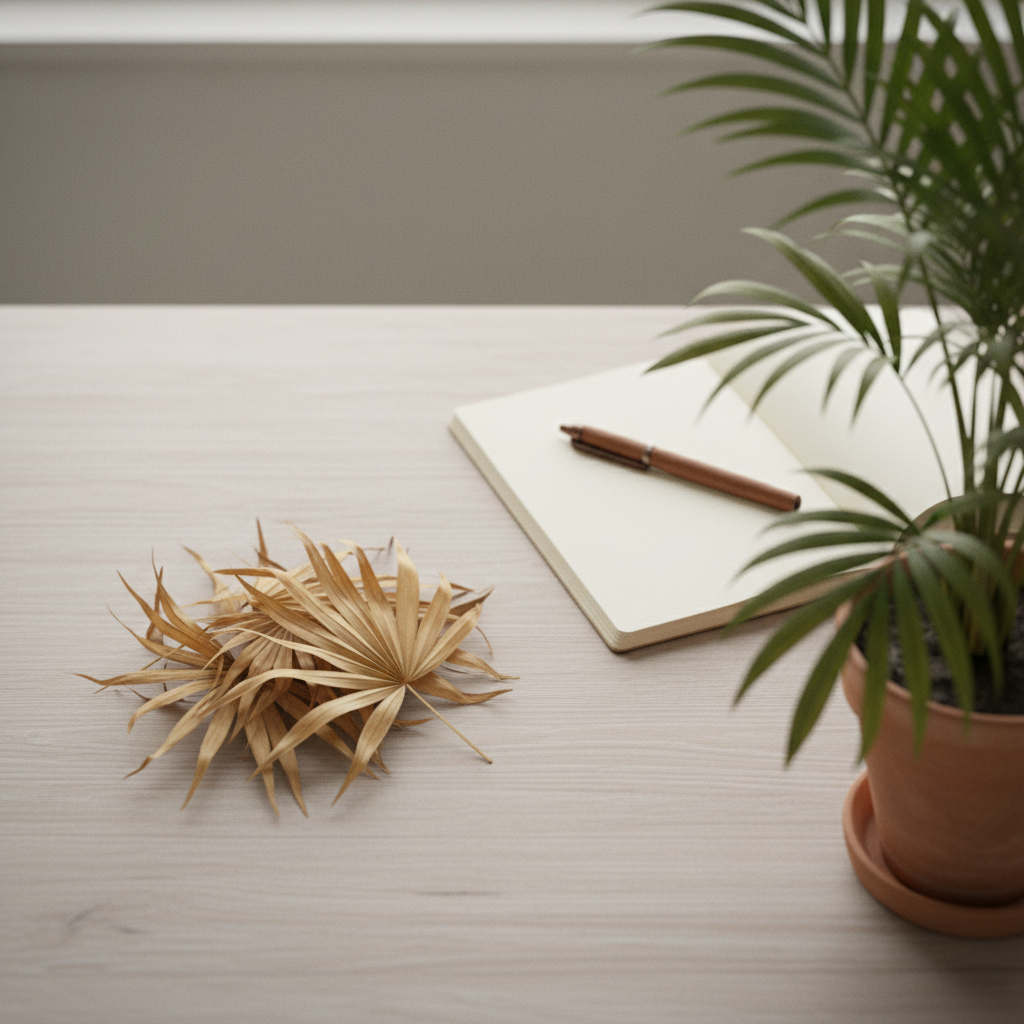
Inspecting fallen and damaged leaflets is the quickest way to diagnose what is troubling a kentia palm.
Kentia palms are not particularly pest-prone but, like all indoor palms, they can attract a small cast of familiar insect visitors. The most common are spider mites, mealybugs and scale, all of which prefer the dry, dusty conditions of centrally heated rooms in winter. Routine inspection is the single best defence: every two or three weeks, examine the undersides of fronds and the joints where leaflets meet the central rachis under a bright light or hand lens.
Spider Mites
Spider mites are the most frequent kentia pest. They thrive in dry indoor air and produce fine pale stippling on the upper surface of leaflets, sometimes with delicate webbing in the leaf axils when infestations are heavy. Treatment combines mechanical removal and environmental change. Stand the plant in a shower or take it outdoors on a mild day and rinse the fronds thoroughly with a firm spray of tepid water, paying particular attention to leaf undersides. Repeat every five to seven days for three weeks to break the mite life cycle. Raising the ambient humidity around the plant, by misting or placing it on a pebble tray, makes the environment uncomfortable for mites and discourages reinfestation.
Mealybugs
Mealybugs appear as small white cottony tufts in the crevices where leaflets join the central rib and at the base of the canes. Light infestations can be removed manually with a cotton bud dipped in isopropyl alcohol, which dissolves the protective wax and kills the insect on contact. For heavier infestations, a horticultural soap or neem oil spray applied weekly for three weeks is reliable. Always test any spray on a single leaflet first and apply in the evening to avoid leaf scorch from sun on wet foliage.
Scale Insects
Scale insects are harder to spot because the adults look like small brown or tan bumps glued to the leaflet undersides and stems, often mistaken for natural plant texture. Their presence is sometimes betrayed by sticky honeydew on lower fronds or on the floor beneath the plant. Heavy scale infestations need a systemic insecticide drench (a horticultural product containing imidacloprid is widely available), as topical sprays struggle to penetrate the protective shell of adult scale. Always follow label rates carefully and ventilate the room well during application.
Brown Leaf Tips
Brown, crisp leaf tips are the most common cosmetic complaint with kentia palms, and they have several possible causes. Low humidity is the usual suspect, particularly in winter when central heating dries indoor air to 25 to 30 percent relative humidity. Mineral build-up from very hard tap water or over-fertilising is the second most common cause, producing tips that brown progressively over weeks. Inconsistent watering — letting the soil dry to dust between drinks — is the third. Trim browned tips with sharp scissors at an angle that mimics the natural leaflet taper; never cut into green tissue.
Yellowing Fronds
Yellowing fronds tell a story depending on which fronds are affected. Uniform yellowing of the oldest, lowest fronds is normal — palms continuously shed their oldest fronds as new ones emerge from the crown, and a healthy kentia will produce a yellow lower frond once or twice a year that should simply be cut off at the base. Yellowing of multiple fronds at once, particularly newer ones near the top, almost always indicates overwatering and incipient root rot. Bright yellow bands on otherwise green leaflets point to a magnesium deficiency, as described in the fertilising section.
Root Rot
Root rot is the single most serious problem affecting indoor kentia palms and the leading cause of unexpected death. Symptoms are a sour smell from the soil, soft mushy black areas at the base of the canes, and a sudden cascade of yellowing fronds. If you suspect root rot, act fast: unpot the plant, rinse the roots under running water, and trim away any black, mushy or hollow roots with sterilised secateurs. Healthy roots are firm, pale tan or cream and break cleanly. Repot in fresh dry mix and a clean pot, water sparingly for the first month, and accept that you may still lose the plant. Prevention — by avoiding overwatering and ensuring drainage — is overwhelmingly more reliable than cure.
Pro Tip — The two-finger test: Before reaching for any insecticide, run your finger and thumb along three or four leaflets and inspect what you wipe off. Greenish dust, fine webbing, white cotton or brown lumps tell you immediately what you are dealing with. Most “mystery” kentia problems are diagnosed in under thirty seconds this way.
Varieties and Close Relatives
The horticultural kentia palm is essentially a single species, Howea forsteriana, with no commercial cultivars of any significance. What you will encounter in nurseries instead is variation in form — single-stem versus multi-stem clusters, plants of different ages and heights — and the closely related sister species Howea belmoreana, also native to Lord Howe Island. Together they form the entire genus Howea, which is found nowhere else on Earth.
Belmore Sentry Palm
Howea belmoreana — the kentia’s sister species and only close relative. The Belmore sentry palm has shorter, stiffer petioles and more strongly arching, curlier fronds that give it a denser, more compact silhouette than H. forsteriana. It is less tolerant of low light and slightly slower-growing, making it the rarer of the two in cultivation. Where the kentia palm reads as elegant and airy, the Belmore reads as architectural and bushy. Care requirements are otherwise identical to H. forsteriana.
Multi-Stem Nursery Cluster
Not a true variety but the standard commercial form of kentia palm. Nurseries pot three to seven young seedlings together to create a fuller, more decorative silhouette that mimics how kentia palms grow naturally in groves. The cluster looks lush and mature even when the individual seedlings are quite young, which is why this form dominates the indoor plant market. It is care-wise identical to a single-stem specimen and should generally be kept undivided for life — the entwined roots have grown together for years and the canes shelter each other.
Beyond Howea, the kentia is sometimes confused at retail with several superficially similar palms. The parlour palm (Chamaedorea elegans) has much smaller, softer fronds and stays under a metre tall; the areca palm (Dypsis lutescens) has bright lime-green stems and grows in dense fountain-like clusters; the majesty palm (Ravenea rivularis) has straighter, stiffer fronds and demands far more light and water. None match the kentia’s combination of low-light tolerance and elegant silhouette, which is why the species commands a price premium in most markets.
Frequently Asked Questions
How fast does a kentia palm grow indoors?
Slowly. Expect one or two new fronds per cane per year in good conditions, and a height gain of perhaps 5 to 10 centimetres (2 to 4 inches) per year. A 1.5 metre (5 foot) plant may take five years to reach 2 metres (6.5 feet). This slow growth is one of the species’ most useful features — it keeps its shape and proportions for years.
Is a kentia palm safe for cats and dogs?
Yes. Howea forsteriana is listed as non-toxic to cats, dogs and horses by the ASPCA, and there are no known toxic compounds in the fronds, stems or seeds. As with any houseplant, ingestion can still cause mild gastrointestinal upset in pets that chew leaves heavily, but no medical intervention is normally required.
Why are the tips of my kentia palm turning brown?
Most often, dry air. Kentia palms tolerate average indoor humidity well but tip-browning is the first symptom when humidity falls below 30 percent, typical of centrally heated homes in winter. Other common causes include hard tap water, over-fertilising and inconsistent watering. Trim the brown tips at a natural angle with sharp scissors and adjust the underlying cause.
Can I put my kentia palm outside in summer?
In temperate climates, yes — placing a kentia outdoors in a shaded sheltered spot from late June through August can rejuvenate a tired plant. Acclimatise it gradually over a fortnight to outdoor light and air, keep it out of direct sun, and bring it back inside well before nighttime temperatures fall below 12 degrees Celsius (54 degrees Fahrenheit). Inspect carefully for pests before returning the plant indoors.
Should I cut off yellow fronds?
Once a frond has turned uniformly yellow it will not green up again. Wait until the petiole (the long stem of the frond) has also started to soften or brown, then cut it cleanly at the base where it meets the cane, using sharp sterilised secateurs. Removing a still-green frond too early deprives the plant of recoverable nutrients that it pulls back into the cane as the frond senesces.
How long does a kentia palm live?
Indoors, a well-kept kentia palm can easily live 40 to 60 years and remain decorative throughout. Wild specimens on Lord Howe Island are estimated to live for several centuries. The kentia is among the longest-lived houseplants in cultivation and is often passed down between generations.
Why has my kentia palm stopped growing?
Several possibilities. The species is naturally very slow and goes essentially dormant in winter, so no visible growth from October to March is entirely normal. If growth has not resumed by late spring, examine light levels (kentias often need brighter conditions to push new fronds than to merely survive), check whether the plant has been overwatered through winter, and consider whether it has run out of nutrients in an exhausted soil that has not been refreshed for several years.
Do kentia palms purify indoor air?
Howea forsteriana was included in the famous 1989 NASA Clean Air Study and showed moderate ability to remove formaldehyde and certain other volatile organic compounds from sealed test chambers. In practice, the air-cleaning effect of houseplants in real rooms is small compared to ventilation, but a healthy kentia certainly does not harm air quality and the dense foliage is mildly humidifying through transpiration.
The kentia palm rewards patience. It is not a fast or showy houseplant, and it will not thrill a grower looking for new growth every week. What it offers instead is something rarer: a tall, graceful, structurally permanent presence that holds its shape for decades, tolerates the imperfect conditions of normal homes, and asks for very little once it has settled. Buy the fullest plant you can afford, give it a position with bright filtered light, water it generously but never often, and it will quietly outlast almost every other plant in your collection.