
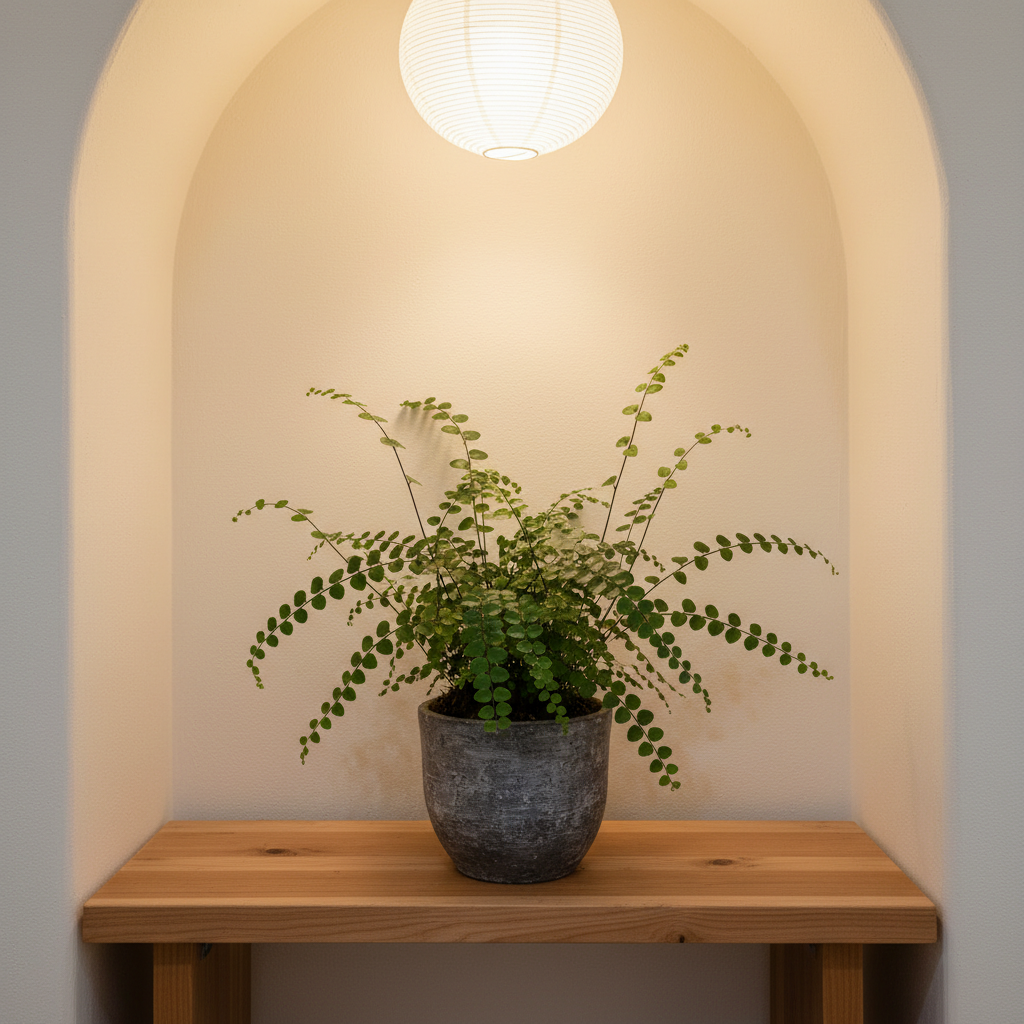
Most ferns ask for jungle humidity and sulk the moment a radiator dries the air, but the button fern breaks the mould. A native of rocky New Zealand and Australian hillsides, Pellaea rotundifolia belongs to a group of “cliff brakes” or “rock ferns” that evolved to cling to limestone outcrops rather than to carpet a damp forest floor. The result is a small, characterful houseplant that tolerates the ordinary dryness of a living room far better than a maidenhair or a Boston fern ever could, while still offering that soft, feathery fern texture so many growers want. Its name comes from the neat rows of round, leathery leaflets, each one the size of a button, threaded along thin near-black stems that arch outward into a low, spreading mound.
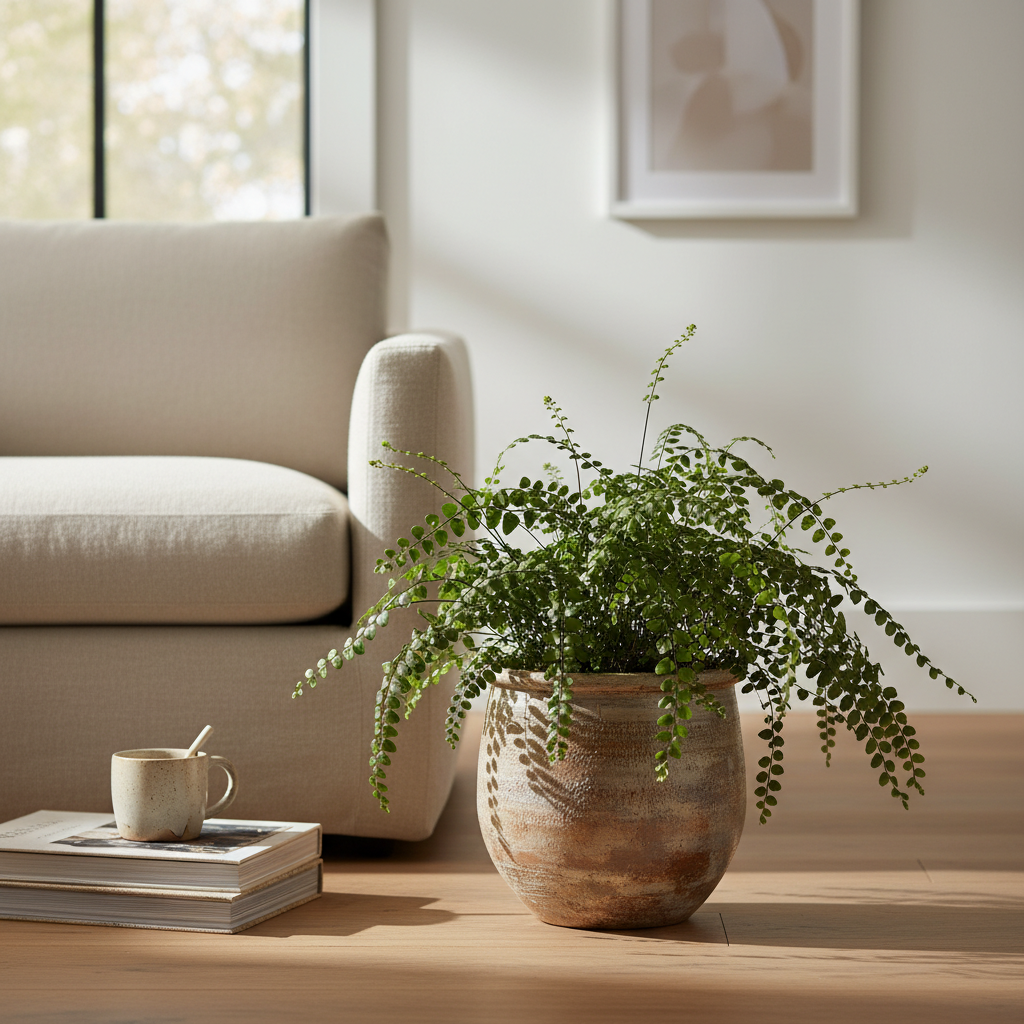
This guide covers everything you need to keep a button fern not merely alive but genuinely thriving: where to place it, how to read its watering needs, the gritty soil it prefers, and the handful of pests worth watching for. Throughout, the distinction worth keeping in mind is the gap between survival and good health. A button fern will survive a surprising amount of neglect, but the plush, fully clothed fronds that make it worth growing only appear when its modest preferences are met.
Quick Reference
The table below distils the essentials. The sections that follow explain the reasoning behind each figure, because a fern grown in a dim northern flat and one grown in a bright Mediterranean apartment will not want identical treatment.
| Common name | Button fern, roundleaf fern, cliff brake |
| Botanical name | Pellaea rotundifolia |
| Family | Pteridaceae |
| Light | Bright indirect light; tolerates medium light; no direct midday sun |
| Water | Keep evenly moist; allow the top 1 to 2 cm to dry between waterings |
| Humidity | Average household humidity is acceptable; 40 to 50 per cent is ideal |
| Temperature | 16 to 24 degrees C (61 to 75 degrees F) |
| Soil | Free-draining mix with perlite; tolerates neutral to slightly alkaline |
| Fertiliser | Dilute balanced feed monthly in spring and summer |
| Mature size | 20 to 30 cm (8 to 12 in) tall and wide |
| Propagation | Division of the rhizome; spores |
| Toxicity | Non-toxic to cats and dogs |
In This Guide
- Why grow a button fern as a houseplant
- Light
- Watering
- Soil and potting
- Fertilising
- Propagation
- Pests and problems
- Varieties and relatives
- Frequently asked questions
Why Grow a Button Fern as a Houseplant
The button fern earns its place on the windowsill by solving the central frustration of indoor ferns: the relentless demand for humidity. Because Pellaea rotundifolia evolved on exposed rock faces where moisture comes and goes, it has leathery, slightly waxy leaflets that lose water more slowly than the gossamer-thin foliage of a maidenhair. This single adaptation means it can hold its looks in the dry, heated air that kills more delicate ferns over a winter. For anyone who has watched a fern crisp to a brown skeleton on top of a bookcase, that resilience is the whole appeal.
It is also a genuinely small plant, which is rarer among ferns than you might expect. A mature specimen settles at roughly 20 to 30 cm in height and a similar spread, the fronds arching outward and then dipping at the tips to form a soft green dome. That compact, mounding habit suits a desk, a bathroom shelf or the front of a grouped plant display, and it spills attractively over the rim of a raised pot. The texture does the heavy lifting decoratively: dozens of small, glossy, dark-green discs ranked along wiry, dark stems give a beaded, almost ornamental quality that contrasts beautifully with broad-leaved plants like a peace lily or a rubber plant nearby.
There is a practical bonus for households with animals. The button fern is listed as non-toxic to cats and dogs, so a curious pet that takes an exploratory nibble is not in danger, and you are spared the worry that comes with more hazardous foliage plants. None of this makes the button fern a plant you can ignore entirely. It is forgiving rather than indestructible, and the one thing it will not tolerate is a soggy, airless root ball. Get the watering and drainage right and the rest of its care is refreshingly undemanding.
Light
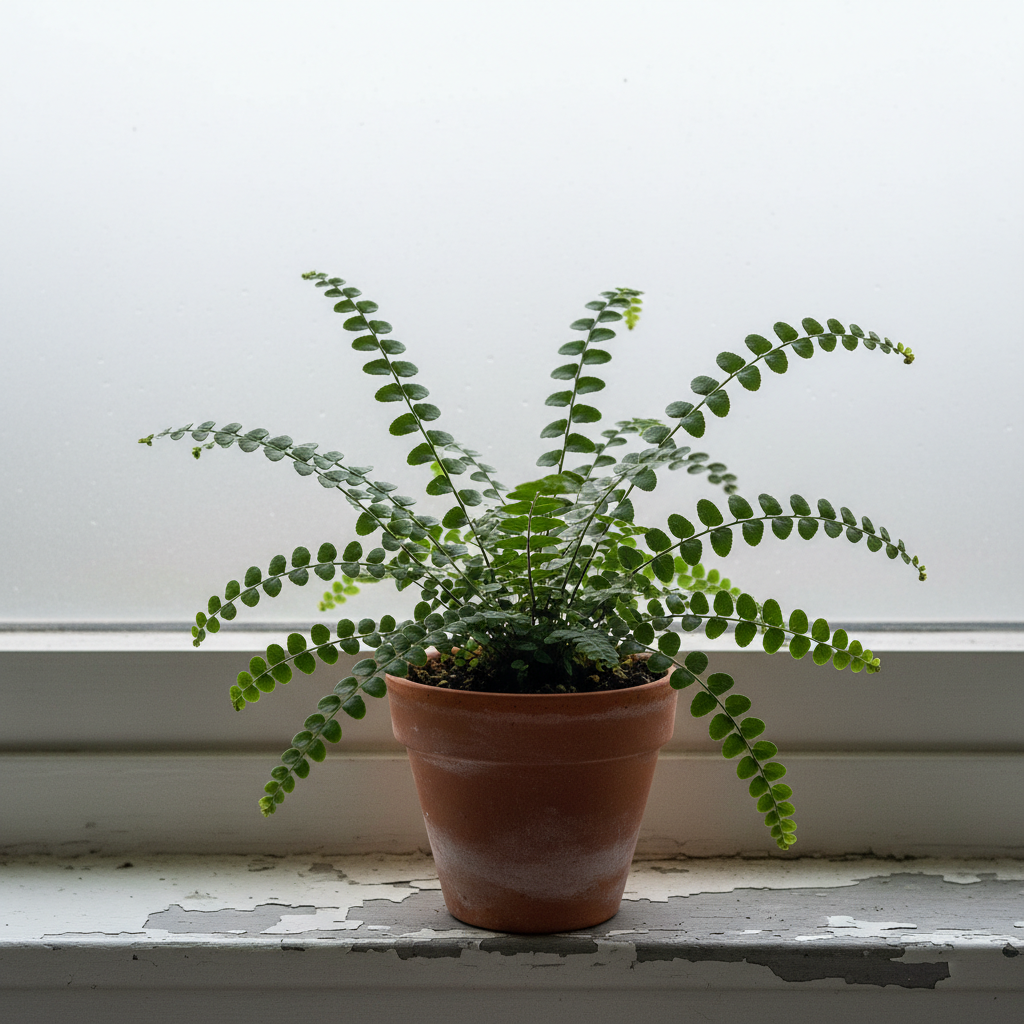
Bright, indirect light is the sweet spot for a button fern. In the wild it grows in the dappled shade of rock ledges and scrub, sheltered from the full force of the sun but rarely in deep gloom, and that is exactly the balance to recreate indoors. An east-facing window that catches gentle morning sun, or a position a metre or so back from a brighter south or west window, gives it the energy it needs to keep producing well-clothed fronds without risking the leaflets.
Direct midday sun is the main hazard. The leathery foliage is tougher than most ferns’, but a few hours of unfiltered summer sun through glass will still bleach the green to a sickly yellow and eventually scorch dry brown patches across the leaflets. A sheer curtain solves this completely, diffusing the light into the soft, even glow the plant prefers. If you only have a hot, sunny window, set the fern off to one side or behind a taller plant that can take the sun and cast a little shade.
At the other extreme, the button fern will survive in medium or even fairly low light, which is part of why it turns up in offices and bathrooms, but survival is the operative word. Starved of light it grows slowly, the new fronds emerge sparse and stretched, and the dense button-on-a-string look thins out. A north-facing window usually provides enough indirect light to keep it respectable, and if your only spot is genuinely dim, a small full-spectrum grow light running for a few hours a day will more than make up the difference.
Pro Tip — Even growth: Ferns lean towards their light source over time, which leaves the back of the plant bare. Give the pot a quarter turn each week so every side receives its share and the dome stays full and symmetrical.
Watering
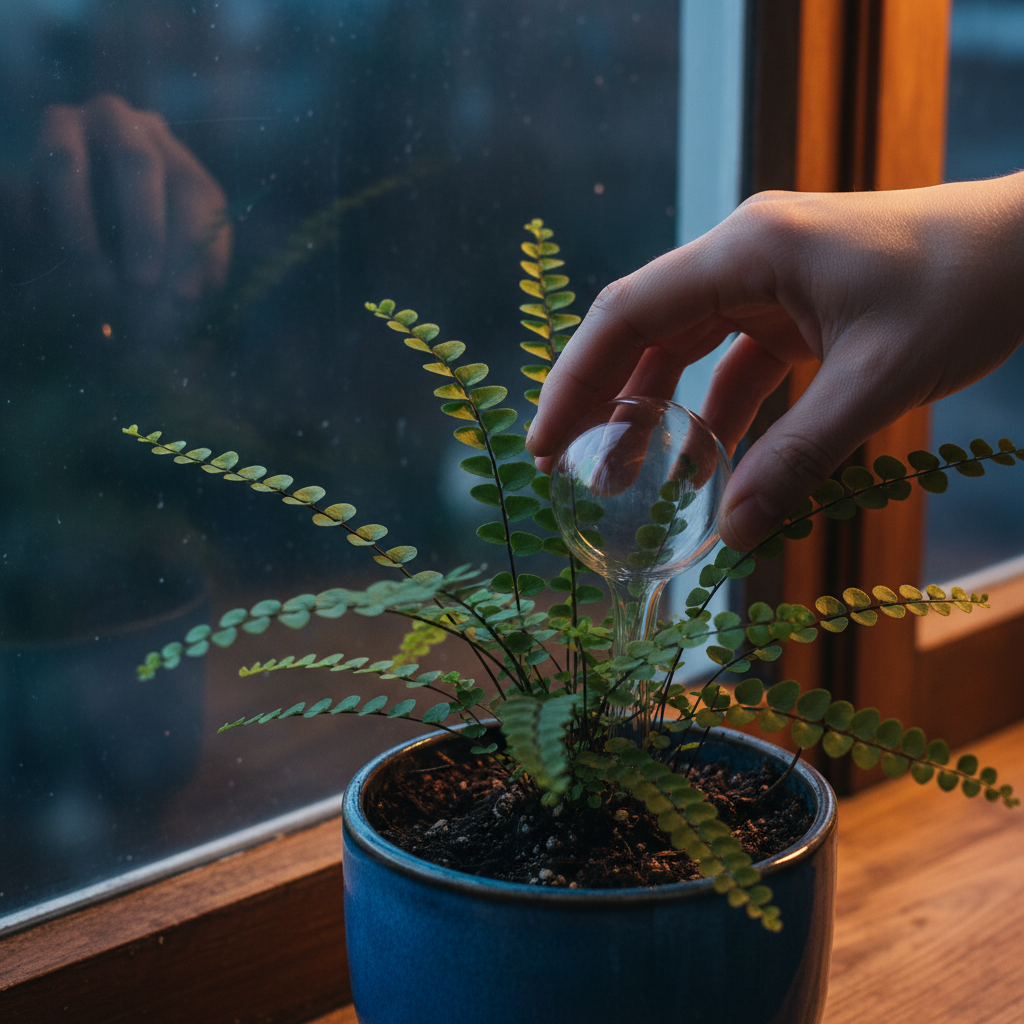
Watering is where most button ferns are won or lost, and the trick is to hold two ideas at once. Like all ferns it wants steady moisture and resents drying out completely, but unlike most ferns it equally resents sitting in sodden soil. Think of the target as a wrung-out sponge: damp throughout, never dripping. In practice that means watering when the top 1 to 2 cm of the mix has dried but the soil below still feels cool and slightly moist to a probing finger.
When you do water, water thoroughly. Take the plant to the sink and let water run through the whole root ball until it drains freely from the holes in the base, then let every drop drain away before the pot goes back on its saucer. This flushes the soil evenly and carries off any build-up of mineral salts. The cardinal sin is leaving the pot standing in a saucer of water; the roots suffocate, rot sets in, and the first you usually know of it is a sudden collapse of fronds that no amount of subsequent watering will reverse.
Frequency shifts with the seasons. Through the warm, bright months of active growth the fern may want watering once or twice a week, while in the cooler, darker months its thirst drops markedly and watering every ten days to a fortnight may be plenty. Always let the soil be your guide rather than the calendar. A button fern that has dried out hard is not necessarily doomed: stand the pot in a basin of water for twenty minutes to rehydrate the root ball from below, let it drain, and trim away any fronds that have crisped beyond recovery while new growth pushes through.
On the question of humidity, the button fern is unusually relaxed. It copes with the 30 to 40 per cent humidity of a typical centrally heated home far better than its fern cousins, which is precisely its selling point. It will not object to a little extra, so a bathroom or a kitchen suits it well, but you do not need to fuss with daily misting or a pebble tray to keep it happy. If the air in your home is exceptionally dry in winter and the frond tips begin to brown, grouping it with other plants to raise the local humidity is gentler and more effective than misting.
Warning — Water quality: Button ferns can be sensitive to the fluoride and chlorine in some tap water, which may show as browning tips. If your water is heavily treated, let it stand uncovered overnight before use, or water with filtered or rainwater.
Soil and Potting
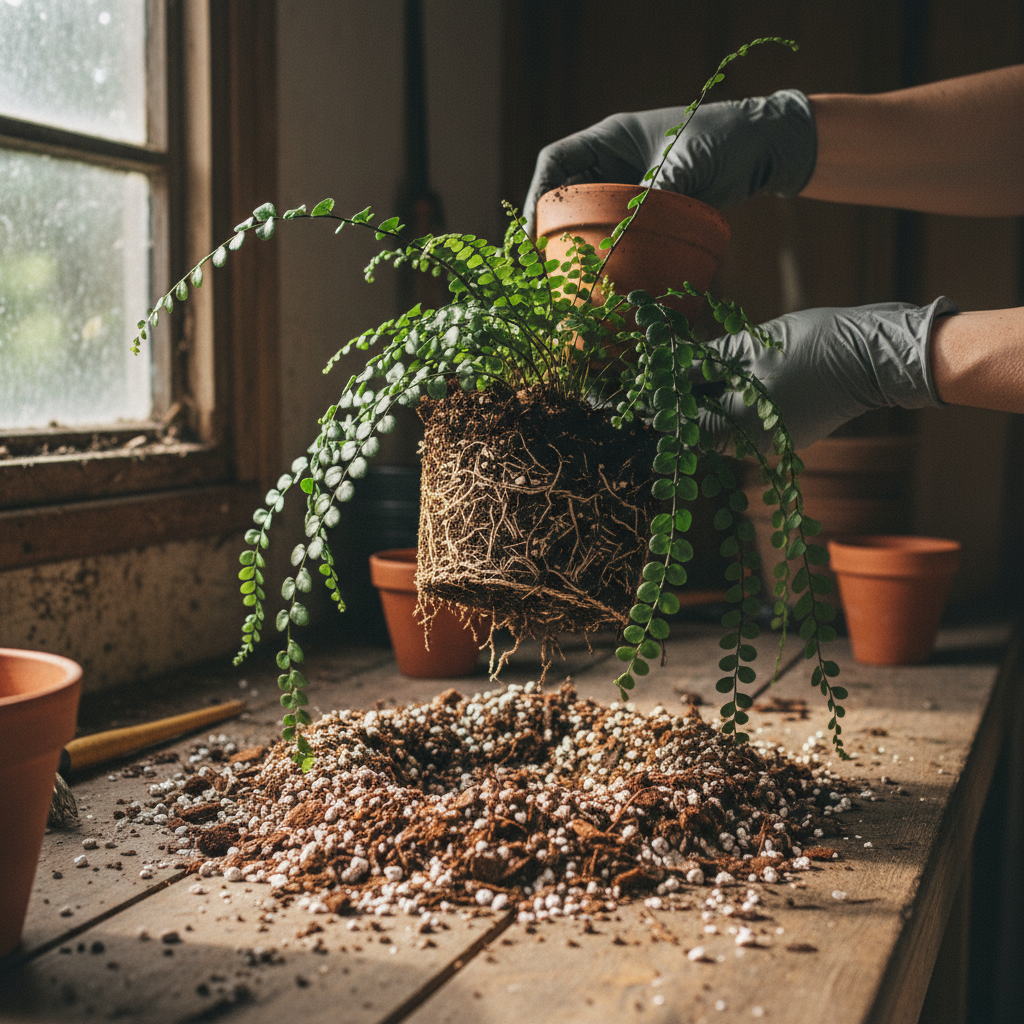
The soil mix follows directly from the watering needs: it must hold moisture yet drain freely, never compacting into a sodden mass. A good starting point is a quality peat-free houseplant compost or a coir-based mix, lightened with a generous handful of perlite or fine bark to open up the structure. Aim for roughly one part drainage material to three parts compost, adjusting towards more grit if your home runs cool and damp and you tend to water heavily.
One detail sets the button fern apart from most houseplants. As a cliff brake it grows naturally over limestone, so it is one of the few ferns that tolerates, and may even appreciate, a neutral to slightly alkaline soil rather than the acidic conditions most ferns demand. You do not need to chase a specific figure, but it does mean the plant is unfussy about a standard, near-neutral potting mix and that the occasional addition of a little crushed eggshell or horticultural lime is well tolerated. Whatever you use, the pot must have drainage holes; a decorative cachepot without them is a recipe for the waterlogging this plant cannot abide.
Button ferns are slow, modest growers and they flower, in the fern sense of producing new growth, most readily when their roots are a touch snug. There is rarely any need to rush them into a larger pot. Repot only every two to three years, or when roots are visibly circling the base and creeping out of the drainage holes, and step up by a single pot size rather than drowning the plant in a vast volume of soil that stays wet. Early spring, as growth resumes, is the ideal moment.
When you do repot, handle the rhizomes and fine roots gently and resist the urge to tease the root ball apart aggressively. Settle the plant at the same depth it sat before, with the crown sitting just at the soil surface and never buried, firm the fresh mix lightly around the sides, and water it in to close any air pockets. Hold off on feeding for a month or so afterwards while the roots recover and settle into the new soil.
Fertilising
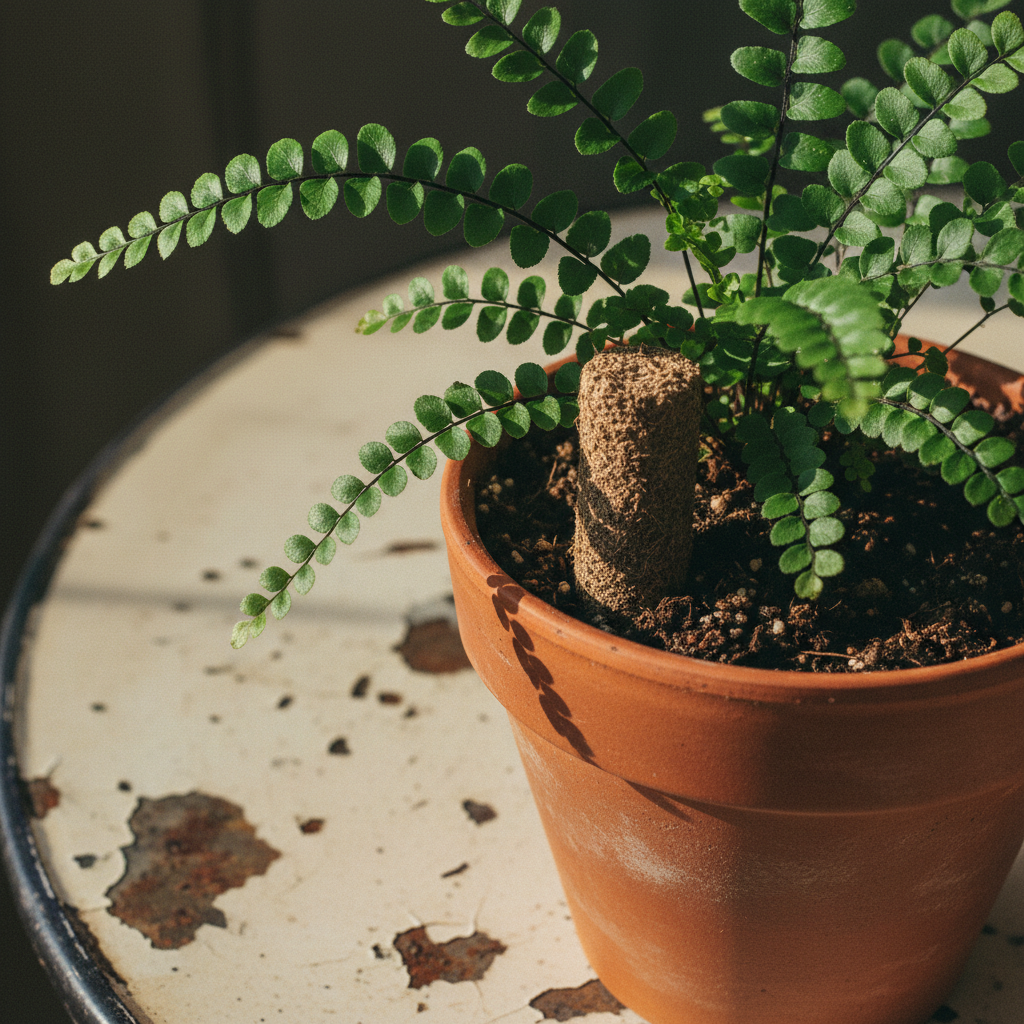
Ferns are light feeders, and the button fern is no exception. Its slow, steady growth needs only a modest top-up of nutrients through the active season, and the most common feeding mistake is generosity rather than neglect. A balanced liquid houseplant fertiliser, diluted to half the strength printed on the bottle, applied once a month from spring through to late summer, is all most plants ask for. Always apply feed to already-damp soil, never to a dry root ball, so the diluted solution spreads evenly and cannot burn the fine roots.
Stop feeding altogether through autumn and winter. As light levels fall the fern slows almost to a standstill, and fertiliser applied to a plant that is not growing simply accumulates in the soil as mineral salts. That build-up shows itself as scorched, brown frond tips and a white crust on the soil surface or pot rim, the very symptoms growers often mistake for under-watering. If you see them, flush the pot thoroughly with plain water several times to leach the excess salts away, and ease back on the feeding next season.
If you prefer a low-effort approach, a slow-release fertiliser stick or a few prills of controlled-release granules pushed into the soil in spring will drip-feed the plant gently over several months and removes any risk of an over-strong dose. Whichever method you choose, remember that for a fern this small and slow, less is genuinely more. A button fern that is fed lightly and consistently will always look better than one pushed hard with frequent strong feeds.
Propagation
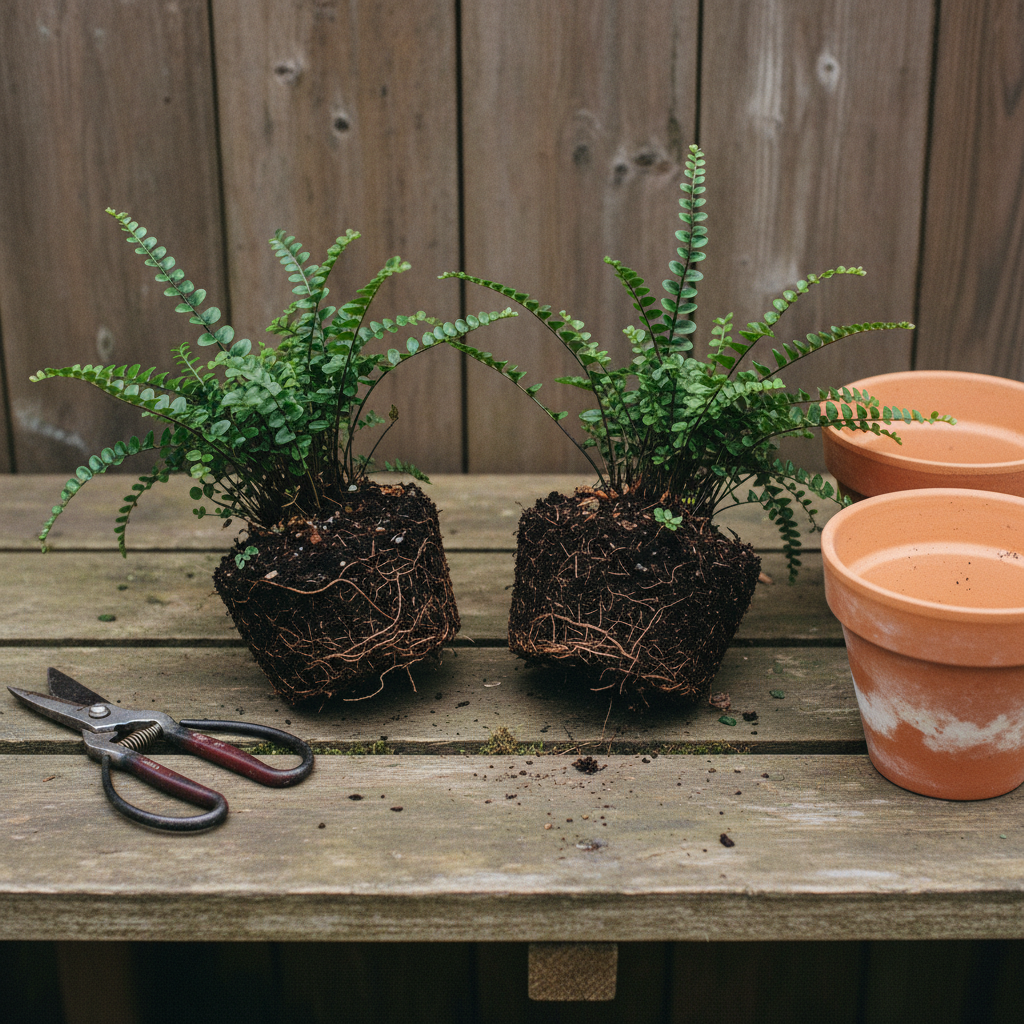
Unlike many trailing houseplants, the button fern cannot be grown from a leaf or stem cutting; it has no nodes to root and a severed frond will simply wither. The reliable home method is division, splitting an established, multi-crowned plant into two or more smaller plants, each with its own section of rhizome and roots. The best time is early spring, ideally combined with a routine repotting so the plant only suffers one disturbance.
Begin by watering the plant a day ahead so the roots are hydrated and the soil holds together. Slide the fern out of its pot and look for natural divisions in the clump, where separate crowns of fronds rise from their own cluster of roots. Working with clean hands and a sterilised knife, ease or cut the root ball into sections, making sure each piece carries a healthy fan of fronds and a generous share of root. Aim for two or three good divisions rather than many tiny fragments, which establish slowly and are far more likely to fail.
- Water the parent plant thoroughly the day before dividing.
- Remove it from its pot and gently shake or brush away loose soil to reveal the crowns.
- Identify natural clumps, each with its own fronds and roots.
- Separate the sections by hand, or cut cleanly through the rhizome with a sterilised blade.
- Pot each division into fresh, free-draining mix at its original depth.
- Water in well and keep in warm, bright, indirect light with steady moisture.
Newly divided ferns sulk for a few weeks while they rebuild their roots, so do not be alarmed if growth pauses or an older frond or two yellows and dies back. Keep the soil evenly moist, hold off on fertiliser until you see fresh fronds unfurling, and resist the temptation to overwater in sympathy. Within a month or two each division should be putting out new growth and settling into an independent plant.
The button fern can also be raised from spores collected from the rust-coloured patches on the undersides of mature fronds, but this is a slow and exacting process better suited to dedicated fern enthusiasts than to a quick increase of your collection. For almost everyone, division is faster, more certain and far less fiddly.
Pests and Problems
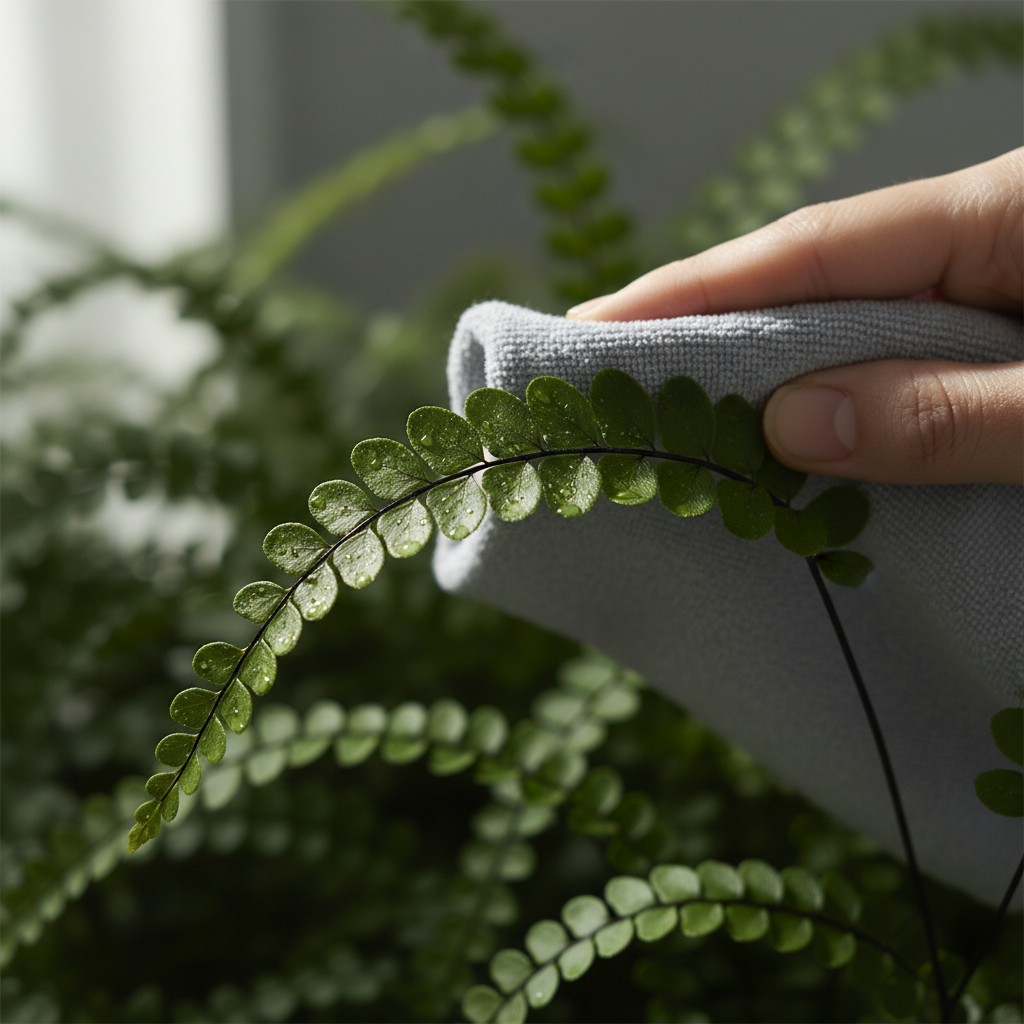
The button fern is relatively untroubled by pests, but a few opportunists are worth watching for, especially on a plant weakened by poor conditions. Scale insects are the most likely visitors, appearing as small, flat brown discs clamped along the wiry stems and the undersides of the leaflets, where they sap the plant and leave a sticky residue. Mealybugs, soft white cottony clusters tucked into the joints of the fronds, are the other common culprit. Both are easiest to catch early, which is the best reason to give the plant a close look whenever you water.
Because the dense, fiddly foliage makes chemical sprays awkward and ferns can be sensitive to them, the gentlest controls are usually best. Wipe or dab visible scale and mealybugs away with a cotton bud dipped in diluted isopropyl alcohol, and for a wider infestation a light treatment with insecticidal soap, tested first on a single frond, is safer than a harsh systemic. Fungus gnats, small black flies hovering around the soil, are a sign the mix is being kept too wet; letting the surface dry more between waterings and topping the soil with a layer of grit usually ends the problem.
Most button fern troubles, though, are cultural rather than the work of pests, and the symptoms point clearly back to care. Browning, crispy frond tips usually mean the air is too dry, the soil has been allowed to dry out too far, or mineral salts have built up from overfeeding or hard water. Yellowing, limp fronds and a generally sad, soft plant almost always signal overwatering and the beginnings of root rot, the single most serious threat to this fern. Pale, washed-out colour and leggy, sparse growth point to too little light, while sudden widespread browning after a move often reflects a draught, a cold snap or a position too close to a radiator.
| Symptom | Likely cause | Remedy |
| Crispy brown tips | Dry air, soil dried out, or salt build-up | Water more evenly, flush the soil, raise local humidity |
| Yellow, limp fronds | Overwatering, poor drainage | Let the soil dry, check drainage, repot if roots are rotting |
| Pale, leggy growth | Insufficient light | Move to brighter indirect light or add a grow light |
| Sudden frond drop | Cold draught or heat source nearby | Move away from radiators, doors and draughty windows |
| Sticky residue or specks | Scale or mealybugs | Wipe with diluted alcohol; treat with insecticidal soap |
Varieties and Relatives
The button fern is sold almost entirely as the true species, Pellaea rotundifolia, and named cultivars are vanishingly rare in the trade. What you are far more likely to meet are its close cousins within the genus Pellaea, the cliff brakes, which share the same forgiving, rock-dwelling temperament but carry their leaflets in different shapes. Knowing them helps when you are browsing a nursery bench and want the same easy character in a slightly different form.
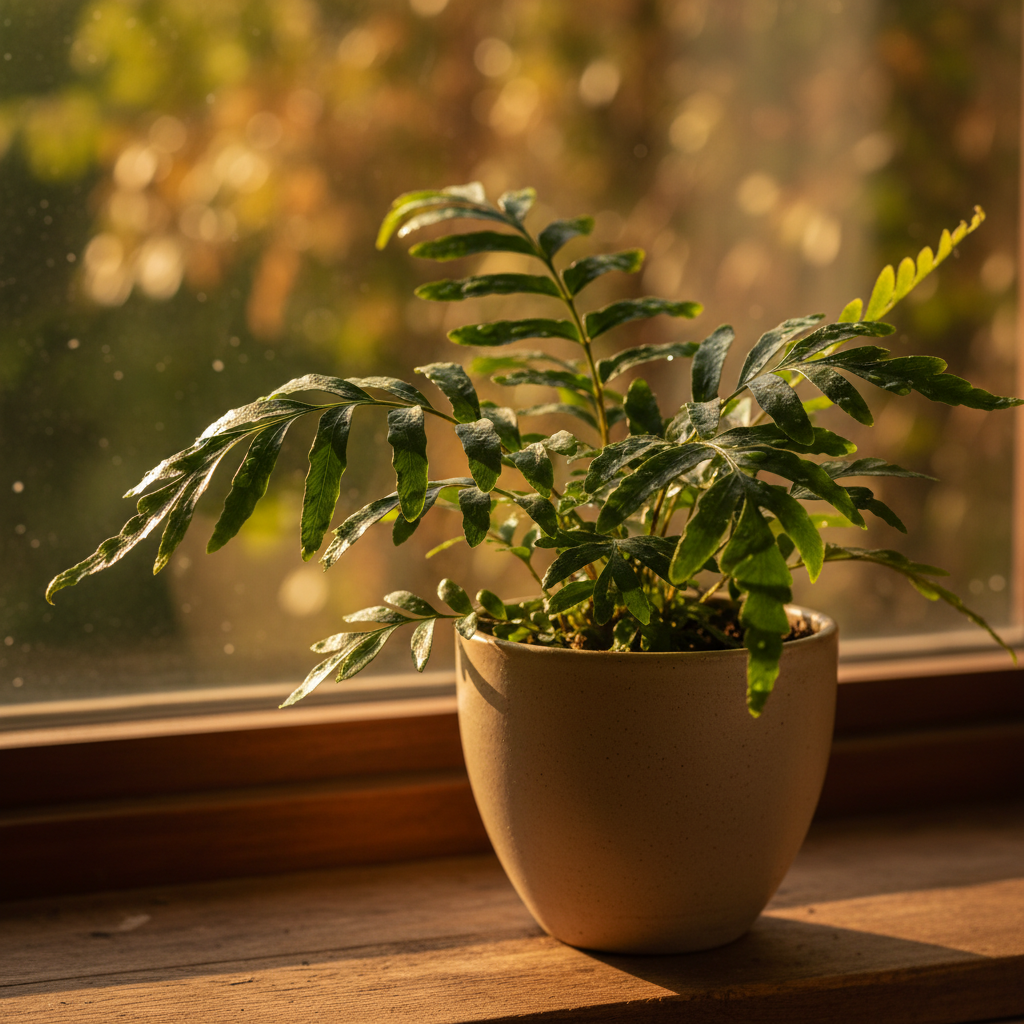
Sickle Fern (Pellaea falcata). The most obvious step away from the round button form, this Australian relative lines its fronds with longer, more elongated, sickle-shaped leaflets that taper to a soft point. It has the same wiry dark stems and the same easy-going, drought-tolerant nature, but a looser, more feathery silhouette that reads as a touch more traditionally fern-like.
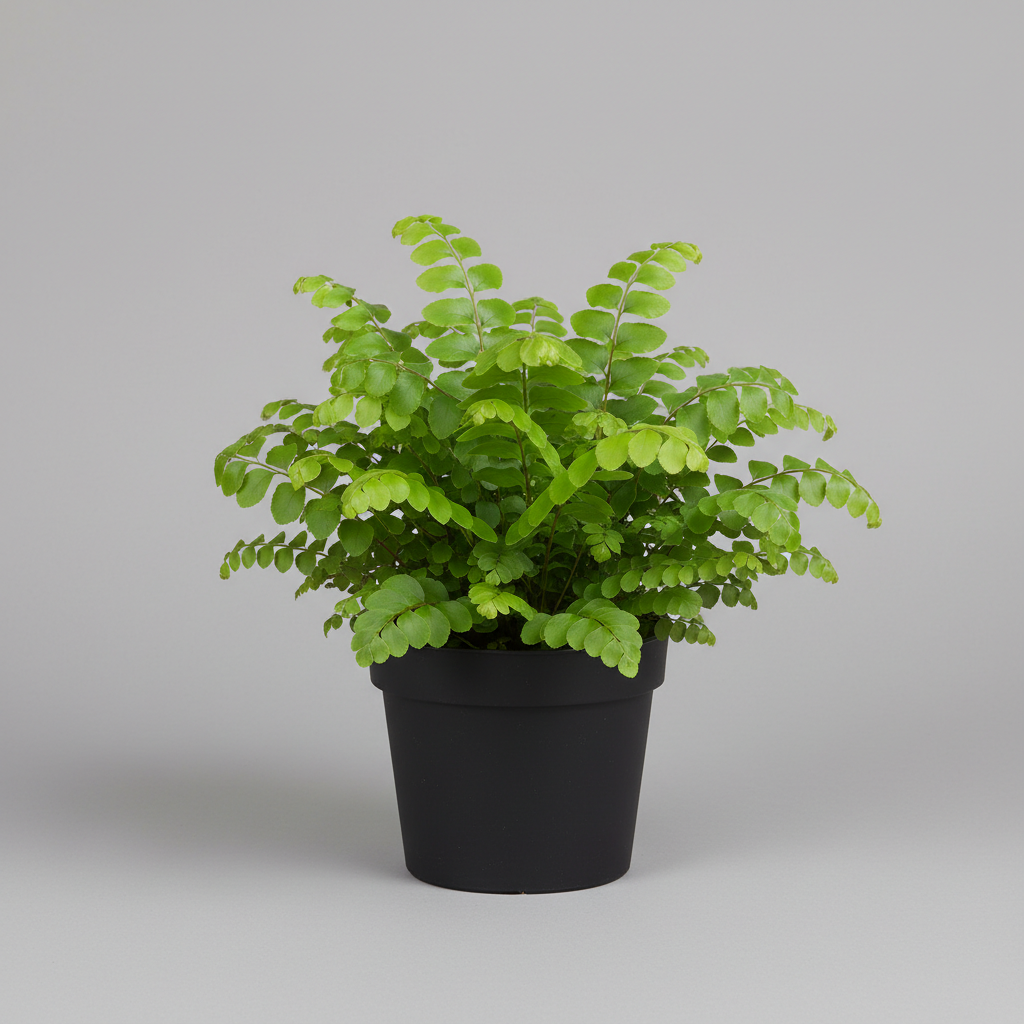
Green Cliff Brake (Pellaea viridis). Larger and brighter than the button fern, this species carries broader, more triangular fronds in a more vivid green on a fuller, more upright, bushy habit. It makes a bolder statement than the low button mound while asking for the same care, and is a good choice where you want a little more height and presence from the same reliable group.
All three share the cliff brake heritage that makes them so much easier than the average indoor fern, so the care described in this guide applies broadly across the group. If you find you get on well with the button fern, its relatives are a natural way to expand a low-fuss fern collection without changing your routine.
Frequently Asked Questions
Why are my button fern’s tips turning brown?
Brown, crispy tips are the most common complaint and usually trace back to one of three causes: air that is too dry, soil that has been allowed to dry out too far between waterings, or a build-up of mineral salts from hard water or overfeeding. Check that you are watering before the root ball dries completely, flush the soil occasionally with plain water, and if your tap water is heavily treated, switch to filtered or rainwater.
Is the button fern safe for cats and dogs?
Yes. Pellaea rotundifolia is listed as non-toxic to both cats and dogs, so it is a sound choice for a pet-friendly home. As with any plant, a pet that eats a large amount may still get a mild upset stomach, so it is best to discourage nibbling, but there is no risk of poisoning.
Does a button fern need high humidity?
No, and this is its great advantage over other ferns. Its leathery leaflets let it cope with ordinary household humidity that would crisp a maidenhair or Boston fern. It will enjoy a slightly more humid spot such as a bathroom, but you do not need daily misting or a pebble tray to keep it healthy.
How often should I water my button fern?
Water when the top 1 to 2 cm of soil has dried but the soil below is still slightly moist. In bright, warm months this often means once or twice a week, dropping to every ten days or so in winter. Let the soil rather than the calendar guide you, and always allow the pot to drain fully so it never sits in water.
Can I grow a button fern from a cutting?
Not from a leaf or stem cutting, as ferns have no nodes to root. The reliable home method is division: split an established, multi-crowned plant in spring, making sure each section has its own fronds and roots, and pot the pieces up separately. Ferns can also be raised from spores, but that is slow and best left to enthusiasts.
Why is my button fern dropping its leaflets?
Sudden leaflet or frond drop is usually a response to stress: a cold draught, a position too near a radiator, or a let-the-roots-dry-then-flood watering pattern. Move the plant away from heat sources and draughty doors and windows, settle it into steady, even moisture, and give it time to adjust before expecting new growth.
Grown with bright indirect light, a free-draining pot and a watering hand that keeps the soil evenly moist but never wet, the button fern rewards you with one of the most distinctive textures in the houseplant world and asks remarkably little in return. It is proof that not every fern is a diva, and a fine place to start for anyone who has been put off the group by their reputation.






