
- Quick Reference: Common Propagation Methods
- Propagate During Active Growth
- Start With a Healthy Parent Plant
- Stem Cuttings: The Classic Method
- Water vs Soil Propagation
- Division: The Fastest Route to a Real Plant
- Layering and Air Layering
- The Propagation Environment
- Frequently Asked Questions
Propagation is the indoor gardener’s version of magic, except the spell is usually a clean pair of scissors and a little patience. One plant becomes two. A leggy vine becomes a fuller pot. A broken stem becomes a gift. Done well, propagation is practical, economical and deeply satisfying.
Penn State Extension defines propagation as creating new plants by sexual means, such as seeds, or asexual vegetative means, such as stems, roots, nodes or leaves.[3] For most houseplants, vegetative propagation is the useful everyday method because it usually creates a plant that is genetically identical to the parent.[3]
Quick Reference: Common Propagation Methods
| Method | Best for | Basic idea |
|---|---|---|
| Stem cuttings | Pothos, philodendron, hoya, coleus, many vines | Cut a stem with nodes and root it in water or media. |
| Leaf cuttings | African violets, begonias, some succulents | Use a leaf or leaf section to grow a new plant. |
| Division | Peace lily, spider plant, cast iron plant, many clumping plants | Separate a multi-crown plant into rooted sections. |
| Layering | Vining plants | Root a stem while it remains attached to the parent. |
| Air layering | Dracaena, ficus and woody indoor plants | Encourage roots on a stem before cutting it away. |
Propagate During Active Growth
Timing matters. University of Nevada, Reno Extension states that the best time to propagate houseplants is while the plant is actively growing.[4] Active growth gives cuttings more energy, faster rooting and better recovery. Spring and summer are usually ideal for most indoor plants.
You can propagate in autumn or winter, especially under grow lights, but expect slower results. A cutting that roots in two weeks in June may sulk for six weeks in January and make you question your life choices.
Start With a Healthy Parent Plant
Propagation is not a hospital. Cuttings taken from a pest-ridden, dehydrated or stressed plant are less likely to root well. Penn State Extension recommends beginning with plants that are free of disease, insects and stress, and using clean tools and sterilised media.[3]
Choose firm, healthy growth. Avoid yellowing stems, mushy tissue, severely wilted leaves and pest-infested sections. If you are pruning anyway, take cuttings from the healthiest portions rather than the saddest evidence.
Stem Cuttings: The Classic Method
Stem cuttings are the most familiar method for vining and soft-stemmed houseplants. University of Nevada, Reno Extension recommends using a clean, sharp knife or snip, cutting a 3- to 4-inch piece from the tip of the parent plant, and making the cut below a node.[4]
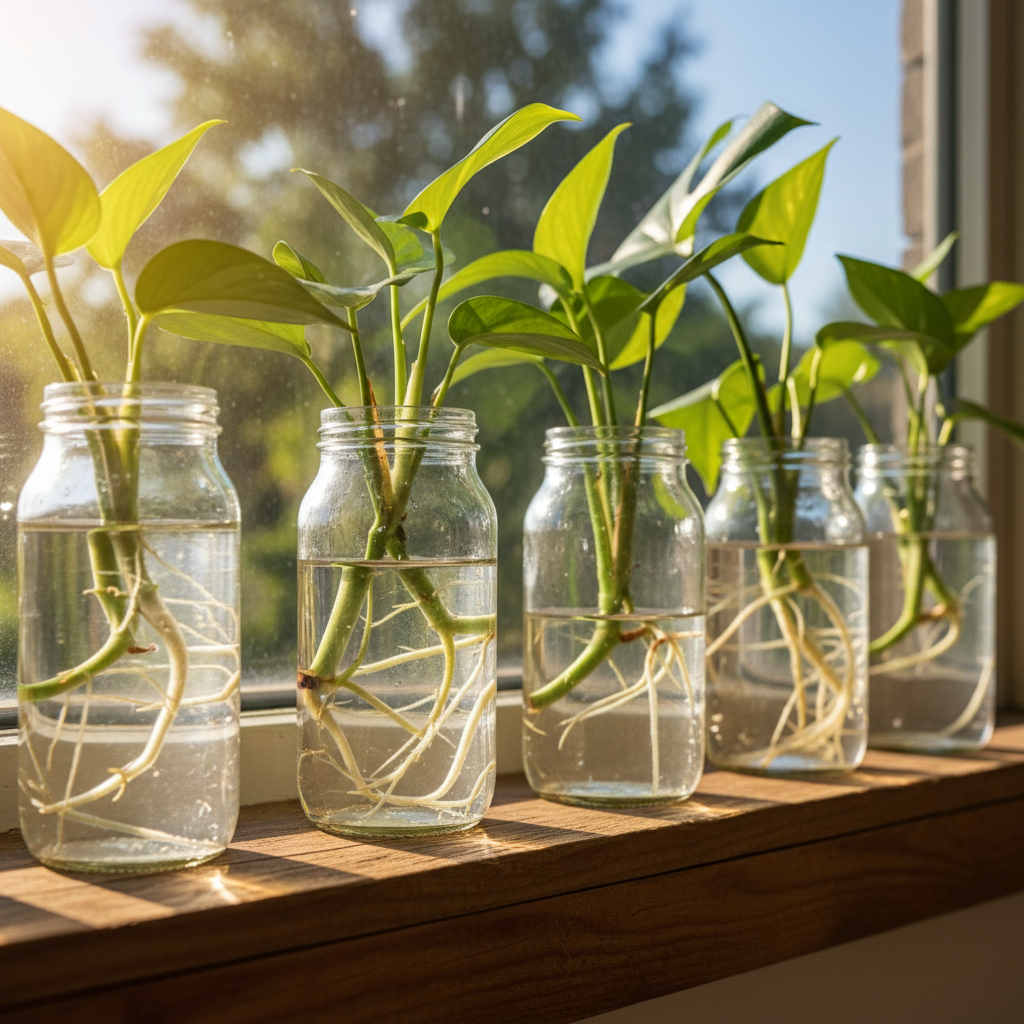
A node is the point on a stem where leaves, buds or roots can emerge. For many popular houseplants, roots develop from nodes, not from random bare stem. Remove the lower leaves, place at least one or two nodes into water or moist propagation media, and keep the cutting in bright indirect light.
Penn State Extension notes that stem cuttings can be inserted vertically into rooting media with at least one node buried, or laid horizontally for certain cane-type plants so roots and shoots can develop from nodes.[3]
Pro Tip — Nodes Are Non-Negotiable: A pothos leaf with a petiole but no node may stay green in water for a long time, but it will not become a new vine. It is a leaf in a vase, not a plant in training.
Water vs Soil Propagation
Water propagation is popular because it lets you watch roots appear. It works well for plants such as pothos and some philodendrons. University of Nevada, Reno Extension notes that not all plants root in water, but creeping Charlie, pothos and some philodendrons root well this way.[4]
Soil or soilless media propagation often produces roots that are already adapted to potting mix. Penn State Extension lists water, sand, vermiculite, perlite and bark as propagation media, noting that these can provide a light, moist environment for root development.[3]
Water-rooted cuttings should be moved into potting mix once they have a reasonable root system. If they stay in water too long, the transition to soil can be more stressful. Keep the new pot evenly moist at first while the roots adapt.
Division: The Fastest Route to a Real Plant
Division is the easiest method when a plant naturally grows in clumps or crowns. Peace lilies, spider plants, cast iron plants and some ferns can often be divided. University of Nevada, Reno Extension recommends carefully removing the plant from the pot, gently pulling clumps apart and using a sharp knife only when roots are thick or tough.[4]
Each division should have roots and shoots. A leaf without roots is not a division; it is optimism. Pot the sections promptly and water them in.
Layering and Air Layering
Layering roots a stem while it remains attached to the parent plant. For vines, bend a stem so a node touches moist soil, hold it in place with a clip or pin, and cut it free after roots form. University of Nevada, Reno Extension describes this method for vining plants, noting that roots form at the nodes.[4]
Air layering is useful for woody or cane-like plants such as dracaena and ficus. It involves wounding a stem, wrapping the area with moist sphagnum moss, covering it, and waiting for roots to form before cutting and potting the rooted top.[4]
The Propagation Environment
Cuttings need bright indirect light, warmth, moisture and humidity, but not swamp conditions. Penn State Extension recommends bright indirect light, moist but not saturated media, high humidity that is not so excessive that disease develops, and warm rooting media for successful propagation.[3]
A clear plastic bag or propagation box can raise humidity, but open it regularly for airflow. Rot is not a sign of high effort; it is a sign the cutting is too wet, too enclosed or too weak.
Frequently Asked Questions
| Question | Answer |
|---|---|
| Do I need rooting hormone? | Not always. It can help some cuttings root faster, but many common houseplants root easily without it. |
| How long do cuttings take to root? | Some root in days or weeks; others take months. Species, season, temperature and method all matter. |
| Why did my cutting rot? | The cutting may have been unhealthy, too wet, too cold, buried too deeply or kept without enough airflow. |
| Can I propagate patented plants? | Patented cultivars may have legal restrictions on propagation for sale. For personal use, check local rules and plant labels. |



