
- Quick Reference: Grow Light Basics
- When a Grow Light Is Worth It
- LED, Fluorescent or Something Else?
- Distance and Duration Matter More Than Drama
- Grow Lights Still Need Darkness
- Where to Put Grow Lights
- Common Grow Light Mistakes
- Frequently Asked Questions
Grow lights can sound suspiciously technical. Suddenly, the calm world of watering cans and ceramic pots becomes full of acronyms, colour temperatures, timers and people on the internet discussing photon density with the intensity of rocket engineers. The good news is that most houseplant owners do not need a laboratory setup. They need enough light, in the right place, for the right number of hours.
Light is one of the most important factors in indoor plant health because plants use it for photosynthesis, the process that allows them to convert carbon dioxide and water into energy-rich carbohydrates.[1] When a room does not provide enough natural light, a grow light can turn a sad corner into a perfectly usable plant spot.
Quick Reference: Grow Light Basics
| Decision | Simple recommendation | Why it matters |
|---|---|---|
| Best bulb type for most homes | LED grow light | LEDs are energy-efficient, long-lasting and produce relatively little heat.[1] |
| Best daily duration | Usually 10–14 hours for foliage plants | Plants need a consistent light period and a dark period. |
| Best placement | Close enough to help, not close enough to scorch | Light intensity drops as distance from the plant increases.[1] |
| Best use case | Dark rooms, winter support, shelves and high-light plants | Indoor light is often the limiting factor for houseplants.[2] |
| Best accessory | Timer | Consistency beats enthusiasm. |
When a Grow Light Is Worth It
A grow light is useful when natural light is too weak, too brief or too seasonal. Iowa State University Extension notes that even the brightest windowsill has only a fraction of the light intensity found outdoors, and that indoor light levels are especially low in winter because of short days, low sun angle and cloudy weather.[2]
Common signs that a plant may need more light include long stretched stems, smaller leaves, pale new growth, leaf drop and poor flowering. University of Minnesota Extension also notes that insufficient light can cause plants to become leggy, lose chlorophyll, drop older leaves, revert variegated foliage toward green and fail to set flower buds.[1]
A grow light is especially helpful for plant shelves, north-facing rooms, deep interiors, winter care and high-light plants such as succulents, cacti, citrus and many flowering houseplants. It is less useful if the real problem is overwatering, root rot, pests or a pot with no drainage. A grow light is powerful, but it is not a therapist.
LED, Fluorescent or Something Else?
For most Plantlex readers, LED grow lights are the easiest choice. University of Minnesota Extension describes LEDs as very energy-efficient, long-lasting, broad-spectrum and relatively low in heat output.[1] Fluorescent lights can also work and may be cheaper at first, though they use more energy and do not last as long as LEDs.[1]
Incandescent bulbs are poor grow lights because they are inefficient, create heat and can encourage stretchy growth.[1] A normal decorative lamp may help a human read a book, but it usually does not provide useful plant light in the way a proper grow bulb or panel does.
Distance and Duration Matter More Than Drama
A grow light that is too far away may look bright to you but be underwhelming to the plant. A grow light that is too close can cause heat stress or bleaching, especially on tender foliage. Start with the manufacturer’s suggested hanging distance, then observe the plant.
If stems lean toward the light or new growth is stretched, the light may be too weak, too far away or on for too few hours. If leaves bleach, curl, crisp or develop pale burned patches, the light may be too intense or too close.
Pro Tip — Use a Timer: A simple plug-in timer prevents grow-light chaos. Plants prefer regularity. Humans prefer not remembering whether they turned the plant shelf into a tiny sunrise at midnight.
Most foliage houseplants do well with a moderate daily light period, often around 10–14 hours under supplemental lighting. Seedlings and high-light plants may need more carefully planned intensity and duration. Iowa State University Extension explains that quality, intensity and duration are the three key factors when providing light for indoor plants.[2]
Grow Lights Still Need Darkness
Plants need light, but they do not need a 24-hour interrogation lamp. A daily dark period supports normal plant rhythms. If a plant is under lights all day and all night, growth may become stressed rather than improved. For most home setups, using a timer to mimic a long bright day is enough.
Where to Put Grow Lights
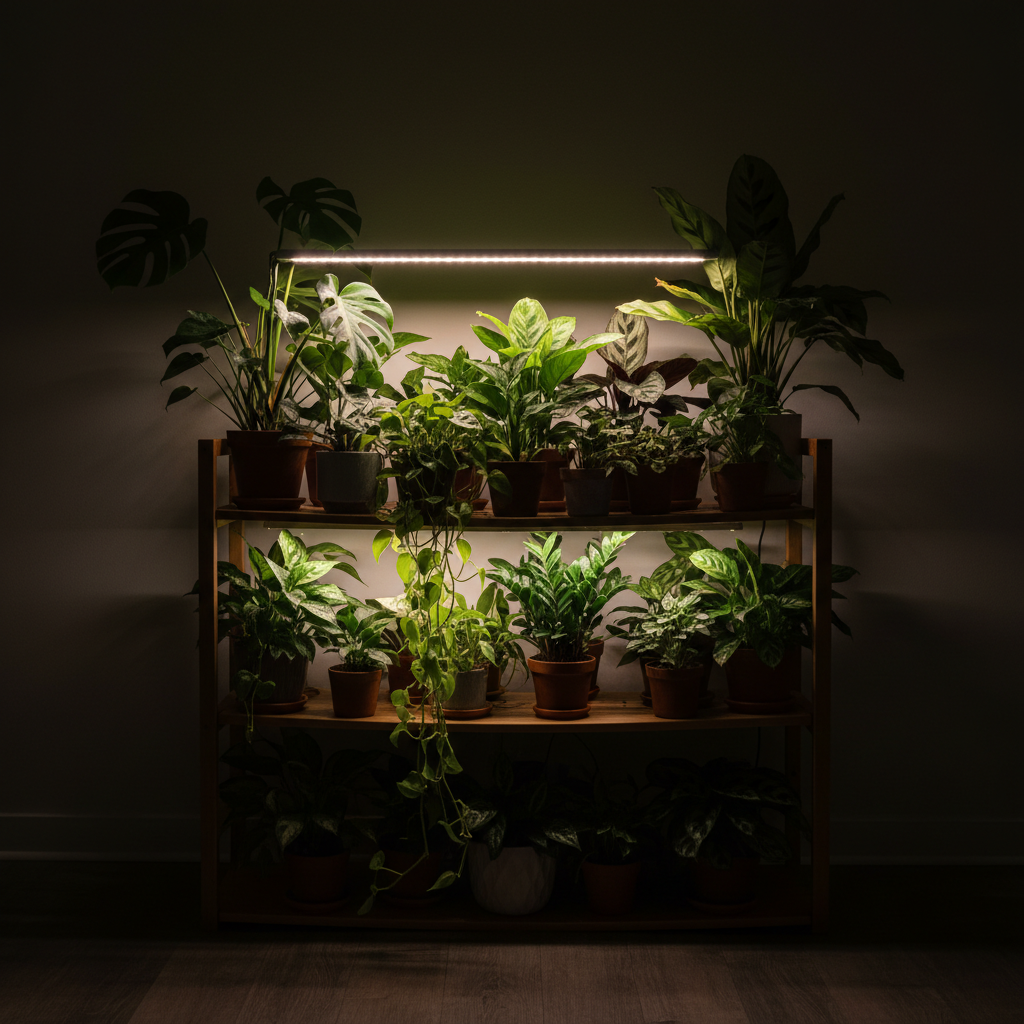
Grow lights work well over shelves, plant cabinets, desks, kitchen herb stations and dark corners where natural light falls short. Place plants with similar light needs together so one fern is not quietly suffering beneath a cactus-strength spotlight.
Keep practical access in mind. You still need to water, rotate, inspect and clean the plants. A beautiful shelf that requires removing fourteen pots to reach the back row will eventually become a pest village with mood lighting.
Common Grow Light Mistakes
| Mistake | What happens | Better approach |
|---|---|---|
| Using a normal household bulb | The plant may still receive too little usable light. | Choose a plant or grow bulb designed for plant growth. |
| Placing the light too far away | Plants stretch toward the light. | Move the light closer within safe manufacturer guidance. |
| Leaving lights on constantly | Plants lose their normal dark period. | Use a timer for a regular day/night cycle. |
| Ignoring watering changes | Plants may dry faster under stronger light. | Check soil more often after adding lights. |
| Expecting light to fix root rot | Decline continues. | Correct roots, watering and drainage first. |
Frequently Asked Questions
| Question | Answer |
|---|---|
| Do houseplants need purple grow lights? | No. Many modern full-spectrum LED grow lights look white and work well for houseplants. |
| Can a grow light replace a window? | Yes, if it provides enough intensity and duration for the plant, though bright windows remain useful. |
| Will a grow light make low-light plants grow faster? | Often, yes, but low-light plants still grow best with balanced water and suitable temperatures. |
| Should I use grow lights in summer? | Only if the plant’s location remains too dim, such as a shelf far from windows. |



