
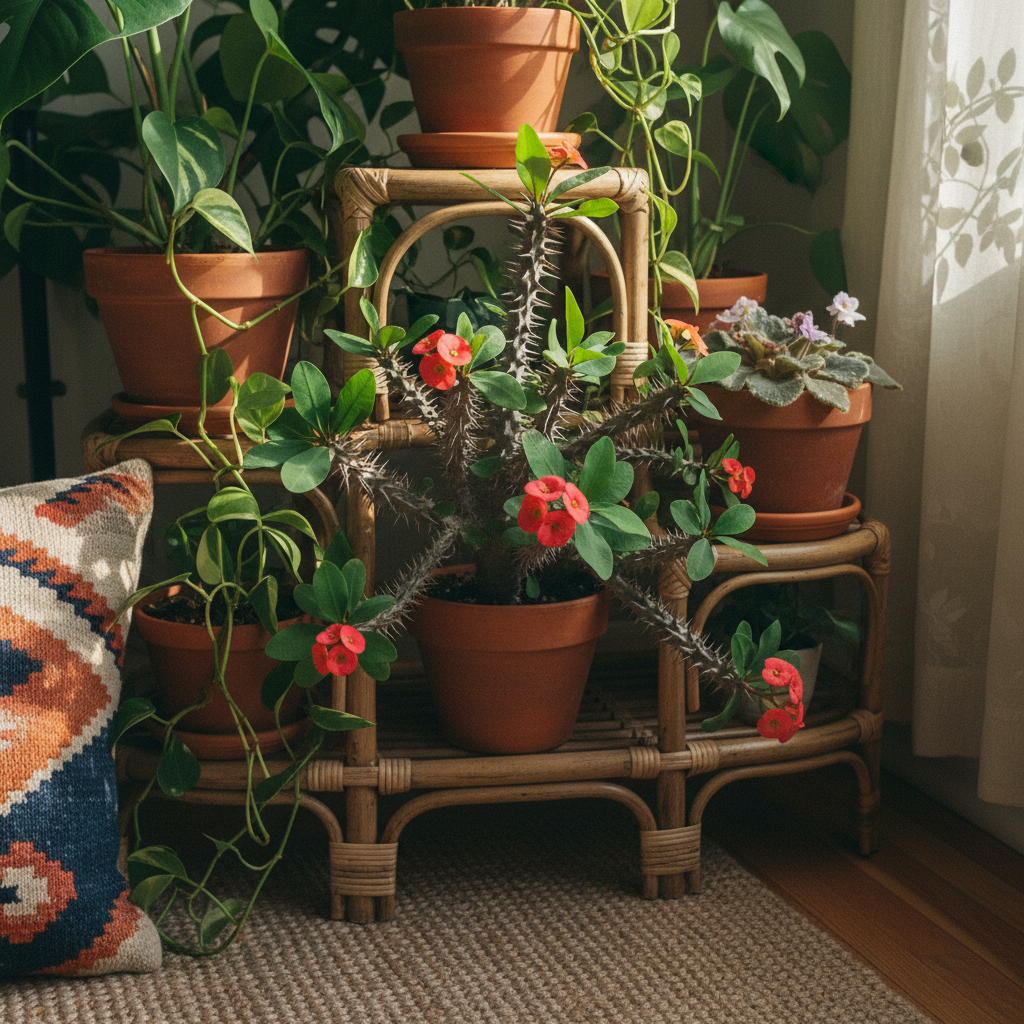
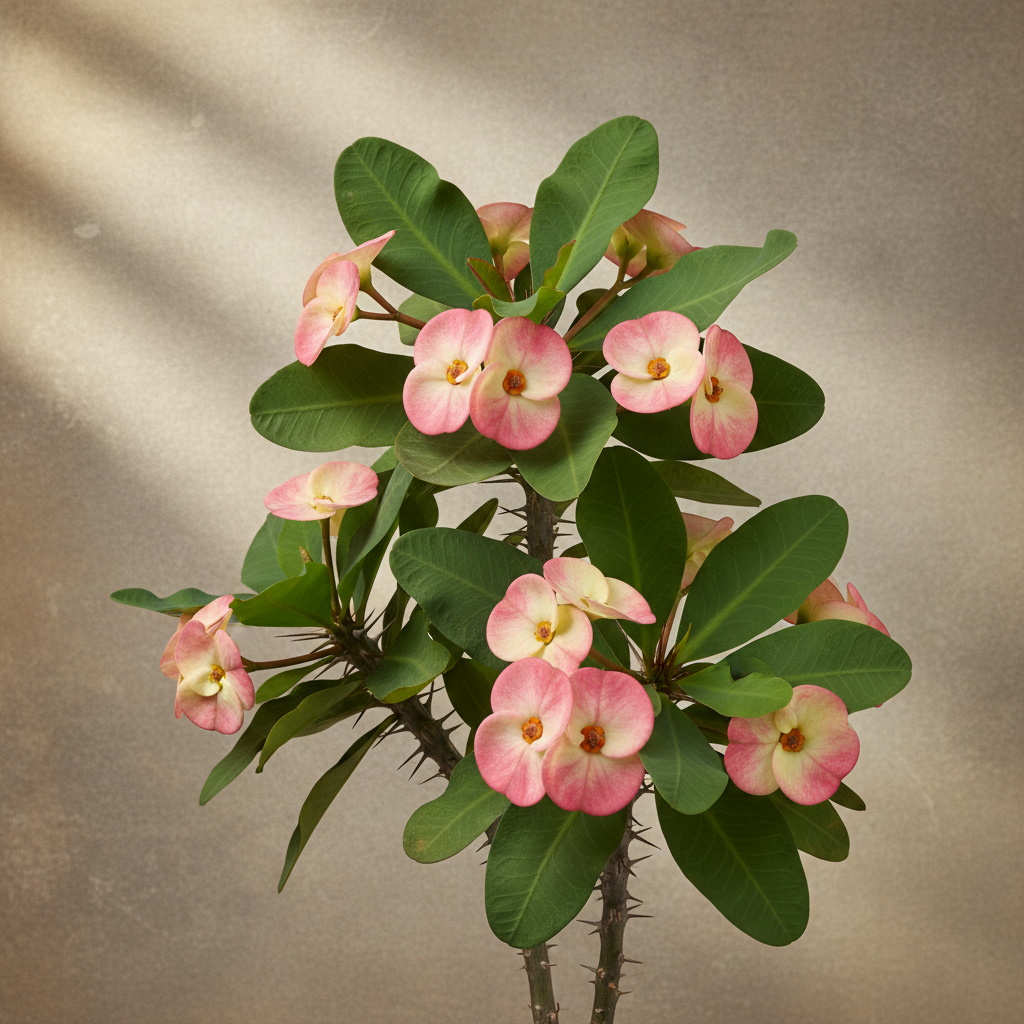
Few houseplants pack as much character into so small a footprint as the crown of thorns, Euphorbia milii, a spiny succulent shrub from the dry south and west of Madagascar that has been quietly persisting on sunny windowsills for the best part of two centuries. Its woody grey stems are armoured with long dark thorns, its oval leaves cluster only at the growing tips, and from between them rise paired showy bracts — most familiarly scarlet, but in modern cultivars also pink, cream, peach, yellow or pure white — that surround the plant’s tiny true flowers and persist for weeks at a time. Common names include Christ plant, Christ thorn and corona de Cristo, a reference to the old legend that this was the species woven into the crown worn by Jesus at the crucifixion, a story that has followed the plant from monastery courtyards in southern Europe through grandparents’ kitchen windows to the bright minimalist apartments where it is again finding an audience.
For all the drama of its name, the crown of thorns is one of the most forgiving flowering succulents available to indoor growers. It tolerates the dry air of centrally heated rooms, asks for water only when the soil has gone bone dry, sulks in damp shade rather than dying outright, and rewards a bright sunny perch with bracts that can keep appearing for ten or eleven months of the year. The rest of this guide moves beyond the bare minimum needed to keep the plant alive and into the conditions that let it actually thrive — sustained sun, a gritty pot that drains in seconds, a careful seasonal rhythm of watering, and a measured attitude to feeding — together with the safety considerations that come with any Euphorbia: a caustic milky latex and a generous covering of needle-sharp spines, neither of which is a problem if you know they are there.
Contents
- Quick Reference
- Why Crown of Thorns Makes a Rewarding Houseplant
- Light Requirements
- Watering and Humidity
- Soil, Potting and Repotting
- Fertilising
- Propagation
- Pests and Diseases
- Popular Varieties
- Frequently Asked Questions
Quick Reference: Crown of Thorns at a Glance
| Botanical name | Euphorbia milii Des Moul. |
| Family | Euphorbiaceae |
| Native range | Dry south and west of Madagascar |
| Mature size indoors | Typically 30 to 90 cm (12 to 36 in) tall; up to 1.8 m (6 ft) in habitat |
| Growth rate | Slow to moderate, faster in a sunny warm spot |
| Light | Full sun, 4 to 6 hours of direct light daily; brighter is better |
| Watering | Thorough soak, then let the soil dry completely; far less in winter |
| Temperature | 18 to 29 °C (65 to 85 °F) ideal; minimum 13 °C (55 °F) |
| Humidity | Any normal household level, 30 to 50 percent; not humidity dependent |
| Soil | Very gritty, fast-draining cactus mix with extra pumice or perlite, pH 6.0 to 7.5 |
| Fertiliser | Half-strength balanced or cactus formula, monthly during active growth |
| Repotting | Every 2 to 3 years, in spring, with thick gloves |
| Propagation | Stem-tip cuttings, calloused for several days before planting |
| Bloom period | Nearly year-round in strong light; pauses in deep winter |
| Pet safe | No. Toxic milky latex; spines a physical hazard |
| Common pests | Mealybugs, spider mites, scale |
Why Crown of Thorns Makes a Rewarding Houseplant
The crown of thorns occupies an unusual niche among indoor plants. It is genuinely succulent and genuinely drought hardy, in the manner of an aloe or a haworthia, yet it also flowers reliably and abundantly in a way that most desert plants reserve for a brief season or refuse to do indoors at all. A plant in a sunny window can carry bracts for ten or eleven months of the year, pausing only during the darkest weeks of midwinter, and a mature specimen kept in a south-facing room can quietly throw out new cyathia almost continuously. That combination — a near-indestructible succulent constitution with the colour of a flowering plant — is rare, and it explains why the species has held a place in cultivation for almost two hundred years despite the obvious obstacles posed by its spines and sap.

The plant also forgives the kinds of treatment that ruin most houseplants. A two-week holiday with no watering is a non-event; central heating that bone-dries the surrounding air leaves it untroubled; an erratic owner who alternates between two glasses of water and a six-week drought will get a sulkier crown of thorns than is necessary, but rarely a dead one. What it does not tolerate is sitting wet at the roots in cool conditions, and any honest assessment of the species comes back to the same priority: choose a fast-draining pot in gritty soil, place it in the sunniest window the household offers, and the rest of the care routine collapses into something close to neglect.
One final point in its favour: although a young plant is small enough to sit on a windowsill, an old crown of thorns gradually becomes a small woody shrub, its thickening trunk taking on the silvered grey of weathered wood and its outline beginning to suggest a desert bonsai. It is one of the few flowering houseplants that genuinely improves with age, and a plant inherited from a parent or grandparent often has a presence in a room that no nursery specimen can replicate.
Important — Toxicity: All parts of Euphorbia milii contain a milky white latex that is sharply irritant to skin, painfully irritant to eyes and toxic if ingested. Wear gloves and eye protection when pruning or taking cuttings, keep the plant well out of reach of pets and small children, and wash any exposed skin promptly. The thorns themselves are a separate hazard and easily draw blood.
Light Requirements
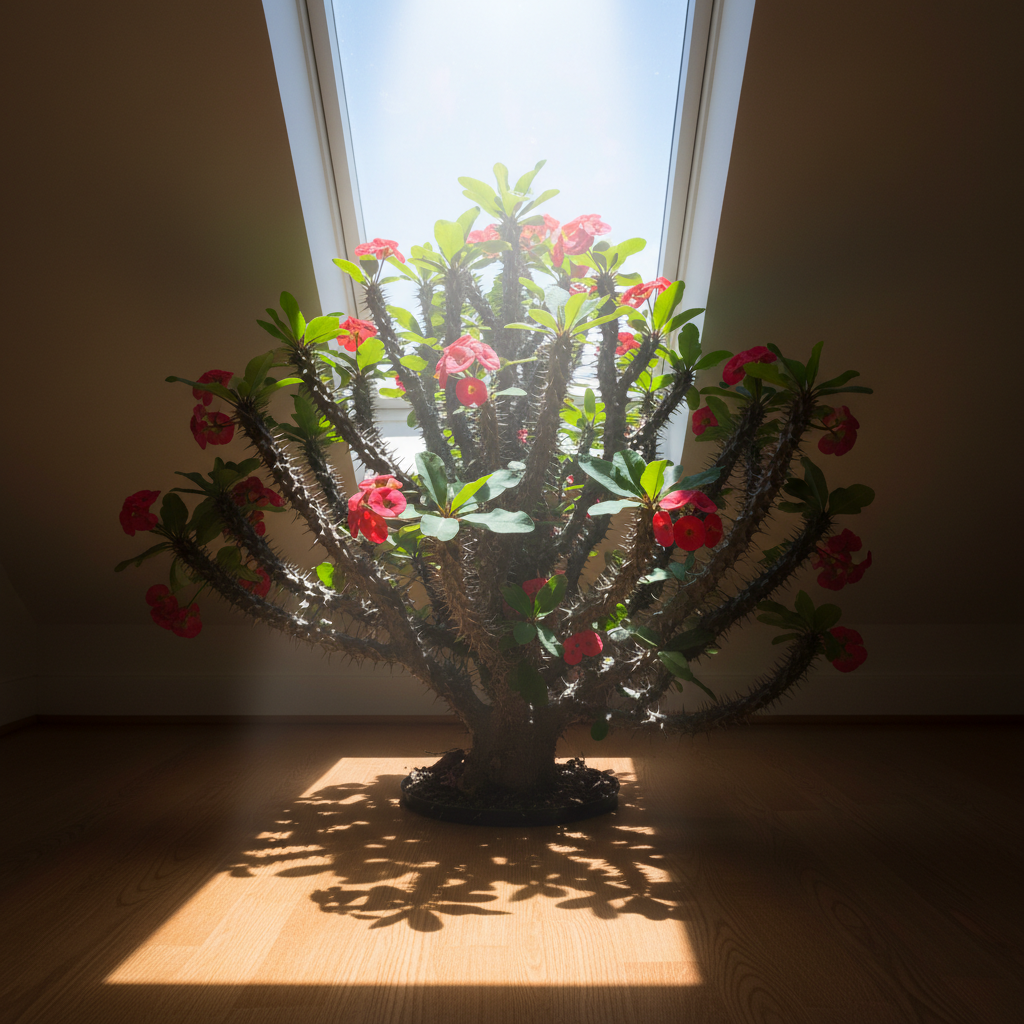
Light is the single most important factor in growing a crown of thorns well. In its native Madagascan habitat the species grows on open rocky slopes exposed to full equatorial sun for most of the day, and almost every problem a houseplant owner encounters with it — leggy growth, sparse leaves, refusal to bloom, vulnerability to rot — can ultimately be traced back to insufficient light. Unlike many flowering houseplants that have been bred to tolerate dim interiors, the crown of thorns has had only minimal genetic adjustment from its wild form, and its tolerance for shade is correspondingly low.
The ideal indoor placement gives the plant at least four hours of direct sun every day, and six hours is better. A spot immediately in front of a south-facing window in the northern hemisphere (or north-facing in the southern) is close to perfect, particularly if it can be slid right up against the glass during the darker months. East-facing and west-facing windows are workable; a north-facing window will keep the plant alive but is unlikely to produce the dense, compact, flower-laden growth that makes the species worth owning in the first place.
Light Levels Explained
The table below translates the loose phrases plant books use into approximate illuminance values measured in lux, so it is possible to check a given spot with a phone light meter or a borrowed handheld unit. Crown of thorns is one of the relatively small group of houseplants that prefers the top end of this scale.
| Light Category | Approx. Level (lux) | Typical Location | Outcome for Crown of Thorns |
|---|---|---|---|
| Direct sun | 30,000 to 100,000+ | Right at a south-facing window or outdoors in summer | Optimal. Compact growth, repeat blooming, deep stem colour. |
| Bright indirect | 10,000 to 20,000 | Within a metre of a sunny window, slightly off-axis | Acceptable. Will grow but flowering reduced and stems slightly longer. |
| Medium | 2,500 to 10,000 | Further into the room, or close to a north-facing window | Marginal. Survives, rarely blooms, stems become etiolated. |
| Low | 500 to 2,500 | Dim corners, rooms with small windows | Decline. Leaf drop, no flowers, vulnerability to rot. |
| Very low | Under 500 | Interior rooms without natural light | Not viable without supplemental lighting. |
Window Orientation and Placement
South-facing window: The default recommendation. A crown of thorns placed immediately in front of an unobstructed south window will receive several hours of direct sun a day for most of the year and is likely to bloom continuously. The only caveat is the height of summer, when an unshaded south window in a sealed room can push leaf-surface temperatures into the range that scorches even sun-adapted plants; a sheer curtain or a 30 cm setback handles this without effort.
East-facing window: A good second choice. Morning sun is intense enough to drive flowering but cool enough not to scorch, and the plant will hold its bracts well. Growth will be slightly slower and the blooming season slightly shorter than in a south window, but the difference is modest.
West-facing window: Also viable, with the opposite trade-off to an east window: less light in the cool morning, intense and warm light in the afternoon. The hot direct sun of a west window is excellent for crown of thorns, with the same midsummer caveat as for south.
North-facing window: Generally too dim for satisfactory growth in temperate latitudes. The plant will limp along, occasionally producing a small flush of bracts in midsummer when the sun rises far enough north to throw some direct light through the window, but it will never look its best and is more likely to rot in the damp conditions of an over-watered winter pot. Supplement with a grow light, or move the plant to a sunnier window.
Pro Tip — The rotation habit: A crown of thorns left in one position will lean steadily toward the light source, the new stems all reaching the same way, and within a year the plant becomes lopsided. A quarter turn every two weeks is enough to keep growth even, and the new bracts then appear all the way around the canopy rather than only on the lit side.
How Light Affects Flowering and Stem Colour
The bright bracts that surround the true flowers of Euphorbia milii are produced only in response to sustained strong light. A plant kept in marginal conditions may keep its leaves and even put out a slow trickle of new stem growth, but it will produce no bracts at all or only the occasional half-hearted pair. The threshold is roughly the four-hour direct sun mark: above it the plant blooms, below it it does not. Strong light also intensifies the colour of the bracts, with red varieties such as ‘Splendens’ producing a more saturated scarlet under high light, and white and pink cultivars taking on a faintly warm blush rather than the washed-out tone they show in dimmer conditions. Stem colour is similarly light dependent: a plant in full sun develops a warm grey-brown bark with reddish undertones in the youngest stems, while a shaded plant produces longer, paler, weaker green stems with widely spaced leaves.
Warning — Sudden direct sunlight: A plant that has spent the winter several metres from the window cannot be moved to the brightest summer windowsill in a single step. Doing so produces papery bleached patches on the leaves and bracts within a day. Move it progressively closer to the light over two or three weeks, or set it briefly outdoors only in dappled morning sun for the first fortnight before letting it take full midday exposure.
Artificial Lighting
The crown of thorns responds well to supplemental lighting and is one of the easier flowering succulents to keep indoors under LED grow lights through a dark northern winter. A full-spectrum white LED bar of 25 to 40 watts hung 30 to 45 cm above the plant, run for 12 to 14 hours a day on a timer, replaces a south window adequately. Cheaper magenta blurple panels work but render the foliage strangely and make it harder to spot pest problems. The plant does not strictly require a dark rest period to bloom, but turning lights off at night respects its natural rhythm and reduces the electricity bill.
Seasonal Adjustments
In temperate climates the available light at a given window can change by a factor of five between midsummer and midwinter. A plant that was happily set back 50 cm from a south window in July will need to be slid right up against the glass in December, and a plant that was acceptably bright on a west-facing windowsill in summer may drop most of its leaves through the winter if left there. Reassess placement at each equinox and move the pot accordingly; the simplest rule is to push the plant toward the brightest window as soon as the days begin shortening in late summer and to allow it to retreat slightly as the days lengthen again in early spring.
Watering and Humidity
Watering is where most crown of thorns plants are killed. The species is a fully succulent member of an arid-habitat genus, with stems that store water and roots that have evolved for fast wet-then-dry cycles on rocky Madagascan slopes; what it asks for indoors is a deep soak followed by complete drying, and what it cannot tolerate is a permanently damp pot in cool conditions. Owners coming to it from leafy tropical houseplants such as monstera or peace lily often water on a calendar — every Sunday, perhaps — and within a year or two the plant rots quietly at the soil line and topples over.
How to Water
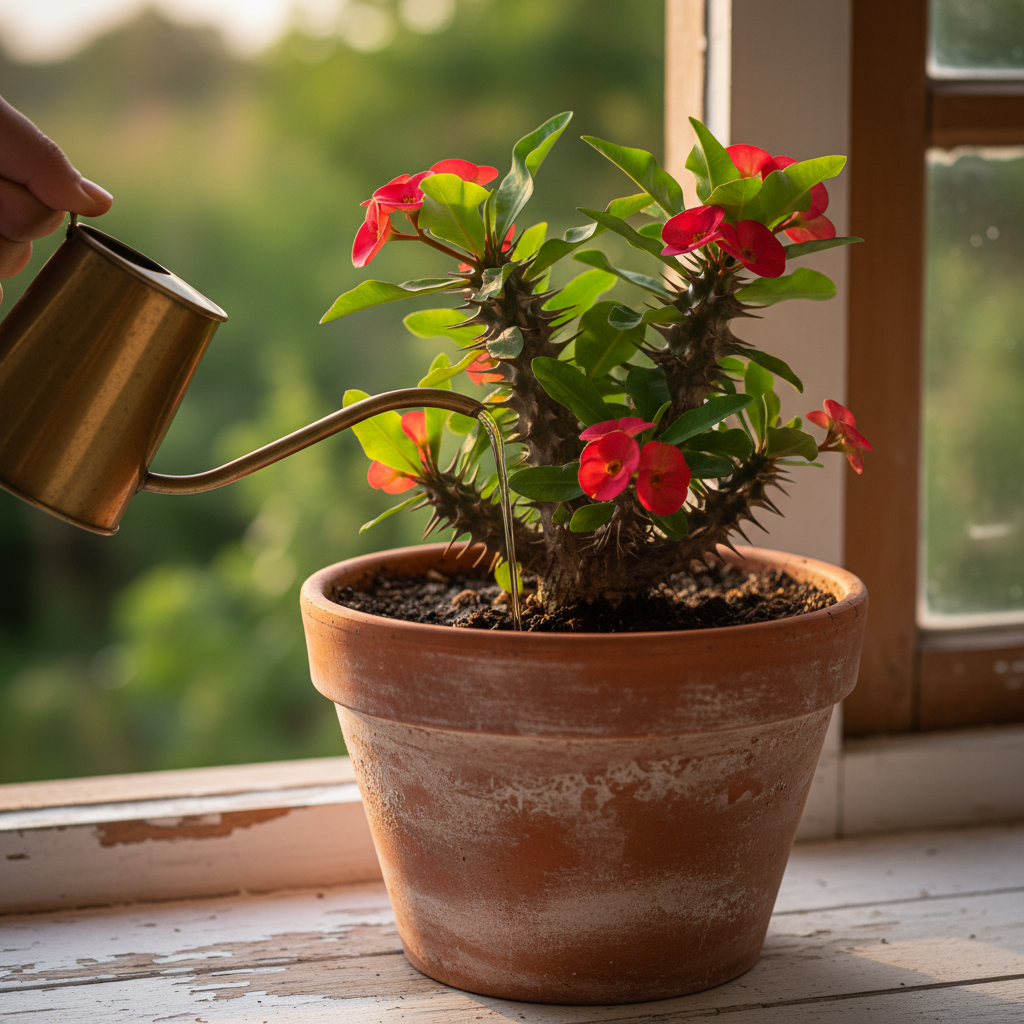
Water deeply, until the excess runs freely from the drainage holes, and then leave the plant entirely alone until the soil has dried out to the bottom of the pot. The simplest test is the weight of the pot: water a plant thoroughly and lift the pot to get a sense of its full weight, then lift it again every few days; when it feels noticeably light, water again. A wooden skewer pushed to the bottom of the pot and pulled out clean is a backup check. The often-cited finger-in-the-top-inch test fails for succulents in tall pots, because the surface dries days before the bottom does and a plant watered on that signal can end up sitting in a permanently wet root zone.
Use the watering session itself as a chance to flush salts from the soil: pour slowly until the water has had time to drip through the entire pot, then tip out anything left in the saucer fifteen minutes later. Standing water in the saucer is one of the few quick ways to kill a crown of thorns.
Frequency by Season
| Season | Approximate Frequency | Notes |
|---|---|---|
| Spring (Mar to May) | Every 7 to 10 days | Growth resumes; water as soon as soil is dry. |
| Summer (Jun to Aug) | Every 5 to 10 days | Peak growth and blooming; soil dries fastest. |
| Autumn (Sep to Nov) | Every 10 to 14 days | Taper as light drops and temperatures fall. |
| Winter (Dec to Feb) | Every 3 to 6 weeks | Minimal watering; some growers withhold entirely if the plant is cool. |
The figures above are starting points only. Actual frequency depends on pot size, pot material, soil composition, temperature, humidity, light intensity and the size of the plant relative to the pot, and the same plant might need water twice as often in a small terracotta pot in a sunny summer kitchen as in a large glazed pot in a cool winter living room. The principle remains constant: dry between waterings, never sitting wet.
Water Quality
Crown of thorns is not fussy about water quality. Hard tap water, soft tap water, rainwater and filtered water all work, and unlike calatheas and some other sensitive species it does not need fluoride-free water to keep its leaves clean. The one chemical it dislikes is chlorine at high concentration, and in regions with heavily chlorinated municipal supplies it is worth leaving a watering can to stand uncovered overnight before use so the chlorine can dissipate. Avoid softened water from a domestic ion-exchange softener: the dissolved sodium accumulates in the soil over time and slowly weakens the plant.
Bottom Watering and Other Techniques
Bottom watering — standing the pot in a shallow dish of water for 15 to 30 minutes until the surface darkens, then draining — works well for crown of thorns and has the small advantage of keeping the woody crown of the plant dry. It is most useful as a periodic technique rather than the default; routine top watering with an occasional thorough flush keeps mineral build-up to a minimum and matches the natural pattern of an occasional heavy rain in the wild.
Humidity
The crown of thorns is genuinely indifferent to humidity and grows happily in the bone-dry air of a centrally heated winter sitting room. Misting is unnecessary and is sometimes counter-productive: water sitting in the leaf axils on a cool day encourages fungal spotting, and damp foliage near a window cooled by a winter night sometimes develops the same small brown lesions. There is no need for a humidifier, a pebble tray or a humidity dome at any stage of the year.
Signs of Over and Under Watering
An over-watered crown of thorns drops its leaves yellow rather than dry, often starting from the bottom of the stems, and the base of the trunk may turn dark and soft. By the time these signs are visible the plant is already in trouble and needs immediate attention: lift it out of the pot, cut away any blackened tissue with a sterile blade well into clean wood, dust the cut with cinnamon or sulphur, allow the plant to dry on its side for a day, and repot into fresh dry gritty mix. Withhold water for at least a fortnight afterwards.
An under-watered plant drops its leaves dry and crisp rather than yellow, and the stems may shrivel slightly along their length. This is recoverable: a single deep watering, repeated once a few days later, usually restores the plant within a week or two, and any leaves shed in the meantime are quickly replaced. The plant uses partial leaf drop as a drought strategy in habitat and treats a brief dry spell as a normal seasonal event, not a crisis.
Soil, Potting and Repotting
The soil mix matters almost as much as the watering routine, and the two are closely linked: a fast-draining gritty mix forgives an enthusiastic owner who waters a little too often, while a moisture-retentive peat-based mix punishes even a careful one. The goal is a substrate that holds enough moisture for the roots to extract a few days’ supply but releases the rest immediately, so the root ball goes through a clean wet-to-dry cycle each time the plant is watered.
A Workable Mix
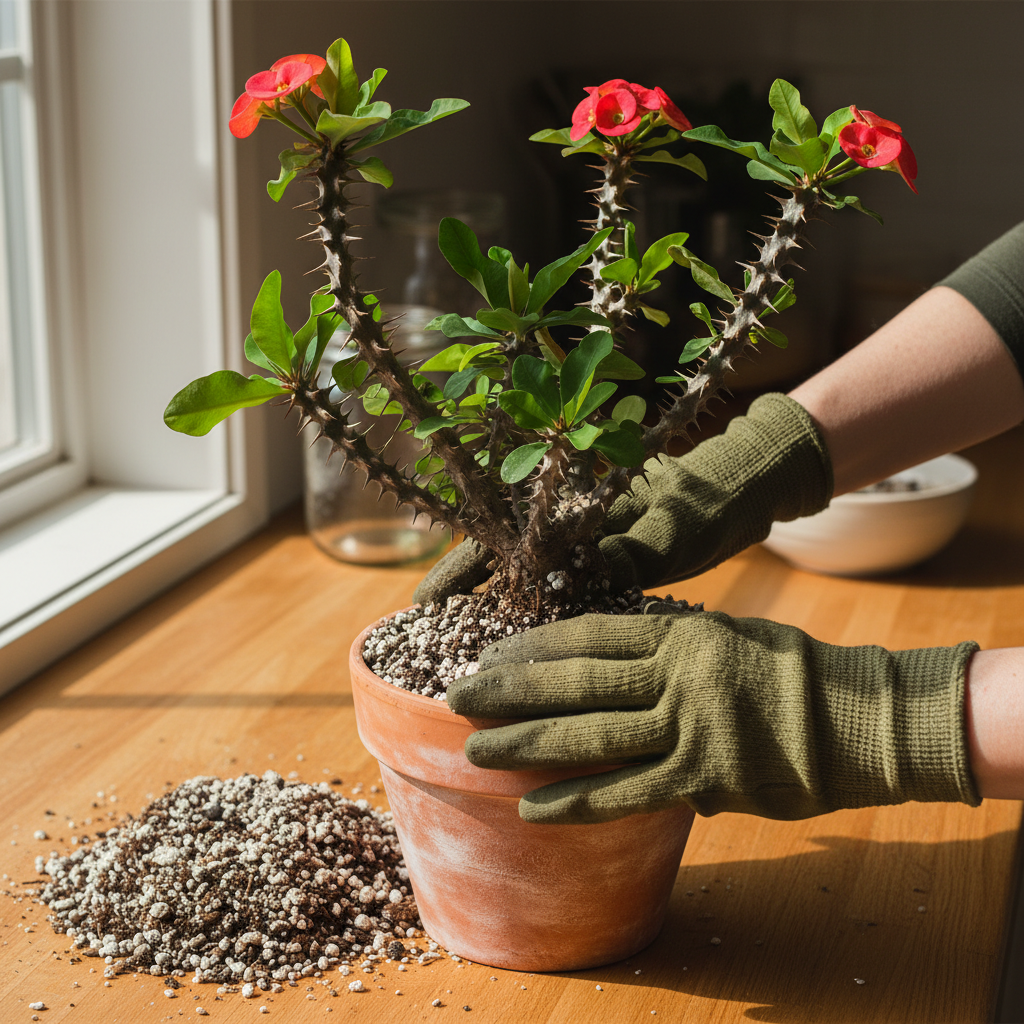
A reliable home blend is two parts of a quality bagged cactus and succulent compost to one part coarse pumice or perlite to one part coarse sharp sand or fine gravel. This roughly halves the moisture retention of a straight commercial cactus mix and is closer to the open mineral substrates used by Euphorbia specialists. If pumice is unavailable, additional perlite is an acceptable substitute, although it is lighter and floats to the surface over time. A small handful of horticultural charcoal added to the mix helps absorb excess moisture and reduce sour-soil odours.
The mix should run water through it in under a minute when freshly potted and feel dry to the touch within a week of watering in average household conditions. If a cactus mix straight from the bag holds water for two weeks or more, it is too rich for this species and needs cutting with pumice or perlite. Peat-heavy general-purpose composts are unsuitable and should not be used even in small proportions.
pH
Crown of thorns is comfortable across a wide pH range from mildly acidic to slightly alkaline (roughly 6.0 to 7.5) and any commercial cactus mix will fall within that window. There is no need to test pH unless symptoms suggest a problem, and even then nutrition is more often at fault than acidity.
Pot Material and Size
Terracotta is the classic choice and remains a sensible one. Its porous walls allow moisture to evaporate from the sides of the root ball as well as the top, helping the soil to dry evenly and reducing the risk of a damp pocket at the centre. Glazed ceramic and plastic both work, particularly for owners who tend to under-water, but they require an extra few days between waterings compared with the same plant in an equivalent terracotta pot.
Whatever the material, the pot must have drainage holes. A decorative pot without holes is acceptable only as an outer cachepot from which the planted pot can be lifted to drain and dry. Match pot size closely to root ball: a crown of thorns prefers a snug fit, with roughly 2 to 4 cm of fresh soil around the existing root system, and over-potting in a vessel several sizes too large creates damp dead zones in the soil that the roots cannot exploit and is one of the most common causes of rot.
When and How to Repot
Healthy crown of thorns plants are repotted every two to three years in early to mid spring, just as growth is resuming and the plant has the energy to recover from root disturbance. Signs that a repot is overdue include roots emerging from the drainage holes, water running straight through the pot without wetting the soil, a noticeable slowing of growth in spring and an obvious top-heaviness to the plant. A crown of thorns that has lived in the same pot for five years without trouble does not need moving simply because the calendar says so.
To repot, wait until the soil has dried thoroughly, gather thick gardening gloves and eye protection, and prepare the new pot with a layer of fresh dry mix in the bottom. Slide the plant out of its current pot — sometimes this requires running a knife around the inside of the pot, or sacrificing a plastic pot by cutting it away — and gently tease away the outer layer of old soil with fingers or a chopstick. Inspect the roots: healthy ones are pale tan and firm, while rotten ones are dark, soft and easily pulled away. Trim any dead roots with sterile scissors. Settle the plant into the new pot at the same depth it sat before, work fresh dry mix down the sides with a chopstick or pencil to eliminate air pockets, and leave the plant dry for a full week before its first post-repot watering — this lets minor root injuries callous over and dramatically reduces the risk of post-repot rot.
Pro Tip — Wrapping the spines: Lifting a large crown of thorns out of its pot is an awkward and bloody business if done bare-handed. Wrap the spiny part of the plant in two or three turns of folded newspaper or bubble wrap secured with masking tape before starting; the wrap takes the punishment instead of your hands, peels off cleanly afterwards and can be reused for the next repot.
Fertilising
The crown of thorns is a light feeder by houseplant standards. Its native habitat is nutrient-poor rocky terrain and the plant has evolved to grow steadily on very little, so any fertiliser routine borrowed from leafy tropical houseplants is liable to be too rich. Over-fertilisation produces soft floppy growth, encourages pest outbreaks and burns the roots when salts accumulate in the gritty mix.
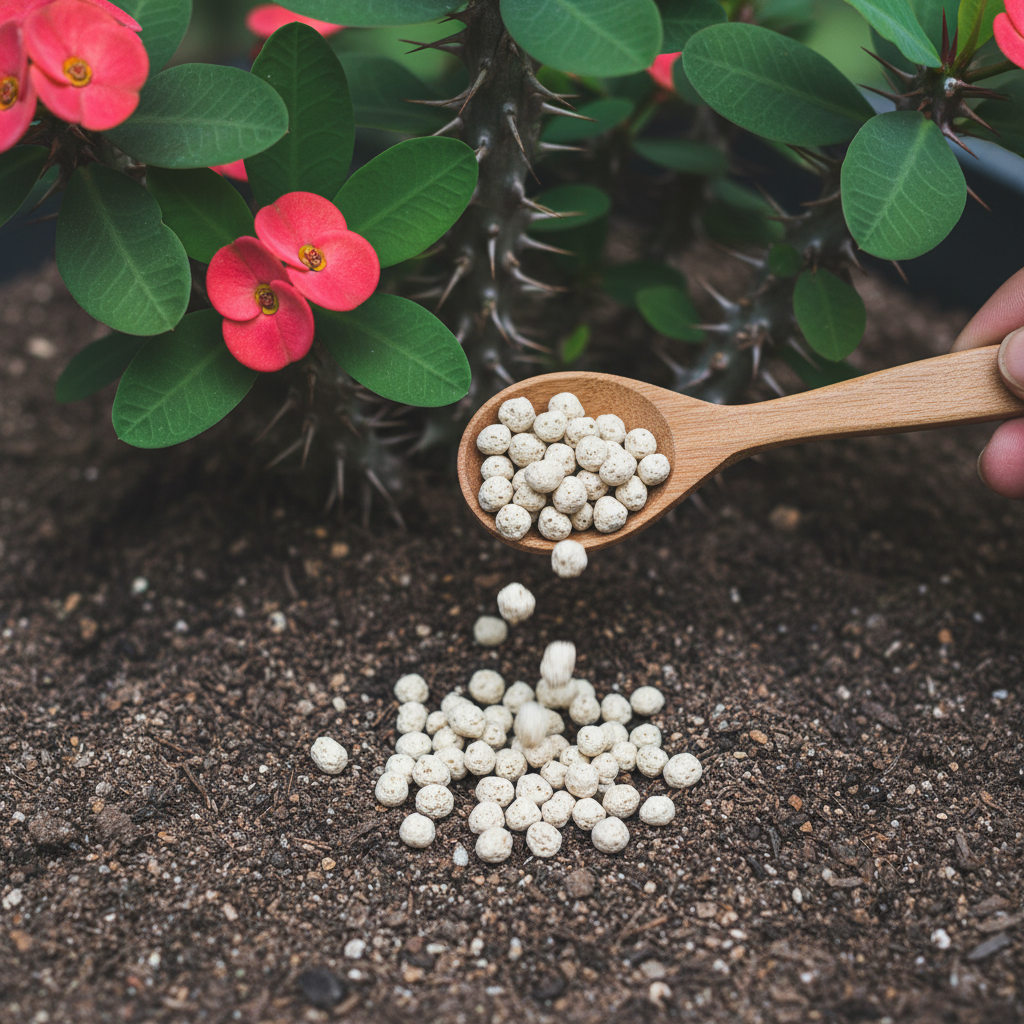
What to Feed
A balanced or slightly low-nitrogen liquid feed diluted to half the strength recommended on the bottle is appropriate, applied roughly once a month during the active growing season from spring to early autumn. A dedicated cactus and succulent formula, with an NPK ratio close to 2-7-7 or 5-10-10, is ideal because it leans toward potassium and phosphorus, which support flowering and root health, and away from nitrogen, which encourages soft leafy growth. General-purpose 20-20-20 fertiliser works at quarter strength but is more likely to push the plant toward foliage at the expense of bracts.
Slow-release prills sprinkled lightly across the soil surface in spring are an alternative for owners who prefer not to mix liquid feed each month. Use no more than half the dose recommended on the packet for general houseplants, and supplement with a single half-strength liquid feed in midsummer if growth is vigorous.
When Not to Feed
Do not feed in winter. The plant is at or near rest, growth has slowed to a crawl, and any unused fertiliser will simply concentrate as salts in the dry soil and burn the inactive roots. Skip the first feed after a repot for at least six weeks: fresh potting mix already contains a modest reserve of nutrients, and the recently disturbed roots are vulnerable to fertiliser injury. Skip feeding a plant that looks stressed for any reason — wilted, recently pest-affected, just brought home from the shop — until it has resumed normal growth.
Signs of Over and Under Feeding
An over-fed crown of thorns looks oddly soft, the new leaves larger and paler than the old ones and the new stem segments visibly weaker. White or yellow crust may form on the soil surface or around drainage holes, and the leaf tips may brown despite adequate watering. Flush the pot thoroughly with two or three volumes of plain water to leach out accumulated salts, then withhold all feeding for at least three months. An under-fed plant, by contrast, simply grows slowly, holds onto its older leaves longer and may produce fewer bracts than it would given a modest monthly feed; this is a much smaller problem than the alternative.
Propagation
Crown of thorns is straightforward to propagate, with one important quirk: it must be calloused before planting. The cut end of a fresh stem leaks copious milky latex, and a cutting planted immediately rots almost without exception. Allowing the cut to dry and seal over for several days before going into substrate transforms a difficult propagation into a reliable one with a success rate well over 80 percent for healthy stem tips taken in spring.
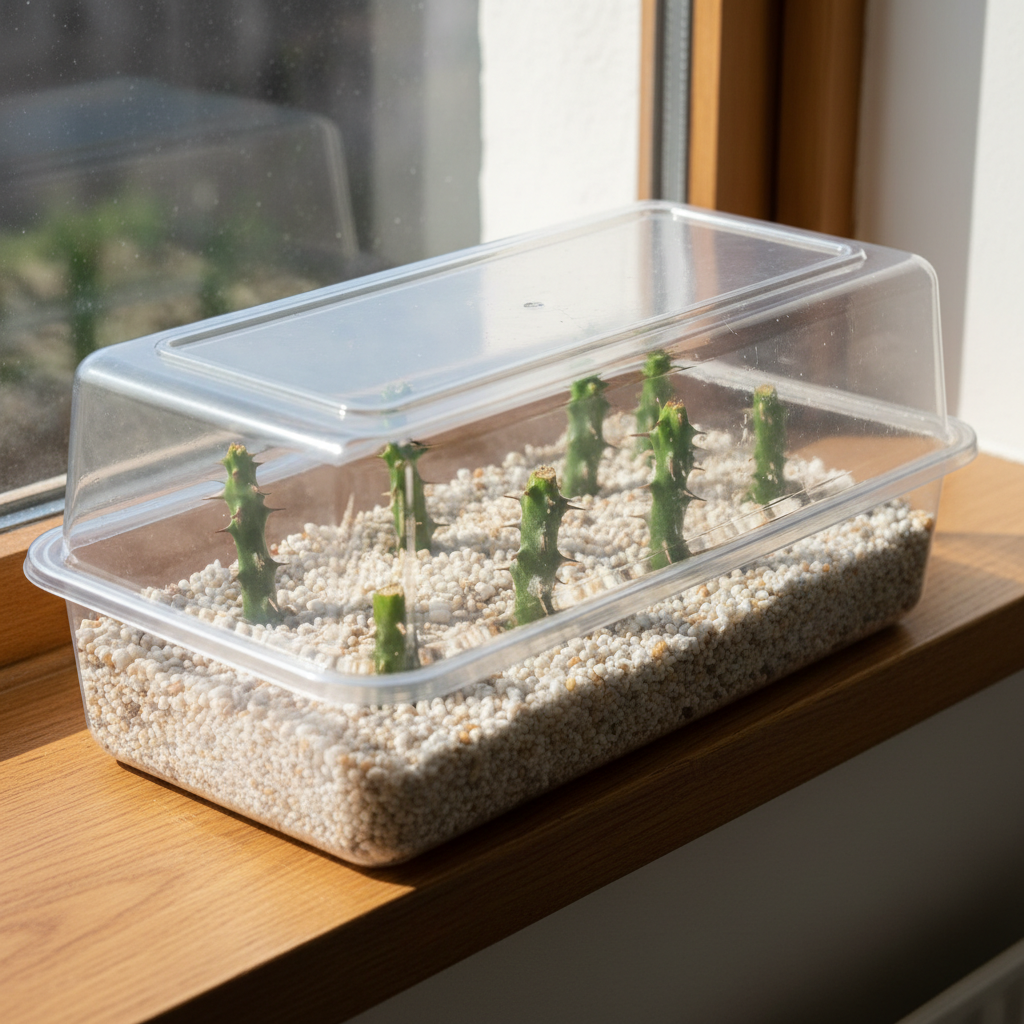
Stem-Tip Cuttings: Step by Step
- Choose a healthy stem tip 8 to 15 cm long, ideally with several leaves clustered near the top. Spring and early summer are by far the best times for new growth to root.
- Wearing thick gloves and eye protection, cut cleanly with a sterilised sharp knife or secateurs just below a node. Cut on a slight angle to expose a slightly larger surface for callus formation.
- Stop the latex flow by holding the cut briefly under cool running water until it stops dripping, then patting the cut dry with kitchen paper. Some growers also dust the cut with horticultural sulphur or a thin layer of cinnamon at this stage to reduce the risk of fungal entry.
- Set the cutting aside in a warm, dry, shaded spot for three to seven days. The cut surface will dry and form a hard pale callus, visible as a flat skin across what was a wet wound. Do not plant before this callus has formed.
- Insert the calloused cutting 3 to 4 cm deep into a tray or small pot of barely damp coarse perlite, pumice or a dry cactus mix. Firm it in just enough to stand upright; staking with a thin bamboo skewer helps if the cutting is top-heavy.
- Place in bright indirect light at room temperature (20 to 25 °C). Resist the urge to water for the first two weeks; thereafter, mist the surface lightly once a week to keep the substrate just on the dry side of damp.
- Roots usually form within three to six weeks. A gentle tug that meets resistance is the sign that the cutting has rooted; at that point shift it to its own small pot of regular gritty cactus mix and treat it as a young adult plant.
Why Water Propagation Rarely Works
The cuttings of many tropical houseplants, including pothos and monstera, root readily in a glass of water. Crown of thorns does not. The milky latex contaminates the water, the cut surface fails to callus while submerged, and the cutting almost always rots before producing roots. Stem-tip cuttings should be calloused dry and rooted in a mineral substrate as described above; the water glass method should be left for plants that prefer it.
From Seed
Seed propagation is possible but rarely worthwhile for hobbyists. The plant produces small explosive capsules that fling seed several metres when ripe, and indoor plants rarely set viable seed unless hand-pollinated between separate clones. Even when seed is available, germination is slow and seedlings take three to five years to reach flowering size, by which time a cutting from a known parent would have grown into a substantial plant. Seed is mainly used by breeders working on new cultivars in the Thai and Californian hybrid programmes; a home grower is much better served by cuttings.
Grafting
Commercial growers occasionally graft Euphorbia milii hybrids onto more vigorous rootstocks (often Euphorbia ingens or Euphorbia trigona) to speed up the production of large showy specimens. This is a specialist technique that requires sterile tools, careful matching of cambium layers and a tolerance for the inevitable latex. It is rarely necessary at home and is mentioned here only because grafted plants are sometimes encountered in nurseries and need slightly different care: keep the graft union dry, do not water from above, and do not let the rootstock sucker.
Pests and Diseases
Crown of thorns is relatively pest resistant: the milky latex deters most chewing insects, the spines keep larger animals at a distance, and the firm waxy leaves do not invite sucking pests as readily as softer-leafed houseplants. Most of the trouble a healthy plant runs into comes from cultural mistakes (overwatering, low light, poor air movement) rather than from arthropod pests, and most of the trouble that does come from pests can be caught and contained early by a regular visual inspection.
Mealybugs
Mealybugs are the most common pest of crown of thorns indoors. They appear as small white cottony spots in the leaf axils and along the thorny stem joints, where they are partially hidden by the spines. Heavy infestations produce sticky honeydew that may later support black sooty mould. Treat individual mealybugs by dabbing them with a cotton bud dipped in 70 percent isopropyl alcohol; treat heavier infestations by spraying the entire plant with diluted insecticidal soap or a horticultural oil, taking particular care to wet the awkward axil pockets between the spines. Repeat every 7 to 10 days for at least three applications to catch successive hatchings, and isolate the affected plant from other succulents until it has been clean for a month.
Spider Mites
Spider mites occasionally appear on plants kept in unusually dry hot air, particularly near radiators in winter. The first sign is fine pale stippling on the leaves, sometimes accompanied by the very faint silken webbing that distinguishes mites from other pests. A strong jet of room-temperature water in the kitchen sink dislodges most of the population, and a follow-up spray with insecticidal soap or 1 percent neem oil three or four times at weekly intervals breaks the breeding cycle. Move the plant slightly further from any heat source while the treatment runs.
Scale
Soft brown scale insects sometimes establish on the underside of the leaves and along the stem. They look like small, flat, oval brown lumps roughly 2 to 3 mm across that do not move when prodded and pop slightly with a fingernail. Scrape light infestations off by hand with the edge of a credit card, then dab the residue with alcohol; treat heavier infestations with horticultural oil. Scale insects produce honeydew much as mealybugs do, so a sticky leaf is often the first sign that something is wrong.
Fungus Gnats
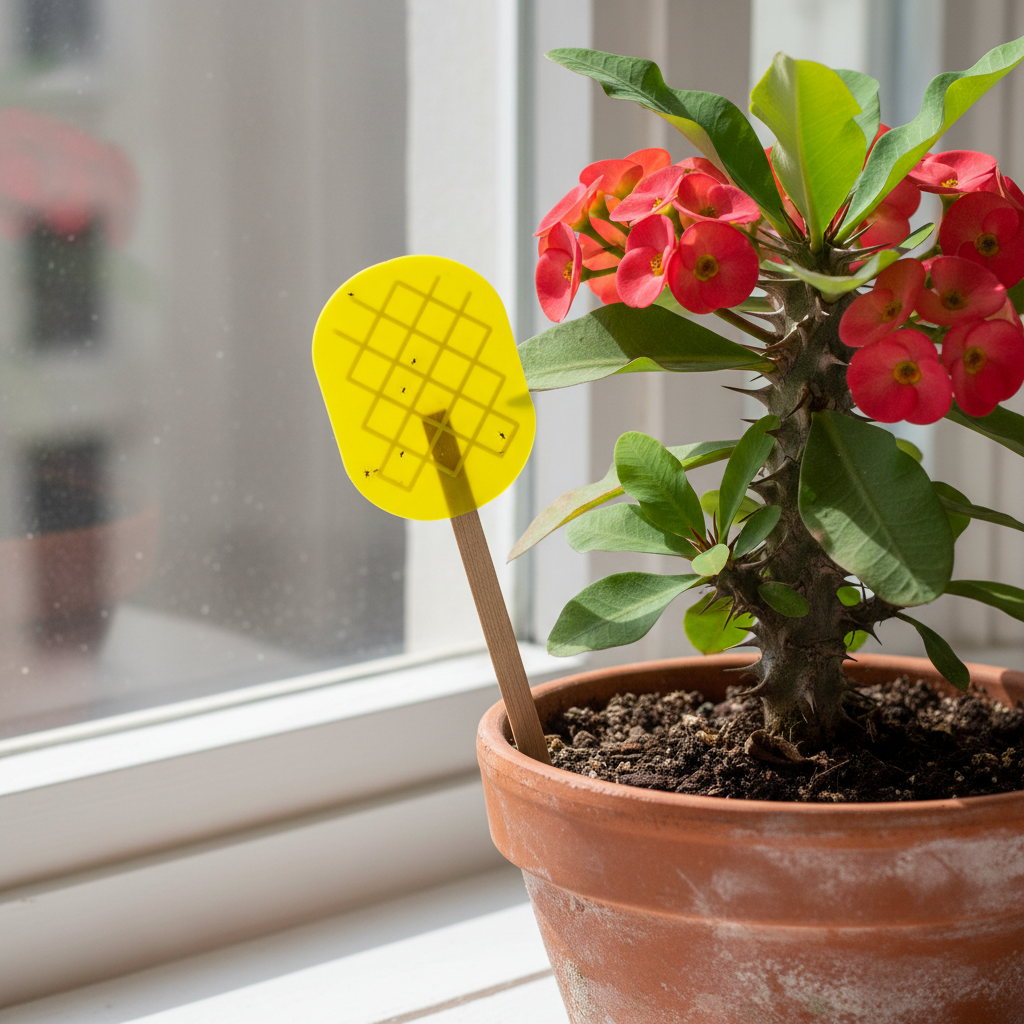
Fungus gnats are the symptom of a much larger problem rather than a problem in their own right: the small dark flies hatch from larvae living in permanently damp organic matter, and a healthy crown of thorns in a gritty fast-draining mix offers them no breeding ground. If they appear, allow the soil to dry out completely, place a yellow sticky trap above the pot to catch the adults, and review the watering routine. Mosquito Bits (which contain Bacillus thuringiensis israelensis) sprinkled on the soil and watered in catch any larvae that do find a damp pocket.
Root Rot
Root rot is the most common cause of death and is almost always traceable to overwatering, a slow-draining soil mix, an oversized pot or some combination of the three. The symptoms are yellowing leaves from the base of the stems, a soft blackening at the soil line, and a sour smell from the pot. Recovery is possible if caught early: unpot the plant, wash the roots clean under running water, cut away all blackened tissue with a sterile blade well into clean white wood, dust the cuts with cinnamon or sulphur, leave the plant on its side for 24 to 48 hours to dry, and repot into fresh dry gritty mix. Withhold water for at least two weeks afterwards. A plant that has lost most of its root system can sometimes be saved by treating the surviving canopy as a single large cutting and re-rooting it from scratch.
Fungal Leaf Spot
Small dark circular spots on the leaves are usually fungal and often appear after a period of cool damp conditions, sometimes following an overzealous misting. Remove badly affected leaves, improve air circulation around the plant, stop misting and water only at soil level. A fungicidal spray containing copper or a sulphur-based product can be useful for severe outbreaks but is rarely necessary if the cultural conditions are corrected.
Pro Tip — The weekly inspection: Make a habit of looking closely at each houseplant once a week, ideally during watering. A two-minute scan of the leaf axils with a phone torch and the camera zoom catches mealybugs and scale at the single-insect stage, when treatment is a cotton bud rather than a fortnight of weekly sprays.
Popular Varieties
The species sold in nurseries today is rarely the wild Madagascan plant. A century of casual cultivation followed by several decades of focused breeding, particularly in Thailand and California from the 1990s onward, has produced a wide spectrum of cultivars distinguished mainly by the size and colour of their bracts. Two stand out, and a handful of others are worth seeking out as they appear in specialist collections.
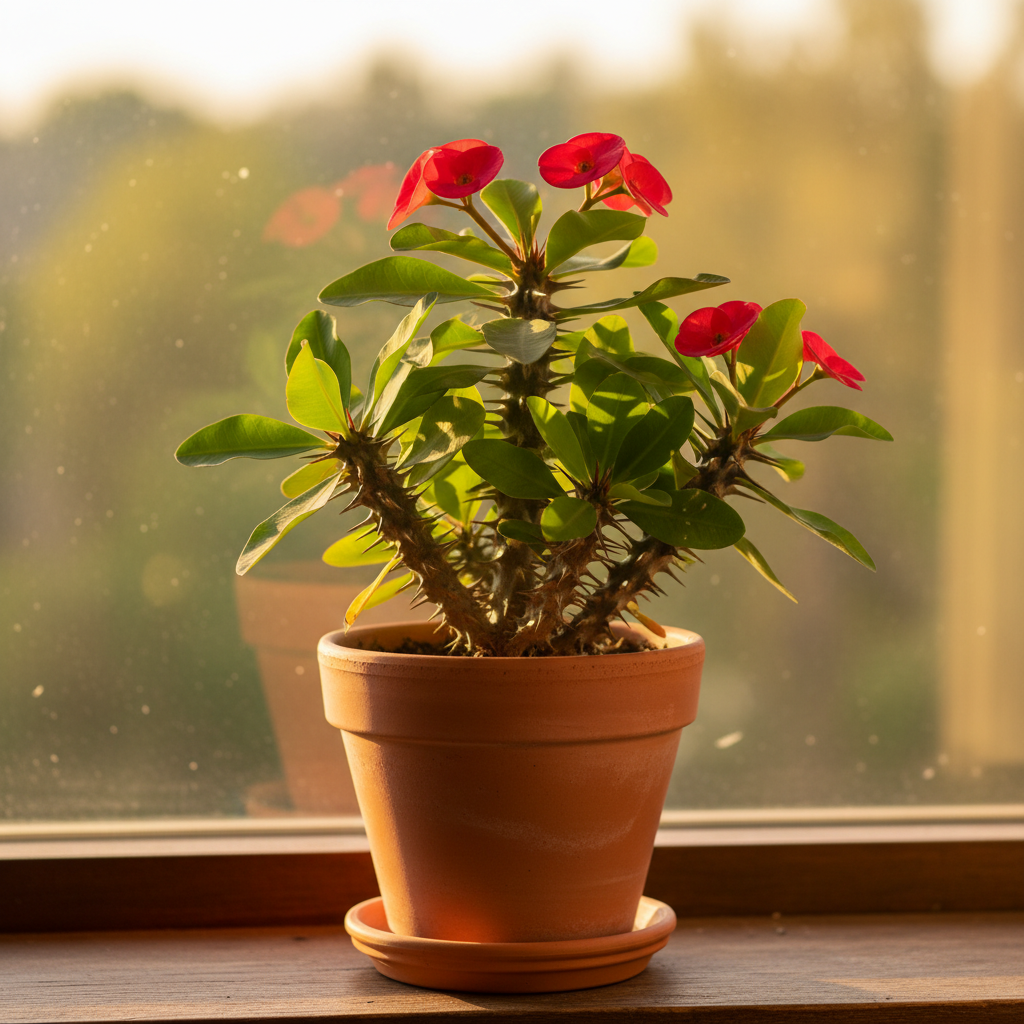
‘Splendens’
The cultivar most people picture when they hear “crown of thorns”. ‘Splendens’ carries the small paired scarlet bracts of the traditional form on dense thorny upright stems, producing a steady trickle of flowers for most of the year given strong light. It is reliable, vigorous, easy to propagate and the easiest variety to find in general garden centres. A good first crown of thorns and still the benchmark against which the newer hybrids are measured.
Thai Hybrid (Poysean)
The Poysean group (also spelled Pohsian) is the umbrella term for the large-bracted hybrids developed in Thailand from the 1990s by crossing Euphorbia milii with the related Euphorbia lophogona. The bracts are dramatically larger than those of ‘Splendens’ — often 3 cm across — and come in pink, cream, peach, salmon, two-tone and even patterned forms. The plants are slightly less thorny and slightly less hardy than the wild type but flower equally generously in bright light, and they are the cultivars worth seeking out in specialist nurseries.
Other Cultivars Worth Knowing
‘Lutea’ (or var. lutea): A clear lemon-yellow-bracted form sometimes treated as a variety of the species and sometimes as a cultivar. Less commonly stocked than ‘Splendens’ but otherwise comparably easy to grow.
‘Short and Sweet’: A compact dwarf selection rarely exceeding 30 cm in height and bearing densely packed red bracts. Useful where space is limited or where a tidy windowsill plant is wanted.
California Hybrids: A parallel breeding line to the Thai Poysean group, developed in California and broadly comparable in bract size, with slightly different colour ranges and stem habits. Less widely distributed in Europe.
‘Apache’: A vigorous red-bracted cultivar with somewhat larger leaves than the wild type and an upright tree-like growth habit that ages into an attractive small specimen over a decade or so.
Variegated forms: Several cultivars with cream or yellow leaf variegation exist (notably ‘Variegata’), although they are generally slower growing, less floriferous and less stable than their plain-leaved parents. Of niche interest for collectors.
Frequently Asked Questions
Why has my crown of thorns dropped all its leaves?
Leaf drop is usually a response to stress and almost always recoverable. The most common causes are sudden drops in light (often after a house move or a seasonal shift), prolonged drought, sudden cold drafts and, less often, overwatering. The plant uses partial leaf drop to conserve moisture in habitat when conditions turn unfavourable and treats it as a normal response rather than a crisis. Identify the underlying cause, correct it, water lightly and the plant will produce a fresh flush of leaves at the growing tips within four to six weeks.
Why won’t my crown of thorns flower?
By far the most common reason for a non-blooming crown of thorns is insufficient light. The plant produces bracts only in response to several hours of direct sun a day, and a plant in a bright but not sunny spot will keep its leaves and grow steadily without ever flowering. Move the plant closer to the window or supplement with a grow light. A secondary cause is over-fertilising with a high-nitrogen feed, which pushes the plant toward leafy growth at the expense of bracts; switching to a low-nitrogen cactus formula or skipping a few months of feed often releases a bloom flush.
Is crown of thorns safe around pets?
No. The milky latex is toxic to cats, dogs and most other pets, causing oral irritation, vomiting and gastrointestinal distress if ingested, and skin or eye contact can cause significant inflammation. The spines are also a real physical hazard. Keep the plant well out of reach of curious pets and children, ideally on a high shelf or in a room they cannot access, and consider a different species (such as a haworthia or a peperomia) for households where reliable separation is not possible.
Can I grow crown of thorns outdoors?
Yes, in suitable climates. Crown of thorns is hardy outdoors in USDA zones 9b to 11, roughly equivalent to frost-free Mediterranean and subtropical regions, and is widely grown as a low hedge or container plant in southern Florida, southern California, parts of Mexico, the Mediterranean basin, South Africa and Australia. In cooler climates it spends the summer outdoors on a sheltered patio (after a gradual two-week acclimation to direct sun) and is brought back indoors before night temperatures fall below 13 °C (55 °F) in autumn.
How long does a crown of thorns live?
Indefinitely, with reasonable care. Specimens documented at over 30 years old in private collections are not unusual, and the plant continues to develop character as it ages, the trunk thickening and silvering and the canopy spreading. Periodic pruning to remove old wood and propagation from cuttings ensures that even a plant past its prime can be renewed.
Should I prune my crown of thorns?
Pruning is optional but useful for shaping. Cut back leggy stems in early spring to a healthy node, wearing gloves and eye protection and being prepared for the cut to weep latex for several minutes. New growth will appear from the node below the cut, often producing two or three new branches where there was one, which results in a denser bushier plant over time. The pieces removed are ready-made cutting material; allow them to callous and root them as described in the propagation section.
What do I do if I get latex on my skin?
Wash the affected area immediately with soap and water and dry it gently. Most healthy adults experience only mild stinging and redness that fades within a few hours. Avoid touching the face, particularly the eyes, until hands have been thoroughly washed, and avoid handling food before washing. If latex contacts the eyes, flush them with copious cool water for at least 15 minutes and seek medical attention promptly: Euphorbia sap is a recognised cause of corneal injury and the consequences of leaving it untreated can be serious.
My crown of thorns has stopped flowering in winter. Is that normal?
Yes. Even in a bright south-facing window the dramatic reduction in day length and light intensity through midwinter usually pauses flowering for a few weeks. The plant resumes blooming once light levels rise again in late winter or early spring, often with a particularly heavy flush after the dim period. There is no need to do anything special; reduce watering accordingly, skip the monthly feed and wait for the days to lengthen.
Why are the leaves at the bottom of the plant dropping but the top still looks fine?
This is the plant’s normal growth pattern rather than a problem. Crown of thorns produces leaves only at the active growing tips of each stem, and old leaves on the lower part of the stem yellow and drop in due course as that part of the stem ages and woods up. The bare lower stem with leaves clustered at the tip is the characteristic look of a mature plant. If the drop seems unusually heavy or extends quickly into newer growth, investigate watering and light; if it is restricted to the oldest leaves and proceeds slowly, it is simply the species behaving as it should.
Can I keep a crown of thorns small?
Yes. A combination of a small pot, restrained feeding and annual pruning back to a chosen framework keeps a crown of thorns at almost any desired size, much as a bonsai is kept. The plant tolerates root restriction well and will continue to flower in a 12 cm pot for many years if periodically lifted, the roots lightly trimmed and fresh gritty mix worked in. Dwarf cultivars such as ‘Short and Sweet’ are a useful starting point for owners with limited space.






