

Few houseplants are as immediately recognisable as the Ric Rac Cactus, a trailing epiphytic species whose flat, segmented stems zig-zag so symmetrically that the plant looks half-architectural, half-aquatic. Native to the cloud forests of southern Mexico, where it grows wedged into the bark of mossy trees rather than rooted in the ground, Disocactus anguliger is also sold under a small flock of common names: Fishbone Cactus, Zig Zag Cactus, Saint Anthony’s Rik-Rak, and (occasionally and incorrectly) Orchid Cactus. The botanical name has shifted several times in recent decades, and many older books and labels still place it in Epiphyllum or Cryptocereus. Whichever tag it carries home from the nursery, the plant is the same: a soft-stemmed forest cactus that wants treatment closer to a tropical orchid than to a desert succulent.
That distinction matters enormously, because the Ric Rac Cactus has a reputation for being effortlessly easy, and an equal reputation for mysterious collapse in the hands of growers who treat it like its desert cousins. The plant tolerates a wide range of indoor conditions and will survive periods of neglect, especially drought, with the kind of stoicism you expect from a cactus. To get it to thrive, however (to throw out cascades of fresh zig-zag growth, root deeply into its pot, and reward you with the spectacular pale-yellow nocturnal flowers it produces in autumn), takes a slightly different approach than most care guides suggest. This guide covers what the plant needs at every step, from light and water through propagation and pests, and pays particular attention to the small adjustments that lift a healthy Ric Rac Cactus out of mere survival into long, exuberant growth.
Contents
- Quick Reference
- Why the Ric Rac Cactus Makes an Outstanding Houseplant
- Light Requirements
- Watering & Humidity
- Soil, Potting & Repotting
- Fertilising
- Propagation
- Pests & Diseases
- Popular Varieties
- Frequently Asked Questions
Quick Reference: Ric Rac Cactus at a Glance
| Light | Bright indirect light; tolerates a few hours of gentle morning sun. Avoid harsh midday sun, especially through glass. |
| Watering | Water thoroughly when the top 3 to 4 cm (1 to 1.5 inches) of mix has dried; reduce in winter. The stems wrinkle slightly when thirsty. |
| Temperature | 18 to 27 degrees C (65 to 80 degrees F) in growth; will tolerate brief dips to 7 degrees C (45 degrees F) when dry, which can trigger flowering. |
| Humidity | Prefers 50 to 70 percent; will cope with average household 40 percent but grows faster and looks lusher with more. |
| Fertiliser | Balanced liquid feed at half strength every two to four weeks from spring through early autumn; nothing in winter. |
| Toxicity | Generally considered non-toxic to cats, dogs and humans; the sap may cause mild stomach upset if eaten in quantity, and the stem segments break easily under chewing. |
Why the Ric Rac Cactus Makes an Outstanding Houseplant
What sets Disocactus anguliger apart from almost every other trailing houseplant is its silhouette. The stems are flat, fleshy and segmented, and along each side they cut deeply inward at regular intervals, producing the pronounced zig-zag pattern that has earned the plant most of its nicknames. Held against the light, mature stems read almost like rows of fish vertebrae, and against a pale wall the rhythm of the notches gives the plant a graphic, almost typographic quality that designers seize on. It is also a trailer rather than a climber, which means it works as beautifully in a hanging planter, on top of a tall shelf, or spilling over a plant stand as it does in a regular pot.
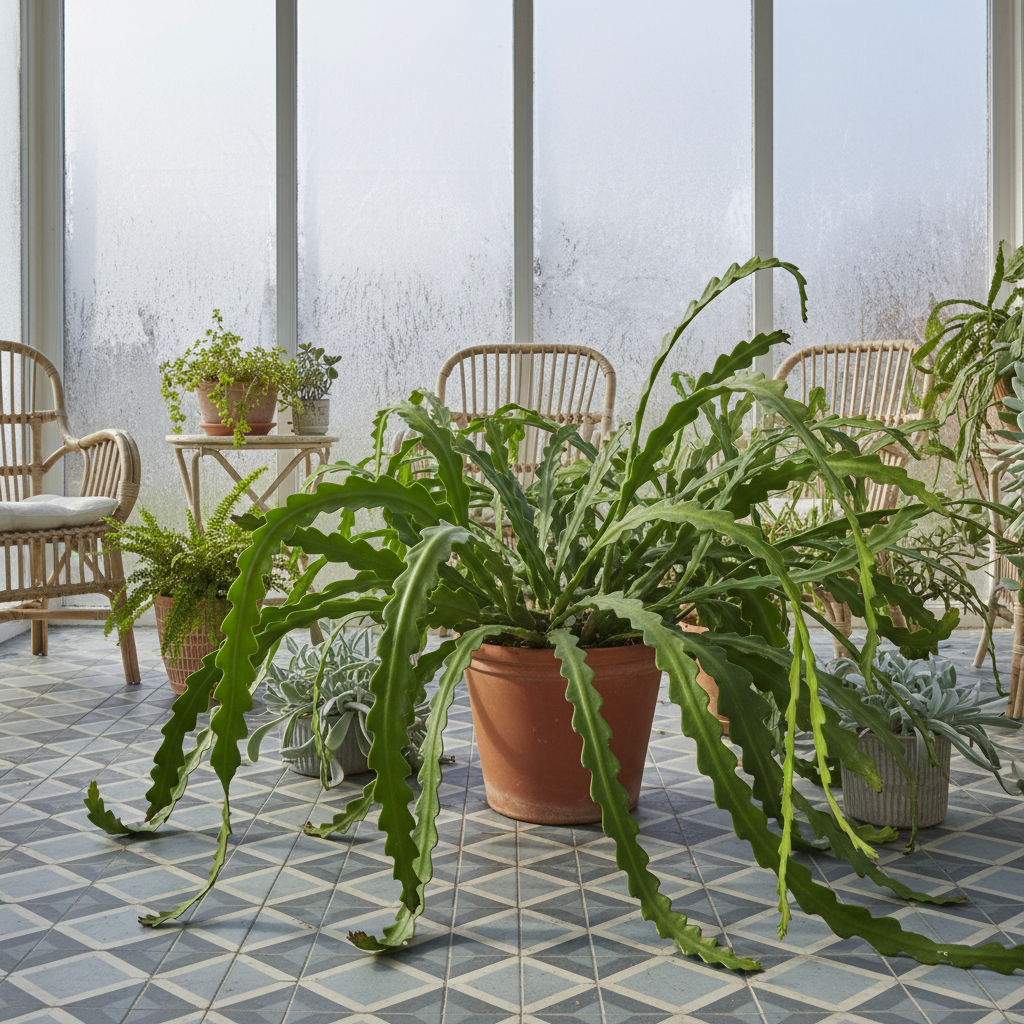
Beyond the looks, the Ric Rac Cactus has a forgiving disposition that suits the realities of indoor growing. It does not need the kind of fierce direct light that prevents desert cacti from succeeding away from south-facing windows; an east window, a west window with some shielding, or even a bright spot a metre back from the glass is enough. It stores water in its flat stems and shrugs off the occasional forgotten watering. It rarely outgrows its space because growth is concentrated in new pendant stems rather than in upward bulk, and individual plants stay productive for decades, getting steadily more impressive as the trailing curtain thickens. The flowers, when they come, are extraordinary: large pale-yellow trumpets, often lightly fragrant, that open after dark in autumn and last only a night or two each, but appear in flushes across a mature plant. They are uncommon but not difficult to coax once you understand the cool-and-dry trigger covered later in this guide.
Important — Toxicity: The Ric Rac Cactus is widely listed as non-toxic to cats, dogs and humans, including by the ASPCA, which makes it a comfortable choice for households with pets and curious children. The sap is not irritating to skin in the way that some euphorbias are. The stems do, however, snap easily if pulled or chewed, and the breakage points can ooze sticky sap that may stain fabric, so it still pays to position trailing growth out of bumping range.
Light Requirements
Understanding light is the single biggest shift a new owner has to make, because most people assume a cactus needs full sun and treat their Ric Rac accordingly. In the wild, Disocactus anguliger grows on the branches of trees in cloud forest at altitudes of 1,100 to 1,800 metres, where it spends its days in dappled, filtered light beneath an evergreen canopy. The flat stem shape is itself a clue: deserts cacti are cylindrical or ribbed to reduce the surface area exposed to merciless sun, while forest cacti like this one are flat and wide precisely because they are starved for light in their natural setting and need every square centimetre of stem surface to gather it.
Translated into a living room, that means bright indirect light is the goal. A position just inside a south-facing window with a sheer curtain, set back about half a metre from an east-facing window, or directly on a north-facing windowsill in summer will all work. Direct midday sun through glass, especially through south or west windows in the warmer months, is the most common cause of unhappiness: the stems pale, lose their fresh green, and develop yellow or brown scorched patches that never fully recover.
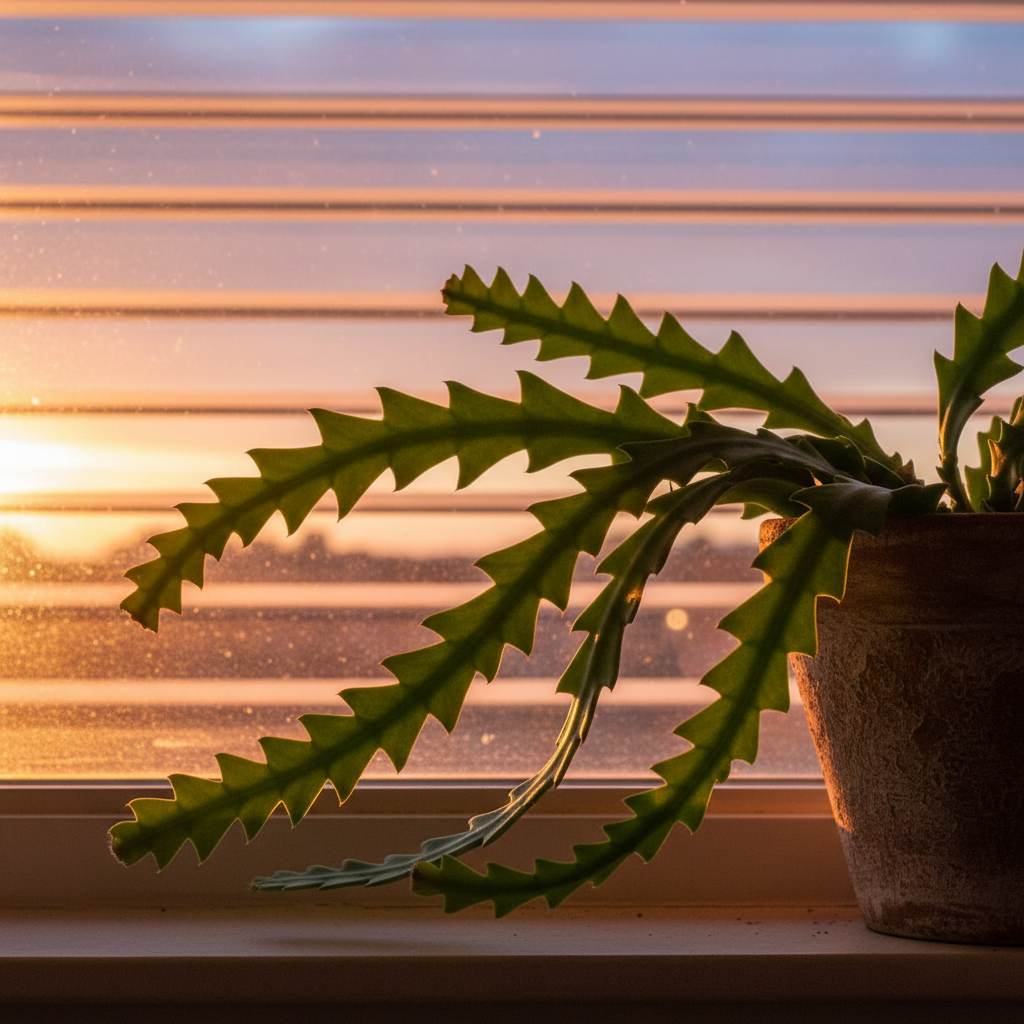
Light Levels Explained
If you have a light meter or a light-meter app on your phone, the figures below give a more objective sense of what the plant wants. If you do not, the descriptions of typical locations are usually enough to place a Ric Rac Cactus correctly.
| Light Category | Approx. Level | Typical Location | Outcome |
|---|---|---|---|
| Direct sun | over 25,000 lux | Unfiltered south or west window through glass | Scorches stems, fades the fresh green, risks irreversible burn marks within a few hours on a hot day. |
| Bright indirect | 10,000 to 20,000 lux | Just inside a sheer-curtained south window, half a metre from an east window | The sweet spot. Compact, segmented new growth and the best chance of flowering. |
| Medium indirect | 5,000 to 10,000 lux | One to two metres inside a bright room, north-facing window in summer | Tolerated; growth slows and stems become longer and slightly thinner. |
| Low | 1,000 to 5,000 lux | Three or four metres from the nearest window, hallways | Survives but stretches noticeably. Few new stems. No flowers. |
| Very low | under 1,000 lux | Bathrooms or corners with no clear view of the sky | Decline within months. Move the plant or supplement with grow lights. |
Window Orientation and Placement
South-facing window: Excellent in winter, when the low angle and weaker sun let the plant sit right on the sill. From late spring through to early autumn, pull it back half a metre to a metre or hang a sheer curtain; otherwise the midday hours will scorch stems most weeks.
East-facing window: Often the easiest year-round position. The plant gets a couple of hours of gentle direct morning sun, which it handles well, then bright indirect light for the rest of the day. Stems stay segmented and fresh green.
West-facing window: Workable, but the afternoon sun in summer is harsher than morning sun, so the plant usually does better set back from the glass or behind a sheer panel. Watch for warm, faded stems on hot days.
North-facing window: Acceptable in summer when light is generally stronger and skies are clearer; the plant will be slower-growing but healthy. In winter at higher latitudes, a north window is usually too dim and the plant should either be moved or given a small supplemental grow light.
Pro Tip — Read the New Growth: The honest indicator of correct light is the shape of fresh stems. In good light, new segments emerge with deep, regular zig-zag notches and stay relatively short and thick. In poor light, new growth comes out pale, thin, with shallow notches and unusually long internodes between turns. That stretchy, almost flattened-fern look is the plant telling you to move it closer to the window.
How Light Affects Stem Colour and Flowering
Healthy stems in correct light show a fresh, slightly cool mid-green with a subtle waxy sheen. In low light they shift to a darker, more saturated green that beginners often read as a sign of health but which actually indicates the plant is producing extra chlorophyll to compensate. In too much sun the stems turn pale, yellowish, sometimes with a faint reddish or bronze blush along exposed edges; this is mild sunburn, and while a sunset blush can be a deliberate aesthetic choice for some growers, it usually precedes outright scorching if conditions are not eased. Flowering, when it comes, depends on the plant having received steady bright indirect light through the spring and summer; combined with a cool, drier autumn (covered in the watering section), this is what triggers the buds.
Warning — Direct Sunlight: Sunscald on a Ric Rac Cactus is permanent. Once a section of stem develops the pale yellow or bleached-brown soft patches typical of burn, the tissue dies and never re-greens. The plant will continue to grow from healthy parts, but scorched stems are cosmetic damage you have to either accept or prune away. Move the plant out of direct midday sun at the first sign of paling, not after the damage has set.
Artificial Lighting
Where natural light is in short supply, the Ric Rac Cactus responds very well to supplemental grow lights, which makes it a reasonable choice for offices and interior rooms. A full-spectrum LED grow bulb of 15 to 25 watts, positioned 30 to 50 cm (12 to 20 inches) above the plant on a 10 to 12-hour timer, gives roughly the equivalent of a bright indirect spot. Keep the lights on a timer rather than running them constantly: the plant uses daily light and dark cycles to regulate growth, and a steady day-night rhythm in autumn is one of the cues for flowering.
Seasonal Adjustments
Indoor light intensity at temperate latitudes can fall by two-thirds between summer and midwinter. Plants that look perfectly placed in May often slip into low light by November without the position changing at all. The simplest seasonal adjustment is to move the Ric Rac Cactus a step closer to the window once the clocks change and a step away again in spring. For specimens that flower, the autumn cool-down is part of the cycle, so do not panic if growth obviously slows from late September; pause feeding, reduce watering and let the plant rest.
Watering & Humidity
Watering is the second place where Ric Rac Cactus care diverges sharply from the standard cactus advice. Because this plant evolved on the moss-soaked branches of cloud forest trees, where moisture is high but never stagnant, it likes a generous drink followed by a quick drain and a brief drying interval. The aim is to keep the chunky mix lightly moist for most of the growing season and only fully dry out the top few centimetres before watering again, rather than the bone-dry-and-soak cycle used with desert species.
When to Water
The most reliable cue is a finger pushed two to three centimetres into the soil. If it comes out dry and the mix feels light, water; if it still feels cool and damp, wait. In a bright indoor spot during summer that usually means watering every seven to ten days; in a cooler or shadier position, every ten to fourteen; in winter, every three to four weeks. The plant itself adds a second cue: as the stems begin to wrinkle slightly along their edges and lose a touch of their plumpness, that is a thirst signal you can act on without anxiety. Wrinkling reverses fully within a day of a thorough watering, and using the stems as a backup gauge keeps you from over-relying on the calendar.
Skip the temptation to water on a fixed weekly schedule regardless of conditions. Indoor evaporation rates change with the seasons, with heating systems coming on, and with how often you open windows. A plant that needed a drink every seven days in July might need water only every three weeks in February; treating watering as something you decide each time by checking the mix is the most reliable practice.
Pro Tip — The Pot Weight Test: Pick the pot up just after a thorough watering and note how heavy it feels. Pick it up again a few days later; once it feels noticeably light, the mix is dry enough to need another drink. After a few cycles you will know the difference instantly by feel, and you can rely on that rather than poking a finger into the soil or trusting a moisture meter.
How to Water Correctly
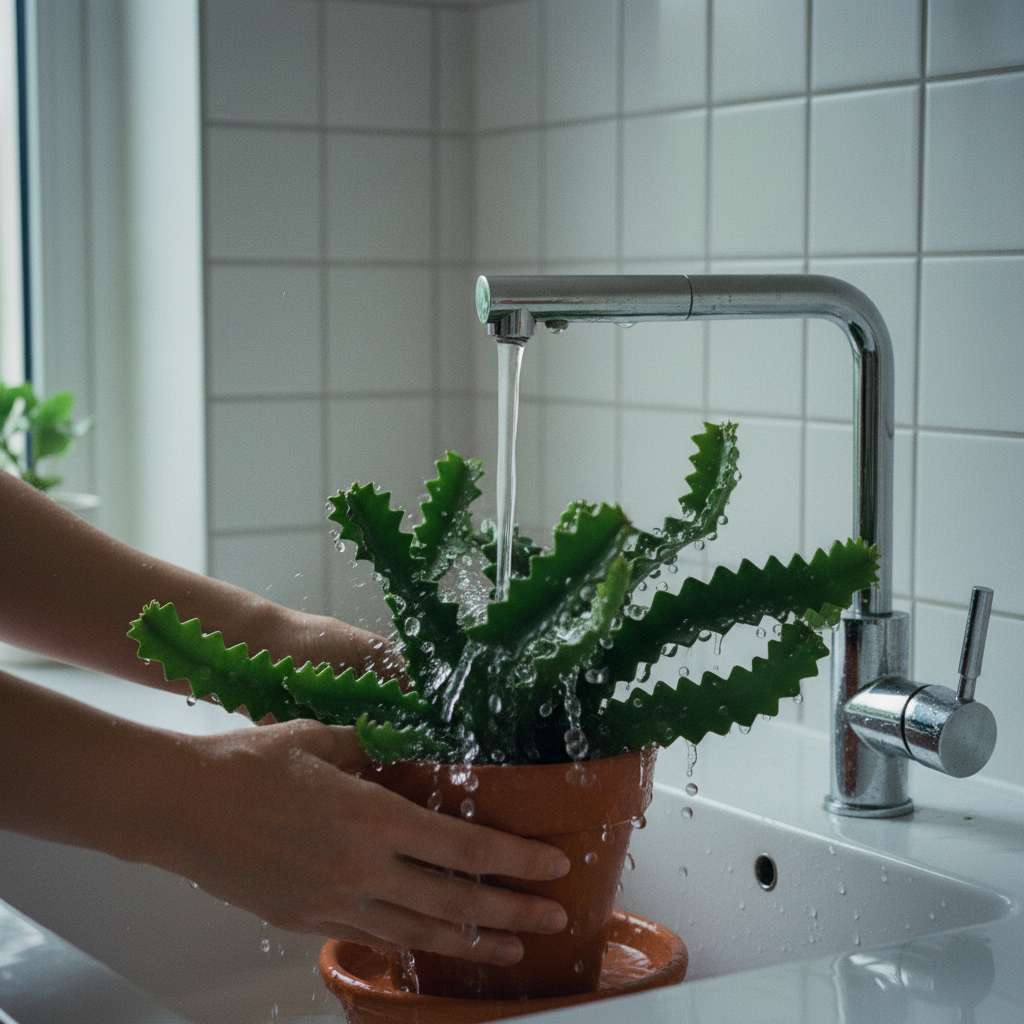
- Take the plant to a sink or shower if possible, so excess water can drain freely without leaving the pot sitting in runoff.
- Water slowly and evenly across the surface of the mix, going around the inside edge of the pot as well as the centre, until water begins to run out of the drainage holes.
- Continue for another fifteen to thirty seconds to flush accumulated salts and ensure the entire root ball has been moistened, not just the surface.
- Let the pot drain for at least five to ten minutes before returning it to its decorative cover pot or saucer.
- Empty any water that collects in the saucer; the plant must never sit in standing water.
- Wipe down any spilled water on the leaves or pot rim with a dry cloth, which discourages fungal spotting and water marks on stems.
Signs of Overwatering vs. Underwatering
| Symptom | Overwatering | Underwatering |
|---|---|---|
| Stem colour | Yellowing or bronzing of older stems, often starting at the base nearest the soil | Slight paling and dulling of the green, evenly across the plant |
| Stem texture | Soft, mushy, sometimes translucent where rot is taking hold | Wrinkled, slightly shrivelled, but still firm to a gentle squeeze |
| Soil | Stays damp for more than a week, may smell sour or musty | Bone dry, pulled away from the sides of the pot |
| Roots | Brown, mushy, easily peeling away from the firm white core | White or pale tan, dry but intact, sometimes brittle |
| Stem base | Blackened, soft and collapsing — a serious symptom requiring immediate action | Slightly thinner than usual but still healthy and firmly attached |
Warning — Root Rot: Root rot is the leading cause of Ric Rac Cactus death and almost always starts at the base of the plant where the main stem meets the mix. If you notice softness, blackening or a sour smell from the soil, act immediately: unpot the plant, cut off any rotted tissue with a clean blade, let healthy cuttings callous for two or three days, and re-root them in fresh dry mix. Trying to dry out a rotted plant in its existing pot rarely works because the damaged tissue continues to spread.
Humidity Requirements
The Ric Rac Cactus prefers humidity between 50 and 70 percent, which is higher than most homes manage in winter but well within the range of any room where another houseplant or two is grown happily. Below about 40 percent you may notice slight crisping at the very tips of older stems and a slower pace of new growth, especially during heated months. The plant rarely suffers seriously at lower humidity, however, so this is more a thrive-versus-survive consideration than a survival one.
The clearest sign of unhappily low humidity is a stem-tip crisp combined with stalled new growth in spring or summer. If the plant is otherwise healthy, looks well-watered, sits in good light, and refuses to push out fresh segments, dry air is one of the first suspects.
To raise humidity, the most reliable method is a small humidifier running in the same room. Pebble trays do little because the surface area of water is too small, and misting is at best a brief boost. Grouping plants together helps modestly through their combined transpiration, and moving the Ric Rac Cactus to a bathroom or kitchen with a regularly running tap can sometimes solve the problem without any equipment at all. In winter, keep the plant away from heating vents and radiators, which produce particularly dry, fast-moving warm air that wrinkles even well-watered stems.
Water Quality
Forest epiphytes are sensitive to mineral build-up in soil because in nature they grow in moss and bark debris that does not retain salts. Where tap water is hard, you may see white crusting around the soil surface and along the pot rim after a year or two, and the stems may show pale streaks along their edges. Filtered tap water, rainwater or cooled boiled water all help, and an annual flushing watering (running roughly three pot volumes of water through the soil in the sink) clears most of what does accumulate. Avoid softened water, which exchanges calcium for sodium that the plant tolerates even less well.
Soil, Potting & Repotting
The Ric Rac Cactus is fussier about its soil than about almost anything else. Because it is an epiphyte, its roots are accustomed to anchoring through coarse, airy material with very high oxygen content, not to sitting in dense soil. A standard cactus mix from a garden centre is far too gritty and lacks the chunky organic matter the roots crave; a standard houseplant mix is far too dense and holds too much water at the bottom of the pot. The best results come from a hybrid that combines fine bark, perlite and a small fraction of regular potting soil.
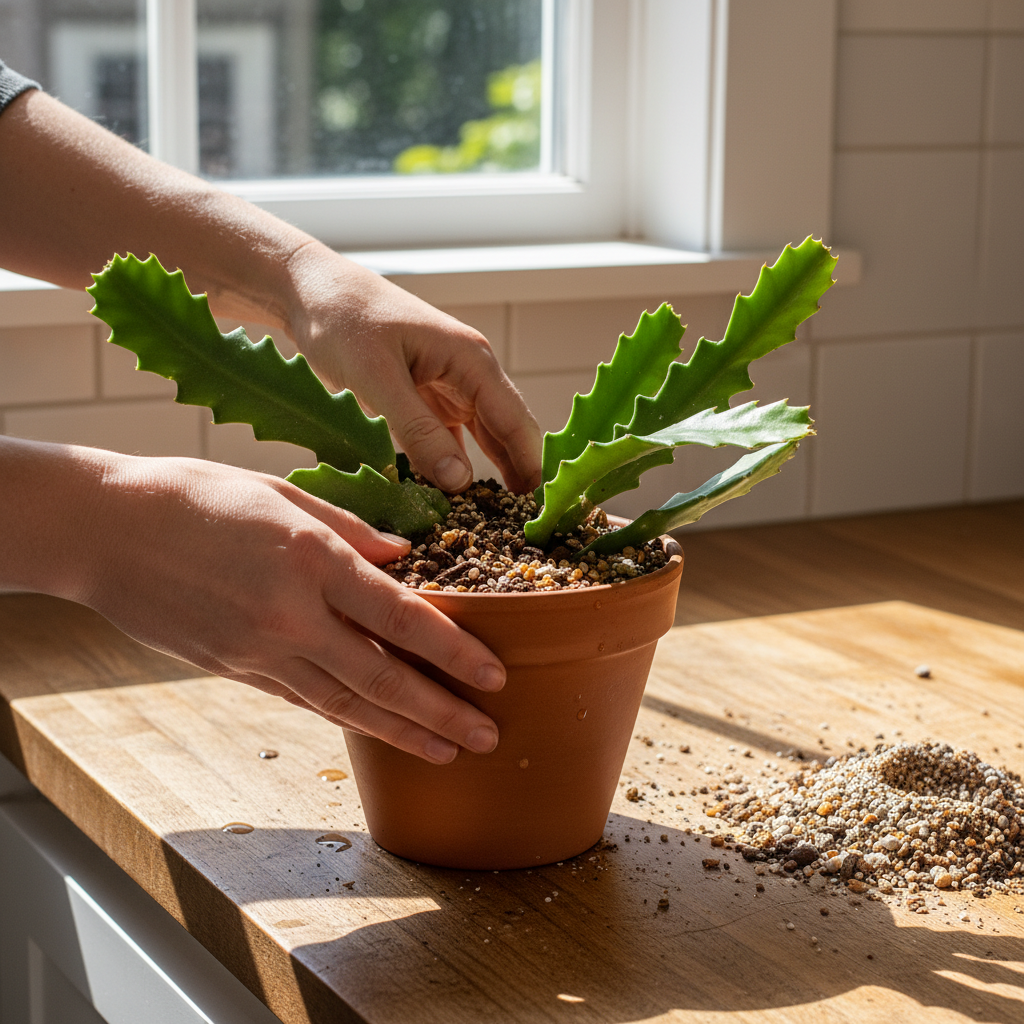
Ideal Soil Composition
Think of the substrate less as soil and more as a stable, airy scaffold for the roots. Water should run through the mix freely, the surface should dry out within a day of watering, and the larger pieces should still be visible months after potting. The mix should feel light when dry, not dense or heavy, and you should be able to push a finger into it without resistance even in the deeper parts of the pot.
| Component | Proportion | Function |
|---|---|---|
| Orchid bark (fine to medium grade) | 40 percent | Coarse anchor for roots, mimics the bark substrate of native cloud forest hosts. |
| Perlite or pumice | 30 percent | Increases aeration and drainage, keeps the mix from settling into a dense mat. |
| Quality houseplant potting mix | 20 percent | Provides modest moisture retention and a small reservoir of nutrients between feeds. |
| Coco coir or chopped sphagnum moss | 10 percent | Adds the spongy organic component the roots cling to in nature. |
If exact ratios sound finicky, do not let that stop you: any well-draining houseplant mix bulked out by an equal volume of orchid bark and a generous handful of perlite gets close enough. The single most important rule is that the mix should never look or feel like the dark, dense, water-holding stuff that comes out of an average houseplant bag.
The Ric Rac Cactus prefers a slightly acidic to neutral pH, roughly 6.0 to 6.8. Most quality potting mixes and unbuffered coco coir fall within this range naturally, and the small fraction of bark slightly acidifies the blend. You do not generally need to adjust pH unless you are using strongly alkaline water and have noticed pale, washed-out new growth alongside soil crusting.
Pro Tip — Quick Mix Recipe: If you do not want to mix from scratch, combine three parts of a quality houseplant potting mix with three parts of orchid bark and two parts of perlite by volume. Add a small handful of horticultural charcoal to the bottom of the pot to keep the mix sweet. This shortcut blend works for ninety percent of forest cacti and epiphytic aroids, so it is worth making a bucket at a time and storing it sealed.
Choosing the Right Pot
Because this is a trailing rather than upright plant, the choice of pot is partly aesthetic and partly practical. The roots themselves are relatively shallow and modest in volume, even on a mature specimen, so the plant does not need depth. What it does need is generous drainage, an opening wide enough for the spreading stem base, and a vessel light enough that hanging is an option without overloading hooks or shelves.
Drainage holes are non-negotiable. Multiple holes are even better, since this plant punishes any pooling water at the base of the pot. A decorative cover pot with no drainage is fine as an outer sleeve provided you remove the inner pot to water and let it drain fully before replacing it; planted directly into a closed cachepot, even a Ric Rac Cactus that has thrived for years can collapse from root rot within weeks.
Pot material: Terracotta and unglazed ceramic are excellent because the porous walls wick moisture out of the mix and provide a built-in safety margin against overwatering. Hanging plastic baskets are lighter and easier on hooks, dry out a little more slowly, and work well in stable warm rooms. Glazed ceramic looks beautiful but retains moisture longer; if you choose it, lean toward the dry side when judging the next watering.
Pot size: Go small rather than large. A pot only two to three centimetres (about an inch) wider than the existing root ball is generally enough. Over-potting creates large pockets of damp mix that the roots cannot reach quickly, and those wet zones are where rot starts. A Ric Rac Cactus is comfortable being slightly root-bound, and many growers keep their plants in the same pot for three years or more.
When to Repot
Plan to repot every two to three years, ideally in early spring just as new growth begins. The clearest signs that a repot is overdue are roots circling the inside of the pot and emerging from drainage holes, water running straight through the pot without seeming to wet the mix (a sign the substrate has broken down and become hydrophobic), or the plant tipping forward under its own trailing weight. If none of these signs is present, do not repot just because a calendar says so; this is a plant that genuinely prefers to be left alone in a stable mix.
How to Repot: Step-by-Step
- Water the plant lightly the day before repotting so the mix holds together but is not soggy; this reduces root disturbance.
- Lay out the new pot, a sheet of newspaper or a tray to work on, and a bowl of pre-mixed substrate. Have clean secateurs to hand.
- Gently slide the plant out of its current pot, supporting the base of the stems with one hand. If it resists, squeeze the sides of a plastic pot or tap the rim of a clay one against the edge of a table.
- Tease away the old mix around the roots with your fingers, working from the outside in. Avoid pulling on roots; let them release naturally as the old substrate falls away. Discard any obviously broken, blackened or mushy roots with a clean cut just above the damaged tissue.
- Add a layer of fresh mix to the bottom of the new pot, then place the plant so that the base of the stems sits about a centimetre below the rim. Fill around the roots with fresh mix, tamping gently with your fingers as you go to eliminate large air pockets without compacting the substrate.
- Settle the surface mix with a light watering once the plant is in place, then let it drain fully.
- Keep the freshly potted plant out of direct sun and slightly drier than usual for the first ten to fourteen days while the roots re-establish in their new substrate.
Warning — Transplant Shock: Mild wilting or stem softening for a week or two after repotting is normal and does not require intervention. Resist the urge to water heavily as a remedy; the roots have been disturbed and cannot take up large volumes of water until they re-establish. Watering on the lighter side and keeping the plant out of strong sun and away from cold drafts is the surest way to recovery.
Fertilising
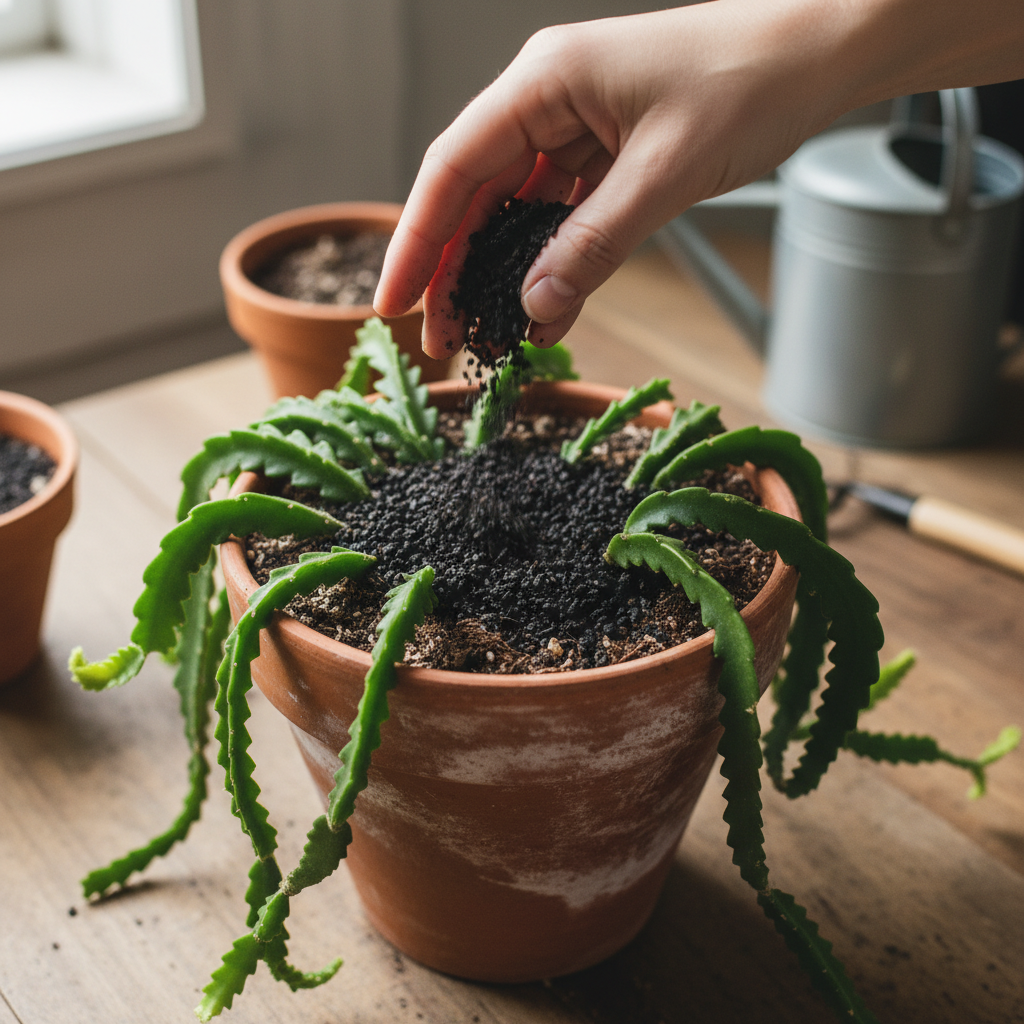
In the wild, the Ric Rac Cactus survives on whatever nutrients rain washes through the moss and decaying bark in which it lives — a thin, slow, almost trickling supply. In a pot, even a chunky epiphytic mix runs out of usable nutrients within a few months of watering and needs occasional supplementation to keep the plant growing well. The good news is that this is a light feeder; over-fertilising causes far more problems than under-fertilising, and a single half-strength dose every two to four weeks during the warmer half of the year is plenty.
The growing season indoors typically runs from early spring through to the start of autumn, roughly March to September in the northern hemisphere. Feed during this window and stop entirely once new growth visibly slows. Continuing to fertilise into the autumn rest period stresses the plant and can interfere with the cool-and-dry cue that triggers flowering.
Understanding Plant Nutrients
Most fertilisers list three numbers on the label, the N-P-K ratio, indicating the percentages of nitrogen, phosphorus and potassium. Nitrogen drives lush stem growth, phosphorus supports flowering and root development, and potassium underwrites overall vigour and resistance to stress. For the Ric Rac Cactus, a balanced formulation such as 10-10-10 or 5-5-5 works well for general maintenance; a flowering-focused mix higher in phosphorus (sometimes labelled as a bloom booster, perhaps 5-10-10 or 2-10-10) can be substituted for a few weeks in late summer if you are trying to push the plant into flower.
| Nutrient | Symbol | Primary Function | Deficiency Symptoms |
|---|---|---|---|
| Nitrogen | N | Drives chlorophyll production and stem growth | Pale, yellowing older stems; slow or stalled new growth |
| Phosphorus | P | Supports root development and flowering | Reduced flowering; weak, sparse new stems |
| Potassium | K | Overall vigour, water regulation, disease resistance | Stem edges browning, weak resistance to stress and pests |
| Calcium | Ca | Cell wall structure | Distorted or wrinkled new growth, deformed segment notches |
| Magnesium | Mg | Central atom of the chlorophyll molecule | Yellowing between veins on older stems with the rest staying green |
| Iron | Fe | Chlorophyll synthesis | Pale yellow new growth with normal older growth; often a sign of high pH locking iron out |
Types of Fertiliser
Liquid fertilisers: The easiest and most controllable option. A standard balanced houseplant feed diluted to half the strength stated on the label gives you the precision the Ric Rac Cactus appreciates. Liquid feeds are applied with regular watering and reach the roots immediately, which makes them ideal for a plant whose substrate flushes through quickly.
Slow-release granular: Convenient and low-maintenance: a single small handful pushed lightly into the surface of the mix in spring releases nutrients gradually each time you water. Use the dose listed for half the pot volume rather than the full pot, since this is a light feeder and over-application can build salt in the mix.
Organic fertilisers: Worm castings, well-rotted compost teas and gentle organic liquids such as seaweed extract all suit this plant and reduce the risk of chemical burn. The trade-off is a slower, less predictable release; if you rely solely on organic feed you may need to dose a little more frequently. Many growers combine a base application of worm castings as a top-dressing with the occasional dilute liquid feed for fast effect.
Feeding Schedule
From early spring to the end of summer, apply a balanced liquid fertiliser at half label strength every two to four weeks. In late summer through early autumn, if you are aiming for blooms, switch to a phosphorus-heavier formulation for two or three feeds. Once autumn arrives in earnest and growth slows, stop fertilising altogether and resume only when fresh new stem growth appears again in spring. Plants in particularly low light should be fed less often, since they cannot use the nutrients quickly and excess accumulates in the mix.
Pro Tip — Half is the Right Strength: Almost every fertiliser label on the shelf is calibrated for fast-growing annual bedding plants, not for slow forest cacti. Diluting to half the recommended strength is the difference between feeding and overfeeding. Even if a label specifies a houseplant rate, halve it again for a Ric Rac Cactus and you will almost never see signs of burn.
How to Fertilise
- Always fertilise into pre-moistened, not bone-dry, substrate. Water lightly the day before or twenty minutes before feeding to coat the roots and prevent chemical burn.
- Mix the liquid fertiliser into a clean watering can at half the label-recommended strength.
- Apply the diluted feed slowly across the mix surface until the substrate is fully moistened and some runs through the drainage holes.
- Let the pot drain fully and discard any liquid that collects in the saucer.
- Twice a year, flush the mix with three pot volumes of plain water to clear any salt that may have built up; this is especially important if you feed with synthetic liquid fertilisers regularly.
Warning — Salt Build-Up: White crust on the surface of the mix or around the rim of the pot, paired with browning stem tips, is the classic sign of fertiliser salt accumulation. Stop feeding immediately, flush the mix with three or four pot volumes of clean water, and consider repotting in fresh substrate if the crusting is heavy. Repeated salt build-up in a plant that gets fed regularly is a sign that the dose is too high or the mix is no longer draining well.
Propagation
The Ric Rac Cactus is one of the easiest houseplants to propagate, partly because each segment of stem already contains nodes capable of generating roots and shoots, and partly because the plant naturally drops or breaks stems in the wild as a self-propagation strategy. A single mature plant can comfortably yield a dozen new plants a year if you wish, and the propagation success rate is extremely high compared with most other tropicals.
The two reliable methods are stem-segment cuttings rooted in water and stem-segment cuttings rooted directly in mix. Each has advantages, and most experienced growers eventually settle on one as a default. Water rooting is more visual and lets you watch progress; direct soil rooting is closer to how the plant would propagate naturally and skips the transition from water roots to soil roots.
Understanding Stem Segments
Each flat stem of a Ric Rac Cactus is divided into segments separated by faint constriction points and joined together by visible nodes. At every notch along the edges of the stem, there is also a small areole, the tiny structure characteristic of all cacti from which fine spines, flowers and (most importantly for propagation) new growth points can emerge. When you take a cutting, you are essentially harvesting a chunk of stem that contains several of these areoles plus a clean cut surface; from those areoles new roots will emerge below the surface and new shoots above it, while the cut end calluses over and is protected from rot.
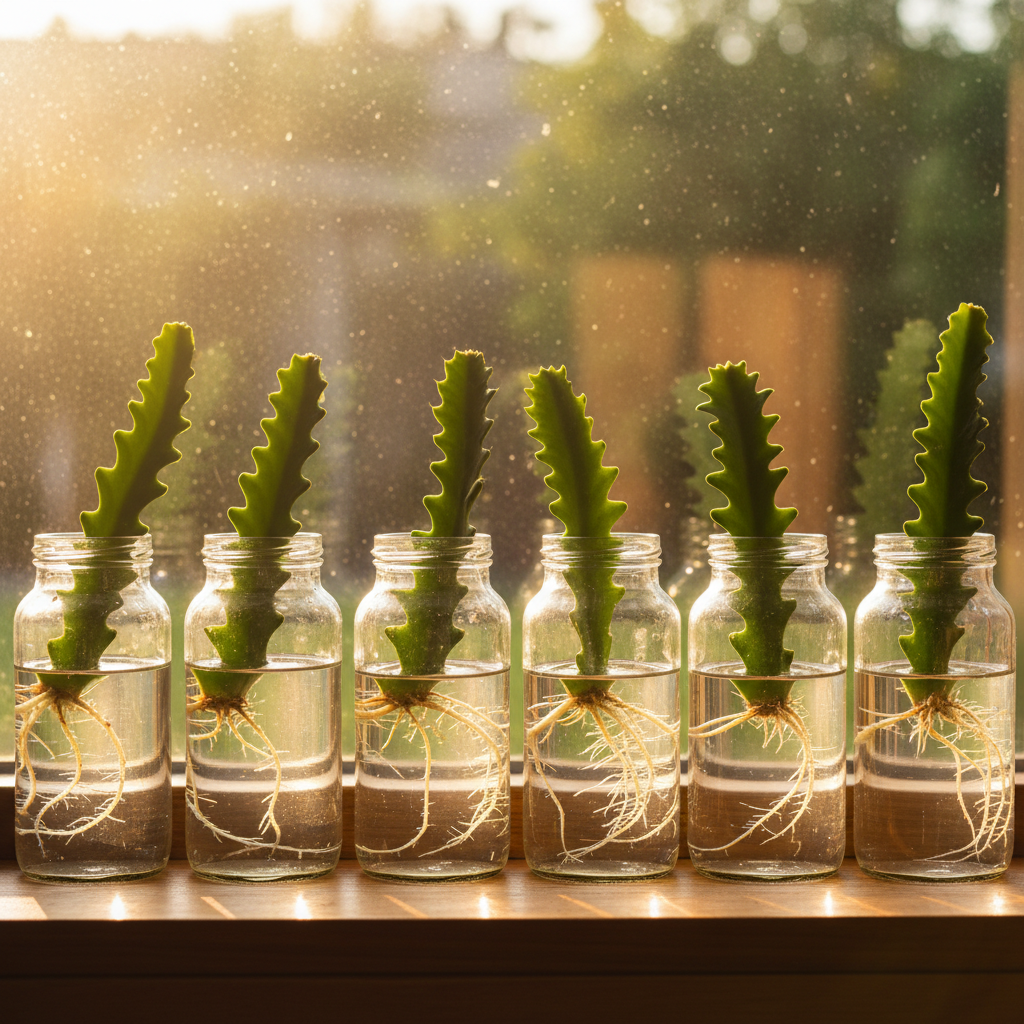
Water Rooting: Step-by-Step
Water rooting works particularly well for this plant because the stem segments hold enough internal moisture to support themselves for weeks while roots develop. The clear glass also makes it easy to monitor progress and remove any segment that begins to deteriorate before it can affect the others.
- Using a clean, sharp pair of scissors or secateurs, take a stem-segment cutting of 10 to 15 cm (4 to 6 inches), cutting at one of the natural constriction points between segments. Each cutting should contain at least three or four full zig-zag notches.
- Lay the cuttings on a clean surface in a warm, shaded spot for two to three days to allow the cut end to callous over. This step is essential; planting fresh-cut wet stems straight into water often introduces rot.
- Fill a clear glass jar with room-temperature filtered or rainwater and place the cuttings so that only the bottom one to two centimetres sits below the water line, with the rest of the stem in air.
- Position the jar on a bright windowsill that gets indirect light, and change the water once a week to keep it fresh and prevent algae or bacterial growth.
- Within two to four weeks you should see fine white roots emerging from the cut end and from any submerged areoles.
- Once the roots are two to three centimetres long, transfer each cutting into a small pot of fresh, very well-draining mix. Keep the substrate just barely moist for the first two weeks while the water roots adapt to soil conditions.
Pro Tip — Plant in a Group: A single trailing stem in a pot looks sparse for the first year. To get a fuller plant faster, root three or four cuttings together and pot them up in the same small container; they will grow as a clump and look like a mature specimen within twelve months rather than two to three years. The plants do not compete in a damaging way at this size.
Direct Soil Rooting: Step-by-Step
Soil rooting skips the awkward water-to-soil transition and tends to produce a sturdier root system from the start. It does take patience: progress is invisible for the first few weeks, and the temptation to check on the cuttings by tugging at them is the most common cause of failure.
- Take cuttings exactly as for water rooting (clean cut, 10 to 15 cm, including several notches) and leave them to callous for two to three days on a clean dry surface.
- Fill a small pot with a free-draining cutting mix: roughly equal parts of perlite, fine orchid bark and a little coco coir or peat works well. Avoid putting cuttings into regular potting mix or anything with high nitrogen.
- Push the calloused end of each cutting one to two centimetres into the mix, deep enough to stand upright without support. A pencil or chopstick can help make a snug planting hole.
- Mist the mix lightly to settle it around the cutting; do not soak. The substrate should feel slightly moist but not wet.
- Place the pot in a warm spot with bright indirect light and resist watering for the first week. After that, water sparingly only when the top of the mix is dry to the touch.
- After four to six weeks, gently tug on a cutting; if it resists, roots have formed and you can start treating it as a regular plant. If it lifts out, replace it and wait another two weeks.
Troubleshooting Propagation
| Problem | Likely Cause | Solution |
|---|---|---|
| Cutting rotting in water within the first week | Cut end was not allowed to callous before being submerged | Discard, take a fresh cutting and let it dry for three days before placing in water |
| No roots after six weeks in water | Light too low, water too cold, or cuttings too small | Move to a brighter spot, ensure the room is above 18 degrees C (65 degrees F), use longer cuttings with more areoles |
| Soil-rooted cutting turning soft at the base | Substrate too wet, too dense, or watered too often early on | Reduce watering, switch to a chunkier cutting mix, and ensure the pot has multiple drainage holes |
| Cutting wrinkling but not rotting | Normal water loss while roots establish; the segments draw on internal moisture | Continue care as normal; the cutting will plump up again once roots take in water |
Pests & Diseases
The Ric Rac Cactus is comparatively pest-resistant by houseplant standards, partly because its waxy stem surface is harder for sap-sucking insects to colonise than soft thin leaves, and partly because its open trailing habit gives good airflow around every stem. Problems that do appear are almost always traceable to either a recently introduced new plant that brought the pest with it or to a stressed Ric Rac Cactus weakened by overwatering, root rot or low humidity.
Routine checking is the single most useful habit. Once a week, when you assess whether to water, take thirty seconds to look closely at the undersides of stems and at the notches along the edges, where insects tend to congregate. Most infestations are easy to clear when caught early and very stubborn once entrenched.
Common Pests
Mealybugs (Pseudococcidae)
The most frequent pest on this plant. Mealybugs appear as small, soft, white, waxy lumps that look almost like specks of cotton wool, tucked into the notches of the stems and around the base. They suck sap, weaken stems and excrete sticky honeydew that encourages sooty mould.
Treatment: Dab visible insects with a cotton bud dipped in 70 percent isopropyl alcohol, which dissolves their waxy coating and kills them on contact. Follow with a thorough spray of insecticidal soap or neem oil solution every five to seven days for three weeks, paying particular attention to the notches and to any new growth.
Scale Insects (Coccoidea)
Small, oval, brown or tan bumps fixed firmly to the stems, often along the spine of a segment. They look more like part of the plant than an animal, which is part of why they are easy to miss until populations build. Like mealybugs, they suck sap and produce honeydew.
Treatment: Scrape adults off carefully with a fingernail or the back of a knife. Then spray the whole plant with horticultural oil, which smothers the protective shells. Repeat every two weeks for at least three cycles to catch newly hatched crawlers, which are the only vulnerable life stage.
Spider Mites (Tetranychus urticae)
Tiny, almost invisible mites that thrive in dry, dusty conditions. The first sign is usually fine pale stippling on the stems and, on close inspection, gossamer webbing in the notches and across the growing tips. Severe infestations cause general dulling and a sickly grey-green cast to the plant.
Treatment: Increase humidity around the plant, as spider mites struggle in moist air. Shower the plant gently in lukewarm water in a sink to dislodge them, then spray with neem oil or a miticide every five days for two to three weeks. Treat any neighbouring plants at the same time, since mites spread invisibly on air currents.
Fungus Gnats (Bradysia spp.)
Small grey-black flies that drift up from the substrate when disturbed. Adults are mostly a nuisance, but their larvae feed on root tissue and on the organic matter in the mix, weakening young plants and recent cuttings in particular.
Treatment: Let the top three centimetres of the mix dry out fully between waterings, which destroys the moisture-dependent larvae. Top the soil with a centimetre of dry sand or grit to deter egg-laying, and use yellow sticky traps to catch adults. For persistent infestations, drench the mix with a solution containing Bacillus thuringiensis israelensis, which is harmless to plants and pets but specifically targets gnat larvae.
Common Diseases
Root Rot (Pythium and Phytophthora spp.)
The leading cause of Ric Rac Cactus death, caused by water moulds that thrive in waterlogged substrate. Roots turn brown and mushy, the stem base softens and blackens, and the rot creeps upward through the plant. Caught early it is treatable; caught late it is usually fatal to the parent plant, though salvaged cuttings can be re-rooted.
Treatment: Unpot immediately, wash away all old mix, cut off every rotted root and any blackened stem tissue with a clean blade until only firm green stem and white root remain. Dust the cut surfaces with cinnamon as a mild antifungal, let them callous for two or three days, and re-root the healthy portions as if they were cuttings. Repot in fresh dry mix and water sparingly until new growth confirms recovery.
Bacterial Stem Rot (Erwinia spp.)
A fast-moving rot that appears as a slimy, blackened patch on a stem, often near a wound or where two stems have rubbed together. Unlike fungal rot, the affected tissue smells sour and the rot can advance by several centimetres a day, so prompt action is essential.
Treatment: Cut the affected stem off well below the visible damage, into clearly healthy green tissue. Sterilise the blade between cuts with alcohol to avoid spreading bacteria. Discard the cut sections rather than composting them, and dust the wound on the parent plant with cinnamon or a sulphur powder. Reduce humidity and improve airflow around the plant while it heals.
Pest and Disease Summary
| Pest / Disease | Identification | Treatment |
|---|---|---|
| Mealybugs | White cottony lumps in notches and stem bases | Alcohol on cotton bud, then insecticidal soap or neem every week for three weeks |
| Scale insects | Brown bumps along stems, sticky honeydew | Scrape off, spray horticultural oil, repeat every fortnight for three cycles |
| Spider mites | Pale stippling on stems, fine webbing in dry conditions | Raise humidity, rinse plant, treat with neem oil every five days |
| Fungus gnats | Small flies near soil, larvae in damp mix | Dry out top of mix, sand top layer, yellow sticky traps, Bt-i drench |
| Root rot | Mushy roots, black soft stem base, sour smell | Unpot, remove all rotted tissue, callous, re-root in fresh dry mix |
| Bacterial stem rot | Slimy black patch on stem, sour smell, spreads quickly | Cut well below damage with sterile blade, dust wound, reduce humidity |
Prevention Strategies
The most effective pest and disease prevention is good basic care. A Ric Rac Cactus in correct light, watered sensibly, in a free-draining mix and not crowded against other plants has all of the natural defences it needs. Pests gain a foothold mostly on stressed plants, and rot takes hold mostly in suffocated roots. Address those underlying conditions and you rarely need to treat anything at all.
Quarantine new plants for at least two weeks before placing them next to an established Ric Rac Cactus, and inspect them carefully before integrating. Avoid reusing old potting mix between plants, especially if any of them showed signs of rot or pest activity. Clean tools between cuts when pruning or propagating, and remove any fallen stems or dead tissue from around the base of the plant rather than letting it sit and break down in place.
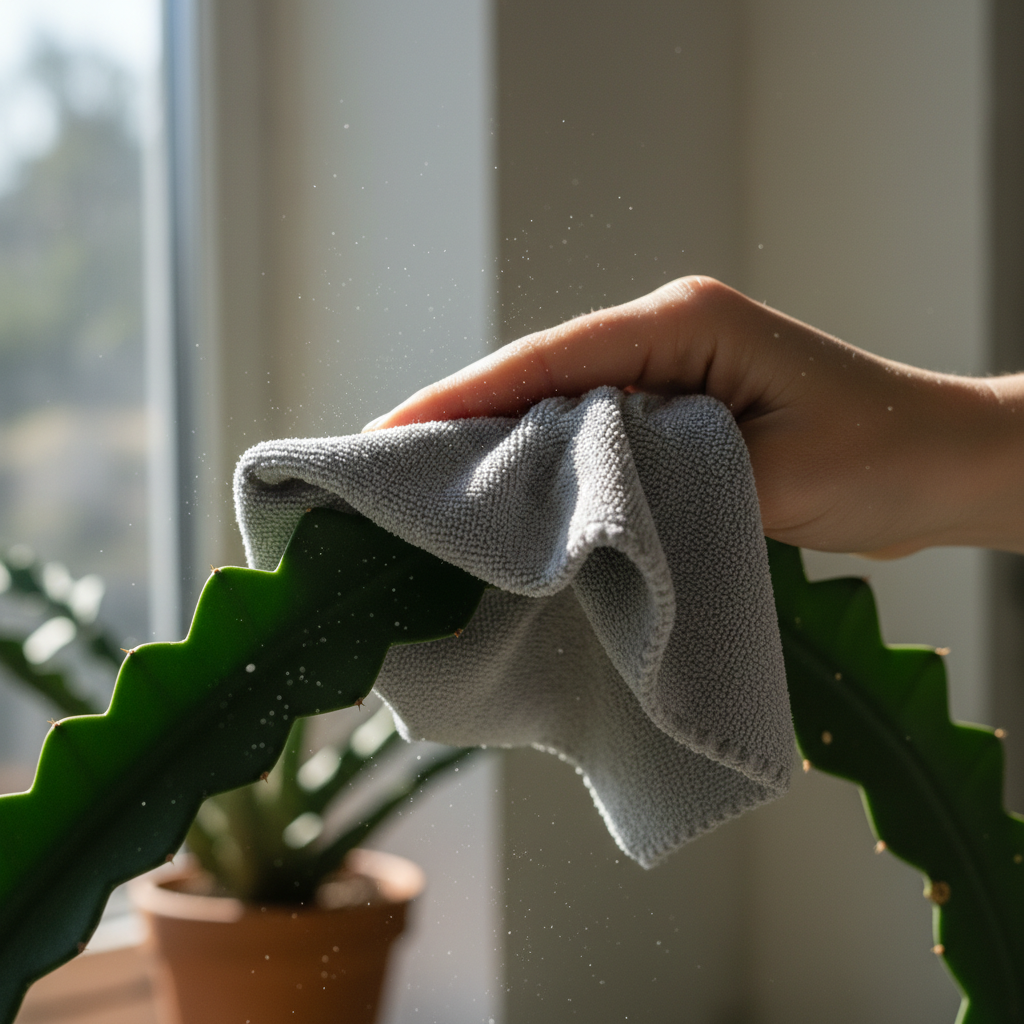
Pro Tip — Weekly Wipe-Down: Wipe each main stem with a damp microfibre cloth once a week as part of your watering routine. This single habit removes dust that would otherwise reduce photosynthesis, dislodges pests before they can establish, and gives you a close-up look at every part of the plant where trouble usually starts. A five-minute wipe is the simplest and most effective preventive measure in houseplant care.
Popular Varieties
Strictly speaking, Disocactus anguliger is sold almost exclusively as the wild species; named cultivars are rare and the major commercial differences between plants of this species reduce to size, vigour and the regularity of stem notching. What you do find in the trade, however, is a small cluster of closely related epiphytic forest cacti that are often sold under overlapping common names and grouped together under the broad label of Fishbone, Zig Zag or Ric Rac cacti.
The most important of these is Selenicereus anthonyanus, often labelled as the Anthonyanus Fishbone Cactus and sometimes sold simply as Ric Rac. Beyond that, the wider Epiphyllum group contains several other trailing forest cacti whose care is almost identical to Disocactus anguliger and which are worth knowing if you grow this plant. The table below summarises the most commonly encountered.
| Variety | Leaf Appearance | Light Needs | Growth Rate | Availability |
|---|---|---|---|---|
| Disocactus anguliger | Classic deep zig-zag stems, mid-green, moderate width | Bright indirect | Moderate | Common |
| Selenicereus anthonyanus | Deeper, broader notches, longer trailing habit, larger night flowers | Bright indirect | Vigorous | Common, often mislabelled |
| Epiphyllum oxypetalum (Queen of the Night) | Flat strap-like stems without zig-zag, very large fragrant white blooms | Bright indirect to part sun | Vigorous | Common |
| Epiphyllum hookeri | Long arching flat stems, faintly scalloped edges, white nocturnal flowers | Bright indirect | Moderate | Specialist |
| Disocactus ackermannii | Long flat stems, bright orange-red day-blooming flowers | Bright indirect to part sun | Moderate | Specialist |
| Rhipsalis spp. | Pencil-thin trailing stems, tiny pale flowers, distinct from zig-zag types but often grown together | Bright indirect | Slow | Increasingly common |
Featured Varieties
Anthonyanus Fishbone Cactus
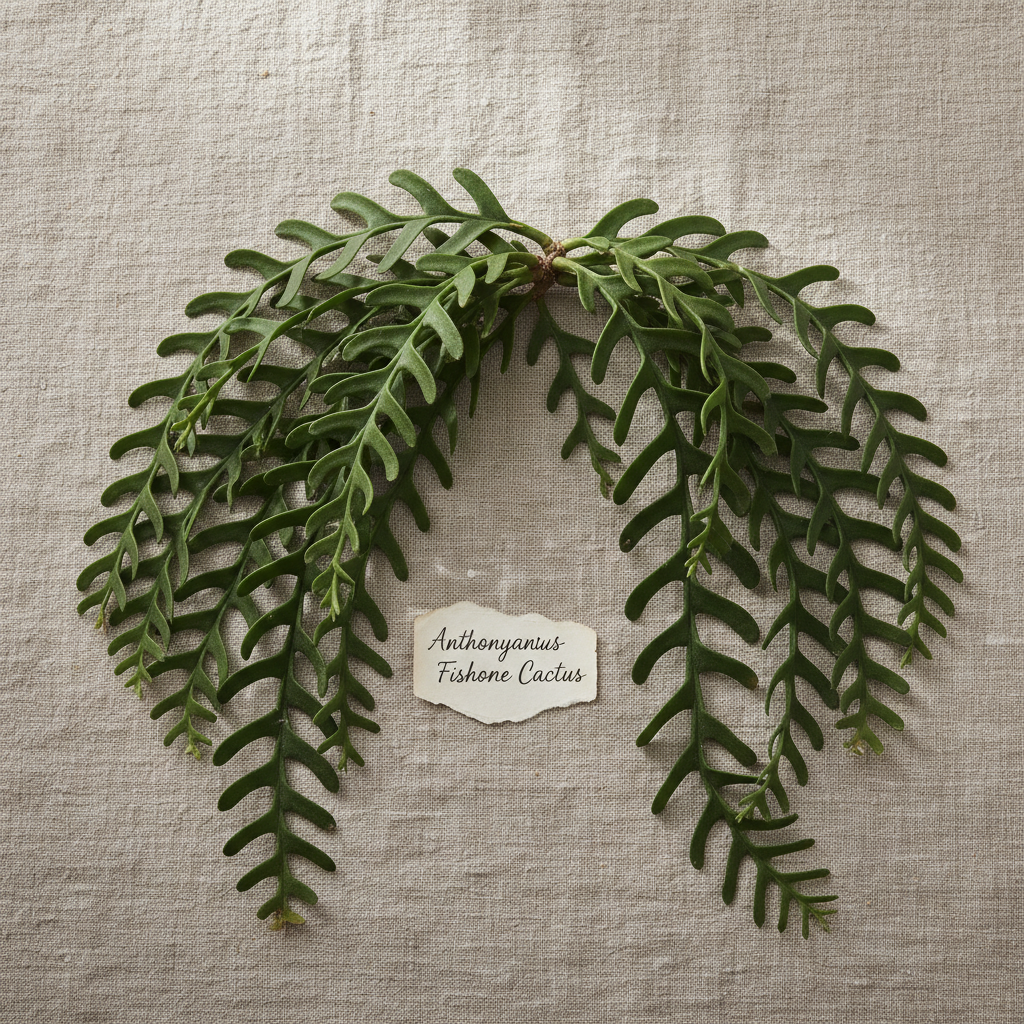
Often sold under the same common names as Disocactus anguliger, this close relative (Selenicereus anthonyanus) is distinguished by deeper and more dramatically toothed notches, broader stems and a more vigorous trailing habit. Its nocturnal flowers are larger and showier, opening in late summer or autumn.
Queen of the Night (Epiphyllum oxypetalum)
A close epiphytic relative with long, flat, strap-like stems lacking the zig-zag notches but famous for enormous fragrant white flowers that open for a single night each year. Care is essentially the same as for the Ric Rac, and the two make beautiful companions in a forest-cactus collection.
Variety Profiles in Detail
Anthonyanus Fishbone Cactus (Selenicereus anthonyanus)
The plant most often confused with Disocactus anguliger, and arguably the more dramatic of the two in cultivation. The stems are broader, can grow to a metre or more in trail, and the lateral notches go deeper, sometimes nearly to the central spine, giving the plant a bolder zig-zag profile. It flowers more reliably indoors, producing large pinkish-cream nocturnal blooms that release a faint fragrance. Care is identical to D. anguliger, although its more vigorous growth means it may need annual rather than triennial repotting.
Queen of the Night (Epiphyllum oxypetalum)
One of the most famous nocturnal flowers in horticulture, blooming for a single night a year (or rarely a few nights across a season) with enormous, intensely fragrant white trumpets. Its stems are smooth, flat and strap-like rather than zig-zagged, and the plant grows much larger than the Ric Rac, often requiring substantial trellising or a sturdy hanging position. Worth growing alongside D. anguliger for the dramatic contrast in stem shape and for the unforgettable annual flowering event.
Epiphyllum hookeri (Epiphyllum hookeri)
A less common but elegant species with long, arching flat stems carrying faint scalloped edges rather than full notches. The white nocturnal flowers are smaller than those of E. oxypetalum but appear more freely, often over several nights. Best suited to growers with a slightly larger hanging space; the plant can reach over a metre in length.
Orchid Cactus (Disocactus ackermannii)
One of the few day-blooming members of this group, with striking orange-red flowers held against long flat green stems. Despite the common name overlap with Disocactus anguliger, this is a distinct species and the two should not be confused on labels. Care is similar but the plant appreciates slightly brighter light to bloom well, including a few hours of gentle direct morning sun.
Choosing the Right Variety for Your Space
For most growers and most rooms, the classic Disocactus anguliger is the right pick: its compact trailing habit suits standard pots and shelves, its zig-zag shape is the most distinctive in the group, and its modest size makes it easy to live with. If you have a generous overhead spot, want bolder stems and are willing to manage more vigorous growth, the Anthonyanus Fishbone Cactus is the natural step up. For a real showpiece and an annual flowering event, add an Epiphyllum oxypetalum to the collection. All three plants take essentially the same care, so growing them together is straightforward and rewarding.
Frequently Asked Questions
Why is my Ric Rac Cactus not flowering?
Indoor flowering on Disocactus anguliger requires three ingredients: a mature plant of at least two to three years old, consistently bright indirect light through spring and summer, and a cool, drier autumn rest of six to eight weeks where night temperatures dip toward 10 to 13 degrees C (50 to 55 degrees F) and watering is much reduced. Plants in steady warm rooms watered all year rarely bloom, even when otherwise healthy. Reproducing the seasonal swing is the single most reliable trigger.
Why are the stems turning yellow?
Yellowing most often signals either too much direct sun or overwatering. If only the older lower stems near the soil are yellowing while new growth looks normal, suspect root issues and check the substrate and pot drainage. If yellowing is concentrated on the stems most exposed to a sunny window, the plant is being burnt; move it back from the glass or add a sheer curtain.
Why are the stems wrinkled?
Wrinkling almost always means thirst or, less commonly, root damage preventing water uptake. Check the soil: if it is dry, water thoroughly and the stems usually plump up within twenty-four hours. If the soil is still damp but the stems are wrinkled, the roots are probably compromised by rot and the plant cannot move water up regardless of supply. In that case, unpot, inspect and treat as for root rot.
Can I hang my Ric Rac Cactus outdoors in summer?
Yes, and the plant often thrives outside between late spring and early autumn provided night temperatures stay above 12 degrees C (54 degrees F). Place it in deep shade or under filtered light from a tree canopy; even mild direct sun outdoors is far stronger than the brightest indoor spot and will scorch the stems within hours. Bring the plant back indoors before nights start to drop into single digits.
Is the Ric Rac Cactus safe for pets?
It is widely listed as non-toxic to cats and dogs, and the ASPCA includes it on safe-plant lists. The sap is not irritating to skin in the way some other cacti and euphorbias are. Stems do snap easily, however, and the breakage points can stain fabric; positioning trailing growth out of bumping or chewing range still pays off practically even when there is no toxicity concern.
How big does a Ric Rac Cactus get?
Indoors, mature trailing stems typically reach 60 to 90 cm (2 to 3 feet) in length, with exceptional specimens passing a metre. Growth is concentrated outward and downward rather than upward, so the plant does not outgrow most rooms. In ideal conditions it forms a curtain of zig-zag stems cascading from a hanging basket or shelf edge, with new segments adding length year on year.
How long does a Ric Rac Cactus live?
With good care, individual plants can live for decades, and there are records of specimens passed between gardeners for more than fifty years. Because the plant propagates so easily from stem-segment cuttings, the practical lifespan is functionally unlimited: even if a parent plant is eventually lost, fresh cuttings rooted along the way carry the line forward.
Why do the notches look shallow on new growth?
Shallow, elongated new growth almost always indicates insufficient light. The plant stretches toward whatever light is available and stops investing energy in the deep notch pattern, since broader uniform stems gather more light per centimetre. Move the plant a step closer to the window or supplement with a grow light, and within a season fresh growth should return to the classic zig-zag.
Should I prune my Ric Rac Cactus?
Pruning is optional and mostly aesthetic. You can trim stems back to encourage branching at the cut point, control the size of a plant that has become unruly, or simply harvest cuttings for propagation. Use a clean sharp blade, cut at a natural constriction between segments, and let the cut surface dry for a day before treating it like a regular stem. The plant tolerates pruning well at any time of year, but spring cuts heal and respond fastest.
Can I grow a Ric Rac Cactus from seed?
It is possible but rarely worthwhile. Seeds require successful pollination of the short-lived nocturnal flowers, then months of careful germination in sterile conditions, and seedlings take three or more years to reach a recognisable Ric Rac shape. Stem-segment cuttings give you the same result in a matter of weeks and are genetically identical to the parent. Unless you are breeding for new traits, propagation by cuttings is the obvious choice.






