
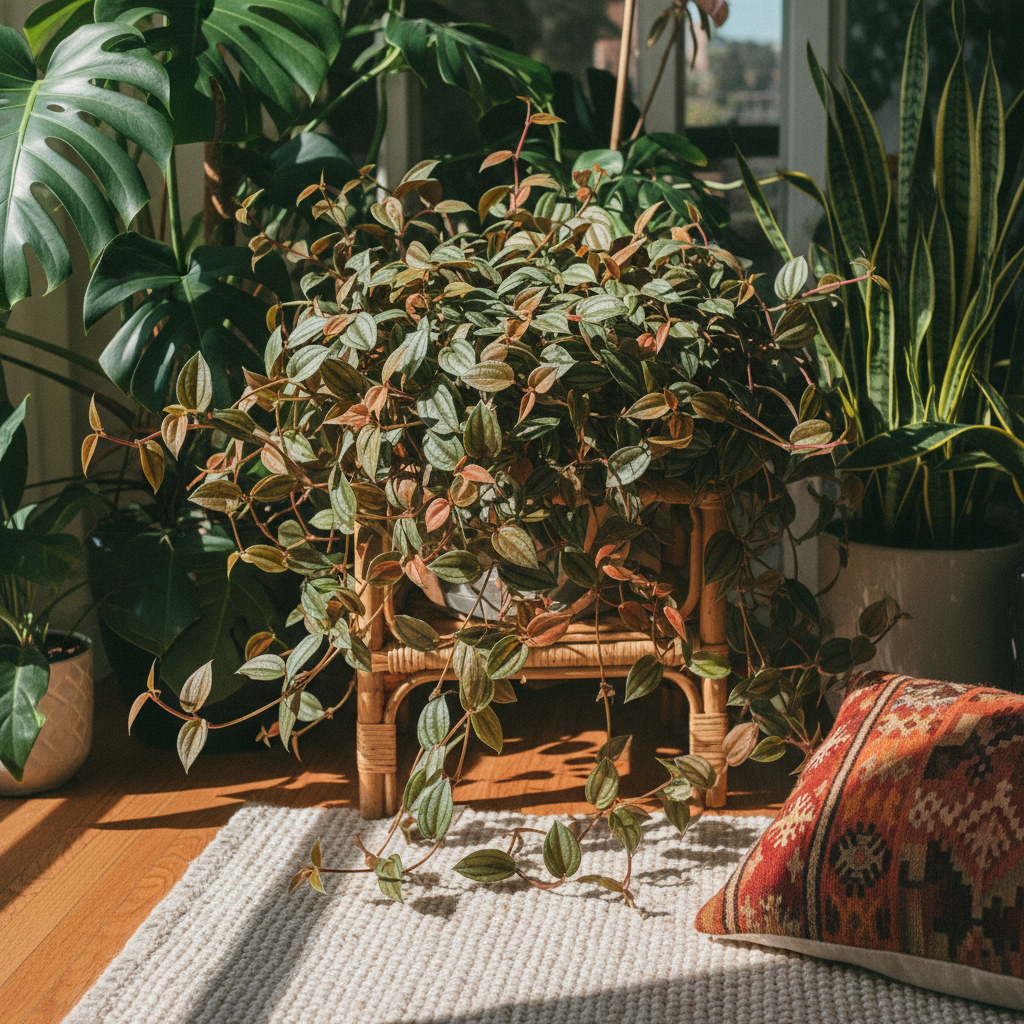
The aluminum vine, known botanically as Pellionia repens, is one of those quietly compelling houseplants that most people meet for the first time tucked into the floor of a terrarium kit, half-hidden beneath a fern, before realising it deserves a stage of its own. Sold under a confusing roll-call of common names, including trailing watermelon begonia, polynesian ivy, rainbow vine and trailing pellionia, it is in fact none of those things botanically. It is a low-growing creeper in the nettle family (Urticaceae), the same family that gave us the much-loved Pilea peperomioides, and it comes from the humid understory of Vietnam, Burma, southern China and the Malay Peninsula.
What sets the aluminum vine apart from its better-known relatives is its leaf colour. Each oval leaf, rarely longer than four centimetres (1.6 inches), is painted in a band of warm bronze or coppery green down the middle, framed by a darker olive-to-black margin and crossed by a faint silvery iridescence along the central vein. The reddish, fleshy stems trail and root at every node, so a single small pot quickly becomes a soft cascading mat. As a houseplant the aluminum vine has a reputation for being a little fussy about humidity but otherwise forgiving, and it rewards attentive care with a remarkable amount of bronze foliage from a very small footprint. This guide covers everything required not just to keep the plant alive, but to help it spread and shine the way it does in its native rainforest.
Contents
- Quick Reference
- Why Aluminum Vine Makes a Distinctive Houseplant
- Light Requirements
- Watering & Humidity
- Soil, Potting & Repotting
- Fertilising
- Propagation
- Pests & Diseases
- Popular Varieties
- Frequently Asked Questions
Quick Reference: Aluminum Vine at a Glance
| Light | Bright indirect light; tolerates medium light. No direct sun beyond brief early morning rays. |
| Watering | Keep evenly moist but never soggy. Water when the top 1 to 2 cm of substrate feel barely dry to the touch. |
| Temperature | 18 to 27 degrees Celsius (65 to 80 degrees Fahrenheit). Avoid anything below 15 degrees Celsius (59 degrees Fahrenheit). |
| Humidity | High, ideally 60 to 80 per cent. Thrives in terrariums; struggles below 50 per cent for long periods. |
| Fertiliser | Balanced liquid feed at quarter to half strength every three to four weeks in spring and summer. |
| Toxicity | Considered non-toxic to cats and dogs. Most reputable veterinary toxicology databases list Pellionia as safe, though casual nibbling is still best discouraged. |
Why Aluminum Vine Makes a Distinctive Houseplant
Most popular trailing houseplants belong to a small handful of genera: pothos, philodendron, tradescantia, hoya. The aluminum vine sits outside all of them, a small understory creeper from the nettle family that brings something distinctly different to a plant collection. Its leaves are tiny by comparison with a heartleaf philodendron or a satin pothos, and that is precisely the point. Where most trailing plants ask for vertical space and read as bold green silhouettes, Pellionia repens works as ground cover, edge softener and textural detail. It is the plant you tuck around the base of a taller specimen, or run along the front of a shelf, or use to soften the lip of a terracotta pot containing something architectural like a sansevieria.
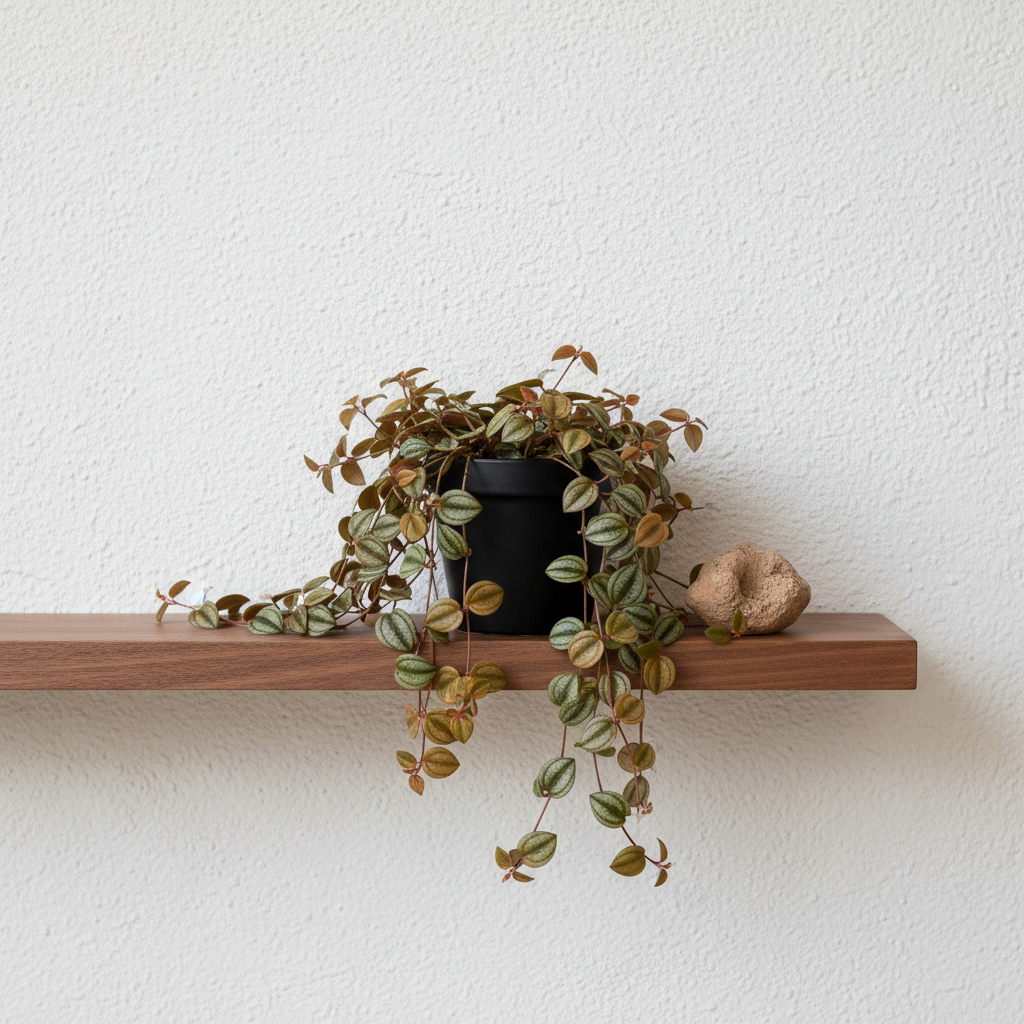
The colour story is the second reason to grow it. A close inspection of a healthy leaf reveals at least five tones: the bronze centre band, the dark olive margin, the silvery sheen along the midrib, the rosy underside that shows whenever a stem twists, and the deep red of the petioles and young stems themselves. Few houseplants pack this much variation into leaves the size of a thumbnail. In a mixed bowl with brighter-leaved species like a button fern or a baby’s tears, the aluminum vine reads as the moody, warm-toned anchor that grounds the composition.
The third reason is practical: it is one of the easiest trailing plants to propagate. Stems root so readily at the nodes that a damp scrap of moss and a closed plastic bag are usually all that is required. A single mature plant supplies an indefinite number of giveaways for friends and a steady supply of new material for terrariums and dish gardens.
Important – Toxicity: Pellionia repens is generally classified as non-toxic to cats, dogs and humans, and most veterinary toxicology resources do not list it as a problematic plant. That said, no plant is genuinely food, and the trailing habit puts the foliage right at floor and pawing height. Place it where curious pets cannot make chewing on it a regular habit.
Light Requirements
In its native habitat the aluminum vine grows along the forest floor of humid Southeast Asian rainforests, beneath a closed canopy that filters and diffuses sunlight before it ever reaches the leaves. The light that does arrive is dappled, soft and constantly changing as branches shift overhead. Recreating an approximation of those conditions indoors is the single most useful thing a grower can do, because every other care decision flows from how much light the plant is receiving.
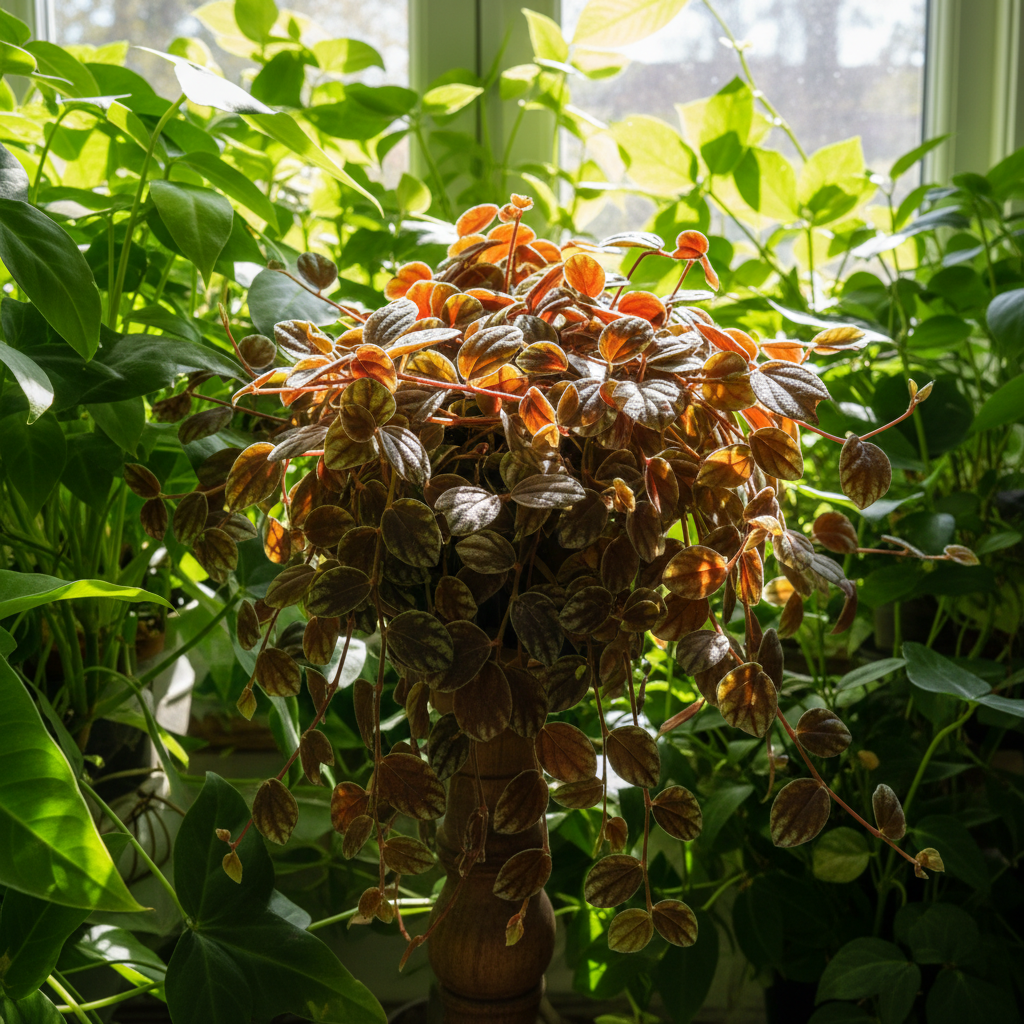
The ideal indoor placement is bright indirect light, the kind of position that is clearly illuminated and reads as a bright room to the eye, but where direct sun never lands on the leaves for more than a few minutes at a time. Set back a metre or so from a south-facing window, immediately beside an east-facing window, or close to a north-facing window in a bright room are all good options. The plant will also tolerate medium light, growing more slowly and producing slightly larger but more spaced-out leaves. What it will not tolerate well is harsh, direct, prolonged sunlight, which scorches the thin leaf tissue and bleaches the bronze pigments to a flat, washed-out green.
Light Levels Explained
Indoor light levels are surprisingly hard to judge by eye. A spot that looks bright at midday on a summer afternoon may sit at fern-level dimness on a January morning. The table below offers approximate ranges in lux to help calibrate placement, alongside the typical outcomes for the aluminum vine in each tier.
| Light Category | Approx. Level | Typical Location | Outcome |
|---|---|---|---|
| Direct sun | 30,000 lux and above | On a south or west windowsill at midday | Leaves scorch, bronze bleaches to dull green within days. |
| Bright indirect | 10,000 to 20,000 lux | One metre from a south window, or beside an east window | Best growth, deepest leaf colour, fastest trailing. |
| Medium indirect | 2,500 to 10,000 lux | Two to three metres from a bright window, or close to a north window | Slower growth, slightly leggier stems, but healthy plant. |
| Low light | 500 to 2,500 lux | Deeper in a room, away from windows | Survives a few months but stretches; bronze fades. |
| Very low | Under 500 lux | Hallways, rooms without windows | Will decline over weeks. Not viable long-term. |
Window Orientation and Placement
South-facing window: Bright but usually too intense at the glass itself. Place the plant at least a metre back, or filter the light through a sheer curtain. A south-facing window two rooms deep gives lovely soft light if the doors are open.
East-facing window: The best single placement. Morning light is gentle and warm, and by midday the sun has moved past, leaving bright but indirect light for the rest of the day. The plant can sit very close to the glass.
West-facing window: Tricky in summer because the afternoon sun is hot. Set the plant back from the window, or filter with a sheer, or use the west window in winter and move it to a softer spot from late spring onward.
North-facing window: Works well in a bright room, especially one with pale walls that bounce light around. In a dim north-facing room the plant will survive but grow slowly and pale.
Pro Tip – Bronze as a Light Meter: The bronze band running down the centre of each leaf is unusually responsive to light. In high light it deepens to a warm copper, almost glowing. In low light it fades toward an unremarkable medium green within a few weeks. If colour starts to flatten, move the plant brighter before doing anything else.
How Light Affects Leaf Colour and Habit
The bronze and silvery markings of the aluminum vine are produced by structural and pigmentary responses to ambient light. Anthocyanins, the same family of pigments responsible for red autumn leaves, give the bronze its warmth and intensify under brighter conditions. The silvery sheen is partly structural: tiny air spaces in the upper leaf surface scatter light and produce the metallic effect. Both depend on the plant receiving enough light to make the investment worthwhile. In dim conditions the plant prioritises chlorophyll, which is green, and pulls back on the decorative anthocyanin layer. The result is paler, blander leaves and stems that stretch noticeably between nodes as the plant reaches for the window.
Warning – Direct Sunlight: Even a couple of hours of harsh midday sun through unfiltered glass can permanently scar the leaves. Damage shows as crisp tan or papery brown patches in the centre of leaves rather than at the edges. Once scorched, those leaves do not recover; new growth will be unaffected if light is corrected.
Artificial Lighting
The aluminum vine responds well to supplemental LED grow lights, which makes it a viable plant for dim flats and basement terrariums. A full-spectrum LED panel suspended thirty to forty centimetres above the foliage and running for ten to twelve hours a day is plenty. The leaves benefit from a colour temperature in the 4,000 to 6,500 kelvin range, which keeps the bronze pigments saturated without bleaching them. Cheap clip-on grow lamps work just as well as expensive setups for a plant this small, because total light output rather than fixture cost is what matters.
Seasonal Adjustments
In the northern hemisphere, daylight in midwinter can be half or less of midsummer’s intensity at the same window. A plant happy three metres from a south window in July may need to move within a metre of the same window in January simply to maintain growth. Rotate the pot a quarter turn each week so all sides get equal exposure; trailing plants are particularly prone to lopsided growth because the side facing the light fills out while the back goes bare.
Watering & Humidity
Watering is where most aluminum vines either die or stagnate, and it is also where the difference between surviving and thriving is most pronounced. The plant comes from constantly damp leaf litter and rotting wood on the rainforest floor, so it has never had to develop the drought tolerance of, say, a pothos or a sansevieria. Its small, thin leaves wilt within hours of the substrate drying out, and the wilt itself, while dramatic, is not always reversible. On the other hand, roots sat in saturated soil rot quickly, and the first sign is usually a sudden whole-plant collapse. The goal is consistent, light moisture: damp, never wet, and never bone dry.
How to Tell When to Water
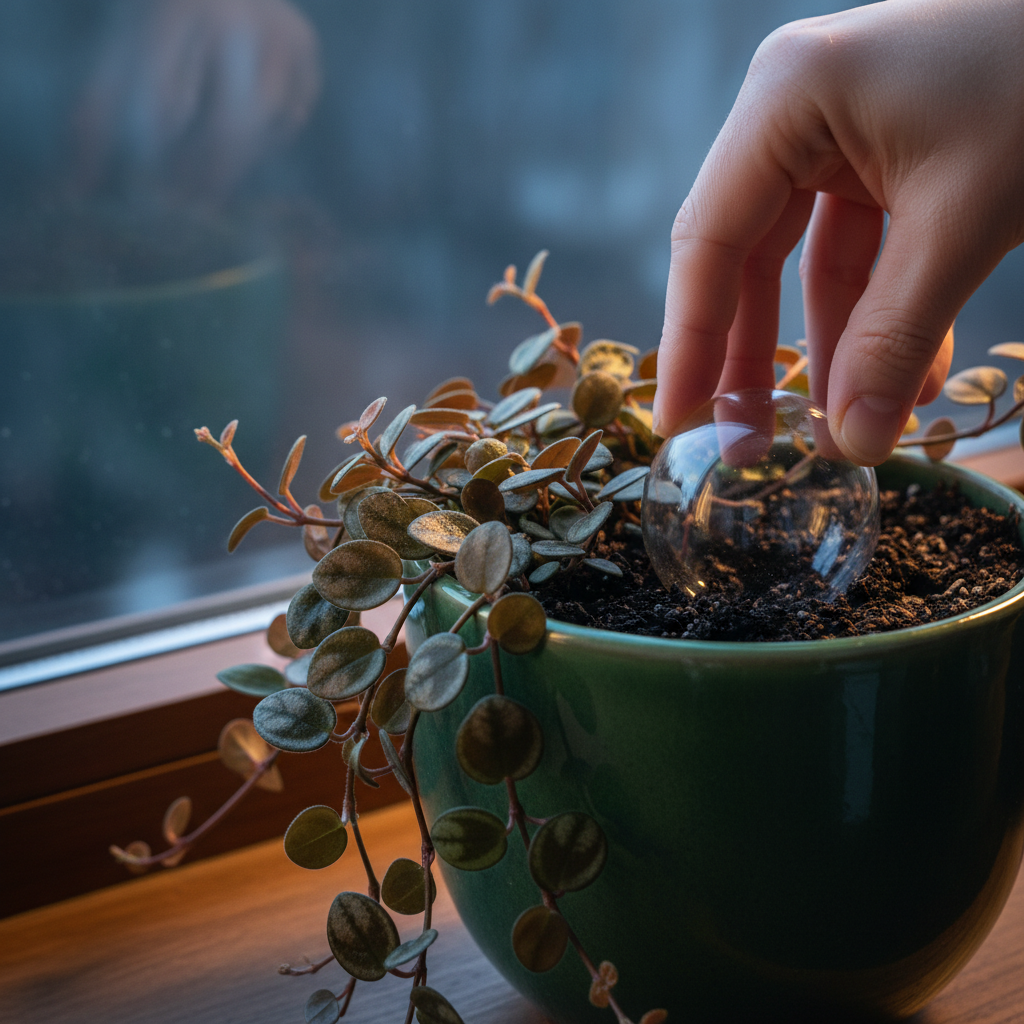
Forget any fixed weekly schedule. The best indicator is the substrate itself, checked by touch. Push a finger one to two centimetres into the mix and pay attention. If the surface feels barely cool and just a touch damp, wait. If it feels dry on the surface and only slightly cool a centimetre down, water. If you have to push deeper than two centimetres to find any moisture, the plant has already been too dry. A second useful indicator is pot weight: a freshly watered pot feels distinctly heavy compared to one that has dried; over a week or two a grower learns the heft of “ready to water” and can confirm by lifting.
How to Water
Water thoroughly each time. Take the pot to a sink and pour room-temperature water across the surface until it runs freely from the drainage holes, then let it sit for five to ten minutes to drain completely before returning to its saucer. A thorough soak followed by good drainage encourages roots to grow throughout the rootball and flushes out salts that accumulate from tap water and fertiliser. Light, frequent sips that wet only the surface produce shallow roots and a tired, declining plant.
Tap water is fine for most aluminum vines, though the plant prefers rain water or filtered water if the local supply is very hard or chlorinated. Leaving a jug of tap water out overnight allows chlorine to dissipate, though chloramine, which is increasingly common in municipal supplies, will not. If leaves start showing crispy brown tips that don’t track to any other cause, switch to rain water for a month and see whether new growth comes in cleaner.
Humidity: The Crucial Variable
If light is the single most important variable for leaf colour, humidity is the single most important variable for whether the plant looks lush or perpetually tired. Aluminum vines come from a habitat where ambient humidity rarely falls below 70 per cent and frequently saturates. Most indoor environments, particularly in winter when heating systems are running, drop to 25 to 40 per cent. At those levels leaf edges crisp, growth slows and the plant becomes a magnet for spider mites.
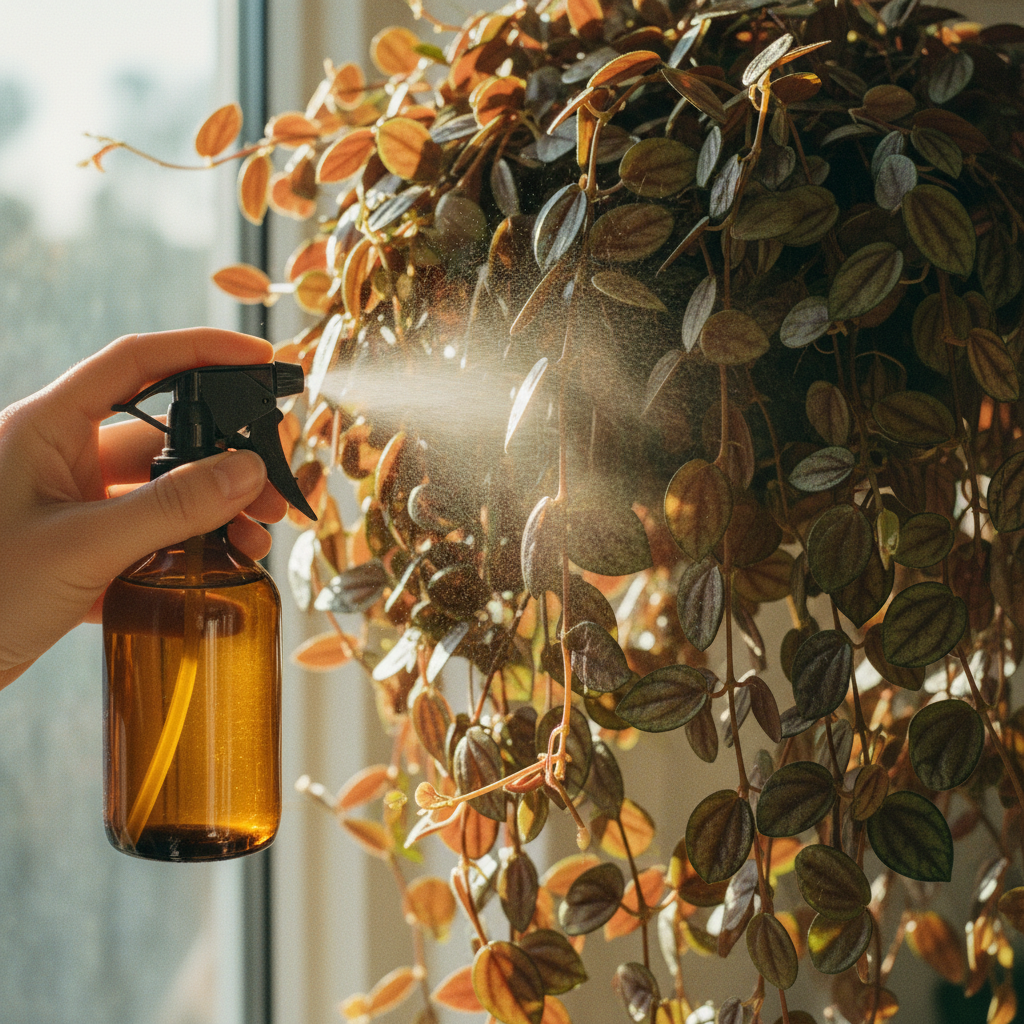
The reliable solution is to raise humidity locally rather than trying to mist the plant back to health every morning. A small ultrasonic humidifier running for a few hours a day in winter does the work of fifty mistings. A grouping of plants together creates a microclimate of mutual humidity. A pebble tray, where the pot sits on stones above a shallow reservoir of water, lifts local humidity by ten to fifteen per cent. And a closed glass cabinet or terrarium provides effectively unlimited humidity at the cost of needing to manage ventilation against fungal problems. For most homes a combination of grouping the plant with others and running a humidifier in the heating season is sufficient.
Pro Tip – Misting Is Not Enough: A few sprays of water from a bottle raise humidity for perhaps ten minutes before the moisture evaporates. Misting can be a useful supplement, especially if it includes a gentle leaf wipe, but it does not solve a dry-air problem on its own. If a plant is unhappy with humidity, the air around it needs to change, not just its leaves.
Recognising Watering Mistakes
Underwatered plants wilt visibly, with stems drooping and leaves losing their slight shine. The substrate pulls away from the sides of the pot. Recovery from mild underwatering is usually quick: a slow soak in a bowl for fifteen minutes will revive a wilted plant within a few hours. Overwatering is more sinister because the early symptoms look almost identical to underwatering. A plant whose roots have rotted cannot take up water, so the leaves wilt as if drought-stressed. The substrate, however, is still wet, sometimes with a slightly sour smell. If a wilted aluminum vine has saturated soil and softened, yellowing lower leaves, the cause is almost certainly root rot rather than thirst, and the response is to unpot, inspect the roots, trim away anything black and mushy, and repot into fresh damp mix in a smaller pot.
Soil, Potting & Repotting
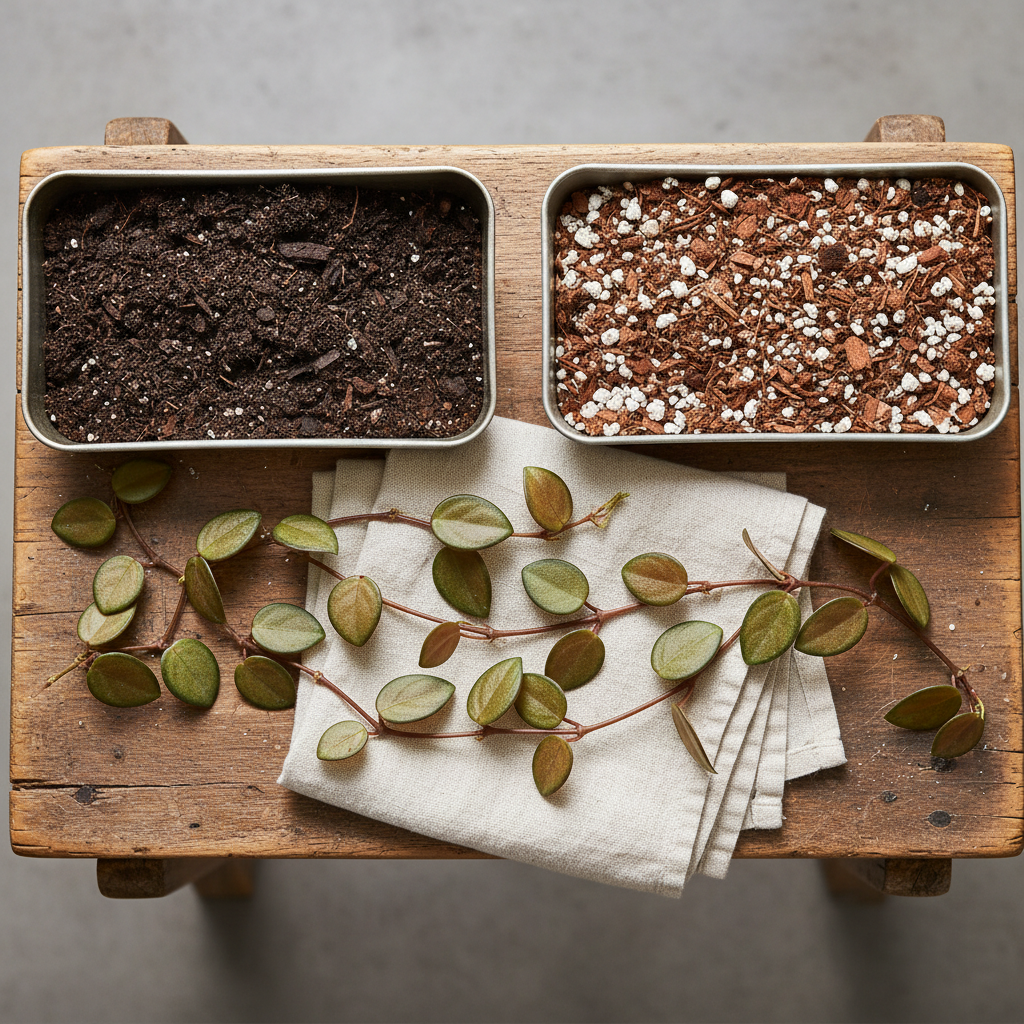
The aluminum vine wants a substrate that holds moisture without compacting into a sodden lump. In nature it roots into a loose blanket of leaf mould, mossy bark and decomposing wood, which manages the trick of staying constantly damp while remaining well aerated. The best indoor analogue is a peat-based or coir-based potting mix amended with substantial perlite and a little orchid bark or composted bark fines.
A Reliable Mix
A simple recipe that works well for most homes is four parts standard houseplant potting compost, two parts coarse perlite and one part fine orchid bark or composted bark fines. The compost provides moisture retention and a base of nutrients; the perlite keeps the mix from collapsing into a dense block; the bark introduces structural pockets of air that mimic the loose forest floor. A small handful of horticultural charcoal, if available, helps absorb trace impurities and keeps the substrate sweet. Avoid heavy, peat-only multipurpose composts straight from the bag; they hold too much water for a plant this small.
For terrarium plantings, where drainage is by definition limited, a sphagnum-heavy mix works better. Two parts long-fibred sphagnum moss to one part orchid bark to one part perlite creates a substrate that wicks moisture evenly and stays oxygenated. A thin layer of clay gravel or LECA at the very bottom of the terrarium adds a small drainage reservoir that prevents the substrate from going anaerobic.
Pot Choice
The aluminum vine has a shallow, fibrous root system rather than the deep tap roots of a larger plant. A wide, shallow pot suits it better than a tall, narrow one, both for the look of the trailing foliage and for the health of the roots. Terracotta works well because it breathes and releases excess moisture from the sides, which suits a plant that dislikes saturated soil. Glazed ceramic, plastic and resin all work too; the trade-off is that they retain more water, so the substrate dries more slowly and watering frequency drops accordingly. A drainage hole is non-negotiable. Decorative pots without holes can be used as outer cachepots around a plastic nursery pot, but the plant should never sit directly in a sealed vessel.
When and How to Repot
Aluminum vines are slow to fill a pot and slower still to suffer from being root-bound, so annual repotting is unnecessary. Every two to three years, in spring as new growth resumes, lift the plant out and inspect the roots. If they have started circling the pot or the substrate has visibly broken down into a dense, fine textureless block, repot. The new pot should only be one size larger, perhaps two centimetres wider in diameter, since a small plant in a large pot of damp substrate is the classic recipe for root rot.
To repot, gently squeeze the sides of the old container to loosen the rootball, slide it out, and tease away as much of the old substrate as comes away easily without yanking roots. Trim any roots that are obviously dead, dark and mushy. Settle the plant into fresh mix in the new pot at the same depth it sat before; the small reddish stems should rest just at substrate level, not buried. Water lightly to settle the mix and keep the plant in slightly lower light for a week or so as it recovers.
Fertilising
The aluminum vine is not a heavy feeder. Its rainforest-floor habitat is rich in slow-release organic nutrients from decomposing leaf litter but never in concentrated bursts of soluble salt. The most reliable indoor approach mirrors that pattern: a small, frequent dose of dilute balanced fertiliser during the growing season, nothing during winter dormancy.
What to Feed
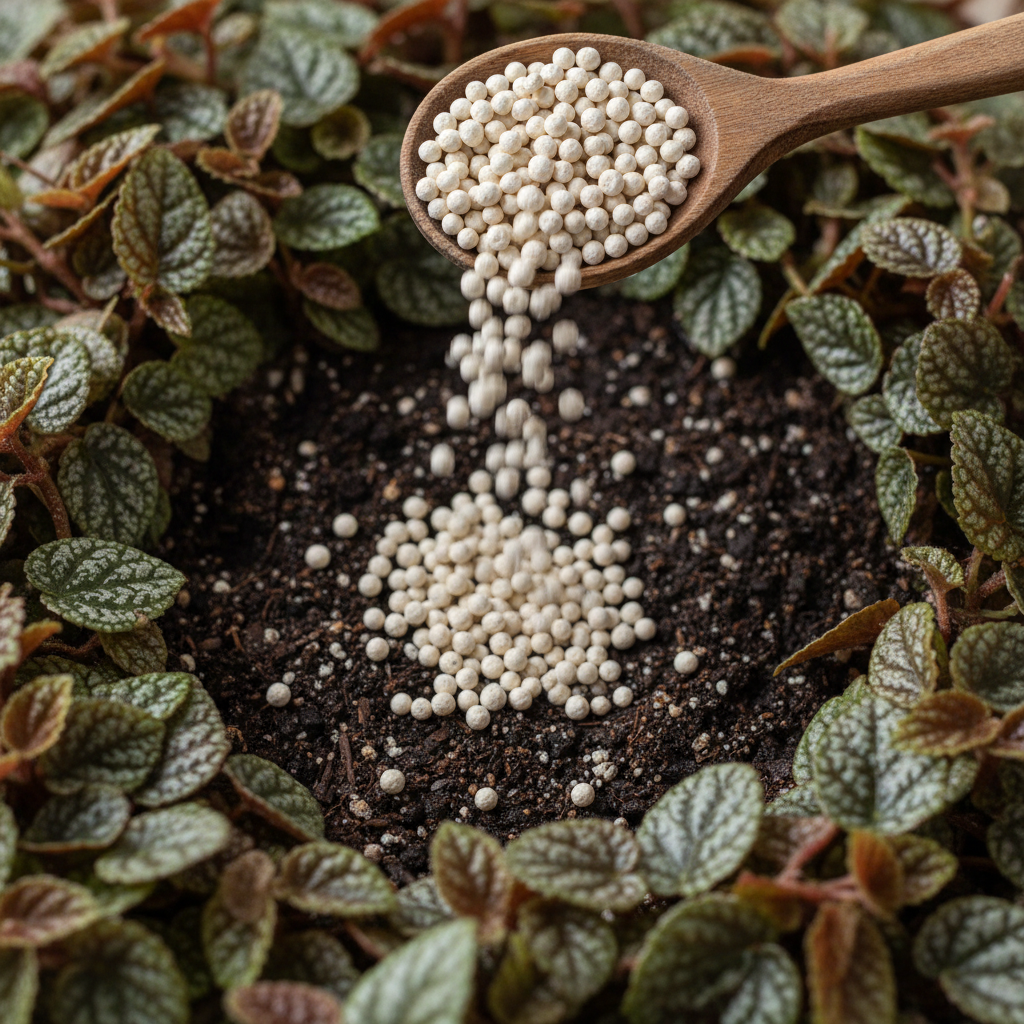
A balanced liquid houseplant fertiliser, typically labelled with an NPK ratio close to 10-10-10 or 20-20-20, suits the aluminum vine well. Use it at a quarter to half the strength printed on the bottle; the plant is small and easy to over-feed. Slow-release coated prills, scattered lightly across the surface of the substrate in spring, are an even gentler option and release nutrients across two to three months without requiring weekly attention. Organic options like worm-casting tea, diluted seaweed extract or fish emulsion are also welcome, especially in mixes that are coir or peat-heavy and a little nutritionally bare.
Schedule
From early spring through to early autumn, feed every three to four weeks with dilute liquid fertiliser, or apply slow-release prills once in spring and once in midsummer. From late autumn through to late winter, when light levels drop and the plant slows its growth markedly, stop fertilising entirely. Feeding a slow-growing plant only builds up unused nutrient salts in the substrate, which can scorch roots and tip the foliage.
Recognising Over- and Under-Feeding
An overfed aluminum vine shows crispy brown leaf tips and edges, often with a faint white crust visible on the substrate surface or around the rim of the pot. The remedy is to flush the substrate thoroughly with several pot-volumes of plain water and to skip fertilising for a couple of months. An underfed plant produces small, pale, slightly anaemic-looking leaves and very slow growth, even with adequate light and water. A few rounds of dilute feed will restore vigour within a month or two.
Propagation
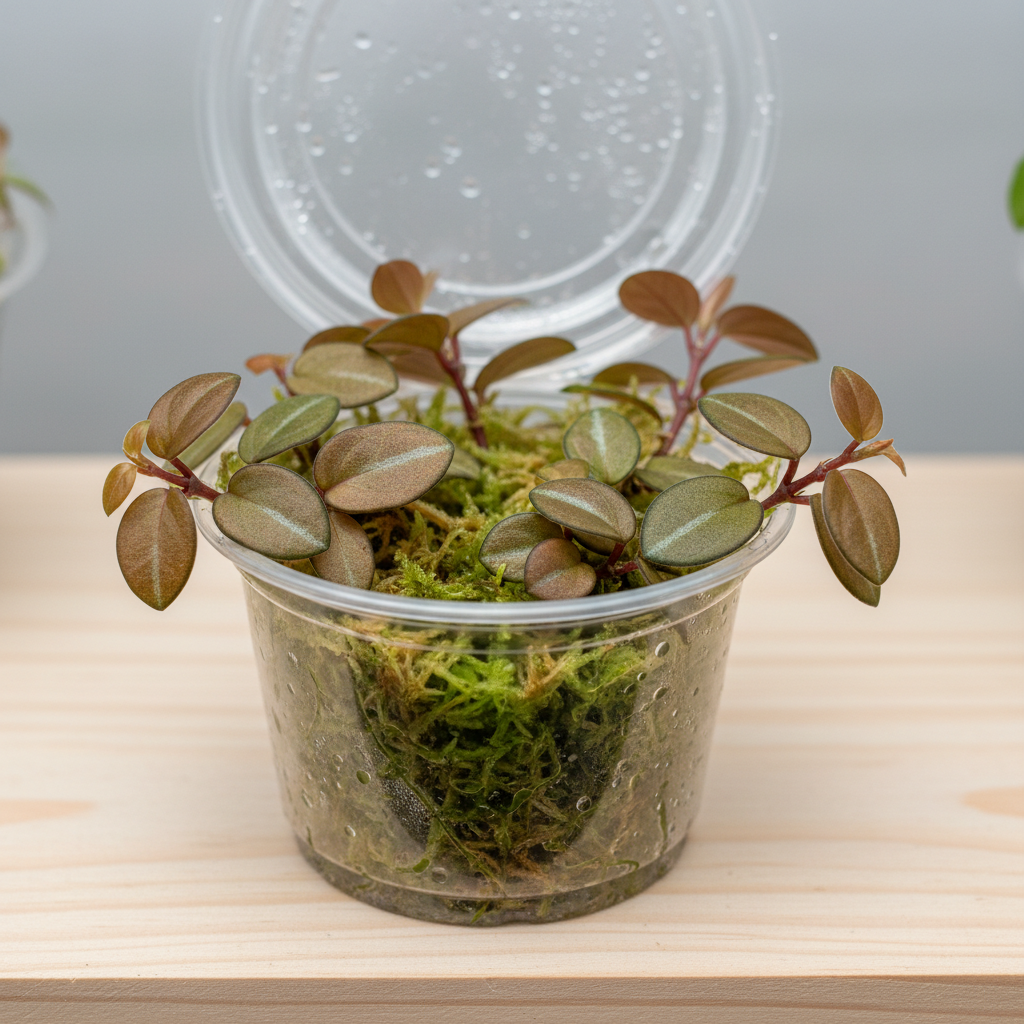
The aluminum vine is one of the most generous houseplants when it comes to making more. Stems root at every node, and a closed humid environment with damp moss is essentially all that is needed. There is no need for hormones, complicated mediums or specialist equipment; a clear deli pot and a pinch of sphagnum will produce a tray of new plants in three to four weeks.
Stem Cuttings in Sphagnum (Recommended)
The single most reliable method, summarised:
- Using clean, sharp scissors, take cuttings of healthy stems with at least three to four nodes each. The cutting should be about five to eight centimetres long.
- Strip the leaves from the lowest one or two nodes, leaving only the top leaves intact.
- Lightly hydrate a small handful of long-fibred sphagnum moss until it feels damp but not dripping; squeezing it should release at most a drop or two of water.
- Lay the moss in a clear plastic deli cup or takeaway container with a lid, and nestle the cuttings horizontally or shallowly upright so the bare lower nodes are in contact with the moss.
- Close the lid loosely, leaving a small gap or a couple of pinprick holes for air exchange, and place the container in bright indirect light.
- Check every few days. Mist lightly if the moss begins to dry; remove any leaves that show black or rot.
- Within two to four weeks, fine white roots emerge from the nodes. Once the roots are a centimetre or two long, pot up small bundles of cuttings into the standard substrate mix.
Water Propagation
Aluminum vine cuttings also root readily in plain water, though water roots are slightly more fragile than moss-grown roots and the transition to soil can sometimes set the plant back. Place cuttings in a small glass with just the lower one or two nodes submerged, change the water weekly, and keep the glass in bright indirect light. Roots appear in seven to fourteen days. Pot up once the longest roots reach two to three centimetres, and keep the substrate noticeably damper than usual for the first fortnight to ease the transition.
Layering in the Same Pot
Because Pellionia repens stems naturally root at the nodes wherever they touch damp substrate, the easiest propagation method of all is to pin a trailing stem down to the surface of a neighbouring pot using a small loop of bent wire. Keep that pot damp, wait six to eight weeks, and then snip the stem away from the parent. A fully established new plant is the result, with no propagation chamber and no transition step required.
When to Propagate
Late spring through to early summer is the ideal window, because warm, lengthening days produce the fastest rooting and the strongest new growth. Cuttings taken in midwinter will often root but may sit dormant until light levels rise. Whenever the parent plant is pruned to control its sprawl, the trimmings are essentially free propagation material; few plants are this obliging.
Pests & Diseases
The aluminum vine is not particularly pest-prone, but its love of humidity puts it in close proximity to the species of mite, fungus and bacterial trouble that flourish in similar conditions. Most issues are preventable through good airflow, consistent moisture and the occasional careful inspection of leaf undersides.
Spider Mites
Spider mites are the most common pest, especially in dry winter indoor air. They appear as faint stippling on the upper leaf surface and fine silken webbing in the leaf axils. Wipe leaves clean with a damp cloth, apply a fine mist of neem oil or insecticidal soap to the undersides, and raise local humidity. Mites cannot reproduce easily above 60 per cent humidity, so a humidifier alone often clears a light infestation within a fortnight. Repeat treatments at weekly intervals for at least three rounds, since mite eggs are not killed by most contact sprays.
Mealybugs and Scale
Mealybugs show up as small white cottony tufts in leaf axils and along stems. Scale insects appear as flat brown bumps that look almost like growths on the plant itself. Dab each individual insect with a cotton bud dipped in isopropyl alcohol, then follow up a week later with a neem oil spray to catch any survivors and freshly hatched crawlers. Severe infestations may justify cutting the plant back hard and starting fresh from clean cuttings.
Fungus Gnats
Tiny black flies that hover around the substrate surface are fungus gnats, attracted by damp organic matter. Their larvae live in the top centimetre of substrate and rarely damage a healthy aluminum vine, but they are unsightly. Let the surface of the substrate dry between waterings, place yellow sticky cards near the pot to catch adults, and consider a top-dressing of sand or fine grit to deny them access to the soil. Biological controls such as Bacillus thuringiensis israelensis drenches are effective in stubborn cases.
Root Rot and Stem Collapse
The most serious problem the aluminum vine faces is fungal root and stem rot brought on by saturated substrate, particularly in cool conditions. The plant suddenly wilts despite damp soil; lifting the rootball reveals soft, blackened roots and a sour smell. Unpot immediately, wash the roots clean, trim away every soft and dark root with sterilised scissors, and repot into fresh, only-just-damp substrate in a smaller pot. Withhold water until the surface dries, then resume cautious watering. Often the safer route is to take a handful of healthy stem cuttings from the unaffected upper growth and start over.
Pro Tip – Quarantine New Plants: Any new houseplant brought into the home should sit alone, away from the rest of the collection, for at least two weeks. Inspect the undersides of every leaf weekly. Most pest outbreaks trace back to a single newly bought plant, and quarantine prevents a manageable problem on one plant from becoming a serious one across an entire shelf.
Popular Varieties
The genus Pellionia is small but contains several species and cultivars grown as houseplants. Naming conventions are unusually tangled: many older references list these plants under Pellionia, while more recent botanical work has moved several into the related genus Procris. In horticulture they are still almost universally sold under their Pellionia names, which is what is used here.
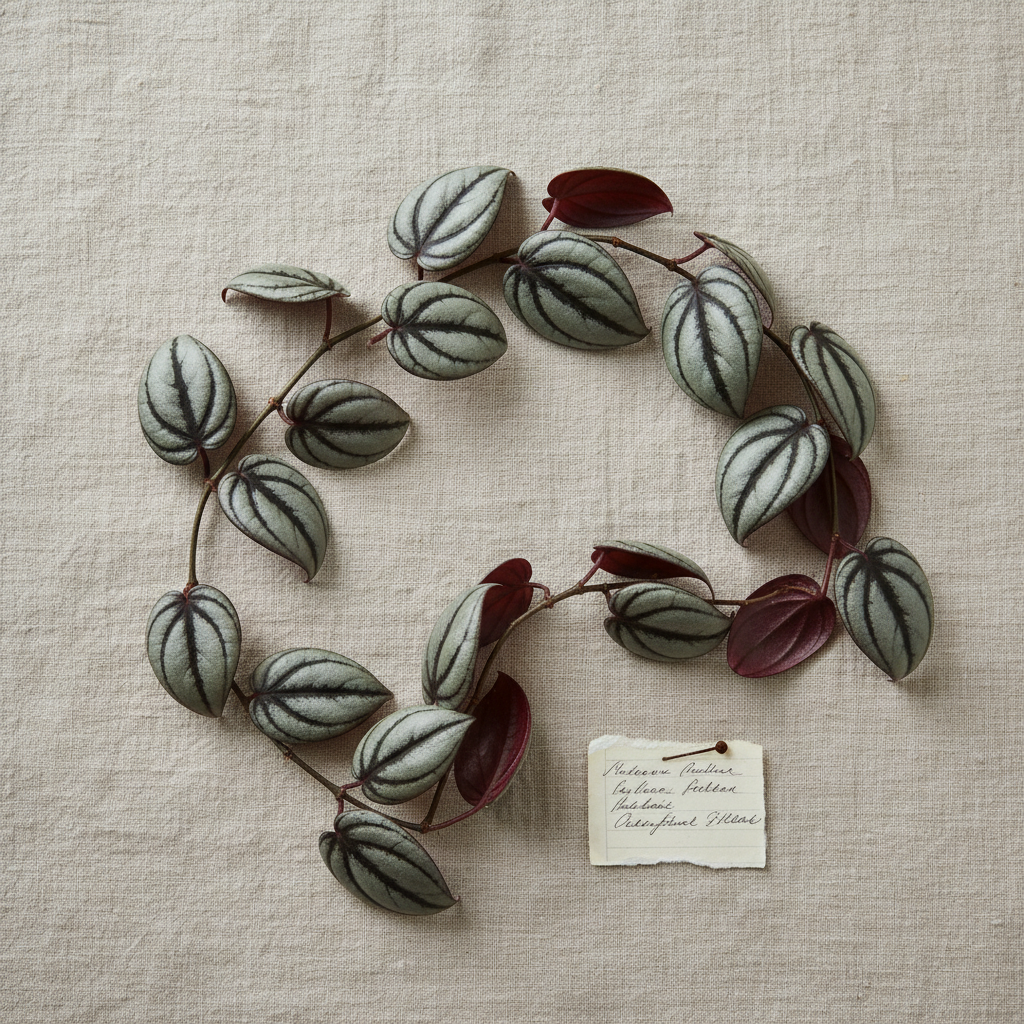
Satin Pellionia (Pellionia pulchra)
Often sold alongside the aluminum vine and frequently confused with it, Pellionia pulchra is a close relative with a far more dramatic appearance. The leaves are larger, broader and a striking metallic silver-grey crossed by dark purple-black veins, with rich burgundy undersides that show whenever a stem curls. Care requirements are essentially identical to P. repens, but the satin variety is a touch fussier about humidity and more reliable in a terrarium than in the open air of a centrally heated flat.
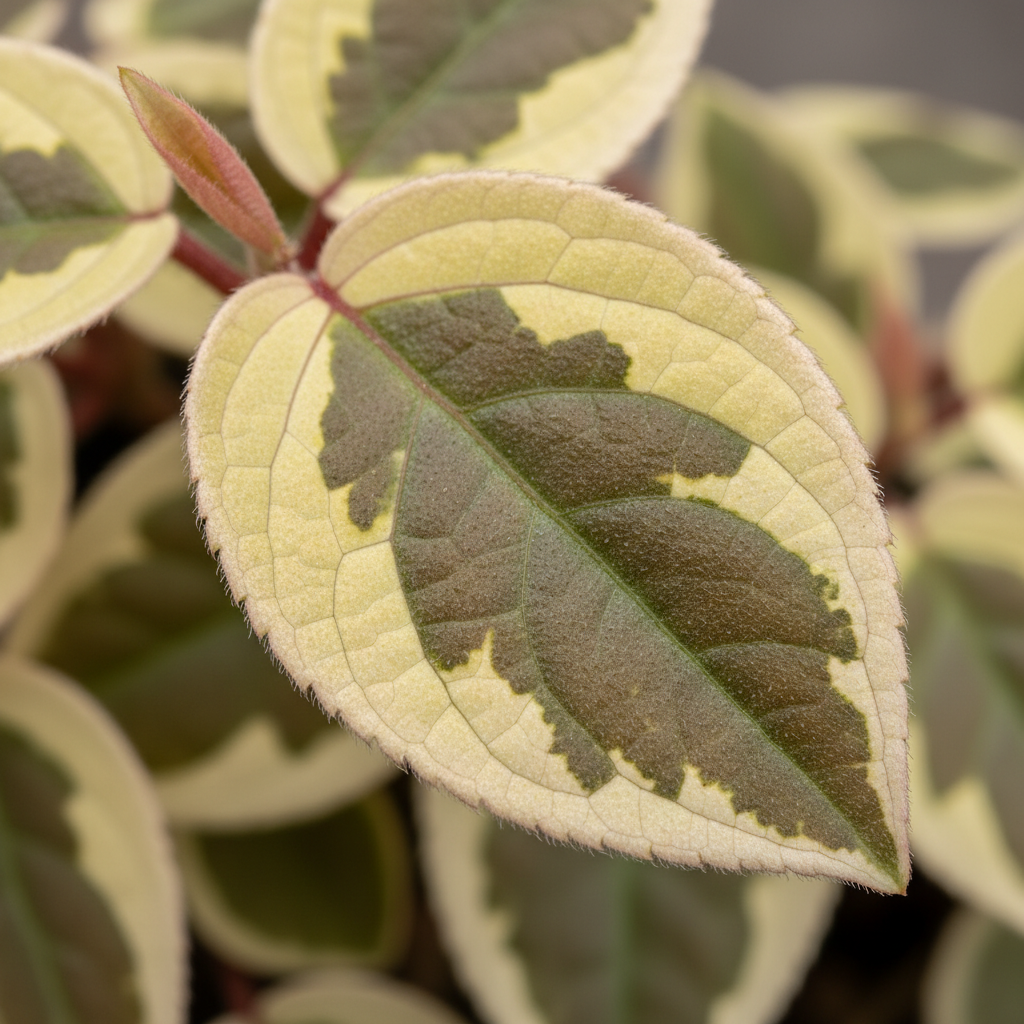
Polynesian Ivy (variegated Pellionia repens)
A variegated selection of the species, sometimes listed as Pellionia daveauana or simply as a ‘Variegata’ form. The leaves carry irregular margins of cream and pale yellow alongside the usual bronze and olive centre, with pink flushing on new growth. Like most variegated cultivars it grows a little more slowly than the plain species and asks for slightly brighter light to maintain the contrast in its leaves; in dim conditions the variegation fades and the leaves revert toward green.
Other Pellionia Species
A handful of other Pellionia species circulate among collectors but are rarely found in mainstream houseplant shops. Pellionia brevifolia, a small upright species from Borneo, makes a striking dwarf terrarium plant. Pellionia elatostemoides, from the Philippines, has narrower lance-shaped leaves and a more upright habit. All share the same general care preferences as the aluminum vine and respond well to a humid, warm, shaded position.
Frequently Asked Questions
Why are the leaves on my aluminum vine going pale and washed out?
Almost always insufficient light. The bronze pigments require a steady supply of bright indirect light to remain saturated. Move the plant closer to a bright window, away from any deep interior position, and give it a few weeks before judging the result; new growth comes in darker first, and existing leaves recover more slowly.
My plant wilts every couple of days, even when I water it. What is happening?
Three possibilities, in order of likelihood. First, low humidity, which causes the small thin leaves to lose moisture faster than the roots can replace it; raise local humidity with a humidifier or a pebble tray. Second, root damage from past overwatering, which leaves the plant unable to take up water even from saturated substrate; inspect the roots and consider taking cuttings. Third, a pot-bound rootball that has run out of substrate to hold moisture; repot in a slightly larger pot with fresh mix.
Can the aluminum vine live in a closed terrarium?
Yes, and it is one of the best small houseplants for the purpose. The constant high humidity, stable temperature and softly diffused light of a glass tank suit it precisely. The main considerations are to provide adequate light (an LED grow strip is often necessary on top of the tank) and to prune occasionally so the plant does not smother slower-growing companions.
Is aluminum vine the same plant as trailing watermelon begonia?
Confusingly, yes. The common name trailing watermelon begonia is widely applied to Pellionia repens, despite the plant having no relation whatsoever to actual begonias. The name was coined because the leaf patterning, with a darker margin and a paler centre, vaguely echoes the rind of a watermelon. The plant is, again, a nettle relative rather than a begonia relative.
How fast does it grow?
In good conditions a small starter plant fills a fifteen-centimetre pot within a single growing season and begins trailing over the edges by the end of the second summer. Growth is faster in warm, humid, brightly lit conditions, slower in cooler or drier ones. Individual stems can extend by five to ten centimetres a month in a warm spring.
Does it flower indoors?
Occasionally. The flowers of Pellionia repens are very small, greenish-white and easy to miss, clustered tightly in the leaf axils. They are not ornamental and the plant is grown entirely for its foliage. If flowers appear, they can be left to develop or pinched off without consequence; indoor pollination is unlikely to set seed.
Should I prune my aluminum vine?
Pruning is optional but useful. Pinching out the growing tips of a few stems each month encourages bushier growth and prevents the plant from becoming a tangle of long, leggy stems. Any trimmings are also free propagation material. Use clean, sharp scissors and cut just above a node, so the remaining stem has a clear point from which to push out side shoots.
Is the plant safe around children and pets?
Generally considered safe. Pellionia repens does not appear on the ASPCA toxic plant list and is widely reported as non-toxic. As with any houseplant, eating large quantities of any leaves is not advisable, and curious pets should be discouraged from making the plant a regular chew toy. The trailing habit at floor level means a determined cat may find the foliage tempting; placing the plant on a high shelf or inside a terrarium removes the issue altogether.






