
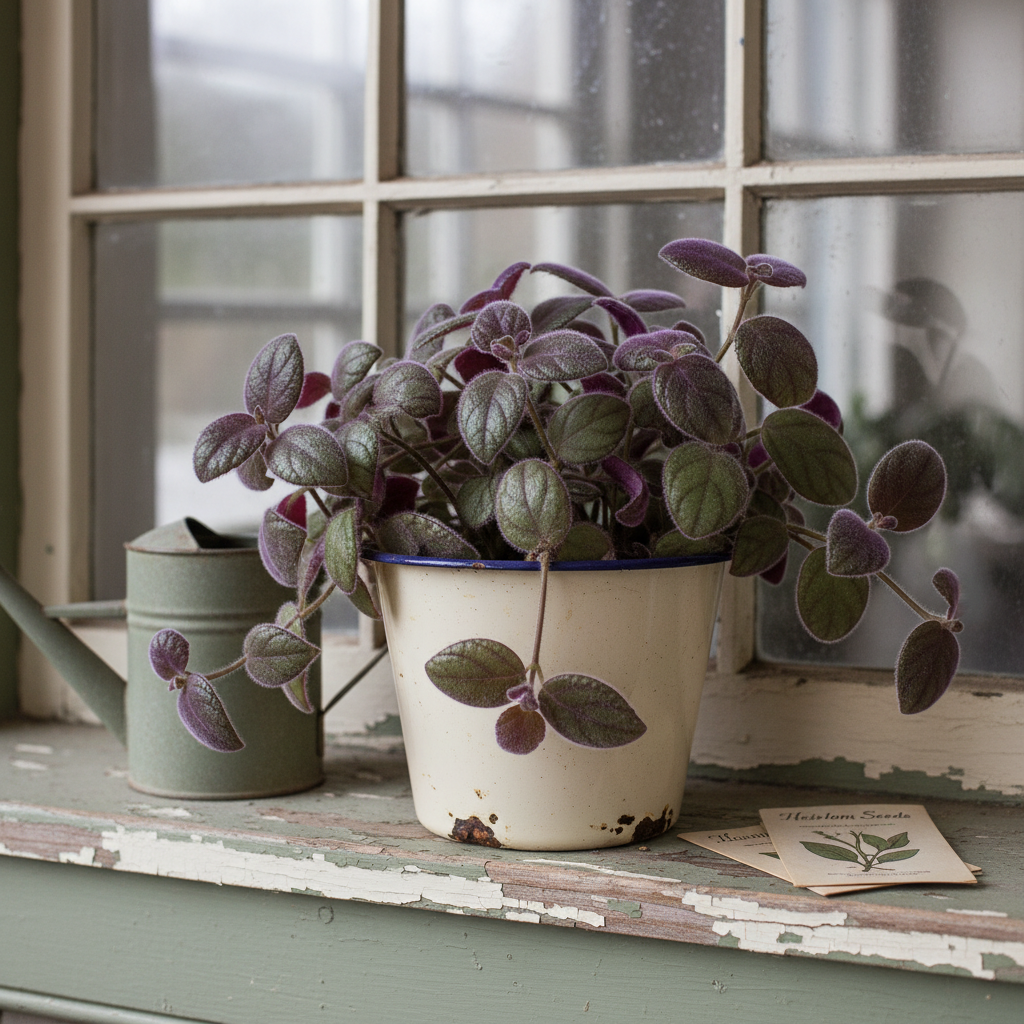
Few houseplants stop a passing glance quite like the purple passion plant. From a distance the foliage of Gynura aurantiaca reads as ordinary green, but step closer and a dense pelt of fine violet hairs catches the light, dressing every leaf in a shimmering plum velvet that almost looks unreal. Native to the warm understories of Java and other parts of Southeast Asia, this softly trailing member of the daisy family (Asteraceae) has earned its alternate names of velvet plant and purple velvet plant honestly: the colour is in the hairs themselves, not the leaf tissue, and it deepens whenever the plant gets enough sunlight to remember it lives near the equator.
It is one of those houseplants that is forgiving enough to keep alive but particular enough to reward attention. Anyone can keep a young purple passion plant going for a season; making it thrive into a cascading, deeply pigmented specimen and then renewing it from cuttings before old age sets in takes a slightly closer relationship with its quirks. This guide walks through what the plant actually wants in terms of light, water, soil, feeding, propagation and pest pressure, and where the difference between surviving and thriving really sits.
Contents
- Quick Reference
- Why Purple Passion Plant Makes a Striking Houseplant
- Light Requirements
- Watering and Humidity
- Soil, Potting and Repotting
- Fertilising
- Propagation
- Pests and Diseases
- Popular Varieties
- Frequently Asked Questions
Quick Reference: Purple Passion Plant at a Glance
| Light | Bright indirect light, with one to two hours of gentle direct sun to deepen purple colour |
| Watering | Water when the top 2 to 3 cm (about 1 inch) of soil is dry; reduce in winter |
| Temperature | 16 to 24 degrees Celsius (60 to 75 degrees Fahrenheit); avoid drops below 13 degrees Celsius (55 degrees Fahrenheit) |
| Humidity | Moderate, around 50 to 60 per cent; tolerates average household air |
| Fertiliser | Balanced liquid feed at half strength every 4 to 6 weeks in spring and summer |
| Toxicity | Generally regarded as non-toxic to people, cats and dogs; sap can occasionally irritate sensitive skin |
Why Purple Passion Plant Makes a Striking Houseplant
The purple passion plant earns its place on a houseplant shelf almost entirely on the strength of its foliage. The leaves themselves are a tidy, slightly elongated oval with softly toothed edges and a moderate size of roughly 5 to 10 cm (2 to 4 inches) long, arranged alternately on supple, succulent-looking stems. What turns an unassuming green leaf into something theatrical is the density of fine purple hairs, called trichomes, that coat every surface and every stem. In bright light they look almost magenta; in shade they read as dark plum. The visual effect is closer to crushed velvet than to a typical leaf.
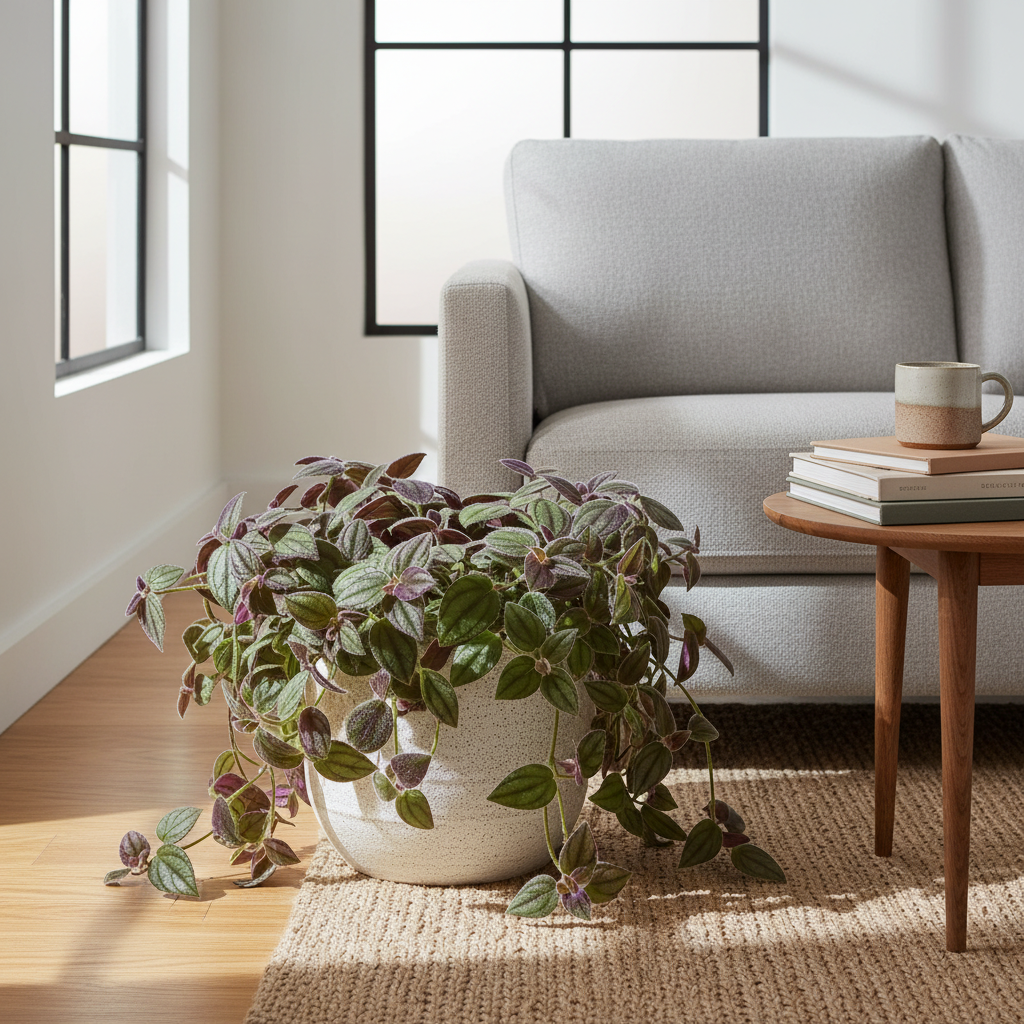
Young plants start out upright and bushy, which makes them well suited to a desk, side table or shelf where the foliage is roughly at eye level. As the stems lengthen they begin to lean and then to trail, eventually cascading 45 to 75 cm (about 18 to 30 inches) over the edge of a pot. This shift in habit is part of what makes the species so versatile in display: the same plant can perform as an upright specimen at one year of age and as a hanging-basket feature a year later. Pinching back stem tips keeps the plant denser, while leaving them encourages the dramatic, curtain-like fall that many growers prize.
The other practical attraction is responsiveness. Few houseplants change their colour in real time according to how they are treated, but the purple passion plant does exactly this. A specimen left in deep shade gradually slides into duller, more olive tones; the same plant moved into brighter, slightly more direct light will produce new leaves with markedly more saturated, almost iridescent purple. That feedback loop turns growing this plant into a small visual experiment, and it is part of why it has remained a staple of plant collections since the mid-twentieth century even as more fashionable aroids have come and gone.
Pro Tip, Reading the colour: the intensity of purple in new growth is the single best indicator of whether the plant is receiving enough light. If recent leaves are noticeably duller than older ones, move the plant closer to a window before adjusting anything else in its care.
One caveat worth knowing from the outset: this is a relatively short-lived houseplant compared with the decades you might get from a snake plant or a ZZ. A purple passion plant typically looks its best for two to three years, at which point stems become woody at the base, leaf production slows, and the overall silhouette grows leggy. Most experienced growers therefore treat it as a renewable plant, taking cuttings every spring and rotating in younger, denser specimens as older ones are retired. Far from being a flaw, this rhythm is part of how the species was historically used in cultivation, and the ease of propagation makes it a low-cost habit to maintain.
Light Requirements
Light is the single most influential factor in growing a good purple passion plant, both because it determines how vigorous the plant is and because it directly affects the saturation of the purple hairs that are the whole point of growing it. In its native Indonesian and Javanese habitats Gynura aurantiaca grows in the bright, dappled edges of forest clearings, where it sees a great deal of filtered light and short bursts of direct sun without ever being permanently exposed to tropical midday overhead glare. Replicating that pattern indoors is the key to a plant whose new leaves are deeply pigmented rather than washed-out.
In practical terms a position within a metre or so (about 3 feet) of an east-facing or lightly curtained south-facing window is close to ideal for most homes in temperate latitudes. The plant tolerates a couple of hours of direct morning sun without difficulty, and indeed seems to colour up most strongly when it gets that gentle exposure. Late-afternoon western sun in summer is more punishing; if a leaf surface feels warm to the back of the hand within a few seconds of touching it, the light at that hour is too direct, and the plant should be pulled back behind a sheer curtain or moved a metre further into the room.
The visible signs that a plant is undernourished for light are easy to read once you know them. New leaves emerge a thinner, paler green with sparser purple hairs; spacing between leaves on each stem lengthens, producing a leggy, etiolated growth pattern; and the plant begins to lean perceptibly towards whatever light source is available. At the opposite extreme, foliage exposed to too much harsh direct sun fades, develops bronzy, dry-looking patches and may scorch outright along its edges. Healthy growth sits comfortably between these two states, with neat internodes of roughly 2 to 4 cm (about 1 inch) and reliably saturated colour on every new leaf.
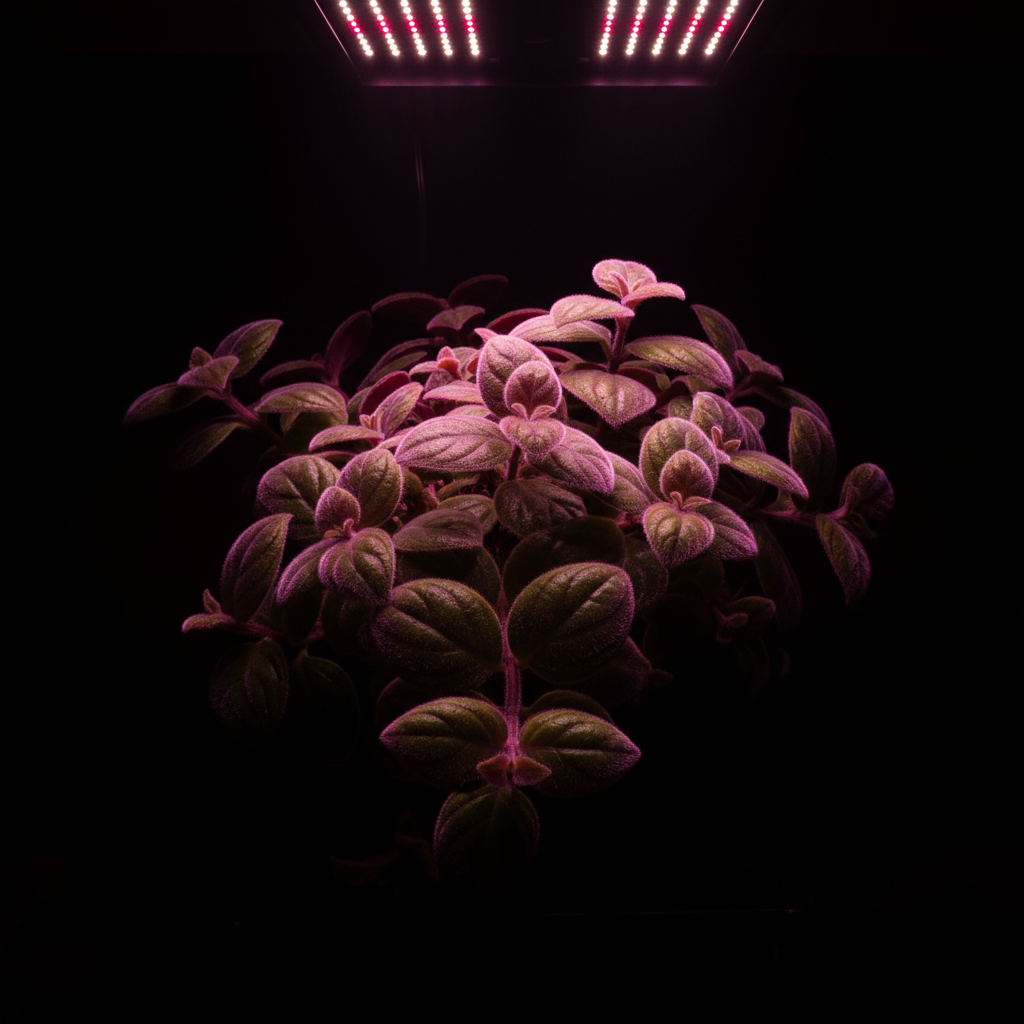
In winter, when daylight hours shorten significantly in northern climates, the plant benefits from being moved closer to the brightest available window or supplemented with a full-spectrum LED grow-light for 10 to 12 hours a day. Grow-lights are a particularly good fit for this species because the colour response to light intensity is so visible: a plant that has spent a dim midwinter under a 20-watt LED panel will produce visibly more pigmented spring growth than one that has been left to coast. If using natural light alone, rotate the pot a quarter turn each week to keep growth even on all sides; an unrotated plant tilts noticeably towards its light source within a month.
Pro Tip, Easing into more light: when moving a plant from a darker spot to a brighter one, do it gradually over a week. Sudden exposure even to indirect morning sun can bleach foliage that has acclimatised to lower levels.
Watering and Humidity
Watering is where well-intentioned growers most often run a purple passion plant into trouble. The species has slightly succulent stems and fleshy leaves that store a modest amount of water, which means it tolerates a brief lapse in watering far better than it tolerates a saturated root zone. Rot, not drought, is the main mode of failure, and most rot incidents trace back either to watering on a schedule rather than by feel, or to leaving the pot sitting in standing water in a saucer or cachepot.
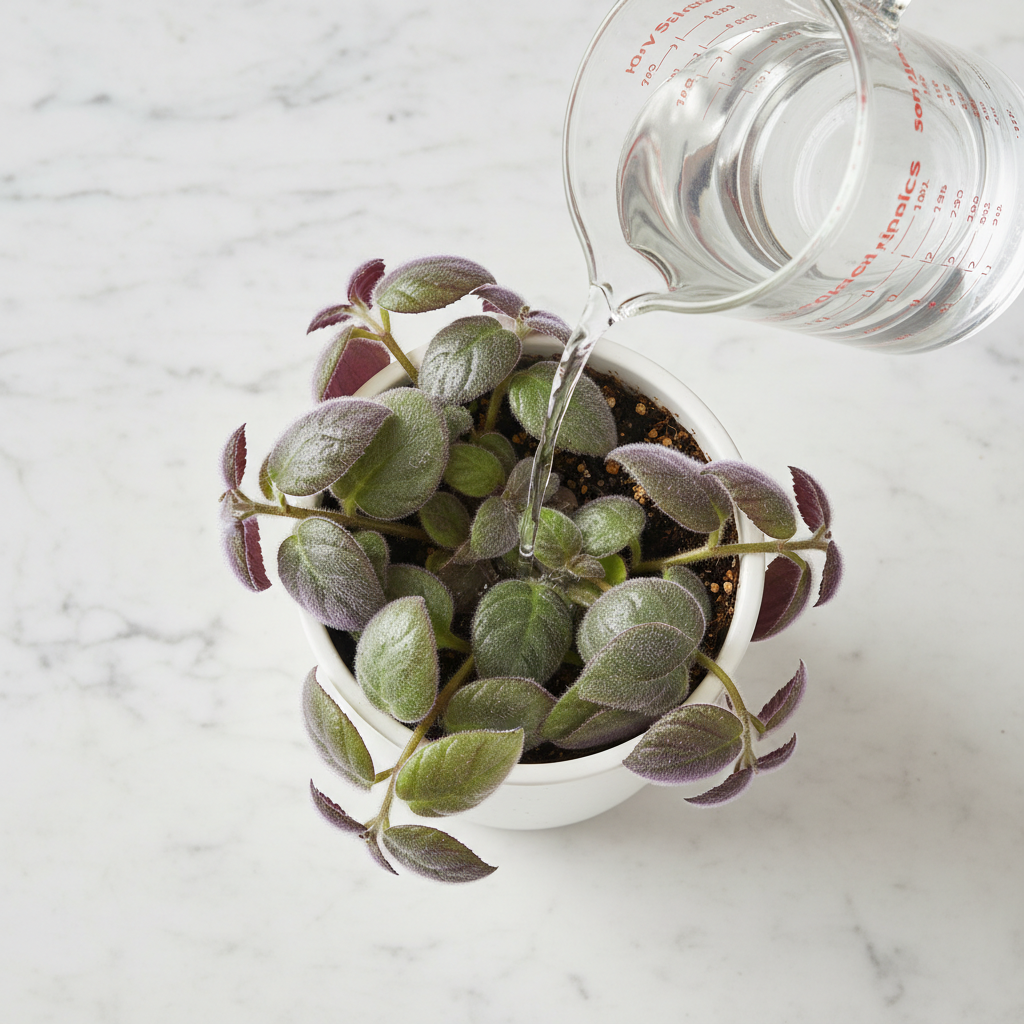
The reliable rule is to check the top 2 to 3 cm (about 1 inch) of soil with a fingertip every few days and water deeply when it feels dry, then to let the excess drain away completely before returning the pot to its display position. In a warm bright spring or summer this might mean watering once or twice a week; in a cool dim winter it can stretch to every 10 to 14 days. Tepid water is preferable to cold straight from the tap, particularly in winter, since a very cold drink at the roots can shock the plant and cause leaves to drop. If the local tap water is heavily chlorinated, leaving the watering can to stand uncovered overnight allows most of the chlorine to dissipate before use.
The plant signals its watering status visibly. A pot that has gone slightly too dry shows leaves that lose their crispness and feel softly limp to the touch; a thorough water typically restores them within a few hours. By contrast, a pot kept too wet produces yellowing lower leaves, sometimes blackening at the base of stems, and a faint sour smell from the soil surface. Crucially, both extremes can produce drooping foliage, so checking the soil moisture before reacting is essential. Watering a wilting overwatered plant is one of the most common mistakes that pushes a marginal case into outright collapse.
How to deliver the water matters too. The dense covering of hairs on the leaves and stems is not designed to shed water cleanly, and droplets that sit in the dimples between hairs can encourage fungal patches or simply leave unsightly stains where minerals dry on the surface. The cleanest approach is to water at the soil surface rather than over the foliage. If a watering can does occasionally splash the leaves, dabbing them gently with a piece of soft kitchen paper avoids long-term marking. Misting, despite often being recommended for tropical houseplants, is best avoided here for the same reason: a fine mist tends to settle on the velvety leaf surface and dry there as small spots.
Warning, Don’t sit in water: always tip out any water that collects in the saucer or cachepot within 15 minutes of watering. Roots left to soak in standing water are the most common single cause of decline in this species.
Humidity-wise, the purple passion plant is more flexible than most other tropical foliage plants. It tolerates average household humidity of around 40 per cent comfortably, and only really objects when air becomes very dry, typically below 30 per cent, as can happen in heated rooms during a cold snap. In those conditions leaf edges may brown slightly and new growth can look a little stunted. Rather than misting, which causes the hair-staining problem mentioned above, the preferred remedies are to stand the pot on a tray of moist pebbles, group it with other plants so their collective transpiration lifts local humidity, or use a small room humidifier nearby for the worst weeks of winter heating.
Soil, Potting and Repotting
The ideal substrate for a purple passion plant is light, airy and free-draining, with enough organic matter to hold a moderate amount of moisture without ever becoming dense or compacted. A commercial peat-free or coir-based houseplant compost works as a base, but it benefits from being lightened with around a third by volume of perlite or pumice and, if available, a smaller handful of fine orchid bark to keep the mix porous. The result should feel fluffy in the hand, drain freely when watered and never settle into a heavy slab between waterings.
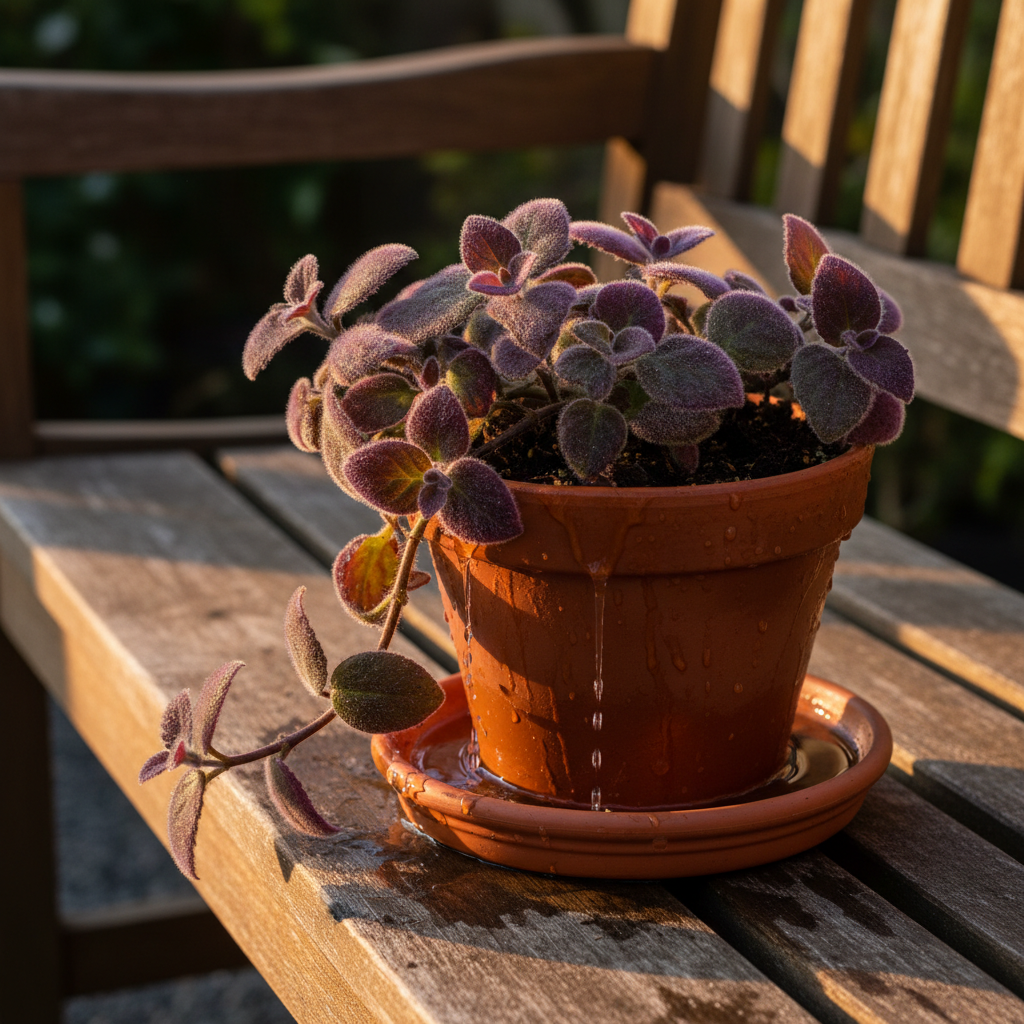
The pot itself matters as much as the mix inside it. Terracotta is well suited to this plant because the porous walls allow the root zone to dry between waterings, which forgives the occasional overwatering more readily than a glazed ceramic or plastic vessel. Whatever material is chosen, the pot must have a working drainage hole, and ideally several. Cachepots without drainage can still be used as outer covers for display, but the plant should always sit inside an inner nursery pot that drains freely, and any water collecting in the outer cachepot must be tipped away rather than left to pool.
Repotting is generally needed every 12 to 18 months while the plant is young and growing actively, though the schedule slows down as plants reach maturity and as older specimens approach the point of being replaced by their own cuttings. The best window for repotting is early spring, just as new growth begins to push from the stem tips. A pot one size up, typically 2 to 3 cm (about 1 inch) larger in diameter, is enough; jumping into a much bigger container leaves too much wet, unused soil around the root ball and increases rot risk. The step-by-step procedure is straightforward:
- Water the plant lightly the day before to make the root ball easier to extract intact.
- Prepare the new pot by adding a shallow layer of fresh mix in the base, enough that the top of the root ball will sit roughly 2 cm (about 1 inch) below the rim.
- Tip the plant out by inverting and supporting the stem base, easing the pot away rather than pulling at the foliage.
- Gently loosen any tightly circling roots with the fingers and trim away any that are obviously blackened or mushy with clean snips.
- Settle the root ball into the new pot, fill in around the sides with fresh mix, and press the surface lightly to remove large air pockets without compacting the substrate.
- Water in thoroughly and place the plant in moderate light for a week before returning it to its usual bright spot.
A useful intermediate option for plants that are still healthy but whose substrate has become tired is top-dressing rather than repotting. With the plant in its existing pot, the top 2 to 3 cm (about 1 inch) of old mix is scraped away carefully and replaced with fresh material. This refreshes the most active root zone, reintroduces some nutrient capacity and prolongs the life of a successful planting by another season without disturbing roots unnecessarily.
Fertilising
The purple passion plant is a moderately hungry foliage species, neither as light a feeder as a cactus nor as heavy as something like a fiddle leaf fig. The aim of feeding is to keep new growth pushing steadily through the active season without forcing soft, overly lush leaves that are more vulnerable to pests and that often show less pigment than slower, sturdier foliage. A balanced liquid houseplant fertiliser, with roughly equal proportions of nitrogen, phosphorus and potassium, applied at half the strength recommended on the label, hits the right level for most plants.
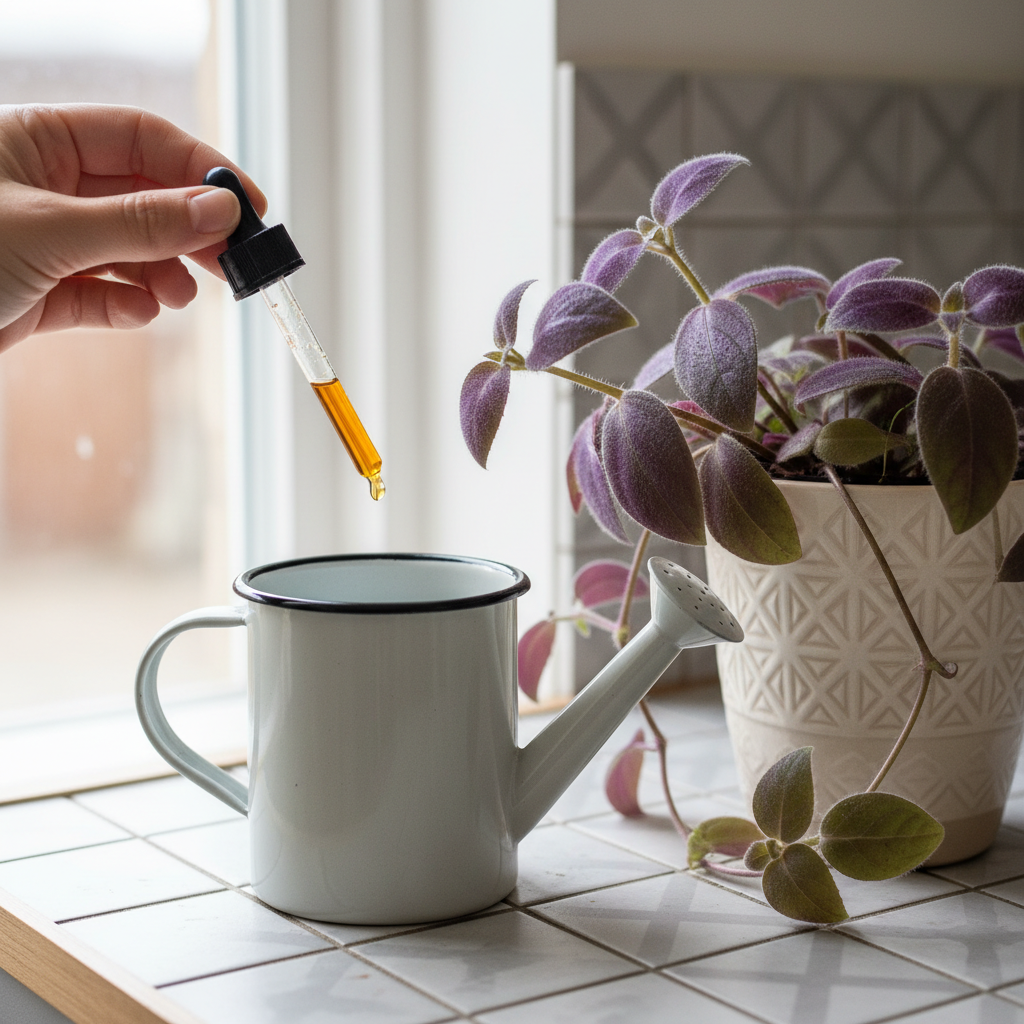
The timing follows the plant’s natural rhythm. Feeding starts when daylight noticeably lengthens in early spring, continues every four to six weeks through spring and summer, and tapers off as autumn shortens day length. Through the depths of winter feeding can stop altogether, because growth slows dramatically and any nutrients in the soil are taken up only sluggishly. Feeding a dormant plant simply builds up unused salts in the substrate, which over time can scorch sensitive root tips and cause crispy leaf margins that look unattractive on the velvety foliage.
The decision between liquid, slow-release granular and organic options is mostly one of convenience. Liquid feed mixed into watering water gives the most precise control and is the easiest to dilute correctly. Slow-release prills sprinkled onto the soil surface in early spring last most of the season but offer less responsiveness if the plant’s needs shift mid-summer. Worm castings or a diluted compost tea provide a gentler, lower-concentration organic alternative that suits growers wary of synthetic feeds; their nitrogen release is slower and the risk of overfeeding is much lower. Whichever form is chosen, the rule of thumb is to feed less than the label suggests rather than more.
Signs of overfeeding are worth recognising early. A noticeable white crust forming on the soil surface or around the rim of the pot indicates accumulated mineral salts and is a clear signal to flush the substrate by watering thoroughly with plain water and discarding the runoff. Leaf tips browning despite adequate humidity, or unusually rapid but pale and floppy new growth, are softer warning signs that the feed strength or frequency should be reduced. Underfeeding, by contrast, shows up as pale, slow growth and weaker purple pigmentation even when light levels are good.
Pro Tip, Always feed a watered plant: apply fertiliser to soil that is already lightly moist rather than to a fully dry root ball. A dry root zone increases the chance of fertiliser burn on tender root tips and reduces uptake efficiency.
Propagation
Propagating a purple passion plant from stem cuttings is one of the most rewarding parts of growing it. The species roots so readily that even quite casual technique tends to succeed, and because the parent plant is naturally short-lived, regular propagation is the way the same lineage is kept in the home over years rather than seasons. Almost any softwood stem section a few centimetres long, taken from a healthy plant in active growth, can be coaxed into rooting given a little moisture and warmth.
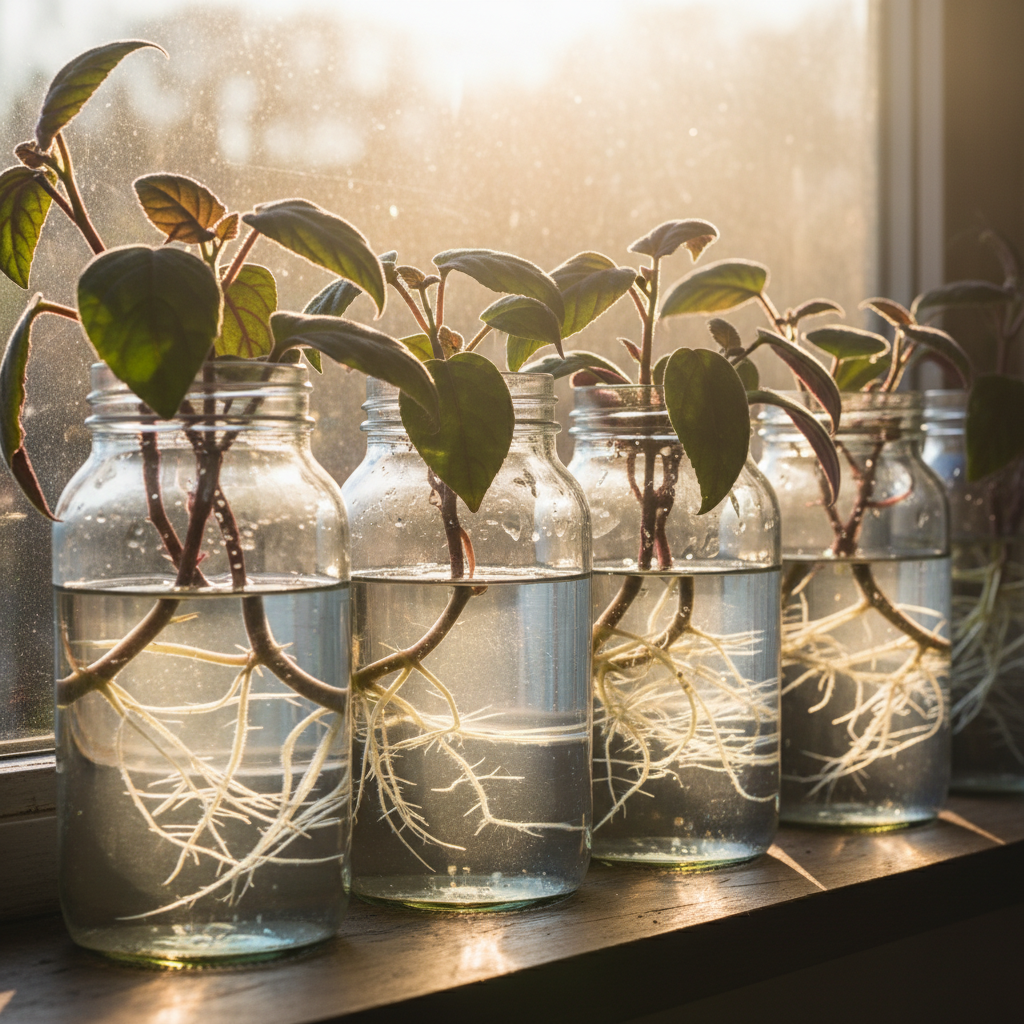
Water rooting is the most reliable method for beginners and the one that lets the process be observed step by step. Take cuttings 7 to 10 cm (about 3 to 4 inches) long from the tips of healthy stems, cutting cleanly just below a node with sharp scissors or a clean blade. Strip the lower leaves so that the bottom one or two nodes are bare, which is where the new roots will emerge. Sit the cuttings in a clear glass or jar of room-temperature water with the bare nodes submerged but the remaining leaves clearly above the waterline, and place the jar in bright indirect light away from harsh direct sun. Refresh the water every five to seven days to keep it oxygenated.
Roots typically appear within 10 to 21 days, starting as small white nubs at the submerged nodes and lengthening into a small fibrous root system within a month. Once roots reach 3 to 4 cm (about 1 to 1.5 inches) long, the cutting is ready to be transferred to soil. Pot it up into a small container of the same airy mix used for mature plants, water in lightly and keep the soil consistently moist but not soaked for the first two weeks while the water-grown roots adapt to a soil environment. From here, gradually reduce watering frequency and treat the new plant like a mature specimen.
Direct soil rooting is an alternative that produces a slightly stronger root system from the outset, since the cutting never has to make the transition from water-roots to soil-roots. The steps mirror the water method until the cutting is prepared:
- Take a 7 to 10 cm (about 3 to 4 inch) tip cutting with a clean blade, just below a node.
- Strip the lower one or two pairs of leaves so the bottom of the cutting is bare.
- Optionally dip the cut end in rooting hormone powder; this is not essential but can speed things up.
- Insert the cutting into a small pot of pre-moistened, airy potting mix so that at least one stripped node is buried.
- Place the pot in bright indirect light and keep the soil lightly moist, ideally enclosing the pot loosely in a clear plastic bag for the first two weeks to lift humidity.
- After 3 to 4 weeks, give the cutting a very gentle tug; resistance indicates that new roots have formed and the bag, if used, can be removed.






