
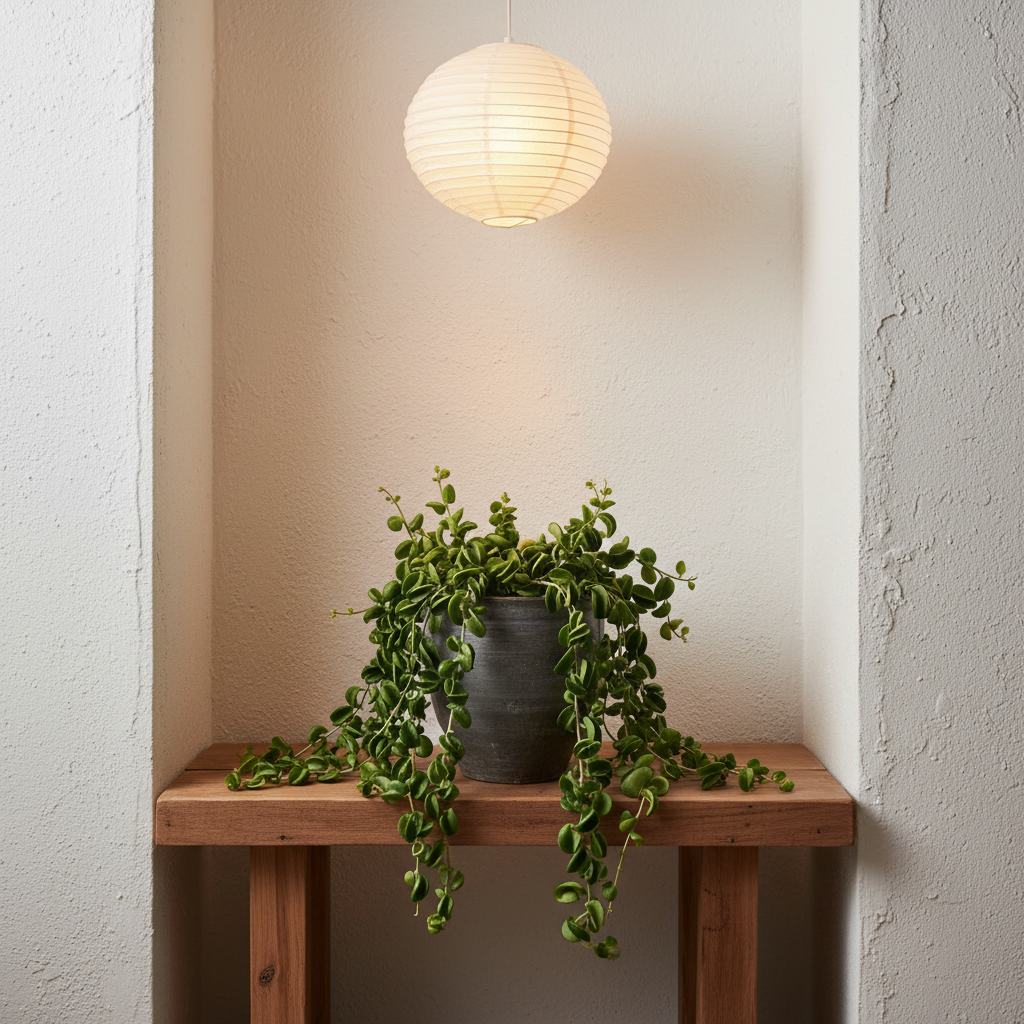
Few houseplants look as sculptural and strange on first glance as the Hindu Rope Plant, a slow-growing succulent vine whose leaves are so tightly curled and twisted that the whole stem resembles a length of braided green rope. Botanically it is Hoya carnosa compacta, a naturally compact, crinkled mutation of the much more familiar wax plant, and it has carried a small cult following ever since it appeared in mid-twentieth-century nurseries. Gardeners also call it Rope Hoya, Krinkle Kurl, Krinkle Vine, and simply “the compact hoya”. Wild Hoya carnosa ranges across southern China, the eastern Himalayas, and parts of Southeast Asia and Australia, where it climbs trees as an epiphyte, draping itself in waxy leaves and astonishingly geometric umbels of pink-and-red star flowers.
The reputation of the Hindu Rope Plant sits in two halves. On one hand it is famously forgiving: it tolerates neglect, stores water in those fleshy leaves, and rarely throws a fatal tantrum if you forget it for a week. On the other hand it is famously slow, and the gap between simply surviving and properly thriving and flowering is wide. This guide covers both. You will learn how to keep a Hindu Rope Plant alive almost indefinitely on a windowsill, and how to coax it into the dense, glossy, multi-stemmed waterfall of curled leaves and waxy blooms that makes it worth waiting for. Along the way, expect specifics on light intensity, watering rhythm by season, the chunky aroid-style soil it actually wants, why you should leave the spent flower stalks alone, and how to multiply it from stem cuttings without losing your nerve.
Contents
- Quick Reference
- Why the Hindu Rope Plant Makes a Rewarding Houseplant
- Light Requirements
- Watering and Humidity
- Soil, Potting and Repotting
- Fertilising
- Propagation
- Pests and Diseases
- Popular Varieties
- Frequently Asked Questions
Quick Reference: Hindu Rope Plant at a Glance
| Light | Bright indirect to a little direct morning sun; tolerates lower light but will not flower |
| Watering | Allow the soil to dry out almost completely between waterings; soak then drain |
| Temperature | 18 to 27 degrees Celsius (65 to 80 Fahrenheit); never below 10 degrees Celsius (50 Fahrenheit) |
| Humidity | 40 to 60 percent ideal; tolerates ordinary room humidity |
| Fertiliser | Diluted balanced or slightly high-phosphorus feed once a month in spring and summer |
| Toxicity | Non-toxic to cats, dogs and humans according to the ASPCA; the milky sap can still irritate sensitive skin |
Why the Hindu Rope Plant Makes a Rewarding Houseplant
The Hindu Rope Plant is a houseplant for the patient. It grows about an inch or two of new vine in a typical month during its active season, and a small starter plant may take three to five years to reach the dense, cascading look most people buy it for. In exchange, you get a plant that looks like nothing else on the shelf: stems so packed with overlapping, contorted leaves that the wood underneath disappears, the whole thing trailing or climbing in dark glossy spirals.
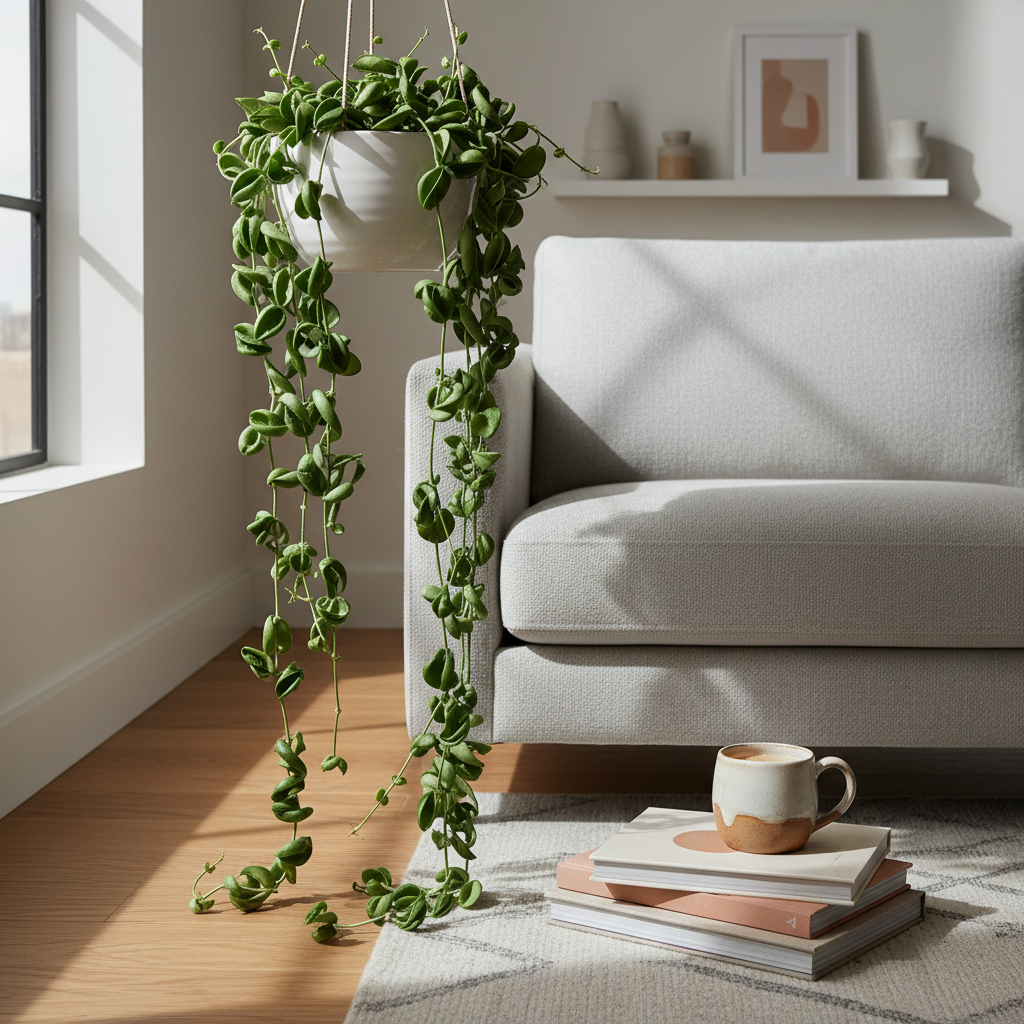
Practically, the plant earns its place because it asks for less than nearly any other flowering houseplant. The leaves are succulent storage organs, packed with water and waxy on both surfaces, which means a missed watering or a long weekend away rarely registers. It tolerates the dry indoor air of centrally heated flats. It does not shed leaves dramatically when moved. It carries pests poorly, in the helpful sense that they often skip it in favour of softer foliage nearby. And it lives for decades when settled: a Hindu Rope Plant in a good window is a slow accumulating heirloom rather than a seasonal purchase.
The reward, when it comes, is the flowers. Mature plants produce umbels of small, intensely fragrant, five-pointed stars in soft pink with a crimson centre, arranged in a perfect dome of fifteen to thirty blossoms. The umbels emerge from short woody spurs called peduncles. Each peduncle can flower again year after year from the same point, which is why you should never cut them off once the petals have dropped. Pinching out a spent peduncle is one of the most common mistakes new owners make, and it removes the only spot the plant intends to flower from again.
Pro Tip — Never Cut the Peduncles: The short woody nubs left after the flowers drop are not dead stems. They are flowering spurs that will bloom again, sometimes for many years, from the same point. Snipping them sets the plant back another year or more before the next flowering.
Light Requirements
Light is the single biggest lever you have over a Hindu Rope Plant. To survive, it will accept moderate indirect light from almost any room. To thrive, and especially to flower, it wants more light than most owners give it. Aim for bright indirect light for most of the day, with one or two hours of soft direct sun at either end. An east-facing window is close to perfect. A south or west window also works well if the harshest midday sun is filtered through a sheer curtain or a screen of taller foliage in front. A pure north exposure will keep the plant alive and tidy but will almost never produce flowers.
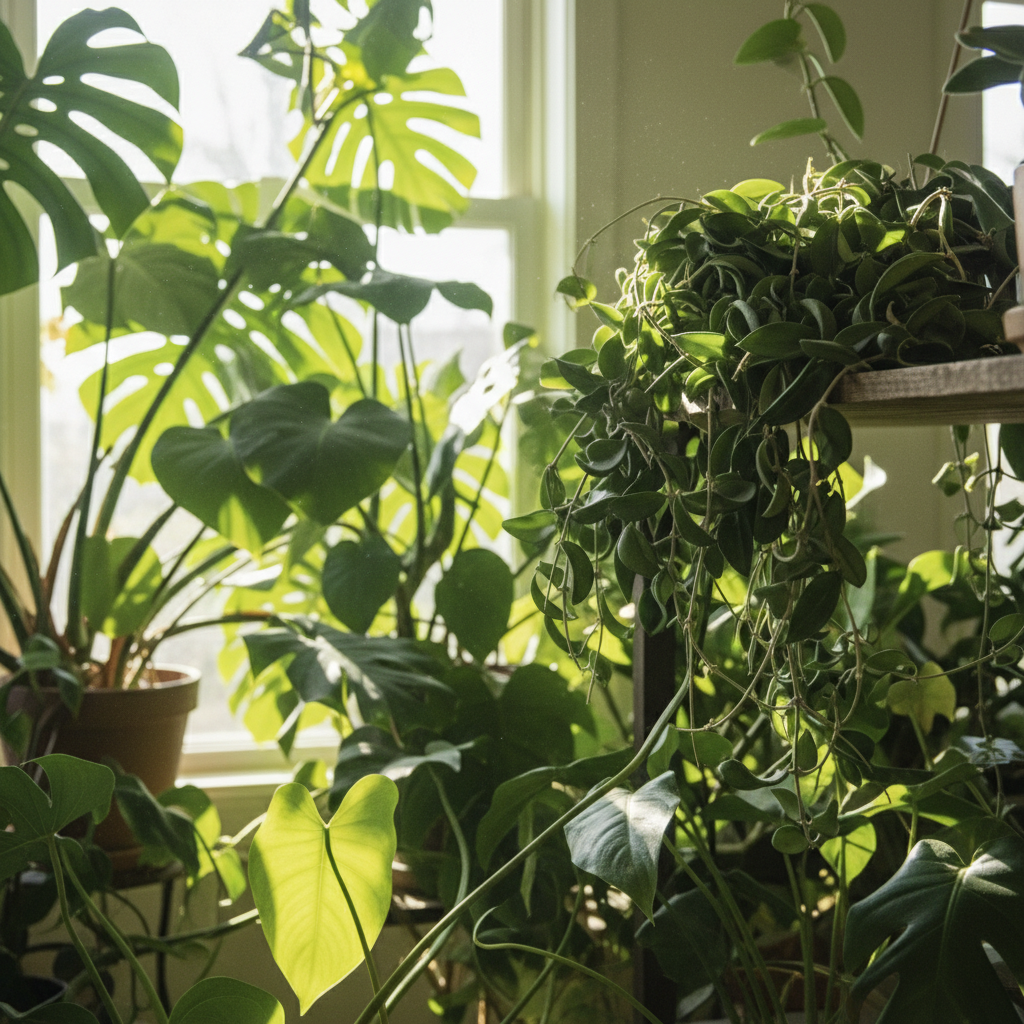
The leaves themselves are an honest light meter. In good light they are deep, glossy, mid to dark green, often with a faint silvery freckling visible on the upper surface in some clones. The new growth flushes pink or coppery red where the brightest beams hit, hardening to green over the following weeks. In too much harsh direct sun the green bleaches yellow and crisp brown patches develop on the leaves that took the worst of the light. In too little light the leaves become long, soft, spaced widely along the stem rather than tightly stacked, and the characteristic curl flattens out. A plant grown in low light may still produce a stem now and again, but it tends to be a pale, lanky, single-leader vine that bears no flowers.
If your only available window is darker than ideal, a small full-spectrum LED grow light positioned 30 to 45 centimetres (12 to 18 inches) above the canopy on a 12-hour timer changes the calculation completely. Hindu Rope Plants respond well to supplemental light, and many growers report their first flowering within a year of adding one, even in deep-winter latitudes.
Seasonal light adjustments
From late autumn through early spring the sun arrives at a lower angle and is far weaker even at midday. Move plants closer to the glass during this period, or onto a south-facing windowsill they would not tolerate in summer. In high summer step them back from the window by 30 to 60 centimetres (one to two feet), or pull the sheer curtain across at midday, to avoid the leaf-scorching peaks. Rotate the pot a quarter turn every week or two so the plant grows evenly on all sides rather than leaning into the light.
Watering and Humidity
The Hindu Rope Plant treats every leaf as a small water reservoir, and it expects the same dry-then-soak cycle that suits most epiphytic succulents. Water thoroughly, until water runs freely from the drainage holes, then leave the plant alone until the potting mix has dried out almost entirely. Pushing a finger an inch or two into the soil is the simplest moisture check: if it comes out clean and dry to the second knuckle, water; if any mix sticks or feels cool, wait. In a bright warm room in summer this may mean watering every 10 to 14 days. In a cooler winter room with weaker light it can stretch to every three or four weeks.
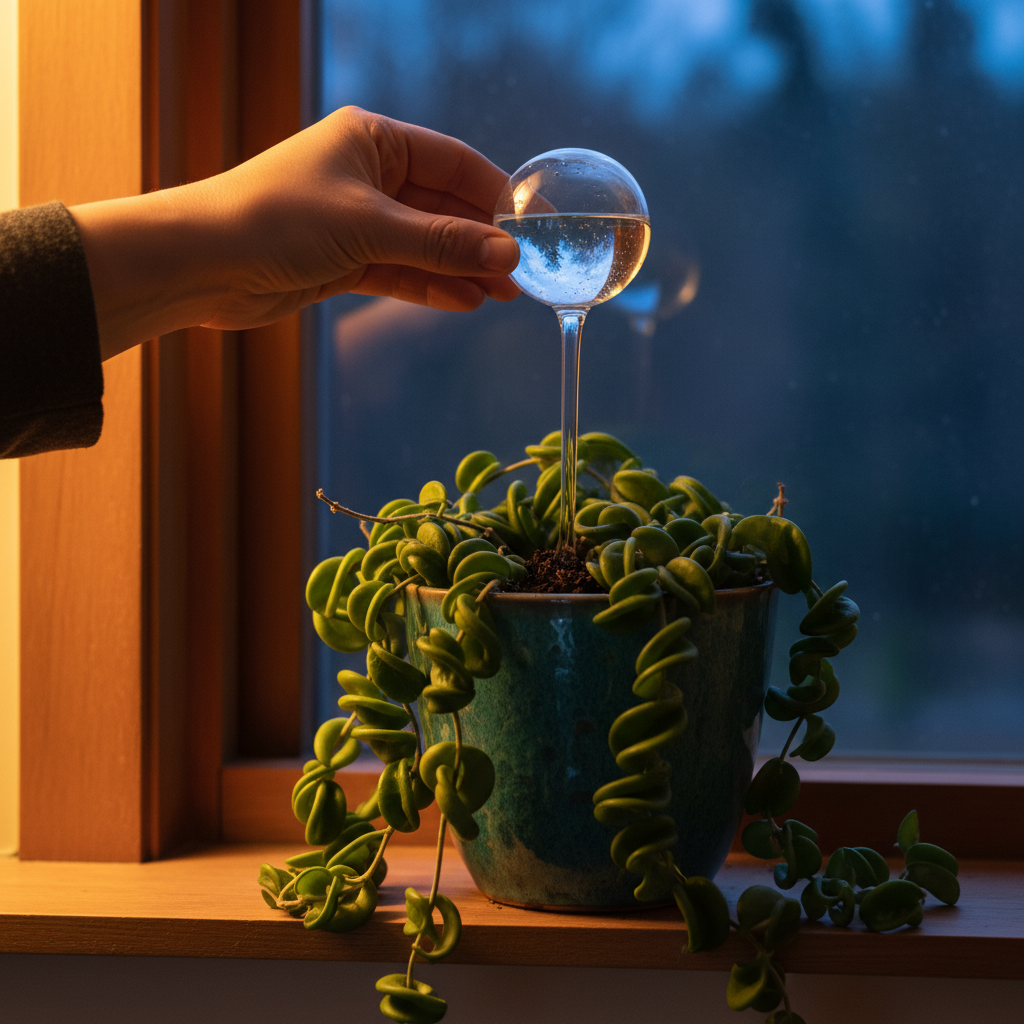
Overwatering is by far the most common cause of decline. The chunky waxy leaves disguise root trouble for weeks. By the time the foliage starts to look limp, soft, and yellowing all at once, the root system has often collapsed quietly under sodden mix. A wilted-looking Hindu Rope Plant whose soil is still damp is a sign of root rot, not thirst, and adding more water at that stage will make things worse. Underwatering looks different: the leaves shrivel and pucker slightly, losing their plump waxy fullness, and the whole plant looks a touch dry and matte rather than dull and floppy. That problem reverses within a day or two of a good soak.
Water quality and temperature
Room-temperature water is much better than cold water straight from the tap. Cold water shocks the roots of an epiphyte adapted to warm rainforest canopies. If your tap water is heavily chlorinated, leave a watering can to stand uncovered overnight to let the chlorine dissipate. Hard water tends to leave a chalky deposit on the leaf surface but causes no real harm. Distilled water or collected rainwater is ideal but not essential for this species.
Humidity
Hindu Rope Plants are far more relaxed about humidity than most epiphytes. Anywhere between 40 and 60 percent suits them, which is roughly the year-round range of a typical home. They tolerate the dry winter air of centrally heated rooms surprisingly well thanks to the thick cuticle on each leaf. If your home runs especially dry, grouping plants together, placing the pot on a pebble tray with a thin film of water below the base, or running a small humidifier nearby raises the local humidity without any extra fuss. Misting the leaves directly is a debated practice; most experienced hoya growers avoid it because water tends to sit in the deep crinkles of the leaves and can encourage fungal spotting.
Warning — Watch for Limp Yellowing: Soft, yellowing leaves in still-damp soil almost always mean root rot rather than thirst. Stop watering immediately, unpot the plant, inspect the roots, trim away any black mushy sections, and replant in fresh, dry, well-draining mix.
Soil, Potting and Repotting
In the wild the Hindu Rope Plant grows as an epiphyte, clinging to bark with thin roots that breathe between rains. A standard bag of indoor potting compost compacts too readily for that lifestyle and stays wet at the root zone for far too long. The single biggest improvement most owners can make is switching to a chunky, airy mix designed for aroids or epiphytic orchids.
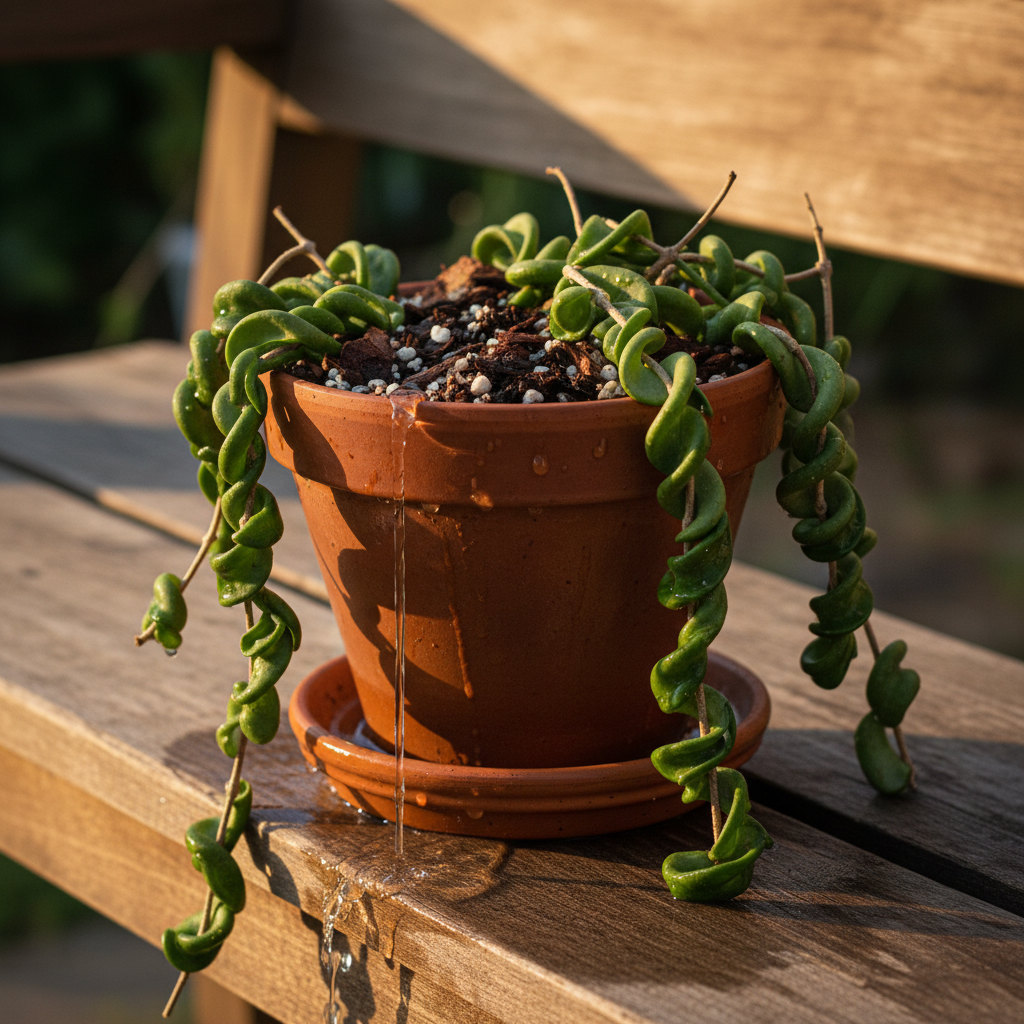
A workable potting mix
A reliable home recipe is roughly two parts good-quality houseplant compost or peat-free coco coir, two parts medium orchid bark, one part perlite or pumice, and a small handful of horticultural charcoal. The bark and perlite create air pockets that prevent compaction; the coir or compost holds enough moisture to keep the roots hydrated between waterings; the charcoal absorbs excess salts and discourages anaerobic conditions if the mix ever sits wet for too long. Pre-mixed bagged aroid blends from reputable plant shops work just as well.
Pot choice
Hindu Rope Plants prefer to be slightly pot-bound. A tight root ball seems to encourage flowering, possibly by mimicking the cramped crevice in tree bark where the plant would naturally take hold. Choose a pot only one size up from the current one when you do move it, and always one with at least one generous drainage hole. Unglazed terracotta dries faster than plastic or glazed ceramic, which suits the plant nicely; in cooler regions or for owners who tend to forget to water, plastic offers a more forgiving rhythm. Hanging pots and pots with a slatted edge for trailing vines work beautifully because they let the rope-like stems cascade without crowding.
Repotting schedule
Plan to repot every two to three years, no more often. The plant resents disturbance and often pauses for several months after a transplant before resuming growth. Repot in early to mid spring, just as new growth begins to flush, so the plant can recover into its strongest season. Signs that repotting is overdue include roots circling tightly around the inside of the pot, roots emerging through the drainage holes, water rushing straight through the pot without wetting the mix, and a heavy build-up of mineral crust on the soil surface.
Step-by-step repotting
- Water the plant lightly the day before to ease the root ball out of the old pot.
- Tip the pot on its side and slide the root ball out, supporting the base of the stem with your hand.
- Loosen the outer roots gently with your fingers. Trim any black, soft or hollow sections back to firm white root.
- Add a 3 to 5 centimetre (1 to 2 inch) layer of fresh chunky mix to the bottom of the new pot.
- Settle the plant in so the crown sits about a centimetre below the rim, then fill in around the sides with mix, tapping the pot to settle the substrate without compressing it.
- Wait three to seven days before watering to allow any nicks in the roots to callus over.
Fertilising
For a plant this slow, fertilising is less about pushing growth and more about supplying the trickle of nutrients an epiphyte would otherwise extract from rainwater running over bark. Feed only when the plant is actively growing, which in most homes means roughly from early spring through to early autumn. A balanced liquid houseplant fertiliser at half the strength stated on the bottle, applied once a month, is enough for foliage and steady stem growth.
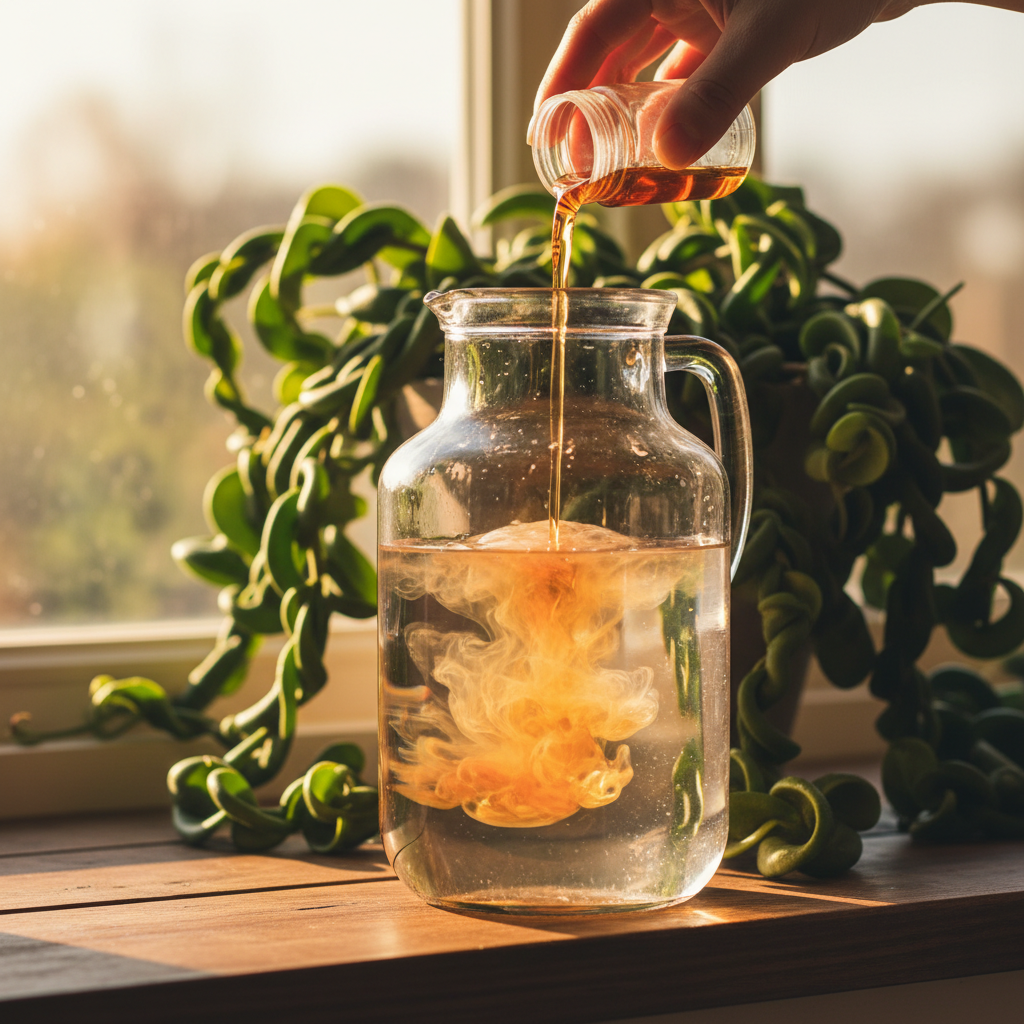
To encourage flowering on a mature plant, switch to a fertiliser with a higher middle number, the phosphorus, in late spring and through summer. Formulations marketed for orchids or tomatoes work well; bloom-booster ratios of roughly 5-10-5 or 7-9-5 give the plant the extra phosphorus and potassium that support flower spur development without driving leafy stretch. Continue at half-strength once a month rather than full-strength less often. Stop feeding entirely from mid autumn through late winter while the plant rests.
Salt build-up is the chief risk of consistent feeding. The waxy mix the plant prefers is light on the bag-clay that buffers ordinary fertiliser, and salts can accumulate at the root zone over the course of a season. Once every couple of months during the feeding period, flush the pot with two or three pot-volumes of plain water, allowing each volume to drain completely before adding the next. This carries any excess salts out through the drainage holes and refreshes the substrate.
Pro Tip — Less Is More: A Hindu Rope Plant fertilised at quarter or half strength every month grows steadier, more compact, and is more likely to flower than one given full-strength feed less often. Over-fertilising shows as crispy leaf tips and a white salt crust on the pot rim.
Propagation
The Hindu Rope Plant propagates readily from stem cuttings, and this is by far the most reliable home method. Each cutting needs two or three leaves and at least one node, the small bump on the stem where a leaf joins. Roots emerge from the nodes, not from the cut end of the stem, so a cutting taken without a node will never root no matter how patient you are.
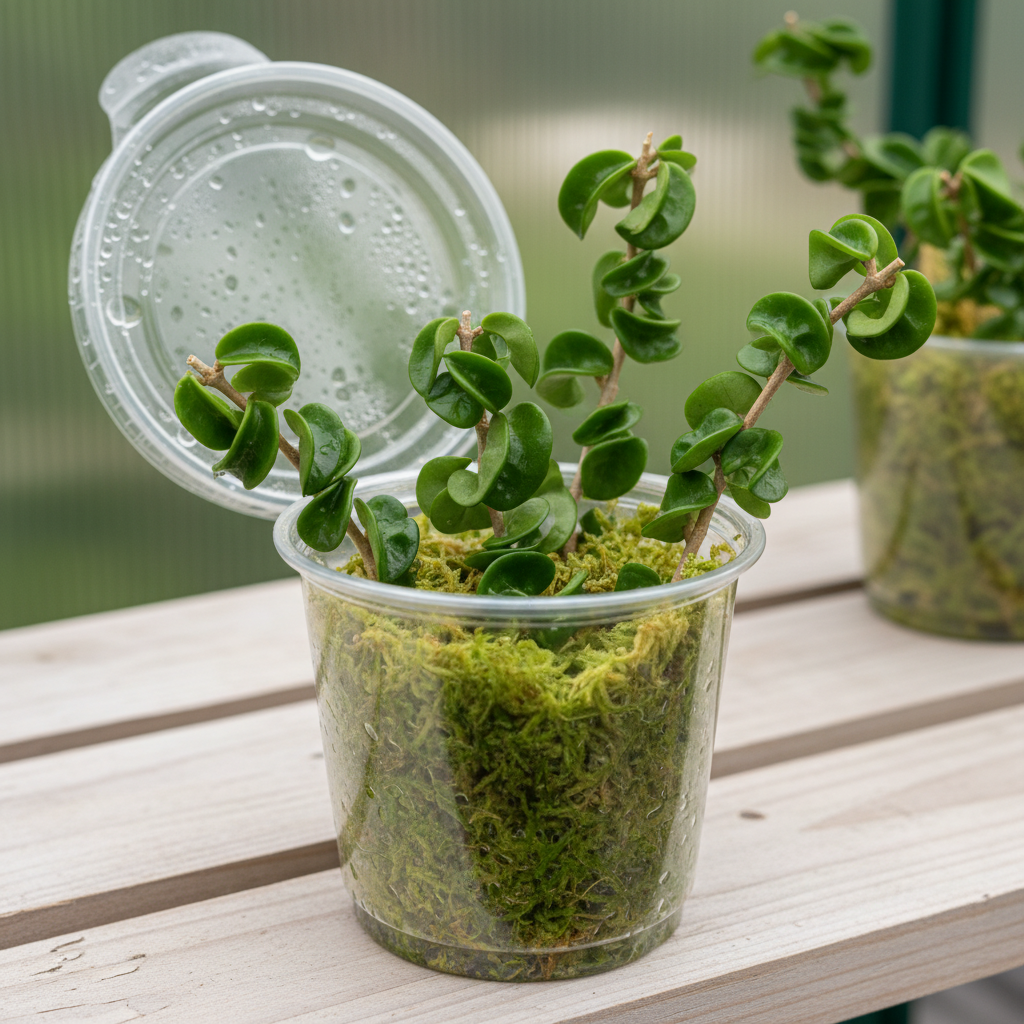
Stem cuttings in sphagnum moss
- Take cuttings in late spring or early summer, when the plant is in active growth. Choose healthy stems with firm, fully developed leaves.
- Cut a section three to four nodes long with clean sterilised scissors. Strip the lower one or two leaves to expose the nodes that will root.
- Let the cut end callus over on a paper towel for a few hours to reduce the risk of rot.
- Fill a small clear deli cup or plastic container with sphagnum moss that has been soaked then squeezed out so it is damp but not dripping.
- Nestle the bare nodes into the moss, leaving the leafy section above the surface. Close the lid loosely so air can still exchange.
- Place the cup in bright indirect light at room temperature. Check weekly for new roots, which usually appear within four to eight weeks.
- When roots reach two to three centimetres (about an inch), pot the rooted cutting into a small pot of the same chunky mix you use for adult plants.
Water propagation
Water rooting also works for Hindu Rope Plant cuttings, though the transition from water roots to soil roots can be more abrupt than with moss. Suspend the cutting in a glass of room-temperature water so the lower one or two nodes are submerged and the leaves stay dry. Change the water every five to seven days, and pot the cutting on once the new roots are two to three centimetres long. Expect a brief pause in growth as the cutting builds new soil roots after transplanting.
Layering
For owners with a mature plant who do not want to detach a stem until rooting is certain, layering offers a low-risk alternative. Lay a long trailing vine across the surface of a second pot of mix, pin a node down with a U-shaped piece of wire, and keep the soil lightly moist. The buried node will root over the following two to three months without ever being separated from the parent. Once a healthy new shoot emerges, cut the connecting stem and the layered section becomes an independent plant.
Pests and Diseases
The Hindu Rope Plant is among the least pest-prone hoyas, but the deep crinkles in the leaves create hidden pockets where small infestations can settle before you notice them. Inspect new growth and the undersides of leaves whenever you water. Catching trouble early matters more here than with smoother-leaved plants because once an insect colonises the curl, it is genuinely hard to dislodge.
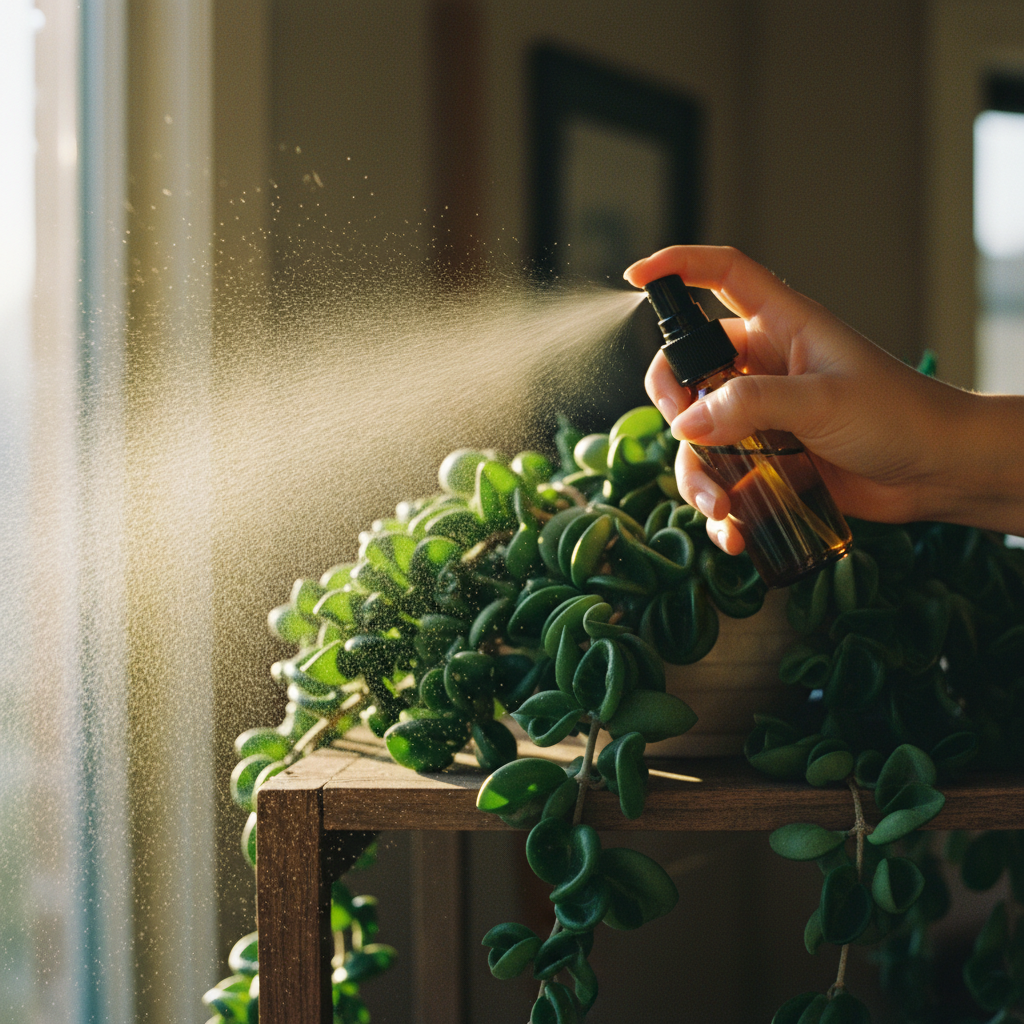
Mealybugs
The most common pest by a wide margin. They look like small specks of white cotton wedged into the join between leaf and stem, and they love the tight crevices of the rope-like growth. Dab each visible insect with a cotton bud dipped in 70 percent isopropyl alcohol, then follow up with a thorough spray of neem oil or insecticidal soap once a week for three weeks to catch the next generation hatching from missed eggs. Isolate affected plants from your other hoyas and any nearby succulents until you have seen at least two clean weekly inspections.
Spider mites
Less common but possible, especially in very dry winter air. The first sign is a faint dusty stippling on the upper leaf surface and, later, a fine webbing in the leaf curls. A strong shower in the kitchen sink will dislodge most of the colony; follow with weekly neem oil sprays to break the breeding cycle. Raising local humidity by grouping plants together also discourages further outbreaks.
Scale
Small brown or amber bumps stuck firmly to the stems or leaf undersides are armoured scale insects. Prise individual specimens off with a fingernail or a wooden toothpick, then wipe the area with rubbing alcohol on a cotton pad. Heavy infestations respond to systemic houseplant insecticides applied as a soil drench, but for most home plants the manual approach combined with neem oil is enough.
Root rot
The single most serious threat to the Hindu Rope Plant is not an insect but its own owner. Overwatering, dense compost, or a pot without drainage will all suffocate the fine roots within a few weeks. The first symptom is the foliage going soft and slightly translucent, often with a sudden yellowing of older leaves. By the time the stems feel mushy at the base the rot is well advanced. Recovery is possible only by unpotting the plant, washing the roots clean, cutting away any black or hollow sections back to firm white tissue, dusting the cut surfaces with cinnamon or sulphur powder, and replanting in fresh dry chunky mix. Withhold water for at least a week after replanting and resume only lightly.
Sooty mould and edema
Occasional black sooty deposits on the leaves are not a disease in themselves but a fungus growing on the sugary honeydew left by sap-sucking insects. Clean the leaves with a damp cloth and address the underlying pest. Pale corky bumps on the leaf undersides indicate edema, caused by the roots taking up water faster than the leaves can transpire it. Reduce watering frequency and improve air circulation, and the existing bumps will simply stop spreading; the affected leaves will not heal but the new growth will be clean.
Popular Varieties
The plain green Hindu Rope is the original form and the most vigorous, but the species has been selected over many decades for a handful of striking variegated and pigmented sports. They share the same care preferences but tend to be slower and a little more demanding of bright light to keep their colour.
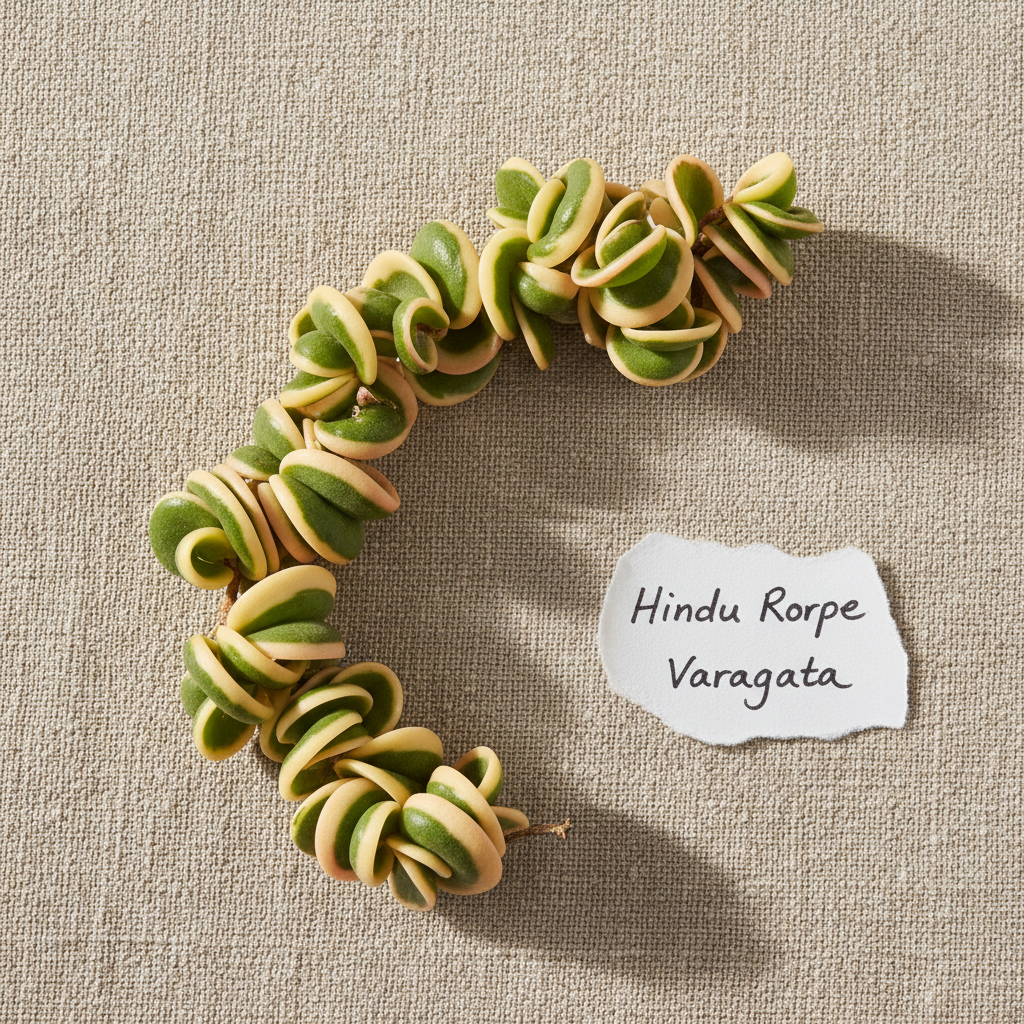
Hindu Rope Variegata is the most widely grown variegated form. Each tightly curled leaf is edged with a broad creamy yellow or pale pink margin, and the green centre flushes a soft rose-pink under strong indirect light. It grows noticeably slower than the all-green form and is more prone to revert to plain green if kept too dark, so a brighter window is essential.
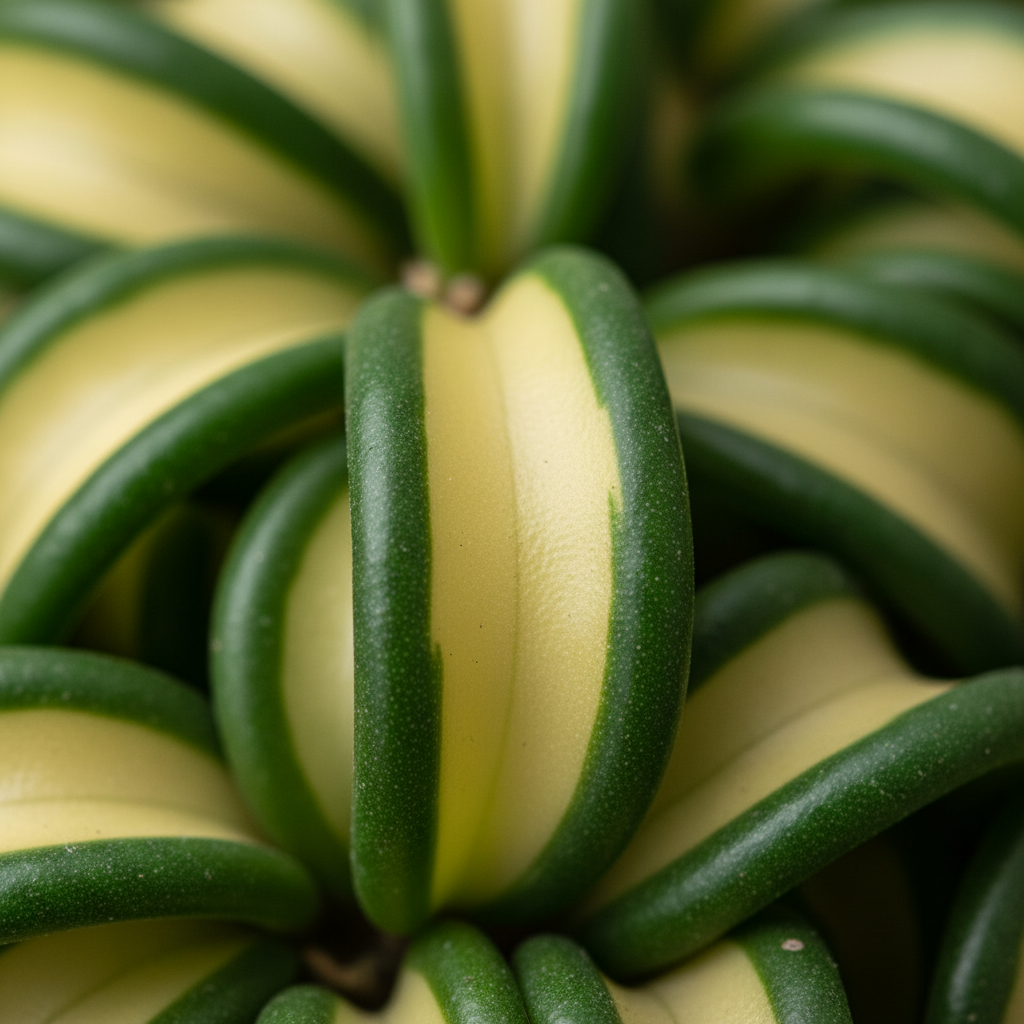
Regalis, sometimes labelled ‘Krimson Princess Compacta’ in the trade, reverses the pattern of Variegata: the leaf centre is a clear cream-yellow, sometimes white, and the outer margin is a deep saturated green. It is the slowest of the popular forms and the most demanding of even, bright, indirect light to hold its colour. Mature stems with strong yellow centres are particularly prized by collectors.
Two further forms turn up occasionally in specialist nurseries. ‘Krimson Queen Compacta’ shows white-to-pink margins on a green centre, much like Variegata but with cooler tones and a tendency to push more pink in cool, bright conditions. ‘Mauna Loa’ is a particularly contorted clone discovered in the 1980s with leaves so tightly clustered that no internodes are visible at all; it is rare, slow, and usually only sold by hoya specialists. All of these forms share the same flowers as the plain green parent, though they may take a season or two longer to reach blooming maturity.
Frequently Asked Questions
Why won’t my Hindu Rope Plant flower?
The two usual culprits are insufficient light and immaturity. Plants typically need to be at least three to four years old, with several long mature stems, before they produce their first umbel. They also need consistently bright indirect light, ideally with an hour or two of soft direct sun. The third hidden cause is the cutting off of the peduncles, the short woody stubs left after each flowering. Leave them in place and the plant will flower from the same point again next year.
Is the Hindu Rope Plant safe for cats and dogs?
Yes. The ASPCA lists Hoya carnosa as non-toxic to both cats and dogs, and the same applies to the compact form. That said, the milky sap can irritate sensitive skin or upset a curious pet’s stomach in large quantities, so it is still sensible to keep nibbled plants away from determined chewers.
How fast does a Hindu Rope Plant grow?
Slowly. Expect a few centimetres of new vine per month during the active season and almost no growth in winter. A small starter plant typically takes three to five years to fill its pot and start to look established. Bright light, warmth and a chunky mix accelerate growth as much as anything will.
Why are the leaves turning yellow?
A single older leaf yellowing and dropping every few months is normal turnover. Several leaves yellowing at once usually points to overwatering, with root rot as the underlying cause; check soil moisture and inspect the roots. If the yellow has a bleached, washed-out quality and the affected leaves are all on the side closest to the window, the cause is more likely sun scorch and the plant should be moved a little back from the glass.
Can I grow a Hindu Rope Plant outdoors?
Only in climates where night-time temperatures remain reliably above 10 degrees Celsius (50 Fahrenheit). In USDA zones 10 and 11 it will live happily outside in dappled shade. Anywhere cooler, treat it as a strict indoor plant or move it outdoors only during the warm months and bring it back inside before the first chilly autumn night.
What is the sticky substance on the flowers and nearby surfaces?
That is nectar, secreted by the flowers themselves rather than a sign of any pest. Each umbel can drip noticeable amounts during the bloom period, sometimes pooling beneath the plant. It is harmless, washes off any surface with warm water, and is one of the small surprises of growing a flowering hoya. Place a saucer beneath the pot or move the plant off polished wood furniture for the duration of the bloom.
How do I encourage thicker, more compact growth?
Three levers matter most. The first is light: more bright indirect light produces shorter internodes and tighter, denser leaves. The second is patience with repotting: a slightly pot-bound Hindu Rope Plant grows more compactly than one given too much fresh root room. The third is to leave the long trailing stems alone rather than pinching them back; new branching usually emerges from old leaf axils rather than from the cut tip, and lost stems can take years to replace.






