
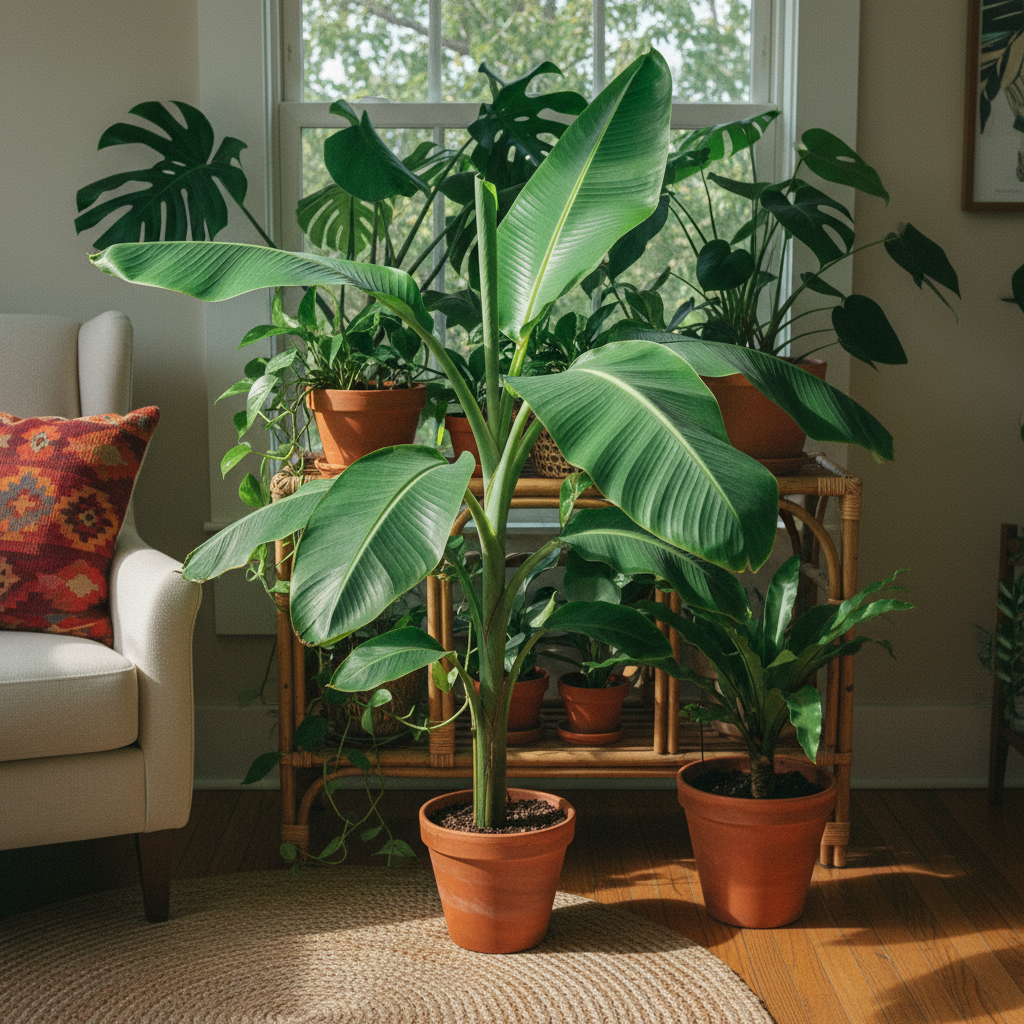
Few houseplants announce a tropical mood quite as confidently as a banana plant. With its sweeping paddle-shaped leaves, vivid green pseudostem and the sheer scale it can reach in a sunny corner, the indoor banana (Musa acuminata, with the species often shortened to “dwarf banana”, “Cavendish banana” or simply the banana plant) turns a living room into something closer to a glasshouse. Despite its size, it is not a tree at all but a colossal herbaceous perennial native to the warm, wet forests of Southeast Asia, where wild populations have been cultivated by humans for at least seven thousand years to give us the modern dessert banana.
The banana plant carries a reputation as either an effortless tropical statement piece or a frustrating diva, depending on whose advice you read. Both stories contain truth. As a tropical giant with prodigious water and light demands, it punishes neglect within days: pale leaves, brown crispy margins and stalled growth come quickly when conditions slip. Yet given what it actually wants, the same plant rewards you with a leaf or two every couple of weeks in the growing season, a steady stream of pups for free new plants, and occasionally even a flower spike if conditions hold long enough. This guide covers what it takes to keep a banana plant alive indoors, and then what it takes to make it thrive.
Contents
- Quick Reference
- Why the Banana Plant Makes a Striking Houseplant
- Light Requirements
- Watering and Humidity
- Soil, Potting and Repotting
- Fertilising
- Propagation
- Pests and Diseases
- Popular Varieties
- Frequently Asked Questions
Quick Reference: Banana Plant at a Glance
| Light | Very bright indirect to several hours of direct sun; south or unobstructed west window indoors. |
| Watering | Keep evenly moist in the growing season; allow only the top 2 to 3 cm (1 in) to dry between waterings. Never bone-dry, never waterlogged. |
| Temperature | 18 to 30 °C (65 to 86 °F); will sulk below 13 °C (55 °F) and drop leaves below 10 °C (50 °F). |
| Humidity | 50 percent and above preferred; tolerates 40 percent reluctantly. Below 30 percent and leaves crisp at the edges. |
| Fertiliser | Heavy feeder. Balanced liquid feed every 2 to 3 weeks in spring and summer; pause or halve in winter. |
| Toxicity | Non-toxic to cats, dogs and humans. Sap can stain fabric a dark rust colour. |
Why the Banana Plant Makes a Striking Houseplant
The visual case for a banana plant indoors is straightforward. Few species in the houseplant trade deliver the same combination of speed, scale and theatrical foliage. A healthy young Musa acuminata will push out a new leaf every 7 to 14 days in summer, each one larger than the last, and within a single growing season a small nursery plant can transform a quiet corner into a tropical alcove. The leaves themselves are huge soft-tissue paddles, often a metre long indoors and twice that outdoors, with a pale glossy midrib and parallel venation that catches light like green silk.
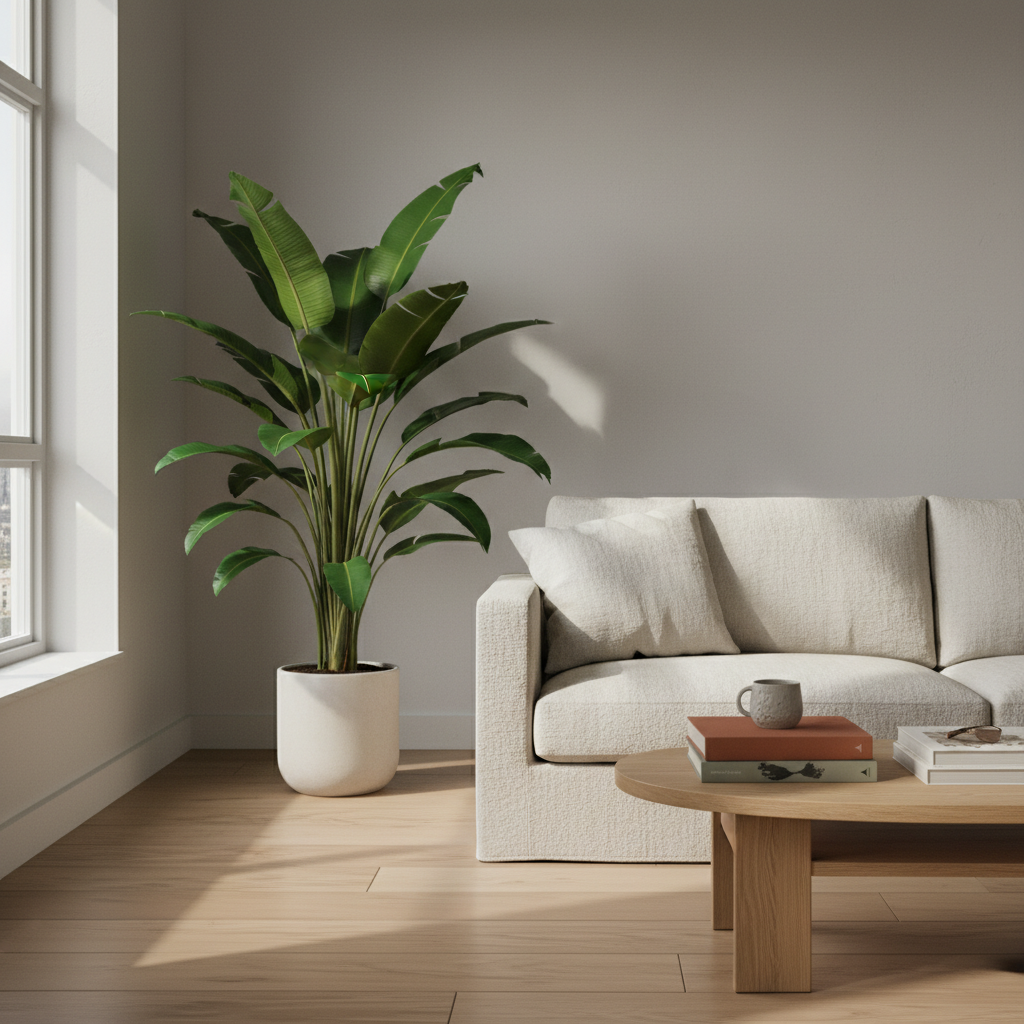
Beyond aesthetics, the banana has a few quiet practical advantages. It is comfortably non-toxic to cats, dogs and curious children, which puts it in a small minority of large statement houseplants. It is also remarkably forgiving of pruning: damaged outer leaves can be trimmed back without harming the plant, because each leaf emerges from the centre of the pseudostem and the older outer leaves are effectively expendable. And because banana plants reproduce vegetatively from suckers around the base, a single specimen will, given time, supply you with multiple identical pups that you can pot up or give away. Few large houseplants are this generous.
It is worth being honest about the limits, too. The banana is monocarpic at the pseudostem level: once a stem flowers and fruits, that particular trunk dies back, and the plant continues through its pups. Indoor flowering is uncommon and indoor fruiting is rarer still, requiring years of strong growth, ample warmth and very bright light. Most indoor banana keepers are growing the plant for its foliage, not its fruit, and that is a perfectly sensible goal. The leaves are the show.
Important — Toxicity: The banana plant is non-toxic to cats, dogs and humans, and all parts (including the leaves) are safe in casual contact. The clear sap can, however, oxidise to a deep rust-brown colour that stains fabric permanently, so handle with a cloth you do not mind ruining when repotting or removing leaves.
Light Requirements
Light is the single biggest variable separating a banana plant that thrives from one that limps along. In its native habitat in tropical Southeast Asia, Musa acuminata grows in forest clearings and at woodland edges where it receives long hours of full sun softened slightly by atmospheric haze. Indoors, the closest analogue is an unobstructed south-facing window in temperate latitudes, or a bright sunroom with overhead glazing. The plant is not a shade-dweller, and trying to grow it as one is the most common reason indoor specimens stall.
Ideally, an indoor banana receives 6 to 8 hours of strong light each day, including some direct sun. Where direct sun is hard to come by, supplementing with a full-spectrum LED grow light extends the practical growing season and prevents the gradual decline that sets in over a dim winter. A plant kept too dark for too long produces narrow, washed-out leaves on long thin petioles, with longer and longer intervals between new leaves until growth halts altogether.
Light Levels Explained
A useful way to translate lighting jargon into reality is the lux scale. Lux measures the amount of visible light reaching a surface, and a small inexpensive lux meter (or any of the free smartphone apps) lets you check what your banana is actually receiving rather than guessing from the look of the room. Direct summer sun at midday measures around 100,000 lux outdoors. By the time it has passed through window glass and travelled a metre or two into a room, that figure has often dropped to a quarter or less.
| Light Category | Approx. Level | Typical Location | Outcome for Banana |
|---|---|---|---|
| Direct sun | 20,000 to 50,000 lux | Right at a south or west window in summer | Strongest growth, ideal if humidity stays up |
| Bright indirect | 10,000 to 20,000 lux | A pace back from a sunny window | Good growth, marginally smaller leaves |
| Medium indirect | 2,500 to 10,000 lux | Across a bright room, or behind sheer curtain | Survives, slow growth, leaves narrow over time |
| Low | 500 to 2,500 lux | Far corner of a bright room, or a north window | Gradual decline, then stall |
| Very low | Below 500 lux | Hallways, interior rooms without windows | Not viable; the plant will fail within months |
Window Orientation and Placement
South-facing window: The natural home for a banana plant in the Northern Hemisphere (or a north window in the Southern Hemisphere). A south-facing window delivers the strongest light for the longest stretch of the day. Place the plant within a metre of the glass for best results, and rotate it a quarter turn weekly so growth stays even and the pseudostem does not lean.
East-facing window: Workable, especially in summer. East light is gentler and arrives early in the day, which the plant tolerates well. Growth will be slightly slower and leaves marginally smaller than in a south window, but the plant will look healthy.
West-facing window: A strong second choice. West windows deliver intense afternoon sun, which a banana plant relishes, although the heat can dry the soil quickly and stress the leaves if humidity is low. Pull the plant back about half a metre from the glass on the hottest summer afternoons to soften the load.
North-facing window: Marginal at best. North light is the dimmest and coolest of the four cardinal orientations, and a banana plant will only tolerate it as a temporary holding spot. For long-term north-window placement, supplement with a grow light directly above the plant for 10 to 12 hours each day.
Pro Tip — Acclimatise to Direct Sun: A banana that has been kept in indirect light for months will scorch dramatically if you move it straight to a sun-blasted south window. Step it up over 10 to 14 days, adding an hour of direct exposure every couple of days. The leaves toughen visibly as they adjust.
How Light Affects Leaf Size and Colour
Leaf size in a banana plant is a direct read-out of how much energy the plant has banked. Strong light produces broad, substantial paddle leaves that hold their shape; weak light produces narrower leaves on lengthy petioles, with a paler green that lacks the slight sheen of a well-grown plant. In strong direct light, leaves may also develop a faint reddish bronze tint along the midrib and at the unfurling tip, which is a normal pigment response and not a sign of distress. In the burgundy-striped ‘Zebrina’ or Blood Banana variety, this same effect is dramatically amplified into the deep maroon banding the variety is named for; in light too dim, the burgundy fades to muddy bronze.
Warning — Direct Sunlight: Although the banana plant is sun-loving, large soft leaves still scorch if they are pressed against hot south-facing glass on a still summer day. Leave at least a hand’s width between the leaves and the windowpane, and consider a sheer curtain during the worst of midday heat in very sunny rooms.
Artificial Lighting
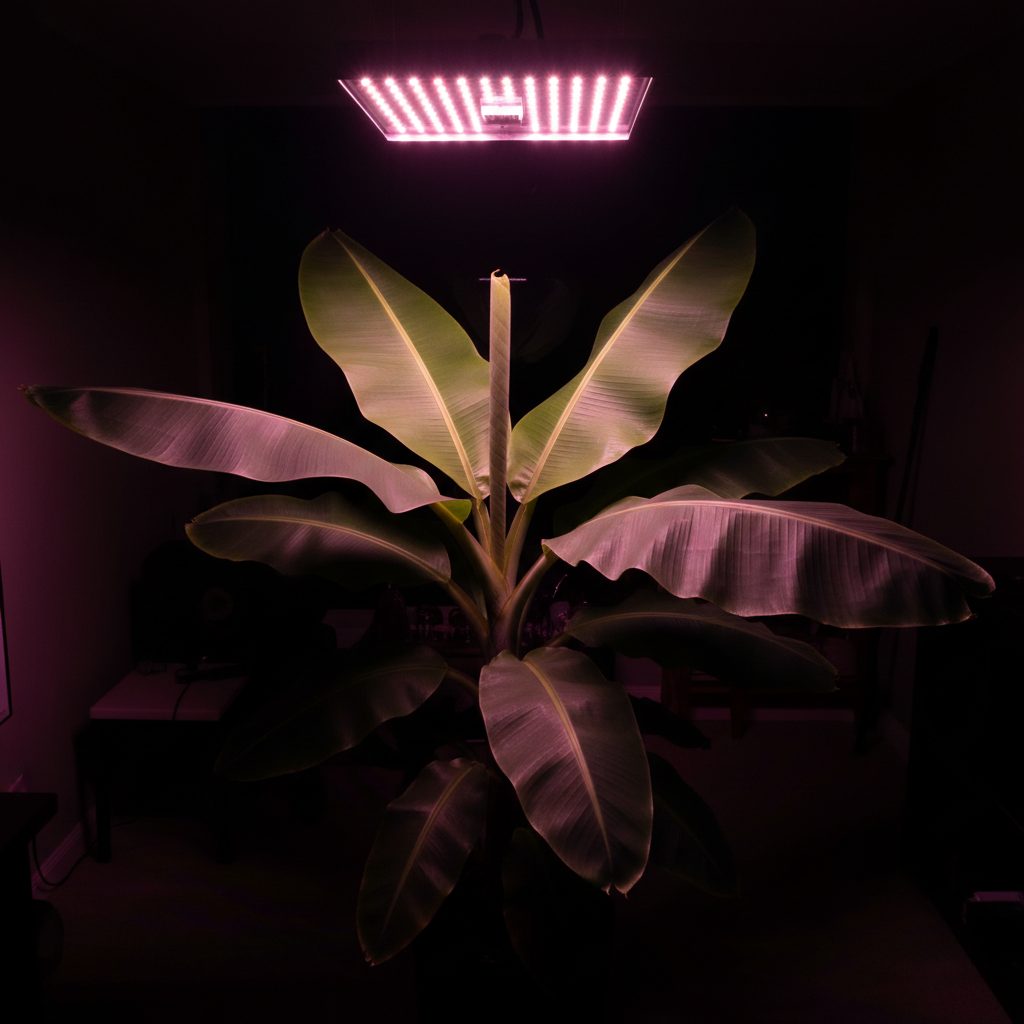
Because the banana plant photosynthesises so vigorously, it is one of the houseplants that responds most visibly to supplementary lighting. A full-spectrum LED grow light at 30 to 50 watts, suspended 40 to 60 cm (16 to 24 in) above the canopy and run on a timer for 10 to 12 hours each day, can replace much of the missing winter sun in a temperate climate. Older bulb technologies (compact fluorescent, halogen, incandescent) are not powerful enough and waste most of their energy as heat. Look for an LED panel rated at a photosynthetic photon flux density (PPFD) of at least 200 µmol per square metre per second at canopy height for genuine effect.
Seasonal Adjustments
Light through a window varies dramatically across the year. A south window that delivers 30,000 lux at the leaf surface on a clear June afternoon may deliver only 4,000 lux on an overcast December afternoon, with the sun lower in the sky and the days shorter at both ends. The simplest response is to move the plant slightly closer to the glass for the winter months, or to switch on a supplementary grow light from October through to March. Plants under continuous strong light through the winter will continue to produce new leaves at a slower rate; plants left in dimming light from autumn onward typically enter a half-dormancy and produce nothing until March.
Watering and Humidity
Bananas are thirsty plants. In the wild, Musa acuminata grows along seasonally flooded valleys and humid forest fringes where the soil never dries out for long. Indoors, that translates to a steady supply of moisture without ever letting the root ball sit in standing water. The mantra “moist but never soggy” comes up often in houseplant care, and for a banana it is more accurate than most: even a single week of bone-dry soil will brown the leaf margins and shed a leaf or two, while a fortnight of waterlogged soil will collapse the root system to mush.
When to Water
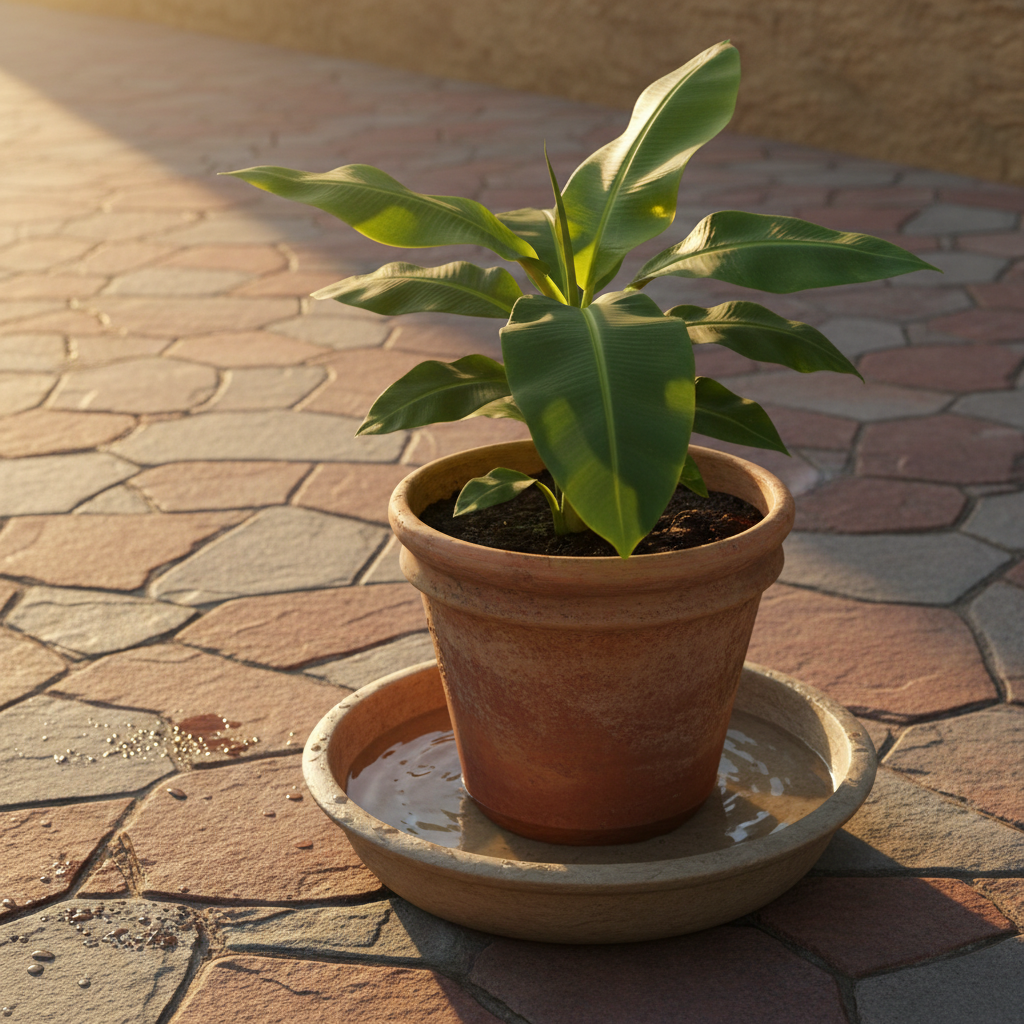
The most reliable cue is a finger pressed two knuckles deep into the soil. When the top 2 to 3 cm (1 in) feels dry and the layer beneath feels just barely cool and moist, it is time to water. In a warm bright spot during summer, that point arrives every 3 to 5 days for a plant in a 25 to 30 cm (10 to 12 in) pot. In winter, with shorter days and slower transpiration, the same plant might only need watering once every 10 to 14 days.
Pot weight is the other useful signal, and arguably the more reliable one once you know the plant. A freshly watered banana plant in a 25 cm pot is noticeably heavy; the same plant a week later, with the root ball largely drained, lifts with surprising ease. Get into the habit of lifting the pot a couple of centimetres off the saucer each morning as you pass by; the gradient from “lead weight” to “almost weightless” tells you exactly where in the cycle the soil is.
Pro Tip — The Wooden Skewer Test: Push a long bamboo skewer or wooden chopstick all the way to the bottom of the pot, leave it for 60 seconds, then pull it out. If it comes out with damp soil clinging to the lower half, do not water. If it slides out almost clean and dry, water thoroughly. This is more reliable than any moisture meter for the deep root zone where a banana actually drinks.
How to Water Correctly
- Move the plant to a sink, shower or saucer that can catch run-off; the volume of water needed for a banana easily overspills a small under-pot tray.
- Water slowly around the entire soil surface, not just one spot. Aim for water to spread evenly so the whole root ball rehydrates rather than channelling down one dry corridor.
- Keep adding water until you see a steady flow from the drainage holes underneath. For a banana this often means 1 to 2 litres for a 25 cm pot.
- Allow the pot to drain for at least 10 to 15 minutes before returning it to its saucer or decorative cover pot. Standing water at the base is the single most common cause of root rot.
- Tip out any water that collects in the saucer after an hour. The roots should be moist, not submerged.
- Wipe down the pseudostem and any splashed leaves; banana sap and water together can attract fungus gnats if left as wet patches.
Signs of Overwatering vs. Underwatering
| Symptom | Overwatering | Underwatering |
|---|---|---|
| Leaf colour | Yellowing of older lower leaves first, often with brown soft patches at the base | Whole-leaf paleness fading to crisp tan, starting at the leaf tip and margin |
| Leaf texture | Soft, limp, sometimes blackened at the petiole | Dry, papery, edges curling inward and tearing at the lightest touch |
| Soil | Stays dark and cold to the touch days after watering; may smell sour | Pulls away from the pot wall, dusty and pale on the surface |
| Roots | Brown, soft, easily snapped between fingers, may smell of rot | Pale, brittle, dry to the touch but still firm |
| Pseudostem base | Soft, sometimes mushy, occasionally weeping clear sticky liquid | Firm but slightly shrunken; the whole stem may lean |
Warning — Root Rot: If you suspect root rot (sour smell from the soil, soft pseudostem base, persistent yellowing of new growth), unpot immediately. Wash the root ball clean of soil, trim every blackened or mushy root back to white tissue with sterilised scissors, and replant into fresh chunky aroid-style mix. Hold off watering for 3 to 5 days afterwards to allow cut surfaces to callous. A banana caught early can recover; one left a week longer almost never does.
Humidity Requirements
Banana plants are tropical understorey emergents, evolved for the cloud-laden 70 to 90 percent humidity of monsoon-fed forests. Indoor humidity, by contrast, frequently sits between 20 and 40 percent, particularly in centrally heated homes through winter. A banana will survive that, but it will look the part: brown crispy edges to every leaf, splits running from the margin toward the midrib, and a generally tired appearance.
Aim for 50 percent or higher at the leaf surface. The most common symptoms of inadequate humidity are tip browning that spreads inward, brittle leaf edges that crack with handling, and a tendency for the slim emerging new leaf (called the “cigar”) to dry out and tear before it can unfurl. These signs all worsen in the dead of winter when heating is at its peak and indoor air at its driest.
Practical ways to raise humidity around a banana include grouping it with other large-leaved plants so each plant adds to the local microclimate, placing the pot on a wide pebble tray kept topped up with water, and running a small ultrasonic humidifier within a metre of the plant for several hours a day. Misting offers a brief lift in humidity but evaporates within minutes; on its own, misting does very little, and it can encourage fungal spotting if it leaves persistent wet patches on the leaves. A humidifier is by far the most reliable solution for serious banana growing in a dry climate.
Water Quality
Banana plants are somewhat sensitive to high mineral content. Tap water in hard-water areas can leave whitish deposits at the pot rim and a yellowing pattern along the leaf margins that mimics underwatering but does not respond to it. If your area has noticeably hard water, switching to rainwater, distilled water or filtered water often resolves the symptoms within a couple of leaf cycles. Letting tap water sit overnight does little for hardness but does allow chlorine to dissipate, which is occasionally relevant. Aim for water at room temperature; cold tap water shocks tropical roots and slows nutrient uptake for hours afterwards.
Soil, Potting and Repotting
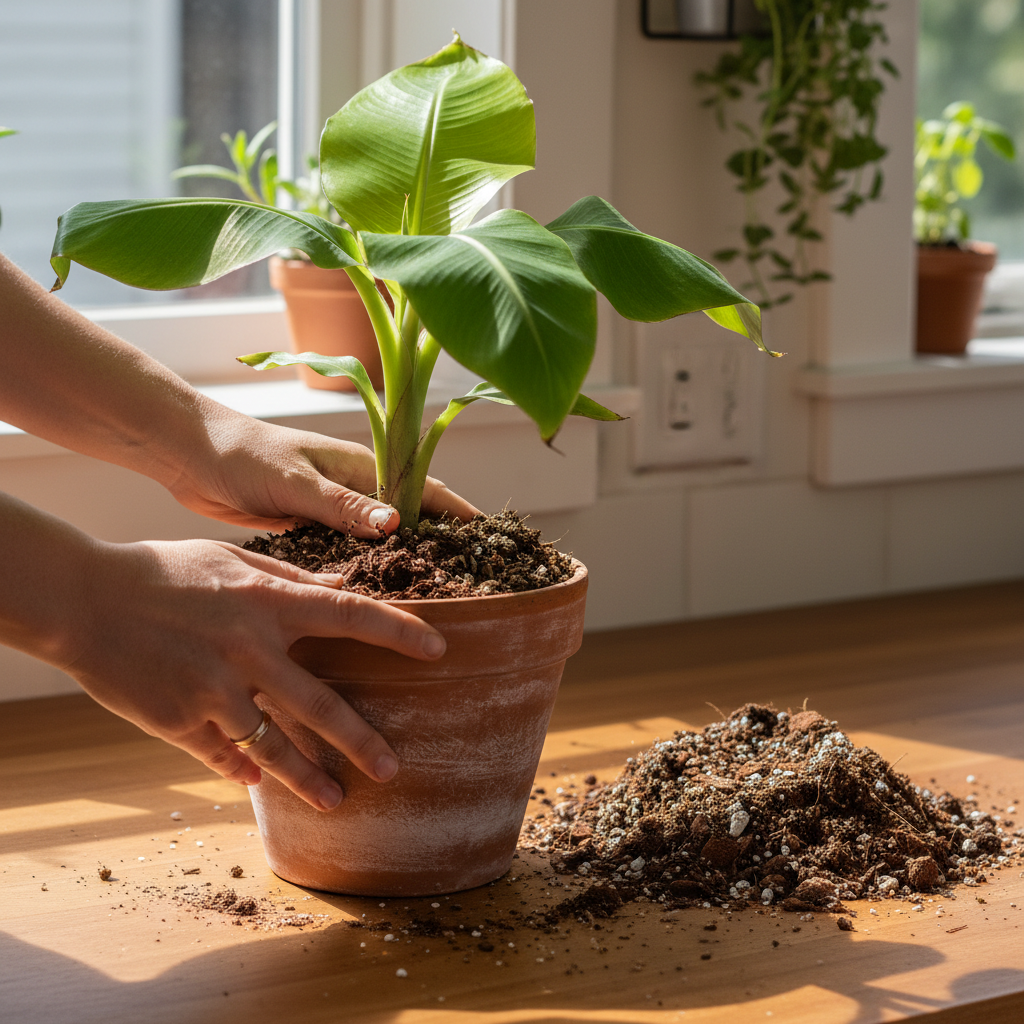
A banana plant lives or dies by its substrate. Because the species transpires so vigorously and demands consistent moisture, the temptation is to potting it into a moisture-retentive mix and let it stay damp. That works briefly and then collapses, because tropical bananas also demand a free flow of air and water through the root zone. The trick is a substrate that holds moisture while still draining freely; in other words, a chunky, peat-light, aerated mix closer to an aroid blend than to a generic compost.
Ideal Soil Composition
A reliable mix for indoor banana plants combines a high-quality houseplant base with substantial aeration material and a generous helping of organic richness. The goal is a substrate that drinks water in quickly, releases it back to the roots over several days, and never compacts into an airless slab. Compaction is the slow killer of banana plants kept in straight potting compost: as the peat breaks down over a season, oxygen disappears from the root zone and the plant simply runs out of breath.
| Component | Proportion | Function |
|---|---|---|
| Quality houseplant or aroid compost | 50 percent | Base nutrition and moisture retention |
| Coarse perlite or pumice | 20 percent | Aeration; prevents the mix from compacting over time |
| Orchid bark (fine to medium grade) | 15 percent | Chunky structure, slow-release organic matter |
| Coco coir or sphagnum moss | 10 percent | Holds moisture between waterings without turning sour |
| Worm castings or composted manure | 5 percent | Slow steady nitrogen release |
The banana prefers a slightly acidic substrate, in the range of pH 5.5 to 6.5, which most peat-based or coco-coir-based potting mixes naturally provide. Strongly alkaline soils (pH above 7.5) lock up iron and manganese, two micronutrients the banana needs in surprisingly large amounts for healthy green leaves. If you live in a hard-water area and water with the tap, you may need to flush the pot with rainwater or distilled water every couple of months to reset the soil pH.
Pro Tip — Quick Mix Recipe: Four scoops of quality aroid compost, two scoops of coarse perlite, one and a half scoops of orchid bark, one scoop of coco coir and half a scoop of worm castings, all mixed in a large bucket. The result drains freely yet holds enough moisture to keep a banana happy between waterings.
Choosing the Right Pot
Banana plants are surprisingly fast root developers, and they appreciate a generous container. A young nursery plant typically arrives in a 14 to 17 cm pot; within six months in good conditions, it will be ready for a 20 to 25 cm pot, and within another year for a 30 cm or larger pot. The plant grows in proportion to its root volume, so an undersized pot caps the entire plant.
Drainage holes are non-negotiable. Skip them and even the most carefully tuned substrate becomes a stagnant trap, because the lowest layer of soil never dries between waterings. A banana planted in a sealed decorative pot is on a slow countdown to root rot. Use a plastic or terracotta nursery pot with proper drainage, and drop that inside a decorative cover pot if the look matters. Empty the cover pot of standing water after every watering.
Pot material: Terracotta breathes through its walls, evaporating moisture from the sides of the root ball and letting oxygen reach the roots; this suits a thirsty banana and forgives small overwatering mistakes. Plastic and glazed ceramic hold water more tightly, which means longer intervals between waterings but a smaller margin for error. A heavy pot also helps anchor a tall banana so it does not topple as the canopy widens; a tall narrow plastic pot in a featherweight cover is asking for a crash.
Pot size: Move up one size at a time, typically 3 to 5 cm of diameter per repot, no more. A banana suddenly translated to a vastly larger pot sits in cold, wet soil it cannot drink, and the root system stalls before it can colonise the new volume. Better to repot a little earlier into a slightly larger pot and do it again next year than to overshoot in one go.
When to Repot
Young vigorous banana plants need repotting roughly once a year, in early spring just as new growth is gearing up. Mature plants in a large pot can stretch this to every other year, although they will benefit from a top-dressing of fresh compost and worm castings in the off years. Signs that a repot is overdue include roots circling at the surface, roots growing out of drainage holes, water rushing straight through the pot without absorbing, and a slow drift downward in leaf size despite consistent care. A plant that has gone too long unrepotted often loses the lowest crown of leaves entirely.
How to Repot: Step-by-Step
- Water the plant lightly the day before repotting so the root ball comes out as a cohesive unit rather than crumbling.
- Prepare the new pot: clean it, place a small piece of mesh or crocked terracotta over the drainage hole, and add a 3 to 5 cm layer of fresh mix at the base.
- Lay the existing pot on its side and slide the plant out, supporting the pseudostem with one hand and lifting the pot with the other. For a stuck root ball, run a long knife around the inside wall of the pot to break the seal.
- Gently tease the outer roots free with your fingers, particularly any that are circling. Trim any blackened or dead roots back to clean white tissue with sterilised scissors.
- Position the root ball in the new pot so the pseudostem sits at the same depth as before, and the top of the root ball is 2 to 3 cm below the rim of the pot to leave room for watering.
- Fill the gap around the sides with fresh mix, pressing gently with your fingers (not packing hard) to eliminate large air pockets. Tap the pot on the ground a few times to settle the substrate.
- Water thoroughly until water drains from the bottom, then let the pot drain fully before returning it to its usual spot. Hold off feeding for 4 to 6 weeks to let fresh roots colonise the new mix.
Warning — Transplant Shock: Banana plants are large enough that the act of repotting frequently strips the outermost leaf within a day or two. This is normal. Cut the spent leaf off cleanly at the petiole base and continue with care as usual. New leaf production resumes within 2 to 3 weeks for a healthy plant.
Fertilising
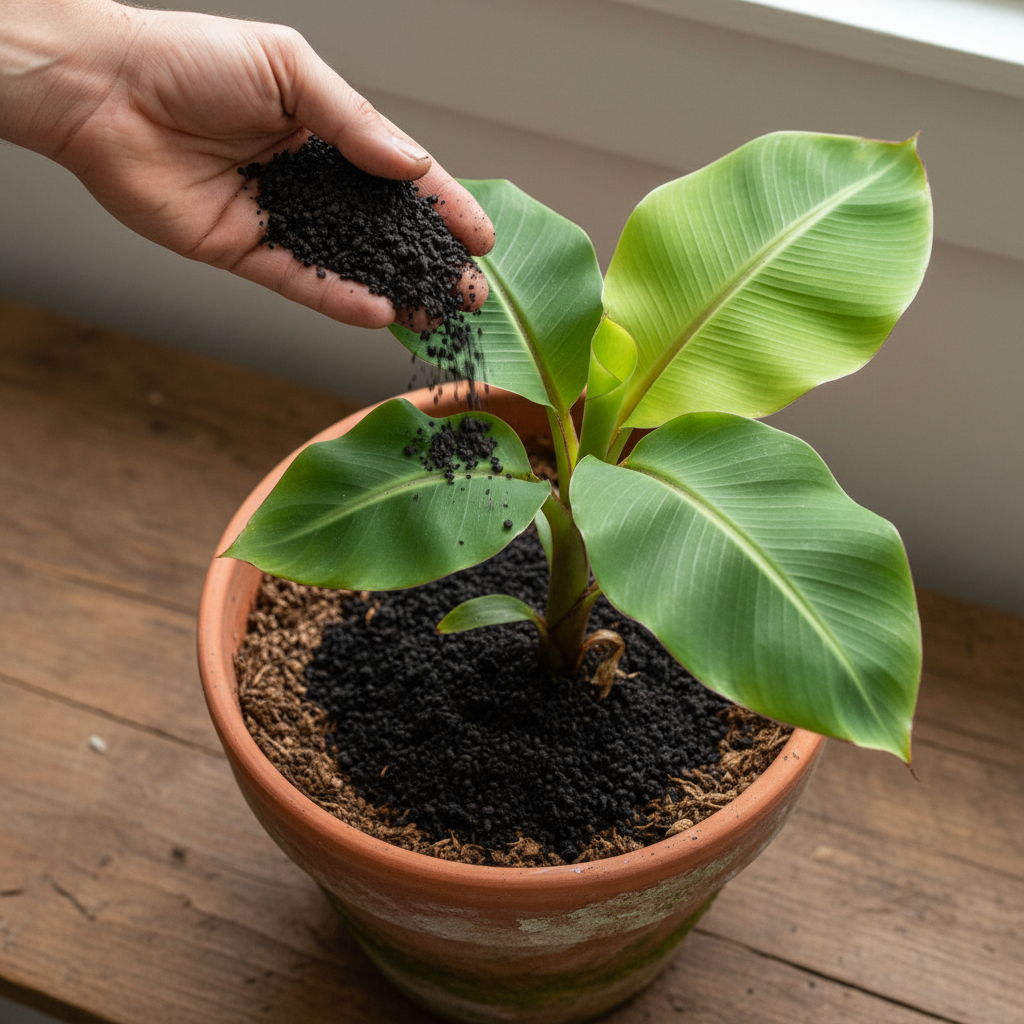
Banana plants are among the heaviest feeders in the indoor jungle. The species evolved in nutrient-rich volcanic and alluvial soils, and a single mature plant pushing out a new metre-long leaf every fortnight is shifting an extraordinary amount of nitrogen and potassium through its tissues. Indoors, the volume of soil available is a fraction of what the plant would draw from in the wild, and that limited pot of nutrients runs dry within months of repotting. Without consistent feeding, a banana plant in good light will simply stall.
The reverse risk, of course, is overfeeding. Because the plant feeds quickly it also accumulates salts quickly, and tap water plus generous liquid feed plus minimal flushing leads to a steady salt build-up around the root ball that scorches leaf margins exactly as drought does. The reliable approach is regular, dilute feeding through the growing season, paired with an occasional thorough flush.
Understanding Plant Nutrients
Banana plants need the same suite of macronutrients and micronutrients as any other foliage plant, but in slightly different ratios. They are particularly demanding of potassium (the K in NPK), which drives the production of large healthy leaves and supports the plant’s prodigious water transport. Nitrogen comes a close second, with phosphorus a more modest requirement. Of the micronutrients, magnesium and iron deserve attention: deficiencies of either show first in indoor bananas, usually as a yellowing pattern between dark green veins.
| Nutrient | Symbol | Primary Function | Deficiency Symptoms |
|---|---|---|---|
| Nitrogen | N | Leaf growth, chlorophyll production | Pale washed-out new leaves, slow growth, lower leaves yellow first |
| Phosphorus | P | Root development, energy transfer | Stunted growth, dull purplish tinge on older leaves |
| Potassium | K | Water regulation, overall vigour | Yellow then brown edges on older leaves, weak floppy growth |
| Calcium | Ca | Cell wall strength | Distorted new leaves, brown spotting on emerging tissue |
| Magnesium | Mg | Centre of the chlorophyll molecule | Yellowing between green veins on older leaves (interveinal chlorosis) |
| Iron | Fe | Chlorophyll synthesis | Yellowing between veins on newer leaves first, sharp contrast pattern |
Types of Fertiliser
Liquid fertilisers: The simplest and most flexible option for indoor bananas. Mix a balanced liquid feed (an NPK of roughly 3-1-3 or 5-2-5 works well) at half the recommended strength and apply with every second or third watering during the growing season. Liquid feed reaches the roots almost immediately, which lets you watch the plant respond and adjust quickly.
Slow-release granular: Coated prills that release nutrients over 3 to 6 months as moisture penetrates the coating. Convenient and forgiving for travel-prone owners, but less responsive: by the time you notice over- or under-feeding, you cannot easily back off. Best used as a baseline at the start of spring, topped up with occasional liquid feed during peak summer.
Organic fertilisers: Worm castings, composted manure, fish emulsion, seaweed extract and similar amendments release nutrients more slowly than synthetic feeds and feed the soil microbiome along the way. Banana plants respond particularly well to a top-dressing of worm castings in spring, and to occasional doses of dilute seaweed extract for trace minerals. The slight earthy smell of organic feed is the only drawback indoors.
Feeding Schedule
In spring and summer, when the plant is actively producing new leaves, feed every 2 to 3 weeks at half the manufacturer’s recommended strength. In autumn, taper feeding to once a month at quarter strength. In winter, when light is short and growth slows or halts, stop feeding entirely; resuming too early in February or March risks salt accumulation in soil the plant is not yet pushing through. A simple rule: if the plant has produced a new leaf in the last three weeks, it earns a feed. If not, wait.
Pro Tip — Half-Strength Always: Manufacturer dosing instructions are written for the outdoor garden, where rain dilutes and flushes excess feed continuously. Indoor pots have no such safety valve. Halving the dose and feeding twice as often gives steadier growth, sharper colour and far less risk of root burn than a single full-strength dose.
How to Fertilise
- Always water the plant first or feed into already-moist soil. Pouring concentrated nutrient solution onto dry soil burns the finest root hairs immediately.
- Mix liquid feed in a clean jug or watering can at half the recommended strength. For granular feed, scatter the prills lightly across the soil surface and water in.
- Pour the diluted feed evenly across the soil surface until you see a little run from the drainage holes. Do not splash leaves or pseudostem.
- Tip out any feed that collects in the saucer after an hour; standing in nutrient solution scorches roots faster than plain water would.
- Once every three months, flush the pot with plain water at three times the pot’s volume to wash out accumulated mineral salts. Skip the feed that week.
Warning — Salt Build-Up: A white crust around the pot rim or on the soil surface is the visible sign of mineral salt accumulation from repeated feeding. Left unchecked, salt build-up burns the leaf margins, mimics underwatering symptoms and gradually poisons the root zone. Flushing with plain water every 8 to 12 weeks prevents the problem.
Propagation
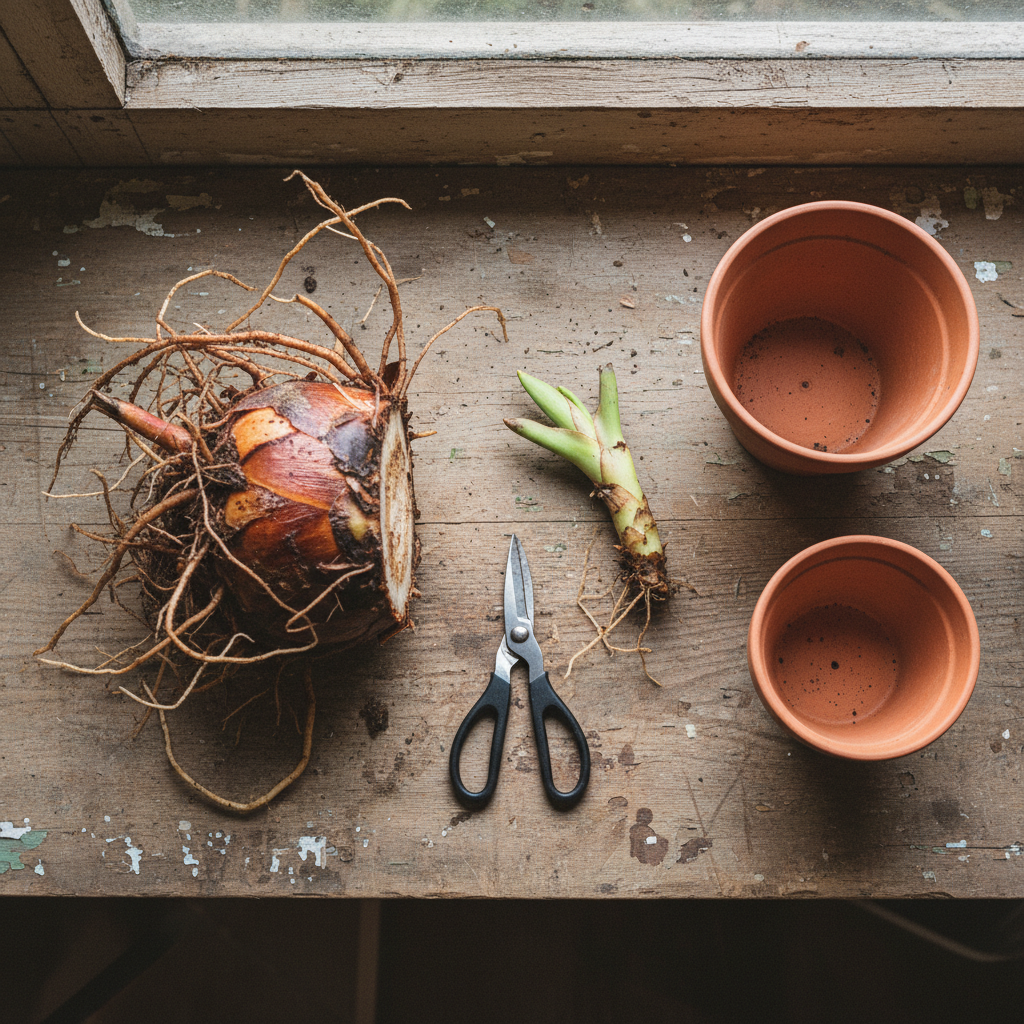
One of the quietly satisfying things about a banana plant is that it constantly produces its own succession plan. Every banana grows from a thick underground stem called the corm, and from this corm new pseudostems (called pups, suckers or keiki, depending on who you ask) emerge alongside the parent. Left to itself, a single banana plant gradually becomes a clump; intervened with, those pups become free new plants.
Because a banana’s pseudostem is monocarpic, meaning it dies after fruiting (or after several years even without fruiting indoors), this constant pup production is how the plant carries itself forward. Encouraging and managing pups is therefore the central propagation task, rather than the more familiar tip cuttings or leaf-rooting of other houseplants. Stem and leaf cuttings do not work on bananas, and seed-grown plants from supermarket fruit are essentially impossible because dessert bananas are sterile triploids.
Understanding the Corm and Pups
The corm sits just below the soil surface and looks something like a knobbly bulb. It is the true stem of the plant; everything visible above the soil is leaf material, including what looks like the trunk. When a pup emerges, it is a new shoot rising from a bud on the corm, and it is already connected to the parent’s root system. Pups grow slowly at first while the parent dominates, then accelerate dramatically once they reach roughly a third of the parent’s height. By the time a pup is 30 to 50 cm (1 to 1.5 ft) tall and has its own visible roots near the corm, it is ready to be separated.
Division of Pups: Step-by-Step
Division is by far the most reliable propagation route for an indoor banana, and the best time to do it is in late spring as the plant enters its strongest growth phase. Cooler conditions slow the healing of cut tissue and increase the risk of corm rot. Aim to separate pups that are at least 30 cm tall, with two or three leaves of their own and visible roots at the base.
- Water the parent plant the day before so the substrate is moist and the root ball comes out cleanly.
- Unpot the entire plant onto a sheet or large tray, taking care not to bend or snap the pseudostems.
- Gently brush away enough soil to expose the corm and identify where the pup joins the parent. Look for the visible junction along the corm.
- Using a clean sharp knife (sterilise the blade with isopropyl alcohol first), make a single decisive cut through the corm to separate the pup with a section of corm and as many of its own roots as possible.
- Dust both cut surfaces with cinnamon powder or a fungicide to discourage rot. Leave them to air-dry for an hour in shade so the wound calluses slightly.
- Pot each piece into its own pot of fresh banana mix at the same depth it was growing before. Water in lightly, just enough to settle the substrate.
- Place the new pup somewhere warm, bright but out of harsh direct sun, and resist the urge to water heavily for the first two weeks. New roots are establishing and excess moisture invites rot at the cut.
Pro Tip — Sword Suckers vs. Water Suckers: Bananas produce two kinds of pup. “Sword” suckers have narrow tapering leaves and a thick connection to the corm; they are the strong genetic match to the parent and the best for propagation. “Water” suckers have broad floppy leaves from the start and only a thin connection; they grow up weaker and are best removed early to redirect the parent’s energy. Look at the leaves on the pup before you commit to dividing.
Corm Sectioning: Step-by-Step
For more advanced growers, the corm itself can be cut into sections, each containing at least one growing bud or “eye”. This method is slower and riskier than pup division but allows one mature corm to give rise to several new plants. It is also a useful technique when a parent pseudostem has fruited and is dying back but the corm remains alive underground.
- Unpot the plant and wash the corm clean of soil so the buds (small pale knobs on the corm surface) are clearly visible.
- Identify sections that contain at least one bud, preferably two, and a portion of root tissue.
- Cut the corm into these sections with a sterilised knife, making clean cuts rather than ragged ones.
- Dust every cut surface with cinnamon or sulphur powder and let the pieces air-dry for 24 hours in a shaded warm spot.
- Pot each section bud-side up in well-draining mix, just covering the corm with substrate. Keep the substrate barely moist and warm (24 to 28 °C / 75 to 82 °F) until shoots appear, which typically takes 4 to 8 weeks.
Troubleshooting Propagation
| Problem | Likely Cause | Solution |
|---|---|---|
| Pup wilts within days of separation | Too few roots taken with the pup, or cut left too wet | Move to a smaller pot, mist the leaves lightly, hold off water until soil is nearly dry, then water sparingly |
| Cut surface turns black and mushy | Fungal infection at the cut | Recut to clean tissue, dust generously with cinnamon or sulphur, dry for 48 hours before replanting |
| New pup produces only thin floppy leaves | Water sucker rather than sword sucker | Accept the plant will be weak, or remove and start again with a sword sucker |
| Corm section produces no shoot after 8 weeks | Bud was damaged, or temperature too cool | Check the corm for firmness; if still firm, move to a warmer spot (above 24 °C) and wait another month |
Pests and Diseases
Indoors, banana plants are not especially pest-prone, but the conditions that suit them (warm temperatures, generous foliage, regular watering) also suit several houseplant pests. The biggest predictor of trouble is low humidity in winter, which weakens the leaves and makes them vulnerable, and overcrowded conditions where the banana is jammed up against other infested plants.
The good news is that a banana plant’s broad smooth leaves make pest detection easy. Routine inspection, ideally a quick check of the leaf undersides and the unfurling new leaf every week or two, catches most problems while they are still small. Most pest issues can be resolved with simple physical measures before pesticides come into play.
Common Pests
Spider Mites (Tetranychus urticae)
Spider mites are the most common pest of indoor banana plants, particularly in heated winter rooms where humidity drops below 30 percent. The mites themselves are minute, pinhead-sized and reddish or pale yellow, and they live on the undersides of leaves where they pierce cells and drain the contents. Early signs are a faint stippling of pale dots across the leaf surface, followed by a dusty look and, in advanced infestations, fine silken webbing strung between the leaf and the petiole.
Treatment: Rinse the plant thoroughly in a tepid shower, paying special attention to leaf undersides. Follow up with weekly applications of insecticidal soap or neem oil spray for at least three weeks to break the egg-hatching cycle. Raise local humidity to above 50 percent for at least a month, which alone will halt most spider mite outbreaks because the mites cannot reproduce well in humid air.
Mealybugs (Pseudococcus spp.)
Mealybugs are slow-moving 3 to 5 mm insects coated in a white waxy fluff. They hide in the leaf axils where the petiole meets the pseudostem, and along the midrib on the underside of the leaf. A mealybug infestation looks at first like specks of cotton wool tucked into crevices; left alone, those colonies grow until honeydew (their sugary excretion) coats the leaves and a black sooty mould follows.
Treatment: Dab visible mealybugs with a cotton bud dipped in 70 percent isopropyl alcohol, which dissolves the waxy coating and kills them on contact. Follow up with a weekly insecticidal soap or neem oil spray for at least four weeks to catch the next generation as eggs hatch. Inspect nearby plants because mealybugs spread on contact.
Aphids (Aphis spp.)
Aphids occasionally appear on indoor bananas, especially during spring when fresh new leaves are unfurling and tender. The aphids cluster on the youngest tissue, the cigar leaf and the tip of the petiole, where they suck sap and excrete honeydew. Plants brought in from a garden or balcony for the cooler months are the usual entry point.
Treatment: Aphids dislodge easily under a firm jet of water from a shower head or kitchen tap; a single rinse removes most of a colony. Follow up with insecticidal soap if any return, applied weekly until no new aphids appear for two consecutive weeks.
Fungus Gnats (Bradysia spp.)
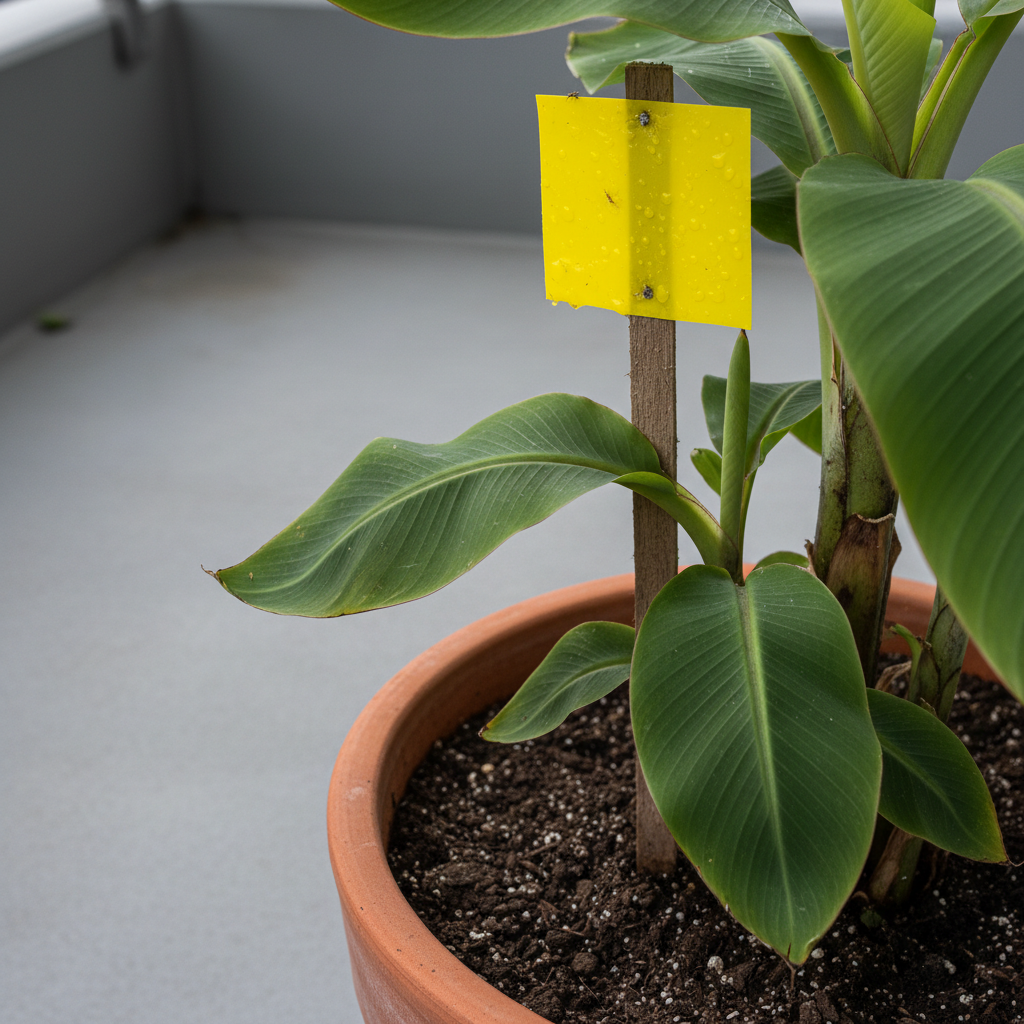
Fungus gnats are small black flies that hover around the soil surface and breed in moist potting mix, feeding on decaying organic matter and tender new roots. Because banana plants prefer consistently moist soil, they offer near-perfect breeding conditions if the surface mix never dries between waterings.
Treatment: Let the top 2 to 3 cm of soil dry fully between waterings; this alone breaks the breeding cycle for most infestations. Top-dress the pot with 1 cm of horticultural sand or fine gravel to deny the females a landing spot for laying eggs. For stubborn cases, drench the soil with a dilute solution of Bacillus thuringiensis israelensis (Bti), which kills the larvae specifically.
Common Diseases
Root Rot (Pythium and Phytophthora spp.)
Root rot is the single most common killer of indoor banana plants. It develops when the substrate stays waterlogged long enough that oxygen disappears from the root zone, allowing opportunistic water moulds to attack the roots. The first visible sign is usually a sudden general yellowing of the newest leaf, followed by a soft mushy base to the pseudostem. By the time the symptoms are obvious from above, the root system is usually well past saving.
Treatment: Unpot immediately, wash the root ball clean and trim every soft brown root back to firm white tissue. Replant into completely fresh chunky mix in a clean pot, ideally one size smaller than before to reduce the volume of damp soil around the diminished root system. Withhold water for 3 to 5 days afterward, then water sparingly until new growth resumes.
Panama Disease (Fusarium oxysporum f. sp. cubense)
Panama disease is a soil-borne fungal disease that infects the vascular system of the banana, causing progressive wilting and yellowing despite adequate water. It is notorious in commercial banana plantations but rare in houseplant settings, where the closed environment and clean substrate offer little entry. Where it does appear indoors, it typically arrives in contaminated soil or on an infected nursery plant.
Treatment: No reliable cure exists once a plant is infected. Discard the entire plant, including the soil and corm, and sterilise the pot thoroughly before reusing. Quarantine any new banana arrivals for several weeks and source plants from reputable suppliers to avoid bringing the disease into your collection.
Leaf Spot (Mycosphaerella spp. and others)
Fungal leaf spot appears as small irregular brown or black spots on the leaf surface, sometimes with a yellow halo around each spot. The fungus thrives in humid stagnant air with water sitting on leaf surfaces, which means consistent overhead misting or splashing during watering is a common trigger. The disease is rarely fatal but can spoil the appearance of a plant.
Treatment: Remove and dispose of affected leaves entirely (do not compost). Improve air movement around the plant with a small fan on low, and water at the soil level only, keeping the leaves dry. A copper-based fungicide can be sprayed at the first sign of new spots if the problem persists.
Pest and Disease Summary
| Pest / Disease | Identification | Treatment |
|---|---|---|
| Spider mites | Pinhead specks under leaves, faint stippling on surface, fine webbing in advanced cases | Shower, neem oil weekly, raise humidity above 50 percent |
| Mealybugs | Cotton-wool tufts in leaf axils and along midribs | Spot-treat with isopropyl alcohol, then weekly insecticidal soap for a month |
| Aphids | Green or black soft-bodied insects on the cigar leaf and youngest petioles | Rinse off with water, follow with insecticidal soap if they persist |
| Fungus gnats | Small black flies hovering at the soil surface | Dry soil between waterings, top-dress with sand, Bti drench for stubborn cases |
| Root rot | Yellowing new growth, soft pseudostem base, sour smell from soil | Unpot, trim affected roots, repot in fresh chunky mix, withhold water |
| Panama disease | Progressive yellowing and wilting despite adequate water and light | No cure; discard plant and substrate, sterilise pot |
| Leaf spot | Brown or black spots with yellow halos on leaves | Remove affected leaves, improve airflow, water at soil only, copper fungicide if needed |
Prevention Strategies
Prevention is always easier than treatment, and almost every banana pest and disease shares a small set of risk factors. Low humidity, stagnant air, waterlogged soil and pests arriving on neighbouring plants account for the overwhelming majority of indoor problems. A weekly inspection that includes a glance at the leaf undersides and the soil surface catches issues at a stage where simple measures work.
Quarantine any new plant for 2 to 3 weeks before placing it next to an established banana. Wipe down the large smooth leaves with a damp microfibre cloth every couple of weeks during the growing season; this removes dust, makes pest sightings easier and improves photosynthesis. Avoid overhead misting in cool dim rooms where leaves stay wet for hours, and keep a small fan running nearby in still summer air to deter fungal issues and discourage flying pests from settling.
Pro Tip — The Weekly Wipe: A 2-minute wipe of every leaf with a damp microfibre cloth each weekend, working from base to tip, does three things at once: removes dust so the leaves photosynthesise efficiently, flushes off the first stages of a spider mite or mealybug colony before they establish, and lets you spot any pest or disease the instant it appears. No spray or routine inspection is as effective.
Popular Varieties
The banana genus Musa contains roughly 70 species, and Musa acuminata alone has given rise to hundreds of cultivars selected over millennia for fruit quality, ornamental foliage or compact size. A relatively small subset of these has become established as houseplants, mostly because they tolerate the lower light, drier air and pot-bound roots of indoor life more graciously than the commercial fruit varieties.
For most indoor growers, the choice comes down to a balance of three factors: ultimate height (a full-size banana can hit 4 metres indoors given space and good conditions), ornamental impact (plain green vs. variegated or coloured foliage), and availability through ordinary garden centres or specialist online nurseries.
| Variety | Leaf Appearance | Light Needs | Growth Rate | Availability |
|---|---|---|---|---|
| ‘Dwarf Cavendish’ | Broad green paddles, very glossy | Bright direct | Fast | Common |
| ‘Super Dwarf Cavendish’ | As above but on a stockier shorter plant | Bright direct | Moderate | Common |
| ‘Truly Tiny’ | Compact deep green leaves, almost miniature | Bright indirect to direct | Moderate | Specialist |
| ‘Zebrina’ (Blood Banana) | Burgundy-striped green leaves, maroon undersides | Very bright, some direct | Moderate to fast | Common |
| ‘Praying Hands’ | Leaves fused in pairs, prayer-like at the tips | Bright direct | Fast | Specialist |
| ‘Lady Finger’ (Musa ‘Manzano’) | Slim elegant green leaves | Bright direct | Fast | Specialist |
| ‘Ice Cream’ (Musa ‘Blue Java’) | Bluish-green leaves with a waxy bloom | Bright direct | Fast | Specialist |
| ‘Red Banana’ (Musa ‘Red Dacca’) | Bronzed-green leaves with reddish midrib | Bright direct | Fast | Specialist |
Featured Varieties
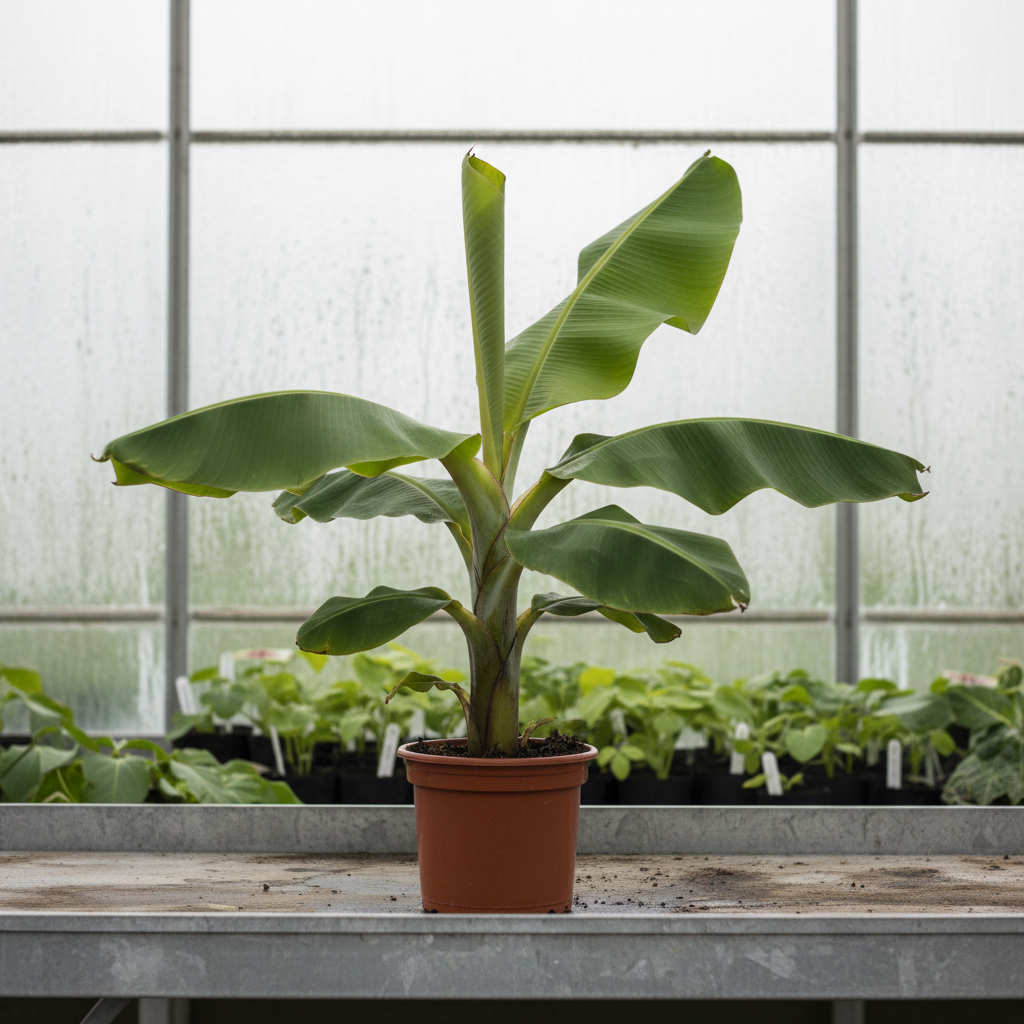
‘Dwarf Cavendish’
The default indoor banana for very good reason. ‘Dwarf Cavendish’ rarely exceeds 1.5 metres in a pot, produces broad bright green paddle leaves at a steady pace, and is the easiest variety to source from ordinary garden centres. It is also the cultivar most likely to flower and fruit indoors, given enough light, warmth and patience.
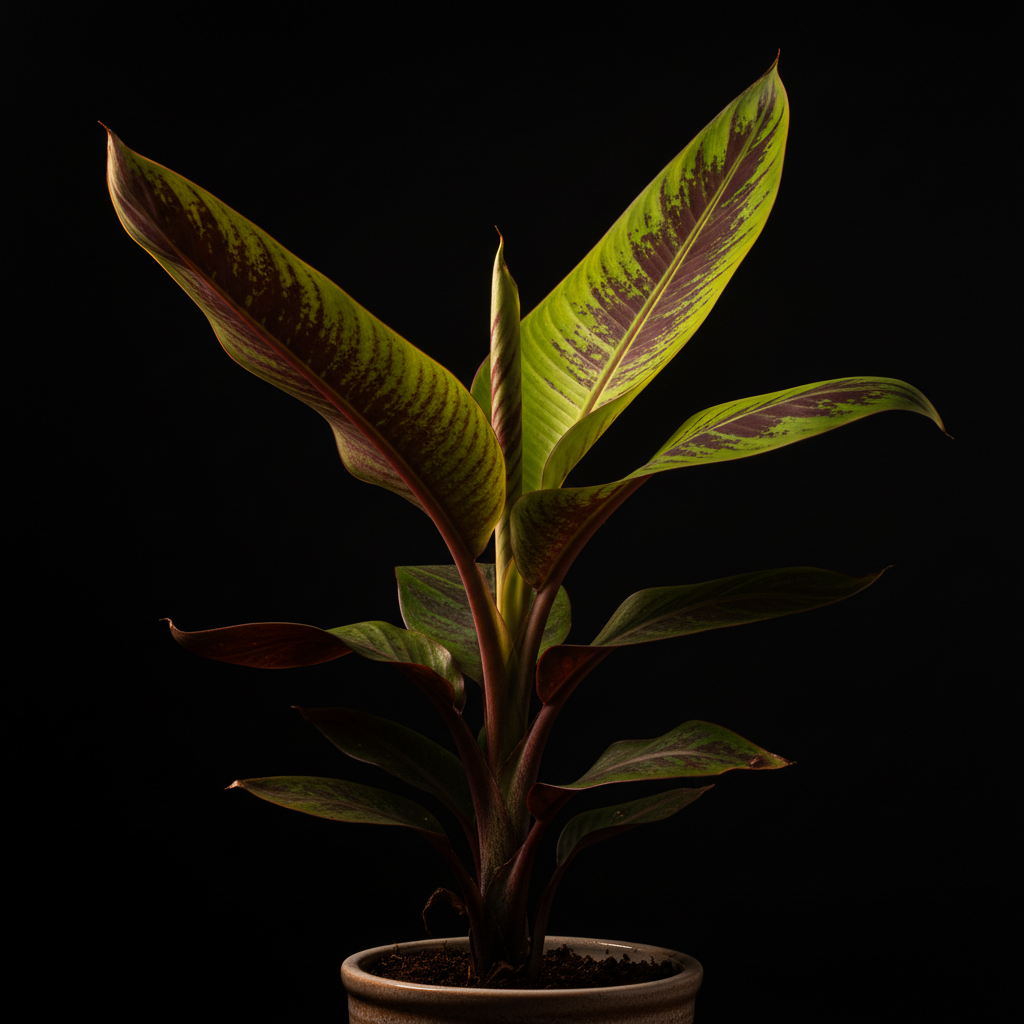
‘Zebrina’ (Blood Banana)
The ornamental star of the indoor banana scene. ‘Zebrina’, sometimes sold as the Blood Banana, carries bold burgundy-red stripes and splotches across each green leaf, with deep maroon undersides that flash when the leaves arch in a breeze. It demands the brightest light you can give it, which intensifies the pigments to their strongest expression.
Variety Profiles in Detail
‘Dwarf Cavendish’ (Musa acuminata ‘Dwarf Cavendish’)
Selected in early-19th-century Britain from a Mauritian banana grown at Chatsworth House, ‘Dwarf Cavendish’ is the original compact banana and the parent of nearly all modern commercial banana cultivars. As a houseplant it sits comfortably in a 30 to 40 cm pot, reaches 1 to 1.5 metres tall and produces leaves a metre long once established. Its compact size relative to other Musa varieties makes it the most realistic option for a banana intended to stay indoors year-round.
‘Super Dwarf Cavendish’ (Musa acuminata ‘Super Dwarf Cavendish’)
An even more compact selection from ‘Dwarf Cavendish’, usually topping out at 80 cm to 1 metre indoors. The pseudostem is correspondingly thicker for its height, giving the plant a stocky stubby look that suits smaller rooms. Leaves remain large for the plant’s size, which can look slightly comical in a positive way. Slower growing than the standard ‘Dwarf Cavendish’, so a less satisfying option if speed is part of the appeal.
‘Zebrina’ / Blood Banana (Musa acuminata var. zebrina)
Originating from the Sumatra region of Indonesia, ‘Zebrina’ is the most ornamentally striking of the indoor banana cultivars. Each leaf emerges deep burgundy and gradually develops its mature pattern of green with bold maroon stripes, retaining the burgundy on the underside. Indoor specimens reach 1.5 to 2 metres in good conditions. The variety demands the brightest light available to maintain its colour; in dim conditions the burgundy fades to bronze and eventually washes out to plain green. The fruit, where produced, is small and seedy and used decoratively rather than eaten.
‘Truly Tiny’ (Musa ‘Truly Tiny’)
A modern hybrid bred specifically for windowsill scale, ‘Truly Tiny’ stays under 60 cm even at maturity. Leaves are correspondingly compact, with the same paddle shape but only 20 to 30 cm long. The plant suits smaller flats and offices where a full-size banana would overwhelm the space, although the trade-off is that the dramatic scale that makes a banana plant special is largely lost. Best appreciated as a botanical curiosity.
‘Praying Hands’ (Musa ‘Praying Hands’)
A botanical oddity in which pairs of fruit are partially fused at the base, giving the bunch a look of pressed-together hands at prayer. The leaves themselves are conventional green paddles, and the plant grows to 2 metres or more, making it ambitious for indoor cultivation. Best treated as a conservatory plant if you have the height for it, where its unusual fruit habit becomes the talking point.
Choosing the Right Variety for Your Space
If you have a bright south or west window, room for a 1.5-metre floor plant, and you want the maximum tropical effect for minimum fuss, ‘Dwarf Cavendish’ is the variety to start with. If you want something visually striking and you can offer the strongest light in the house, ‘Zebrina’ is the show-off pick. If you are tight on space or you want a curiosity rather than a centrepiece, ‘Truly Tiny’ is the one to seek out. The remaining varieties are best understood as collector plants, suited to growers who already have a banana or two and want to expand the range.
Frequently Asked Questions
Will my indoor banana plant ever produce fruit?
It is possible but not common. An indoor ‘Dwarf Cavendish’ with several hours of direct sun, consistent warmth above 20 °C and steady feeding can flower after 2 to 4 years, after which a small bunch of edible (if undersized) bananas will eventually develop. Most indoor specimens never reach this stage, either because light is insufficient or because the plant is divided or moved before it gets there. Treat indoor fruiting as a happy surprise rather than the goal.
Why are my banana plant’s leaves splitting along the edges?
Some leaf splitting is natural; large paddle leaves crease as they unfurl and tear slightly with their own weight, particularly in any draught. Excessive splitting that reaches the midrib indicates very dry air (below 30 percent humidity) or rough handling as the cigar leaf unfurls. A humidifier near the plant during dry months and a cleared space around the canopy where leaves are not brushed by passing traffic prevent most of it.
How fast does a banana plant grow indoors?
In strong light and warm conditions, a healthy ‘Dwarf Cavendish’ produces a new leaf every 7 to 14 days from late spring through early autumn, and gains around 30 to 50 cm of height each year. Growth slows considerably from October through February in temperate climates, and may stop completely. A grow light running 10 to 12 hours through winter can keep mild growth ticking over year-round.
Can I move my banana plant outdoors for the summer?
Yes, and the plant will thrive on it. Once nights are reliably above 13 °C (55 °F), the banana can move to a sheltered sunny spot outdoors and will reward you with stronger growth than any indoor setup can provide. Acclimatise it over a week, starting in shade and gradually moving into direct sun, to prevent leaf scorch. Bring it back indoors well before the first cool autumn nights, inspecting carefully for pests as you do.
What temperature is too cold for an indoor banana plant?
Banana plants begin to suffer below 13 °C (55 °F), losing their lowest leaves and ceasing growth altogether. Below 10 °C (50 °F), even brief exposure causes blackened leaf patches and risks killing the plant outright. Avoid placing the plant near cold draughty windows in winter, by exterior doors that open frequently, or in unheated conservatories that cool sharply overnight. The corm is somewhat hardier than the visible plant and can survive temperatures down to about 4 °C (39 °F) if kept dry, but the pseudostem and leaves will not.
My banana’s lowest leaf has turned yellow and drooped. Is something wrong?
Not necessarily. Banana plants continuously shed their oldest lowermost leaves as they push new ones from the centre of the pseudostem, and a single yellow lower leaf, especially after a repot or seasonal transition, is part of normal turnover. Cut it cleanly at the petiole base when it is mostly yellow and let the plant carry on. Persistent yellowing of multiple leaves, particularly newer ones, points to overwatering, underfeeding or a pest problem and warrants closer investigation.
Should I cut off the dead pseudostem after my banana flowers?
Yes, but wait. After fruiting, the parent pseudostem slowly dies back over several months, gradually translocating its remaining nutrients down into the corm to support the next generation of pups. Cut the pseudostem back too early and you waste that stored energy. Wait until the pseudostem is brown and dry from the base up, then cut it down to soil level. By then a new pup will usually be well underway.
Is the banana plant safe around pets?
Yes. Musa acuminata and the common indoor banana cultivars are non-toxic to cats, dogs, rabbits and humans. The leaves, sap and pseudostem are all safe in casual contact. The clear sap can stain fabric a deep rust colour as it oxidises, so a pet that habitually chews leaves may leave brown stains on furnishings, but the plant itself poses no toxicity risk.
Why is my banana plant leaning to one side?
Leaning almost always points to light. Banana plants are phototropic and bend toward their strongest light source over weeks. Rotate the pot a quarter turn each week to balance growth. A more severe lean can also indicate the canopy has outgrown the pot weight; in that case, move the plant to a heavier pot or place a few bricks in the cover pot for stability.
Can I keep a banana plant in a bathroom?
A bright bathroom with a large window can work well, since the elevated humidity from regular showering suits the plant. The deal-breaker is light: a dim windowless bathroom will not sustain a banana for more than a season, no matter how humid the air. If the bathroom has a south or west window and enough floor space for a 1.5-metre plant, it can be an ideal location.
What do I do if my banana plant is getting too tall for the room?
You cannot prune the height of a banana the way you would a woody plant, because the pseudostem grows from the centre upward and cutting it kills that stem. The practical options are: divide off the pups and pot them up separately, letting the parent finish its life and then replacing it with a younger pup; move the plant to a friend or a workplace with higher ceilings; or accept that the plant will eventually need replacing every few years by its own offspring. The continuous succession of pups is a feature, not a bug, of banana cultivation.






