
- Quick Reference: Arrange Plants by Need First
- Begin With Light Zones
- Use Layers Like a Designer, Think Like a Gardener
- Group by Care Routine
- Avoid Stress Points
- Decorative Pots Without Drainage
- Airflow and Crowding
- Styling Ideas That Help the Plants
- Plan for Growth
- Frequently Asked Questions
A beautiful indoor plant display should look good and function well. Plants are living décor, but they are still living. If a display blocks watering access, traps leaves against cold glass, hides pests or places a cactus in fern conditions, it will eventually become less “interior styling” and more “slow botanical argument.”
The best arrangements combine design with plant health. They place plants where light, temperature, airflow and access make sense, while using height, texture and repetition to make the room feel intentional.
Quick Reference: Arrange Plants by Need First
| Design choice | Plant-health question | Practical answer |
|---|---|---|
| Window grouping | Do the plants share similar light needs? | Put high-light plants closest and shade-tolerant plants farther back. |
| Shelf display | Can you reach every pot? | Leave enough space for watering, turning and inspection. |
| Floor plants | Is there airflow and stable temperature? | Avoid vents, fireplaces, cold glass and door draughts. |
| Hanging plants | Will vines block light or access? | Trim or guide growth before it becomes tangled. |
| Decorative cachepots | Can excess water escape? | Keep inner pots with drainage and empty standing water. |
Begin With Light Zones
Every room has zones. The windowsill is not the same as the coffee table, and the top shelf is not the same as the shadowed corner below it. University of Minnesota Extension recommends choosing plants whose light requirements match the indoor environment, noting that supplemental lighting can make up for a lack of natural sunlight.[1]
Arrange high-light plants nearest the brightest windows or under grow lights. Medium-light plants can sit slightly farther back or in bright indirect exposures. Low-light-tolerant plants can occupy deeper interior positions, but remember that “low light” does not mean “no light.”
Use Layers Like a Designer, Think Like a Gardener
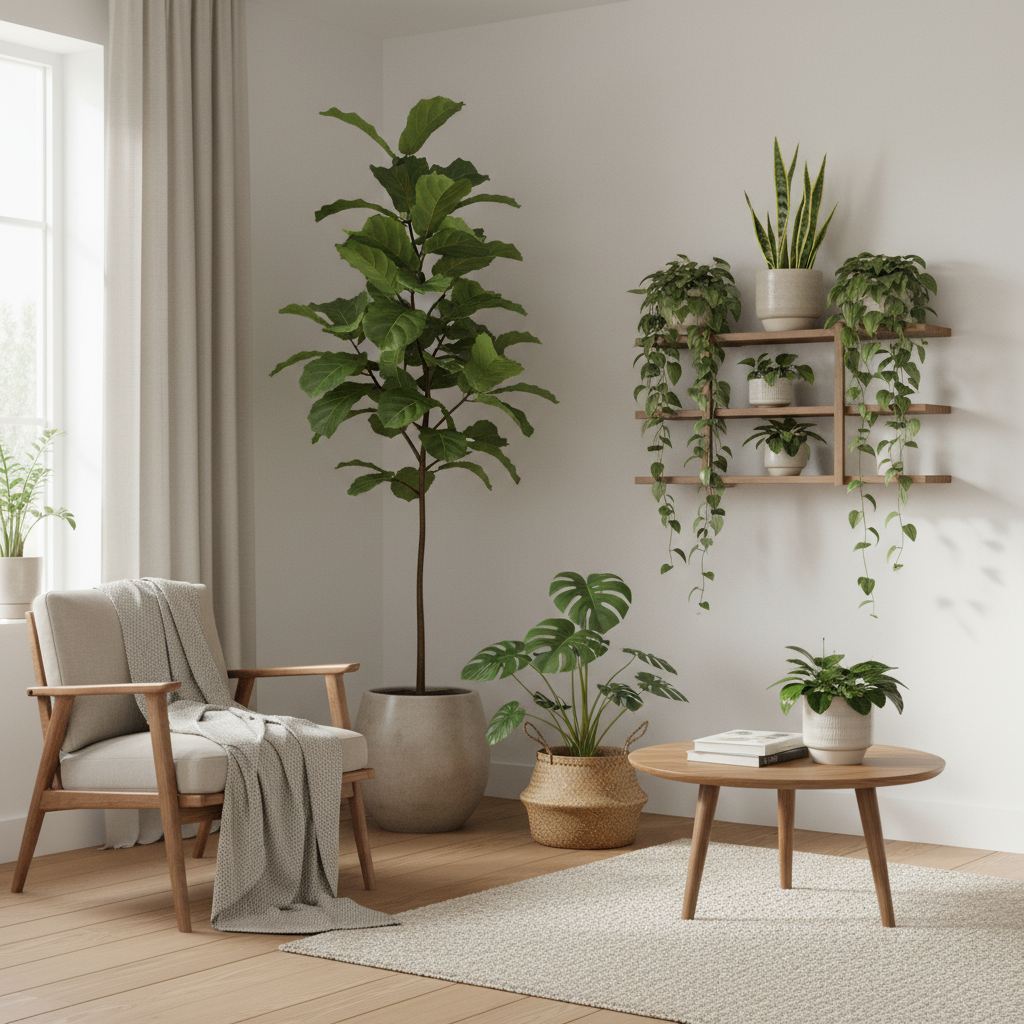
A strong plant display usually has layers: tall floor plants, medium tabletop plants and trailing or small accent plants. This creates depth and rhythm. The gardening trick is to ensure each layer still receives adequate light.
Do not place a large floor plant directly in front of small plants that need the same window. It may look lush for a week, but the back row will slowly become a collection of long stems and regret.
Group by Care Routine
Plants that need similar watering, humidity and light are easier to manage together. A sunny succulent tray should not share a shallow decorative bowl with a moisture-loving fern. Grouping by care also makes it easier to notice when one plant behaves differently from its neighbours.
For example, a shelf of aroids in bright indirect light can be checked together. A separate windowsill of succulents can dry more thoroughly. A bathroom cluster can house humidity lovers. This is practical organisation disguised as style.
Pro Tip — Make Maintenance Visible: If a plant is hard to reach, you will water it badly, inspect it rarely and prune it never. Accessibility is part of plant care.
Avoid Stress Points
Oregon State University Extension recommends keeping plants away from heating vents, fireplaces and cold glass to prevent draught and heat stress.[5] These stress points matter in plant arrangement. A plant may be in a bright location but still decline because hot air blasts it every evening or winter glass chills its leaves.
Leave a small gap between foliage and windows. Avoid placing plants directly above radiators or in the path of forced-air vents. Be cautious with fireplace mantels, which often look excellent and behave terribly.
Decorative Pots Without Drainage
Decorative cachepots are useful because they let you style plants without sacrificing drainage. Keep the plant in a plastic or nursery pot with drainage holes, set it inside the decorative pot, and remove it for watering or empty excess water afterwards.
Clemson Cooperative Extension explains that containers planted directly should have drainage holes and trays, while double-potting can be used with decorative containers; if the outer pot lacks drainage, the inner pot should still drain and excess water must be managed.[6]
Airflow and Crowding
A dense plant corner can look wonderful, but leaves packed tightly together dry slowly and hide pests. Leave enough space for air movement and inspection. If leaves are constantly wet, pressed together or rubbing against walls, adjust the arrangement.
Crowding also makes watering difficult. When plants are too close, one pot gets drenched while another receives a symbolic teaspoon. A good arrangement lets you water the soil, not the furniture, neighbouring leaves or your own socks.
Styling Ideas That Help the Plants
| Styling idea | Why it looks good | Why plants benefit |
|---|---|---|
| Plant stands | Adds height variation. | Brings plants closer to light. |
| Trays | Creates a collected display. | Protects surfaces and organises watering. |
| Repeated pot colours | Makes mixed plants look intentional. | Lets foliage remain the focus. |
| Shelves with grow lights | Creates a feature wall. | Provides consistent light for multiple plants. |
| Rotating display positions | Refreshes the room. | Lets plants recover from one-sided growth. |
Plan for Growth
Plants do not remain the size they were when the room looked perfect. Vines lengthen, palms widen, leaves lean toward windows and roots fill pots. Arrange with future growth in mind. Leave space for leaves to unfurl and for you to turn the pot.
Fast-growing plants may need regular pruning to remain part of the design. Slow-growing statement plants can anchor a room for years. A good indoor arrangement is not frozen; it evolves.
Frequently Asked Questions
| Question | Answer |
|---|---|
| Is it bad to move plants around for styling? | Occasional moves are fine, but repeated changes in light and temperature can stress sensitive plants. |
| Can I group plants for humidity? | Yes, grouping can slightly improve the local microclimate, though it is not a substitute for a humidifier when humidity needs are high. |
| Should all pots match? | They do not have to. Repeating colour, material or shape helps mixed plants look cohesive. |
| How close can plants be to a window? | Close enough for light, but not pressed against hot or cold glass. Watch for scorch in summer and chill in winter. |



