
- Quick Reference: Better Watering Habits
- Why “Once a Week” Fails
- How to Water Thoroughly
- Top Watering Versus Bottom Watering
- Reading Overwatering and Underwatering
- Pot Choice Changes Everything
- Water Quality and Temperature
- Survive Versus Thrive
- Frequently Asked Questions
Watering is where good intentions go to die. More houseplants are damaged by improper watering than by any other routine care mistake, a point made consistently by university extension services.[2] The problem is not that watering is complicated. The problem is that people want it to be a schedule, while plants insist on making it a conversation.
A plant’s water use changes with light, temperature, humidity, pot size, growth rate, soil mix and season. The same plant may need water every five days in June and every three weeks in January. A weekly reminder on your phone is useful only if it reminds you to check the plant, not automatically water it.
Quick Reference: Better Watering Habits
| Habit | Why it works |
|---|---|
| Check soil before watering | Drying speed changes constantly with season, light and temperature.[3] |
| Water thoroughly | The whole rootball should be moistened, not just the surface.[1] |
| Let excess drain away | Standing water deprives roots of oxygen and encourages rot.[2] |
| Match watering to plant type | Ferns, aroids, orchids and succulents do not want the same moisture rhythm. |
| Reduce in winter | Lower light and cooler rooms slow plant water use. |
Why “Once a Week” Fails
A fixed schedule ignores the pot. A small terracotta pot in a warm east window may dry in three days. A large plastic pot in a cool north-facing room may stay damp for two weeks. Watering both every Sunday is not care; it is a coin toss.
Instead, learn the three checks. The finger test works for many plants: push a finger into the mix and water when the appropriate depth has dried. The University of Maryland Extension suggests testing to about two inches for many indoor plants, while noting that cacti and succulents need different treatment.[3] The weight test is even better with practice. A dry pot feels dramatically lighter than a wet one. The leaf test is useful but should come last, because wilting can mean either drought or root damage from overwatering.
How to Water Thoroughly
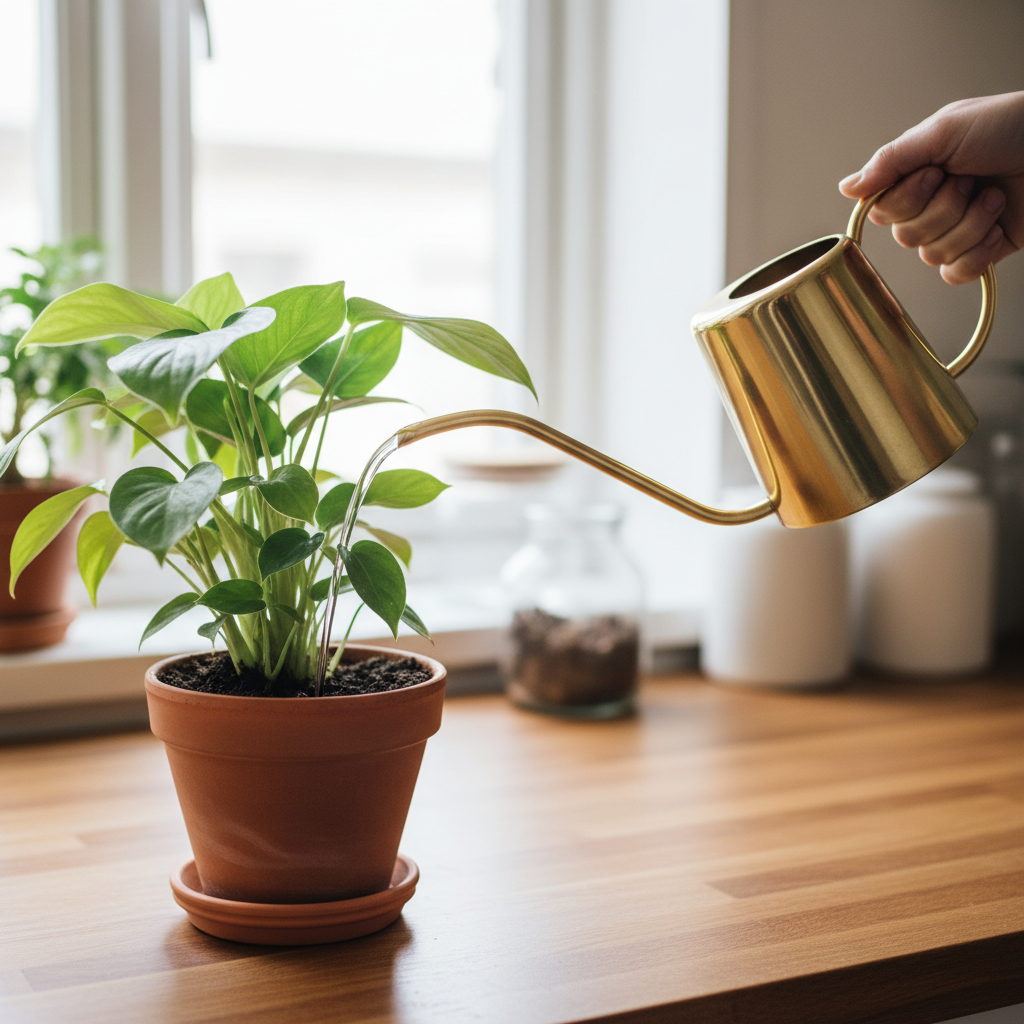
For most potted houseplants, the best basic method is simple. Take the plant to a sink, bath or drainage-safe spot. Pour tepid water evenly across the soil surface until water runs freely from the drainage holes. Wait a few minutes, water once more if the mix was very dry, then let the pot drain completely before returning it to its cover pot or saucer.
This method does two useful things. It wets the full rootball, and it helps flush out excess mineral salts that accumulate from fertiliser and tap water. Maryland Extension notes that soluble salt buildup can cause reduced growth, brown leaf tips, lower-leaf drop and wilting, and recommends periodic leaching with clear water.[3]
Important — Empty the Saucer: A drainage hole only works if the drained water is removed. A plant left sitting in a full saucer is effectively in a pot without drainage.
Top Watering Versus Bottom Watering
Top watering is the standard method and the best default. It flushes the mix, encourages even wetting and reveals whether the pot drains properly. Bottom watering is useful for very dry peat-based mixes that repel water at first, for small plants that topple under a watering can, and for plants with crowns that dislike staying wet. Set the pot in a shallow tray of water until the surface becomes damp, then remove it and let it drain.
The drawback is that bottom watering does not flush salts out of the mix. If you often bottom-water, top-water thoroughly every few rounds to rinse the root zone.
Reading Overwatering and Underwatering
Underwatering usually produces dry, crisp symptoms. Leaves wilt, curl, turn grey-green or brown at the edges, and the pot feels light. Soil may shrink away from the pot wall. If caught early, the plant often recovers quickly after a deep soak.
Overwatering is more treacherous because it masquerades as thirst. Roots need oxygen as much as water. When the mix stays saturated, roots die, and a plant with dead roots wilts because it can no longer absorb moisture. Yellowing leaves, soft stems, sour-smelling soil, fungus gnats and a pot that remains heavy for many days all point toward excess moisture rather than drought.
Warning — Do Not Rescue Rot With More Water: If a plant is yellowing and wilting in wet soil, watering again will make the problem worse. Check the roots, improve drainage, increase light if possible, and let the mix dry toward the plant’s preferred range.
Pot Choice Changes Everything
Terracotta dries faster than plastic. Small pots dry faster than large pots. Hanging baskets dry quickly because warm air rises. Decorative cachepots trap water if you forget to empty them. A pot without a drainage hole is not automatically fatal, but it gives you almost no margin for error.
For valuable plants, grow in a nursery pot with drainage, then drop that pot into a decorative cover. This gives the interior-design look without sacrificing root health.
Water Quality and Temperature
Most ordinary tap water is acceptable for most houseplants, but very hard water or softened water can cause problems over time. Rainwater is excellent where available, and water from a dehumidifier is low in minerals. Tepid water is preferable to cold water, especially for tropical plants; icy water poured into warm roots is an unnecessary shock.
Survive Versus Thrive
A plant can survive months of erratic watering if the light is good and the soil drains well. Thriving requires a more observant rhythm. The goal is not to keep every plant evenly moist. The goal is to give each plant the wet-dry cycle its roots expect. Ferns want steadiness. Many aroids want partial drying. Succulents want a full soak followed by a real dry spell. Orchids in bark want air around their roots as much as moisture.
Watering improves the moment you stop asking, “How often?” and start asking, “What is the pot telling me today?”
Frequently Asked Questions
| Question | Answer |
|---|---|
| Should I mist instead of water? | No. Misting wets leaves briefly but does not hydrate the rootball. Air plants are a special case. |
| Is a moisture meter useful? | It can be, but cheap meters are inconsistent in chunky mixes. Use them as one clue, not an oracle. |
| Why does water run straight through my pot? | The mix may be hydrophobic from drying too much, or the plant may be rootbound. Soak the pot and inspect the roots. |
| Can I water with ice cubes? | It is better to use tepid water. Ice is convenient for people, not especially kind to tropical roots. |



